Omdia: Global smartphone market down 4% in 2Q26 while Apple and Samsung soared
by Horace Dediu
Counterpoint estimating total market sales fell 11%
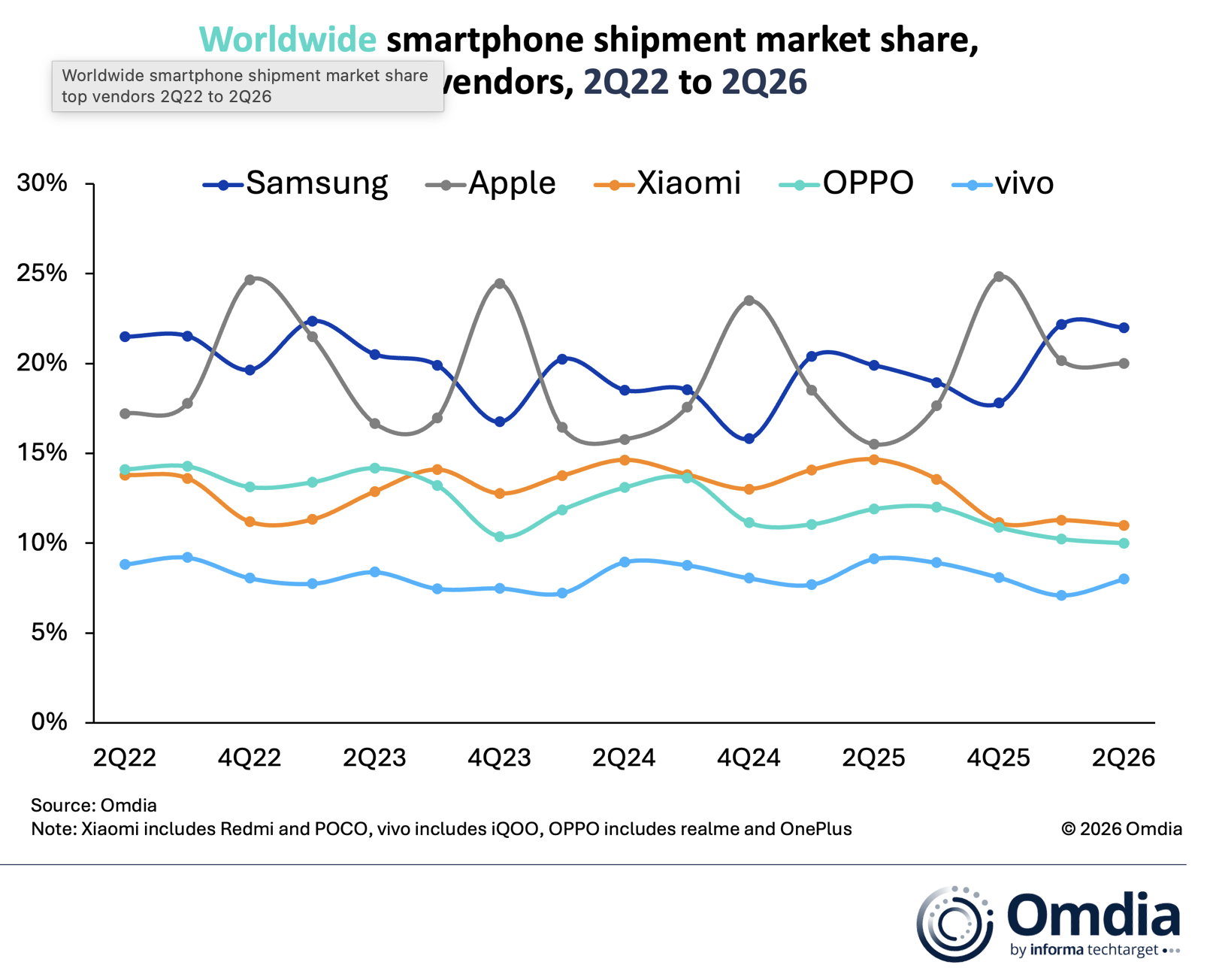
Apple delivered its best second-quarter performance ever, capturing a record-high 20% market share during what traditionally is its slowest quarter of the year. The iPhone 17 series delivered one of the strongest iPhone refresh and upgrade cycles in Apple’s history. Apple also benefited from stable pricing while most competitors were forced to raise their pricing. However, as Apple raised pricing across other products towards the end of 2Q, a key question remains to what extent iPhones might be impacted by similar hikes later this year.
“The steepest volume drops hit the sub-$400 mass market segment, where supply constraints are tightest, profit margins are slimmest, and price sensitivity is highest,” said Runar Bjorhovde, Principal Analyst at Omdia. “To adapt, vendors are shifting their strategies from volume to value by reoptimizing portfolios and adjusting retail pricing. Managing the surging component costs is incredibly complex and unpredictable, with some vendors facing memory costing more than four to five times what they did a year ago. Memory and storage alone now account for more than 60% of the bill-of-material for budget devices and more than 30% for high-end models. Although memory and storage costs are the biggest challenges for vendors, they are far from the only challenge. New semiconductor bottlenecks, such as within foundries, are adding further cost pressures.”
“We anticipate the sharpest volume declines to hit in the upcoming two quarters, where normal seasonal demand peaks – driven by new launches, holidays and shopping festivals — collide with constrained memory chip supply,” added Bjorhovde. “Consequently, vendors are expected to lean further into the higher price segments to capitalize on customers seeking device upgrades in 2026’s sales season. However, while moving upmarket protects margins and revenue, vendors offer fewer options to budget-constrained consumers. Many mass-market buyers will be forced to delay purchases, downgrade expectations, utilize financing, or opt for refurbished devices.”
Source: Omdia
NB: Counterpoint came out with a report the same day estimating that the smartphone market in the second quarter overall sales fell 11% year-over-year while Apple saw a 3% year-over-year rise in shipments and ended the quarter with 20% of the market. I note that …
… Chinese brands Xiaomi, OPPO, and vivo, all saw steep year-over-year declines, due largely to rising memory prices. Overall, during a highly stressful market condition, where the market is contracting and margins are contracting Apple seems to be moving in the opposite direction.
I recall crises such as AI, Covid, supply chain shortages and China demand collapses in the last 6 years leading to sell-offs and loss of confidence in the company. In all cases, the business emerged stronger.
Comments