Asymco

Asymmetric Intelligence

Research

  1. The best worst case scenario

    Research · 4 comments

    Measuring bundle strength to estimate potential for iPhone disruption

    A fasces, from the Latin word fascis, meaning 'bundle' is a bound bundle of wooden rods, often including an axe with its blade emerging. The fasces is an Italian symbol that had its origin in the Etruscan civilization and was passed on to ancient Rome. Its core message is that a single rod is easily broken, but a bound bundle is unbreakable. Thus it is the symbolic version of the phrase united we stand, divided we fall .

    The iPhone was introduced as a bundle: an iPod, a Phone and an Internet Communicator. It went on to bundle a camera, a game console, an email client and literally thousands of other functions which used to be separate products. A calendar, a flashlight, a magnifying glass, a measuring tape, an emergency beacon, all the world's maps, travel assistant, shopping and food delivery, etc. Many of these components created empires for the developers who built them, building separate markets unto themselves.

    The competitive analysis for the iPhone was always about another bundling option in the form of an Android phone. That platform offered to do all the same things, at perhaps a lower price point or a more diverse choice of devices.

    However that competition failed to make a dent in the iPhone. To date, the iPhone continues to grow both in user base and in product variety and price points. Swithing from Android to iPhone is still more common than the alternative.

    But lately, a new competitive thesis has emerged: that of the AI enabled device which is simply an agent that is asked to do things.

    Muse from Meta is the latest example, though we've seen similar arguments for Alexa, Humane, or a future possible set of devices from OpenAI. Less well known are Rabbit R1: A pocket-sized AI hardware device designed to handle tasks and app interactions without a traditional smartphone screen. Smart glasses like those from Meta but also from Solos that integrates artificial intelligence, audio features, and language translation directly into glasses. Abeye: Smart eyewear developer known for health- and wellness-focused optical products like Lexilens and Spectalert.

    Then there are AI-Enhanced Smartwatches: Various next-generation smartwatches and voice-first wristwear serving as screen-light alternatives to standalone AI pins.

    The premise is that if you can ask a microphone-enabled device for anything, it would answer (or act) and it won't need a screen even to interact with. The device is just a passive wearable or even embedded in the environment. Just speak and it will recognize your intent and act.

    The idea is that if you had one of these, you would not need a phone anymore.

    To put it another way, these devices would unbundle the iPhone. They would take a subset of the uses for the product, carve those away and "steal" usage time/cycles/attention into a new platform.

    This is similar to how the original BlackBerry stole usage from computers. They took messaging, initially in the form of short emails, at a time when messaging did not exist as a standalone technology. By stealing messaging, usage of computers shrank to uses that were slow response only. The foothold of messaging arguably anchored the smartphone category.

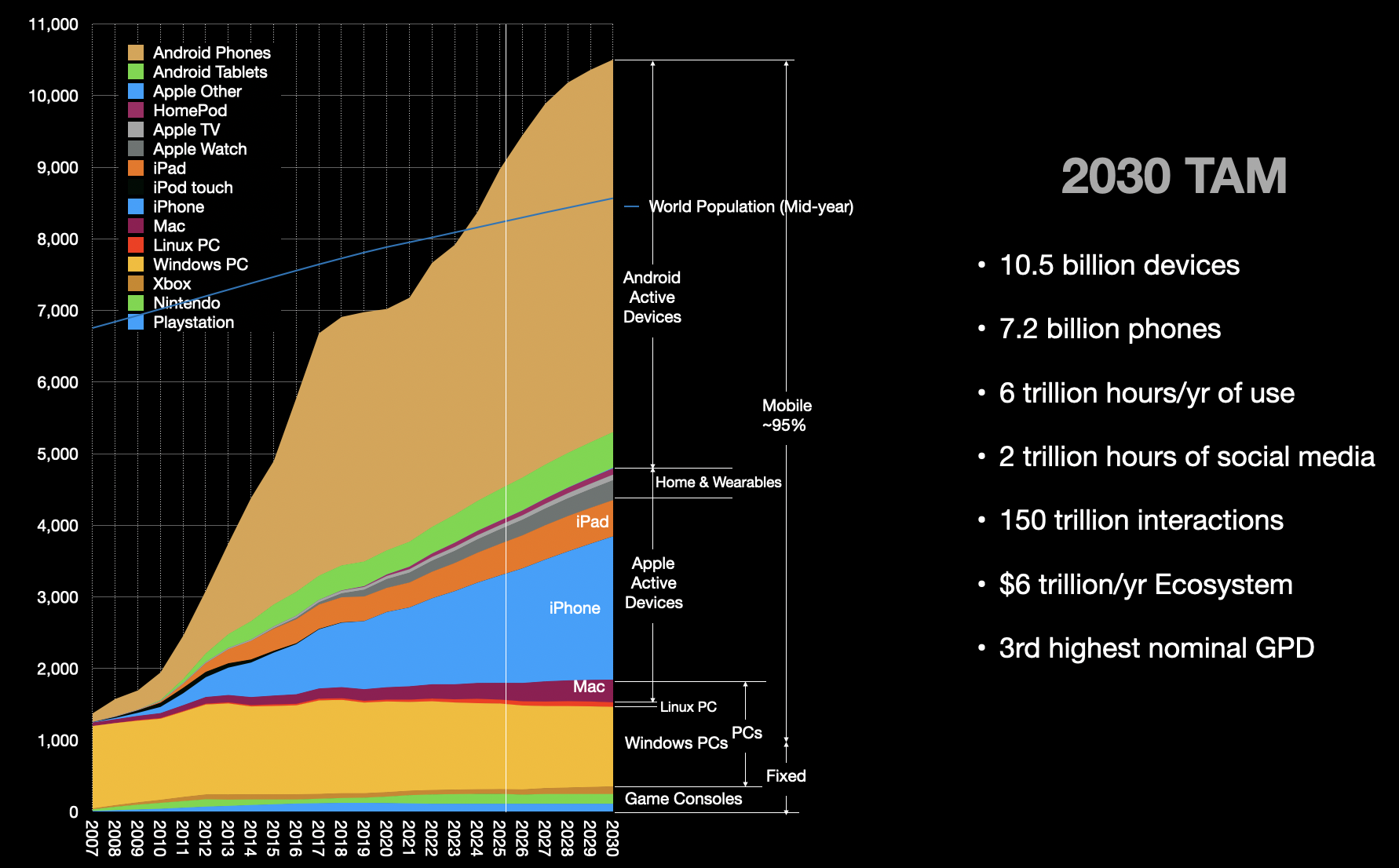
    However, eventually the smartphone grew into more and more capabilities and created its own. I mentioned photography and video but also social media itself, now consuming trillions of hours.

    But will AI devices really unbundle the phone?

    Clearly the phone can do what the AI tchotchke aims to do. Indeed so can the Apple Watch, iPad, Apple HomePod (and whatever is announced for the home). The idea that an internet-enabled microphone replaces the iPhone is not because the iPhone cannot do what the microphone can do. Nobody has more smart microphones in use that Apple.

    The premise for unbundling is that the less-able alternative, focused on one task only, will be more convenient, much cheaper and delightful to use than the bundled alternative.

    But assuming you do have a dongle that listens, what will you do about your social media habit, your camera, your messaging, your entertainment and all your digital life?

    The answer would need to be that the trinket "grows up" into a phone in the future. That is, that at first it seduces with voice but eventually delivers on visuals.

    That's a tough sell since the iPhone is not standing still. Apple is not averse to building delightful wearable devices. I expect we'll see home and vision line-ups that expand on the audio wearables (AirPods) and watches. These are best-in-class and have the polish that only Apple can deliver.

    To date, the premise was that the newcomers will be "better at AI" but here the race is one with commoditization. Apple can just pick the winners or the pieces once the market shakes out. AI is software and software alone has never been a strong business model. It's too easy to replicate, rebuild, remake, rebadge, redesign.

    The argument that the AI agent unbundles the phone is only the latest in a long list of bundle challengers. Although bundling and unbundling are two great ways to enable disruption, it's not an easy thing to pull off.

    I've had my share of attempts to unbundle the automobile but it's far tougher than just imagining it or realizing that it's necessary. The problem with the (un)bundling theory is that there is no clear way of predicting the strength of the bundle. Or the strength of the component separate from it.

    In the case of the car, the bundle is strong because of externalities such as infrastructures. In the case of the iPhone the bundle is strong because the object is dynamic, changing rapidly, diverse, with wearable accessories, part of network exhibiting network effects and has high value and satisfaction.

    Measuring the strength of a bundle and its resilience to unbundling would be a very interesting topic to research.

  2. Why do phones have cameras?

    Research · 6 comments

    Or, why do cameras have phones?

    In a retrospective on the iPhone Uno, I noted that the iPhone was launched with three "tentpoles:" a widescreen iPod, a Phone and an Internet Communicator. Effectively, a music player, telephone, and browser. All in one device. This positioning in 2007 bundled what were considered to be individual products: an iPod, a Phone and a laptop. By bundling these, value would be created in not having to select which you would take with you at any given time. You would have all three with you always.

    I then noted that none of these tentpoles were the most popular uses for the product today.

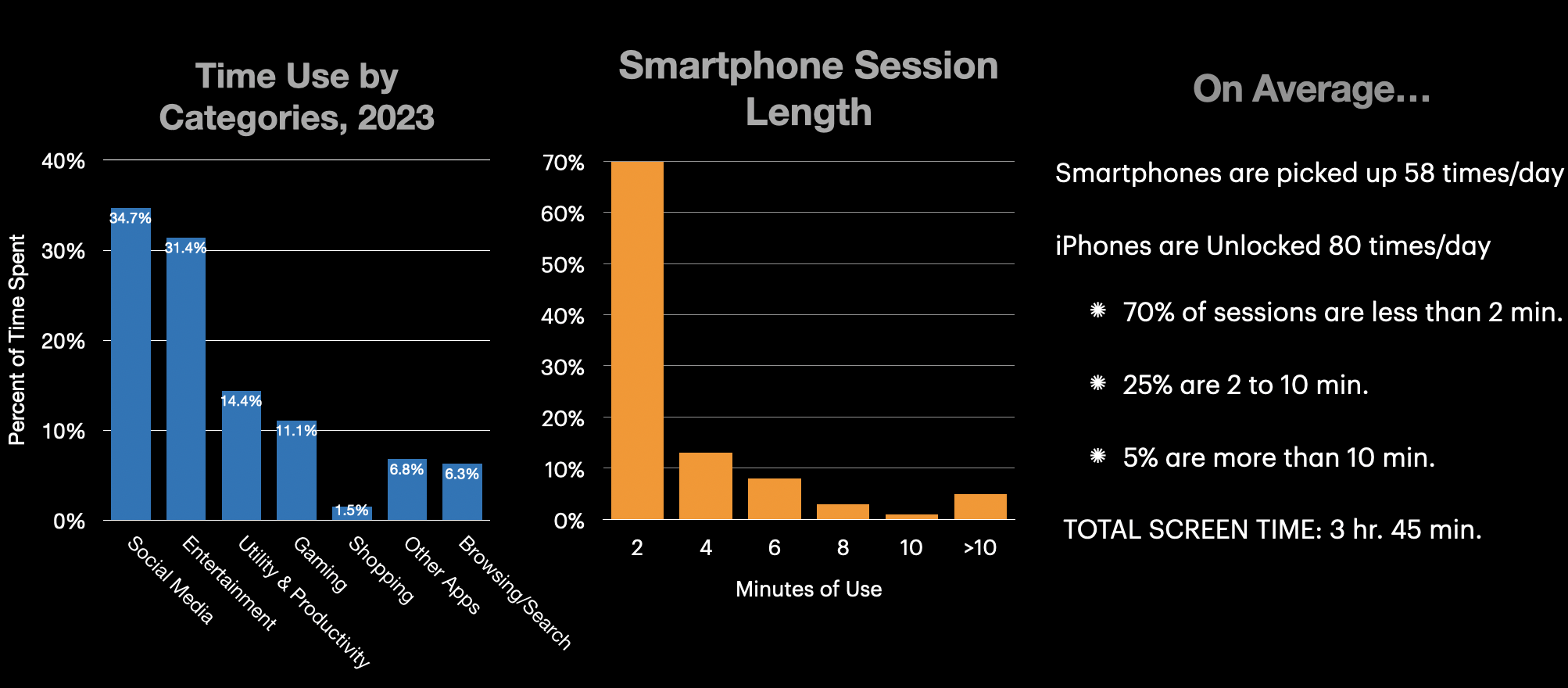
    Social media and entertainment are by far the most popular, followed by utiliy/productivity and finally gaming to round out the top four uses. You can check your own usage patterns using the Settings app on your iPhone.

    By checking Pickups you can also see the time division of usage. On average, smartphones are used in a log-normal distribution with the most common time being less than 2 minutes. The number of pick-ups and their distributions add up to almost four hours of use per day.

    Based on this analysis, it would seem that the iPhone developed in ways unforeseen by its creators. Most of these activities did not exist on phones at all. There were games and there were messages and perhaps a bit of email but phones were mostly used for phone calls. Today, phone use does not usually show up in the top 10 activities.

    The lesson is that truly transformative products create their own demand and their own use cases. You must be humble in your assumption of how buyers will use the product and also provide a platform for new use cases to be created by third parties. Apple did not create social media apps or games or YouTube for the iPhone. It enabled them.

    But one thing missing from this analysis is the camera. Whereas Apple invested in development of a better screen and processor and storage and services to support the apps to became the "killer" apps, it disproportionately invested in the camera.

    Consider the latest iPhone 18 Pro. The cameras are the most prominent design element, shown in all photos of the product. The obverse of the camera view has no distinguishing feature. Cameras are featured as the primary differentiation of the product in advertising. "The ultimate performance and camera of any iPhone." The tentpoles of the iPhone 18 Pro are: 48MP, variable aperture, f 1.48 lenses. The copy reads: "48MP Fusion Main camera with variable aperture. Improved low-light photos and video. Impressive depth of field."

    The latest cameras on the iPhone make it beyond good enough for professional use. It is very capable as the only camera a video or still photographer would need to earn a living. For the consumer it seems to over-serve by a mile.

    But the camera is not what appears in the usage logs and is in a different world from the original tentpoles.

    So why does the iPhone have a pro camera? Why is photography even something to consider in a phone.

    When we look back, the idea of a phone with a camera was only put on the market in 19991. First seen in Japan, it was popularized by Nokia and by the time the iPhone launched it was already considered normal to have camera in a phone. It was no longer a "camera phone" but just a phone.

    By 2007 disruption of traditional cameras was already underway. Digital photography moved quickly to displace analog or film photography. Point-and-shoot cameras quickly overtook every category and DSLRs had been booming. However, phones with cameras quickly overtook all others and the number of photos taken by them exploded by multiple orders of magnitude. Use in messaging, cloud storage and then social media itself came to embody photography.

    New social media emerged around photos: Snapchat, TikTok, YouTube and Instagram were image-first social media while Facebook came to embody it. Now it's hard to see any social media content which is text only.

    In that way, the social media category became an "imaging" category. The camera's improvements were social media improvements.

    Today's pro cameras are used to allow amateurs to appear pro in their posts. The value is in allowing a billion people to become both models and fashion photographers. Vanity is a bigger business than productivity.

    But throughout this period Apple was not valued for being a vanity enabler. Its products and users were measured with dollars and gigabytes. Even today there is no "vanity market share" for iOS or Android. The contrast between what we measure and what people buy could not be greater.

    It behooves the investor to understand this.

    Jobs to be done theory helps explain what is happening. The jobs buyers hire phones for are very numerous. It's not one thing, it's many. So many that we cannot enumerate them. A common theme that runs through the data however is that the iPhone is an indispensable social construct. It is, for better or worse, the medium for communication and that embodies all human frailty.

    The segmentation by the seven deadly sins holds.

    This is not a biblical construct. The fourth-century monk Evagrius Ponticus (pictured above) reduced the forms of temptation to eight (in Greek), Evagrius's list was translated into the Latin of Western Christianity in writings of John Cassian, one of Evagrius’s students; the list thus became part of the Western tradition as follows:

    Avaritia (greed, avarice)
    Tristitia (sorrow, despondency)
    Ira (wrath)
    Acedia (sloth)
    Vanagloria (vanity)
    Superbia (pride)

    Most of the activities on Social Media fall into these categories and Vanity and Pride clearly are enabled by the cameras.

    The value of each of the "sins" or perhaps more euphemistically "temptations" is missing but I'd venture to guess that Vanity and Pride are worth at least $1 trillion in market capitalization.

    1. The first commercial camera phone was the Kyocera Visual Phone VP-210, released in Japan in May 1999
  3. The best selling product of all time

    Research · 1 comment

    Measuring the iPhone Uno

    Ten years ago, I noted that the iPhone was the most popular product of all time. At the time, it had just crossed 1 billion units sold. This exceeded the quantities of other categories I considered comparable. In the comments there was a furious debate on whether I was measuring popularity correctly. In my defense I pointed out that consumables should not count, nor free products or pieces of content. By the metrics of 2016, I argued, one billion sold exceeded any of the other candidate 'bestsellers'. And it wasn't even one thing...

    The iPhone is not only the best-selling mobile phone but also the best-selling music player, the best-selling camera, the best-selling video screen and the best-selling computer of all time.

    I noted that it did all that in less than nine years and challenged readers to wonder what it will do in the next nine.

    Well, wonder no more.

    Since then, another 2.4 billion iPhone have been sold. That is to say, after becoming the all-time best-seller, it accelerated to sell at 2.5x the previous run rate. Moreover, the first billion iPhones sold for an average price of $655 while the next 2.4 billion sold for $780 each.

    To date, iPhone revenues have totaled $2.5 trillion.

    One can again argue whether there are better candidates for "best-seller" but it would be futile. Not because of the quantity sold, nor because of the value created but because of the consequences of these sales. Quantities can be measured, qualities can't.

    The iPhone changed culture and behavior. It's become an indispensable utility. It is infrastructure. And with anything so consequential, its value is hard to measure.

    For this reason I'm always surprised by the discussions around pricing. The idea that users won't spend more than $x for a "phone" as if it were a discretionary expenditure. As the Covid period showed, these products are not nice to have. They are must-haves.

    The utility has only increased: over 100 "pickups" per day, over 4 hours of use per day, over 5 billion (including ersatz iPhone) users. Trillions of Services and activities are built around it. And it's not finished growing.

    That means that it's the most used product of all time. And if you are so attached to it, why would you not spend a bit more for a better version? It's literally the thing you hold and keep with you more than anything. It is more attached than our clothing or our housing and we don't hesitate much to obtain better versions of either.

    The iPhone Uno was the quintessential $1/day product, or one penny per use. Now the iPhone Duo is offered for $2/day. But will it be used more or be better to use? If it is to gain another hour of use, or a dozen more pickups a day, or increase dwell time then surely the extra dollar is worth it.

    Let's reflect on this in another decade but I have become convinced that the Duo is version 2 of the iPhone and as such it will become even more habituated to us and vice versa.

  4. Apple's Unpretentious Moonshot

    Research · 2 comments

    An Office Hours question, September 11, 2026.

    Q: Aside from the iPhone Pro & Duo, what was significant with Apple's latest?

    We've had a lot of betas since WWDC, leading to OS 27. That'll be big. People overall have been giving good reviews. It is much better than many people expected.

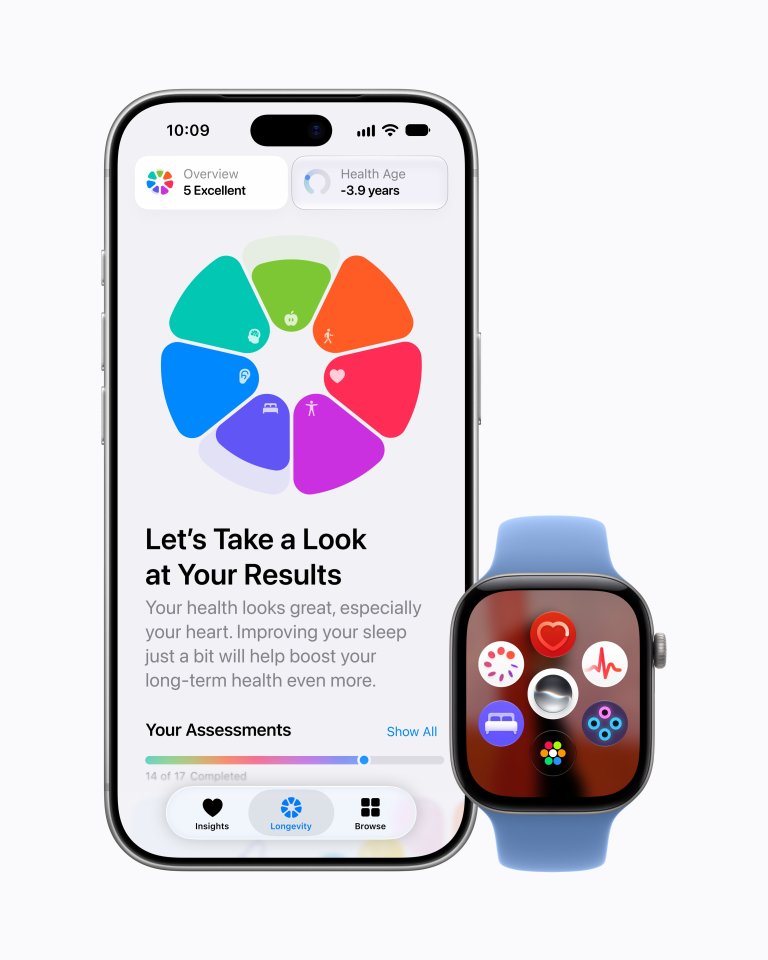
    But the big news of the event, to me, was the Watch, health in general, and how it's going to end up leveraging AI. That is one of those things that keeps compounding.

    The story of health and Apple continues to be a drumroll that gets bigger and louder, and it's still getting ignored. It's getting ignored the way services were ignored ten years ago, when Wall Street didn't think it was worth paying attention to. It was a hobby. Even the most famous followers of Apple would have said Apple's no good at services, that it was Google's game, that Apple was too slow, bad at building data centers. No one's saying that now.

    Tim has a lot of quotes, but the one I like most is where he said that Apple may be known most for its contribution to health. That's a bold claim, and it flew over people's heads. But think about it: would I rather have a device that keeps me healthy? Not just fixes me, but keeps me healthy. That's health maintenance. As a coach, it does all the things that lead to a good lifestyle, and maybe not just health but happiness. What would be the value of that machine versus one that was an AI? We focus entirely on AI being some kind of magic, whereas health is another kind of magic that doesn't seem to be considered very valuable. If I were to do the math, the health industry, including wellness, exercise, apparel and diet, is far bigger than knowledge-based assistance.

    Now, I'm not discounting AI at all. But people are more likely to say: we want to preserve and be healthy. There are big problems with that, in motivation and so on. We like GLP-1s because we like pills. Simple answers, quick, but expensive. Doctors like them because they're easy to prescribe. You don't have to rely on the habits or the mind of the patient.

    But what if you could change people's behaviors? What if you had a machine that was effective in guidance, without the side effects?

    The case in point is exercise. If exercise were a pill, it would be a miracle pill. Every doctor would prescribe it. So the question to ask is: how do I make exercise into a pill?

    Making it into something so reliably delivered and so easily administered: whoever does this will reap enormous rewards. That's where I think Apple is thinking they'll be in twenty years.

    We're seeing continuous progress, always flying under the radar, everyone glazing over: more sensors under the Watch, what's the big deal. But that Watch is collecting so much data. I'm shocked, scrolling through my Health app, at how many different things it's able to infer. It's now tracking your heart rate at five-second increments, as close to real time as possible. What about blood pressure? Glucose? Your hearing, your eyesight? And then the biggest things of all: exercise and diet. Apple will eventually conquer these domains, and then it'll be a thing you have that's as important as an AI assistant. How about my health coach?

    They just did an acquisition of a company using electromagnetic fields for what I first read as intent sensing but now think is biosensing: possibly determining blood sugar or other metrics of your health. It's not going to be neural implants, but they're going to get all this data. This is a moonshot. This is the human moonshot. It's solving something bigger than AI, in my opinion.


    One of the questions asked in Asymco Office Hours. The full recording and transcript are available to Asymco One subscribers.

  5. Stairway to the $3200 Heaven

    Research · 2 comments

    An Office Hours question, September 11, 2026.

    Q: The Stairway to Heaven now tops out at $3,200. That's a very high price at presumably low volume. How does it affect your thinking about the average selling price?

    If you look at the price increases as a percentage from the previous generation, there's a range. They're not the same. Obviously, if you're going from 256 gigabytes to 512, that's double, 1024 is quadruple, and then eight times, so you should see bigger jumps. Indeed, if you divide by the capacity, there's some consistency, between 20 and 30 cents per gigabyte of additional cost. But some configurations are getting a kind of bonus, in the sense that their increases are lower, as low as 8%. That configuration is the 512 gigabyte, and the reason it got a break is probably because it's the most common one. So there's a higher increase at 256, it dips at 512, and then it comes back and is highest at 2048.

    My expectation is that the sweet spot is the 512, and if I were to weight the pricing, I would concentrate on that price point as the mode, the most common configuration. It's multiplying way too many assumptions to come up with an exact ASP, but I penciled in an average price increase of around 12%, which is way lower than most people thought. My estimate was 10 to 15, and we came in close to the 10. That's a surprise.

    What this does to the ASP depends on what the previous ASP was, and that is never given by Apple. People are saying it's already at 1,200, or 1,100. I've been much more conservative. I thought it was about 900, and therefore now we're at a thousand, perhaps. The reason I believe it's lower than what the mainstream is saying is that I can't reconcile the fact that there are 1.2 billion iPhones in use and only 200 million are sold a year. If only 200 million are sold a year, and some are to new customers, how do you account for, say, 150 million phones replacing the worn out, broken and obsolete portion of the 1.2 billion? It suggests the lifespan of the product is eight to ten years. That doesn't make sense either, and no one is talking about this. The ASP immediately affects it: if you assume a huge ASP, you're shrinking the volume, which means you're not servicing the installed base.

    There are several reasons the ASP is lower than list. When Apple publishes a price, there are retail margins. If they sell direct they get the full price, but through carriers you see the discounts popping up, and some of that is eaten by the distributor. Apple's not getting full MSRP on every deal. And they account for the revenue differently: for compliance with GAAP they cannot book the hardware revenue if software is yet to be delivered, so some is deferred. Over time that evens out, but it distorts the picture.

    Why are analysts fixated on the top? Because if you read the Stairway to Heaven, you fixate on the top. Oh, the phones are so expensive. But do you know how few two-terabyte units are sold? You need to be a YouTuber capturing video for hours to need a two-terabyte phone, or so wealthy that you don't question it. That's a vanishingly small number. What people forget is that there's a lot of middle to low end. I was surprised, doing my inventory for the Stairway data, that the 16 is still available for sale, even lower than the 17e, which is considered the low end. There are a lot of good-enough phones down there. So what is the ASP? Excluding the Duo, I think it's gone up to probably 1,100. With the Duo, we're at 1,200. It all depends on how many Duos they sell. And a footnote: Duo sales start in October, so it's not going to make this quarter at all.


    One of the questions asked in Asymco Office Hours. The full recording and transcript are available to Asymco One subscribers.

    See the proceedings at asymco.com/live.

  6. Duo dollars a day, Duo cents an unlock

    Research · 1 comment

    An Office Hours discussion, September 11, 2026.

    Q: The Duo starts at $2,000. How should people think about that price?

    I published this idea that the pricing of the product is about a dollar ninety a day at the starting point of the Duo. Let's round up to two, once you factor in taxes and whatnot. So you end up at two dollars a day, and that's about twice the historical average for the iPhone, or even the average Apple product. The median Apple product is a dollar a day. You can go and check this out: go to store.apple.com, price the product, and see what the lease price is. It'll be approximately $58 per month. Divide that by 365 over twelve and that gets you the daily price. I've done this for all the iPhone configurations, and for other products when they announced Apple Upgrade. Whenever someone says this is going to cost me my mortgage payment, that they can't afford it: you have the option to pay on a monthly basis, and it comes to two dollars a day.

    And here's the killer: it's in use four hours a day. Maybe, because of the fold, it's going to be in use more, because people will find jobs to do with it. Entertainment is a huge time sink. People will sit and watch more video, not just short form but long form. Short is easy, that's swiping. Long form: open it up, start watching a movie. Much more comfortable on this device. Then you start to add up the hours and the number of interactions. The average number of unlocks of an iPhone was 80 many years ago. It's possible we're now at a hundred unlocks a day. So two dollars divided by a hundred unlocks is two cents every time you use the phone. If it gets more use, it becomes even cheaper.

    I think people intuitively know this is the most useful product they own. It's the one they can't leave the house without. It's the one they panic over if they can't find it. I use my Watch to find my phone every other day. It's so important that you can't be without it for more than a few minutes, and you think about safety all the time: if I don't have my phone, I'm unsafe. If it's that important, two dollars a day. And by the way, the median across all the iPhone variants is a dollar forty right now. You can buy a used one for much less: a used iPhone 15 for $400 or $350, no problem. Even if it only lasts two years, that's less than 50 cents a day. The value is unbelievable.

    Q: I did a similar calculation of cost versus daily use across everything I own. The cheapest per hour turned out to be the bed. The smartphone was second.

    The bed goes with the house. That's the difference: the phone is always with you, even when you're not at home. I did this for cars, and cars are the worst. A luxury car that depreciates quickly could be over fifty dollars a day. The cost per mile is fifty to sixty cents nowadays, maybe seventy-five with inflation. I don't question the bed. You're in it for so long, and you should invest in a good mattress. I'm pointing out that the bigger objects in your life, washing machines or refrigerators, are super important and very low per unit. What I'm trying to convey is that there are things in life that are underpriced, in a way, because we use them much more than we think. And other times we're spending way too much. Cars are much too expensive for what they deliver. You spend one hour a day in a car and yet you spend tens of thousands for one.


    One of the questions asked in Asymco Office Hours. The full recording and transcript are available to Asymco One subscribers.

    See the proceedings at asymco.com/live.

  7. The Dawn of Gestural Computing

    Research · 6 comments

    Reflections on the iPhone Uno

    The more one thinks about the iPhone Duo the more the "Duo" branding appears to be signifying something beyond two screens or two thousand dollars. It becomes apparent that it also represents 2.0. The iPhone 2.0 branding seems appropriate as so much of the product is changing: not just the way it looks but the way it works.

    To contemplate this, consider that the premise of folding the screen isn't just to afford a larger surface but also the mechanical theater of moving parts, user gestures and positional geometries. It's a "book", a mini laptop, a notebook (with Pencil!), a tablet, an alarm clock, a movie screen with stand and controls, etc. Note also the role of cases: from being simple skins to now being functional additions requiring modalities and moving parts.

    When the device was only a glass rectangle we got touch computing. When that surface is variable and multi-modal, we arrive at gestural computing.

    Bringing this to market required solving mechanical and UI problems but also conceptual, jobs-to-be-done questions. Perhaps more productivity, perhaps more creativity. The folding mechanism is a wonder, the surface treatment is chemistry and noting also the liquid glass application, the new interface is magical. These developments, and, undoubtedly, more to come, were necessary to make the idea of gestural computing not just possible but attractive.

    Now a new gesture language will emerge: Opening, closing, propping, typing, flipping are all new, adding to swiping, rotating, pinch and zooming brought to us by multi-touch. The promotional videos Apple released highlight these new gestures visually presenting the product as not just being a 2D slate.

    Naturally, the folding capability will come to other screens in the Apple pantheon: the iPad, Mac, and a multitude of iPhone sizes. Missing elements will be added back to the Duos: FaceID, spatial photography, top-level cameras. The Duo will stand next to it first but eventually will likely eclipse the Uno.

    Such screen Origami will force a question of what happens to the iPhone Uno. Will it become a quaint form factor for the artisanal iPhone crowd? Will it be remembered fondly like we remember Nokia phones today? Sturdy, robust, simple and somewhat rustic?

    Or, will the Uno remain the baseline iPhone for decades to come? And what of the accessories "surfaces" which will expand the interaction and sensing universe?

    When I worked at Nokia 20 years ago, the "mono block" or candy bar form factor was the logical way to think of phones. Not long after achieving dominance, flip phones began to catch on in Japan and the US, eventually also becoming popular in Europe. The pinnacle of this trend was the Motorola RAZR which became the best selling phone for years, selling an unheard-of total of 50 million units in no time. We were baffled by this. The flip was more fragile, had a smaller battery, had a terrible UI, was fiddly in use, required two screens and was more expensive to make. It added no functionality but seemingly added friction to the experience.

    Those who loved the form factor kept emphasizing that it was better but could not explain it except to say it was more satisfying to use. The pantomime of opening and closing provided punctuation to phone calling. We were told women loved it because it mimicked using a make-up compact. A very peculiar argument.

    But Nokia was wrong to ignore flip phones. At least until Apple released the iPhone which put the emphasis on what's on the screen rather than what behind it. The iPhone was once again a reset of the basis of phone competition: from mechanical features to software capability. A screen could offer an infinity of buttons and functions.

    So the Duo in many ways betrays the Uno. It drops a mechanical wrench into the "no-moving-parts" machine that defined the phone for two decades. Apple even got rid of almost all mechanical anything: no more home button, no headphone jack, wireless charging.

    One can argue from an engineering point of view about how the Duo is counter-intuitive: so many compromises to cope with and so little gained. But as the flip phone taught us, the customer's perception of usage is not easily measured or explained. The lust for the fidget, the tactile and the third dimension has been served.

  8. Are iPhones too cheap?

    Research · 1 comment

    Prices for the iPhone 18 Pro and Duo are lower than expected

    When the iPhone Duo price was announced in the Steve Jobs theater I was the only one applauding.

    Prior to the Duo bombshell, the iPhone 18 Pro prices were announced to be a mere $100 higher than the iPhone 17 Pro and the Apple watch prices were kept steady while the AirPods prices actually came down (for one of the cases).

    A stunned silence was clearly warranted but applause?

    Of course, these are the starting prices and the higher memory/storage configurations are sharply higher. The top of the iPhone price range is now $3200. 1

    The base price is however the one most talked about. Ignoring for a moment the financing options (and taxes, AppleCare, non-US pricing and even accessories), are we to think that the iPhone is too expensive or is it too cheap?

    Bank of America analyst Wamsi Mohan seems to think Apple made it too cheap. He cut his price target on the shares on account of there being a likely drop in margins (though an increase in volumes.) He had expected a $2,099 Duo and price increases of $150 to $200 on the Pro base models.

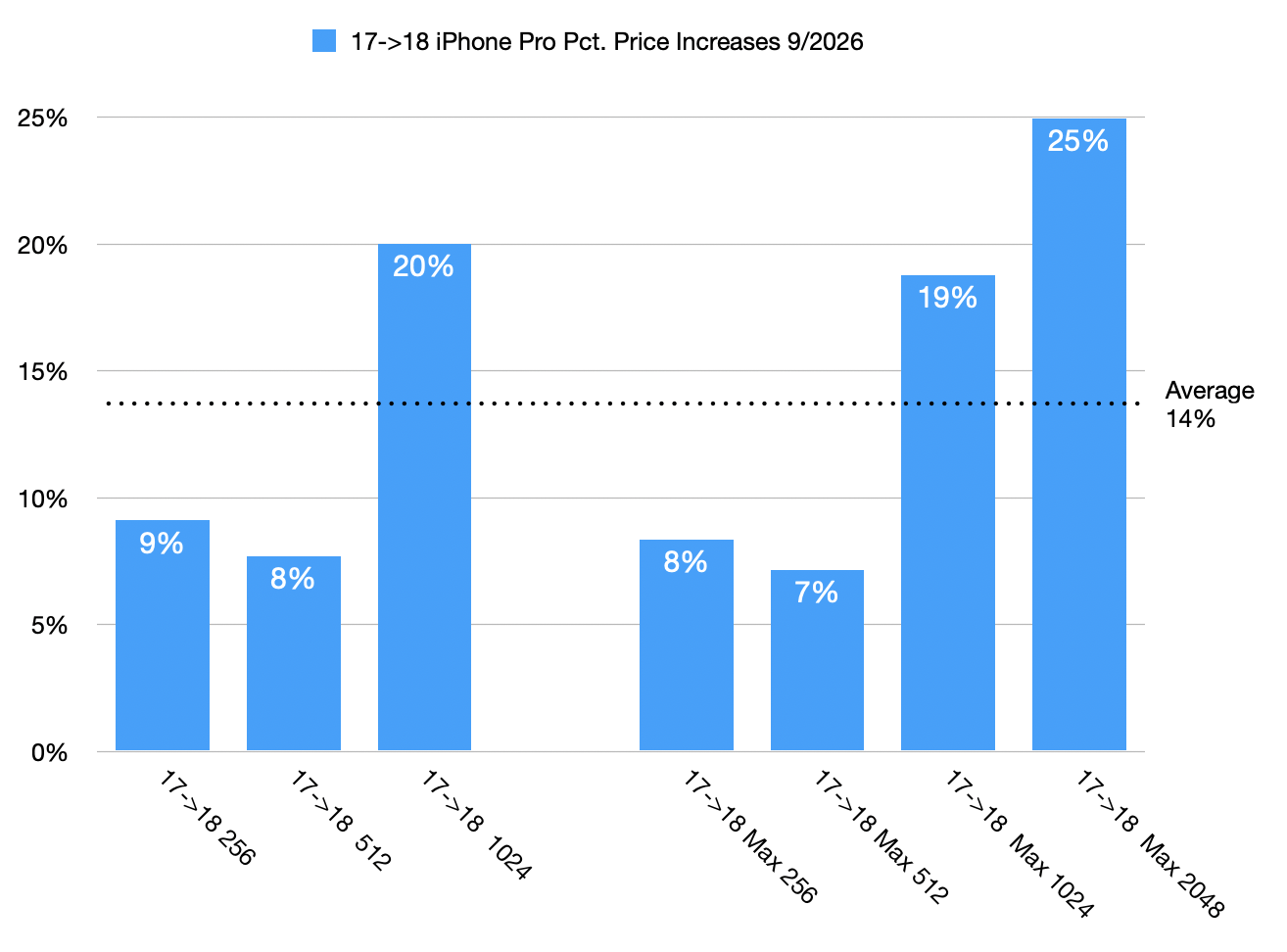
    I had expected a 10% to 15% increase on the iPhone. On an equivalent 17->18 comparison, the price increases for the same memory configurations were as follows:

    Note that there was no 17 Pro 2048 option so the 18 Pro 2048 has no comparison.

    The average (unweighted) price increase was 14%, within my expectations. However, the lower memory configurations are more popular, the 256Gb and 512Gb models saw increases below 10%.2 I expect these are far more popular, putting the weighted average price increase close to 10%.

    On that basis the price increases were lower than I had expected.

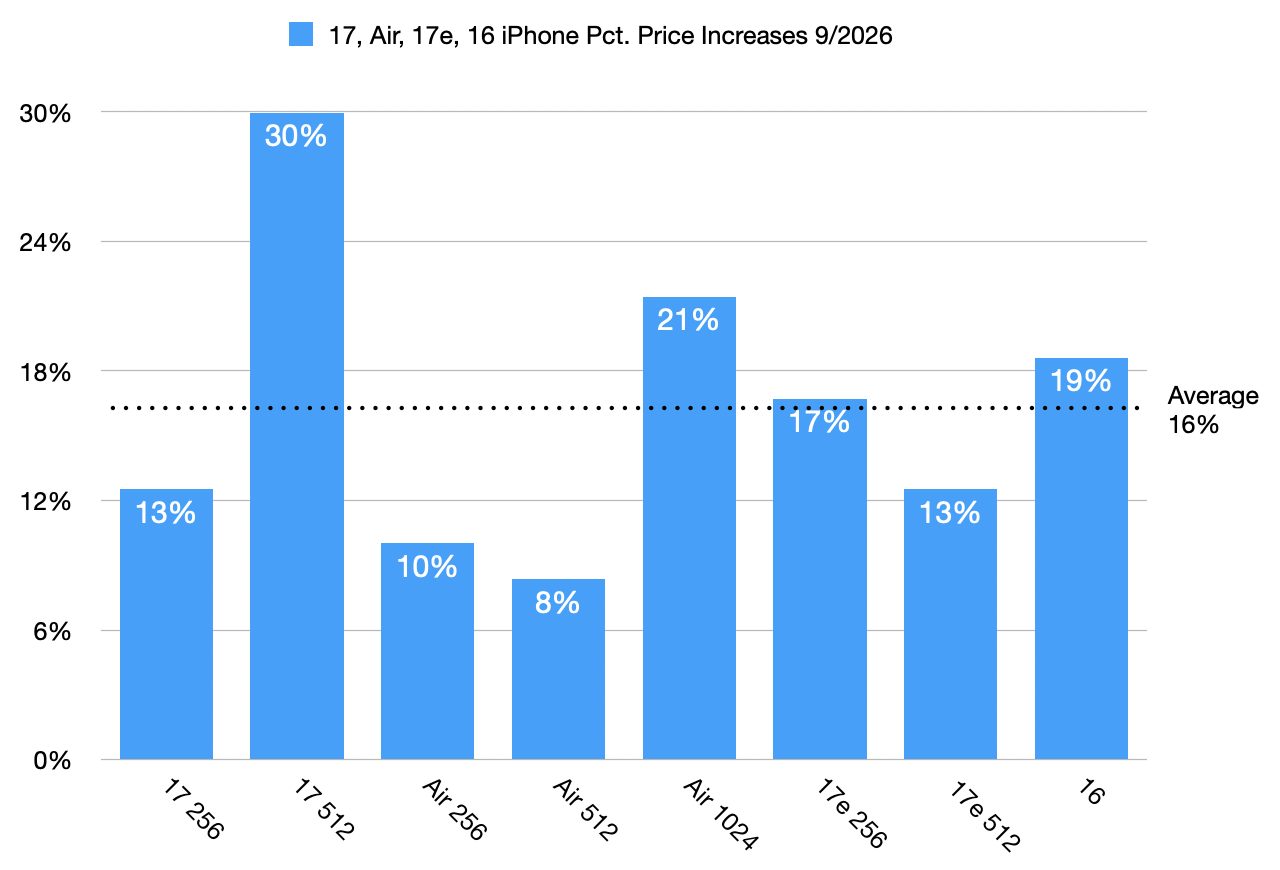
    But there's more price increases to consider. The iPhone 17, Air, and 17e and 16 continue to be sold and they all received price increases. These increases are shown in the following graph:

    Here the increases are typically higher, with an average of 17% and a maximum of 30%. And these are not "better" versions, as in the case of the 17->18 Pros. These are the same exact products. The increase on the Air 512 is the most modest and probably the best deal, again suggesting that the 512 configuration is the most economical, perhaps due to scale. 3

    The Duo is out of scope of this comparison but there have been "leaks" suggesting that the $1999 price was chosen years ago to anchor the product implying that the memory catastrophe is being ignored for now. One does not need a leak to consider the anchor price logical and consistent with history of the product.4

    What does this analysis suggest about ASP and volumes?

    Excluding the Duo, the weighted average increase in ASP is probably around 10 to 12%. My own ASP estimate is perhaps too low at $900, and would increase to $1000 under this assumption. However, adding the Duo could bring it to $1200 in the fourth quarter, depending heavily upon the mix. And this is where the conundrum lies: the supply constraints are unknown for the Duo.

    I believe the product will be supply constrained for many months. Waiting times over 1 month will probably persist well into 2027. We have to anticipate enormous demand in Asia, China in particular. I believe the product will be exceptionally popular as a gift, especially for women and the gifting season will continue into spring.

    The product's "hormonal" attraction is off the charts. It all depends on which components are in constraint. The product's screen, processor and memory are challenges.

    Overall, this is an aggressive stance from Apple on pricing. I noted that they did not increase pricing of the whole line in June when the Mac and iPad were hit. Months went by while Apple held the 17/Air line steady. Those buyers got a good deal as now those units are still available but are more expensive, an unprecedented situation.

    There might be a perturbed market in the fourth quarter as the new Pro products are supply constrained while the base models are kept available longer than ever, but at a higher price. So far we've seen masterful management of this market wherein Apple managed to log double digit growth rates while competitors are contracting. Now more variables are added to the mix but the company is oozing with competence.

    1. I should note here that having 2TB of storage or even 1TB on a phone is necessary perhaps if one captures and stores a lot of video. For the vast majority of users the base configuration is perfectly adequate.
    2. Pro tip: the best deal is on the 512GB configuration, and in particular, the 18 Pro Max 512 seems to be the sweet spot with a 7% increase. It's possible that Apple's data suggests that the 512 might also be the most popular which would drive this distribution of pricing.
    3. The increase in price divided by the memory size suggests about 30c/GB increase in the Pro products and 35c/GB in the 17/Air.
    4. You could say Duo really means two (thousand dollars.)
  9. Is the Stairway to Heaven still working?

    Research · 2 comments

    Time to re-frame pricing on a daily basis

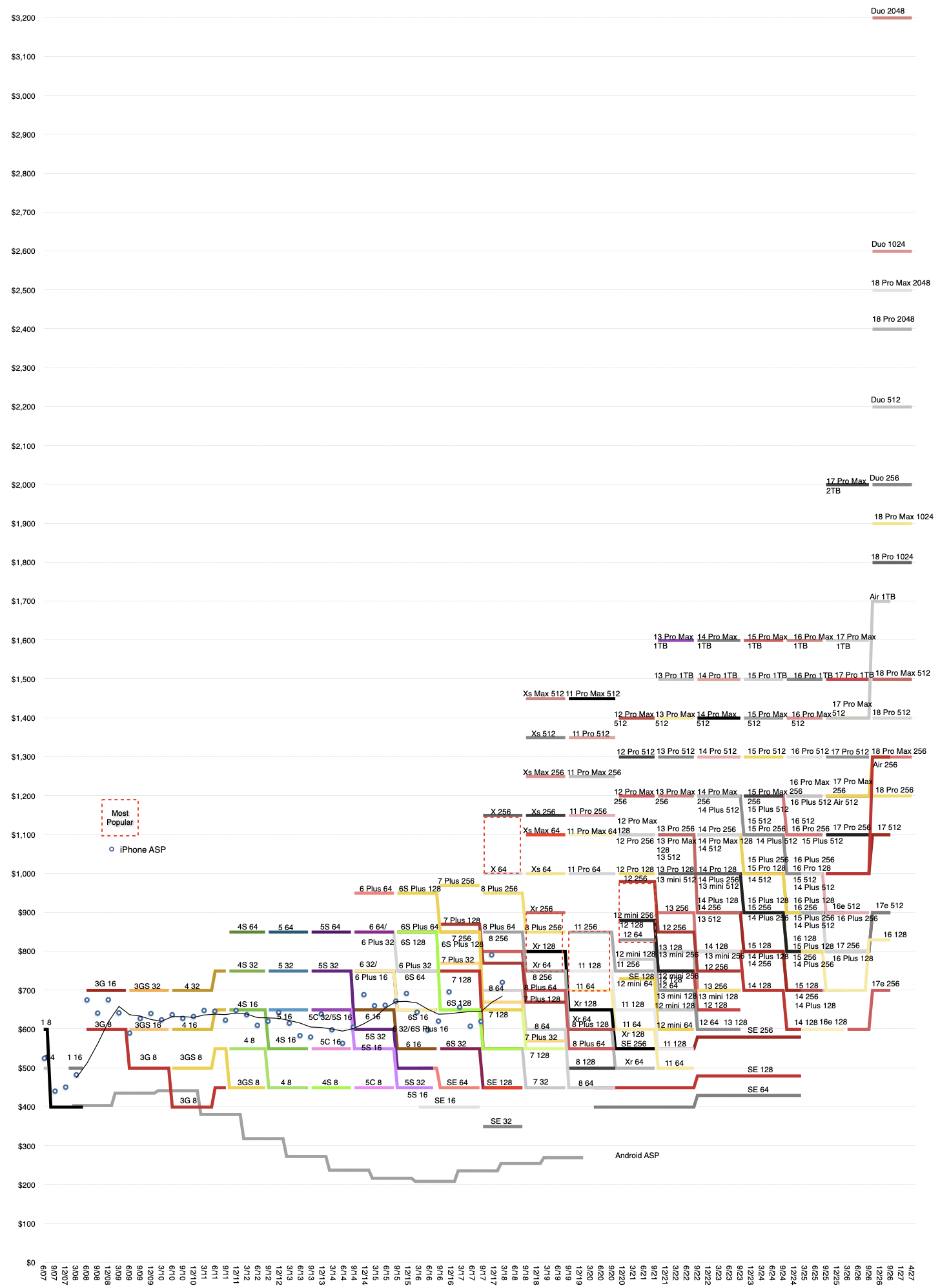
    The launch of the iPhone Duo and the surge in memory pricing has caused a disturbance in the force. The new Stairway graph is shown below (click on graph to see higher resolution.)

    A few notes:

    • The process of lowering prices for n-1 devices has reversed. Previous generation iPhone prices have gone up for the first time ever. This is mitigated by the fact that "n-1" is not quite apparent for the 17 as it's still the current model in the mid-range. The 17e and the 16 are still in the roster since there will not be replacement for at least six moths.
    • The higher the memory, the higher the increase. Base models (256G) see increases of $100 but 1TB configuration Air saw a $300 increase.
    • The Duo starting price is a reasonable $1999 which is probably where they wanted it to be years before launch. The more hard to swallow prices are in the higher memory configurations. The top of the stack is now $3200 vs. $2000 previously. That jump appears scary but the top of the range it's likely to be far from the average (or median) configuration.

    Fortunately we have the Leasing (Apple Upgrade) purchase option to determine the price/day at launch. Previously we would have to estimate the resale values years in advance but leasing means Apple does all the work for us.

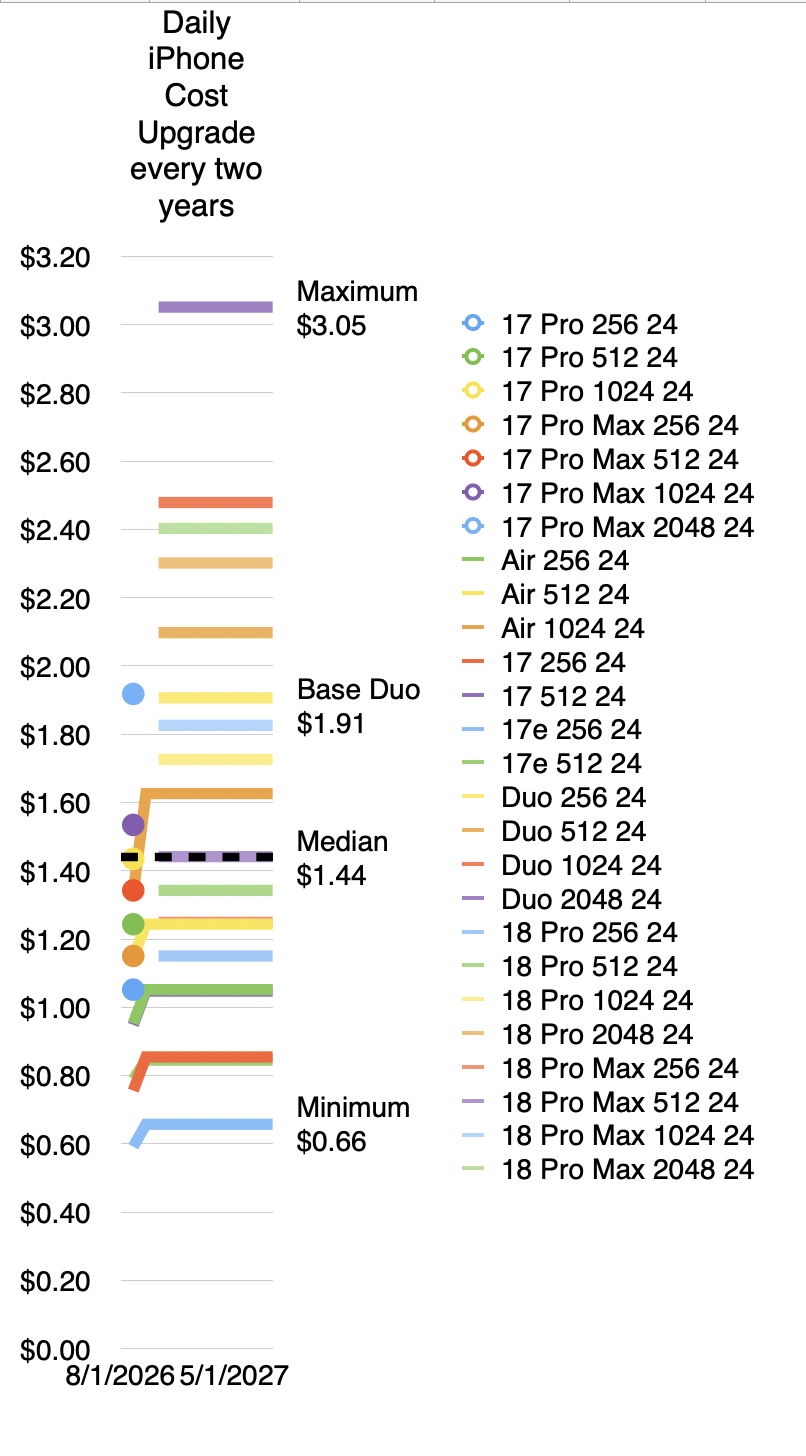
    The distribution of the daily costs for all the current models (and historic) is shown below:

    This is the 24 moth option which is the only option for the Duo. Note that products that are carried forward had an increase in leasing price. The new median iPhone price (half the units are above, half are below) is $1.44/day. The minimum is $0.66/day and the maximum is $3.05/day. The base Duo price is $1.91.

    One could therefore say that Duo stands for two thousand up-front or two dollars/day.

    What are the consequences?

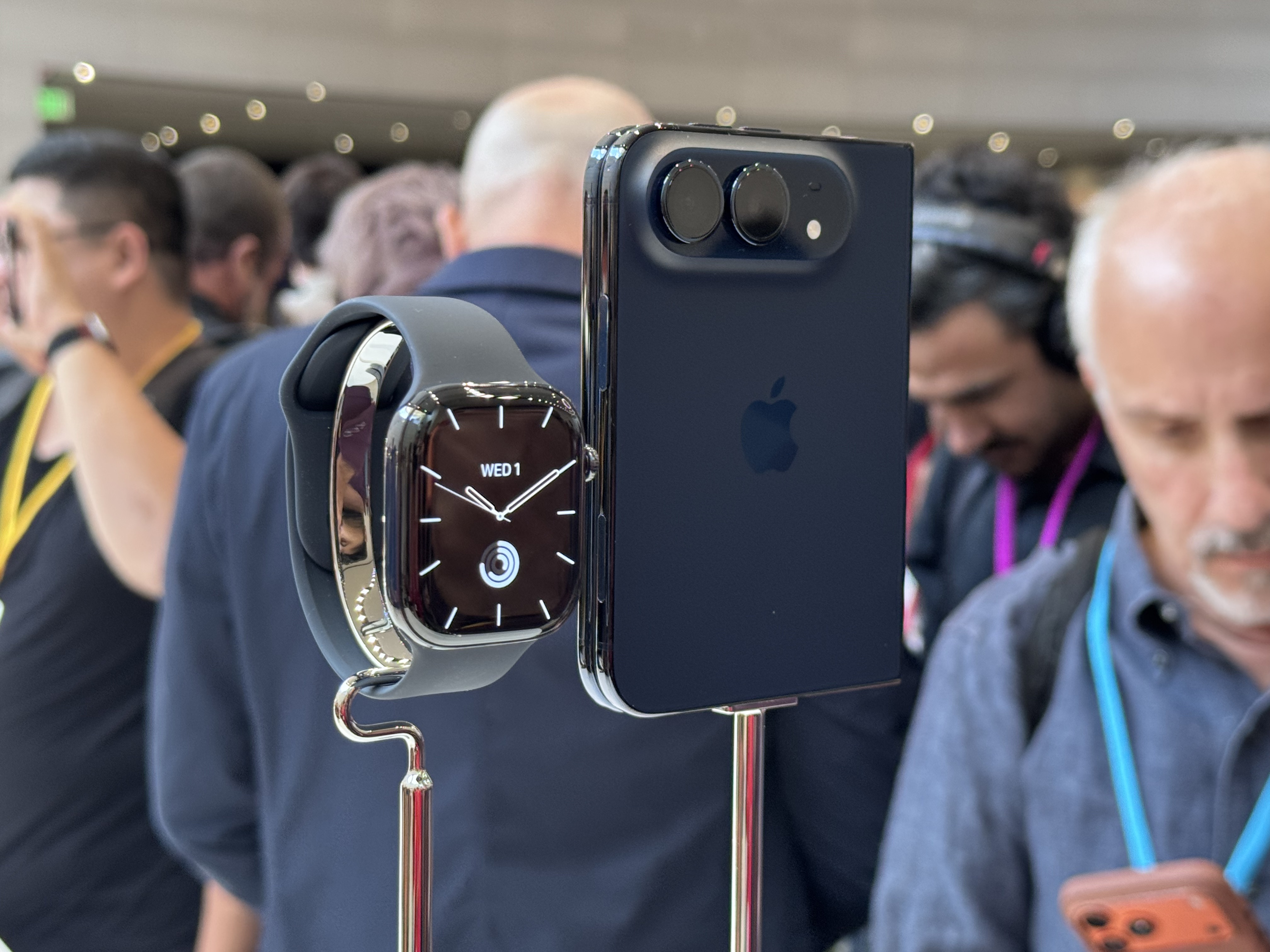
    Having been at the launch event, my impression is that the new iPhones are very attractive and have that wow factor when held and seen up close. The Duo will do very well in my opinion because it has a sense of theater about it and it moves the iPhone experience into three physical dimensions.

    The pricing is being mitigated with leasing and should become normalized. I do wonder if the leasing price will be slowly put forward as the primary metric. Many consumer items such as homes, cars and durable goods are often quoted in terms of monthly prices. The iPhone provides a very high level of utility to many and the idea of subscribing to it will catch on.

    The iPhone will have perhaps an ASP of $1.35, growing from the historical $1/day. It's a matter of time for this pricing to anchor and become normative.

    Regardless, the Duo will be very popular and be supply constrained for, I believe, at least six months.

  10. Apple iPhone Event First Impressions

    Research · 5 comments

    From the Steve Jobs Theater

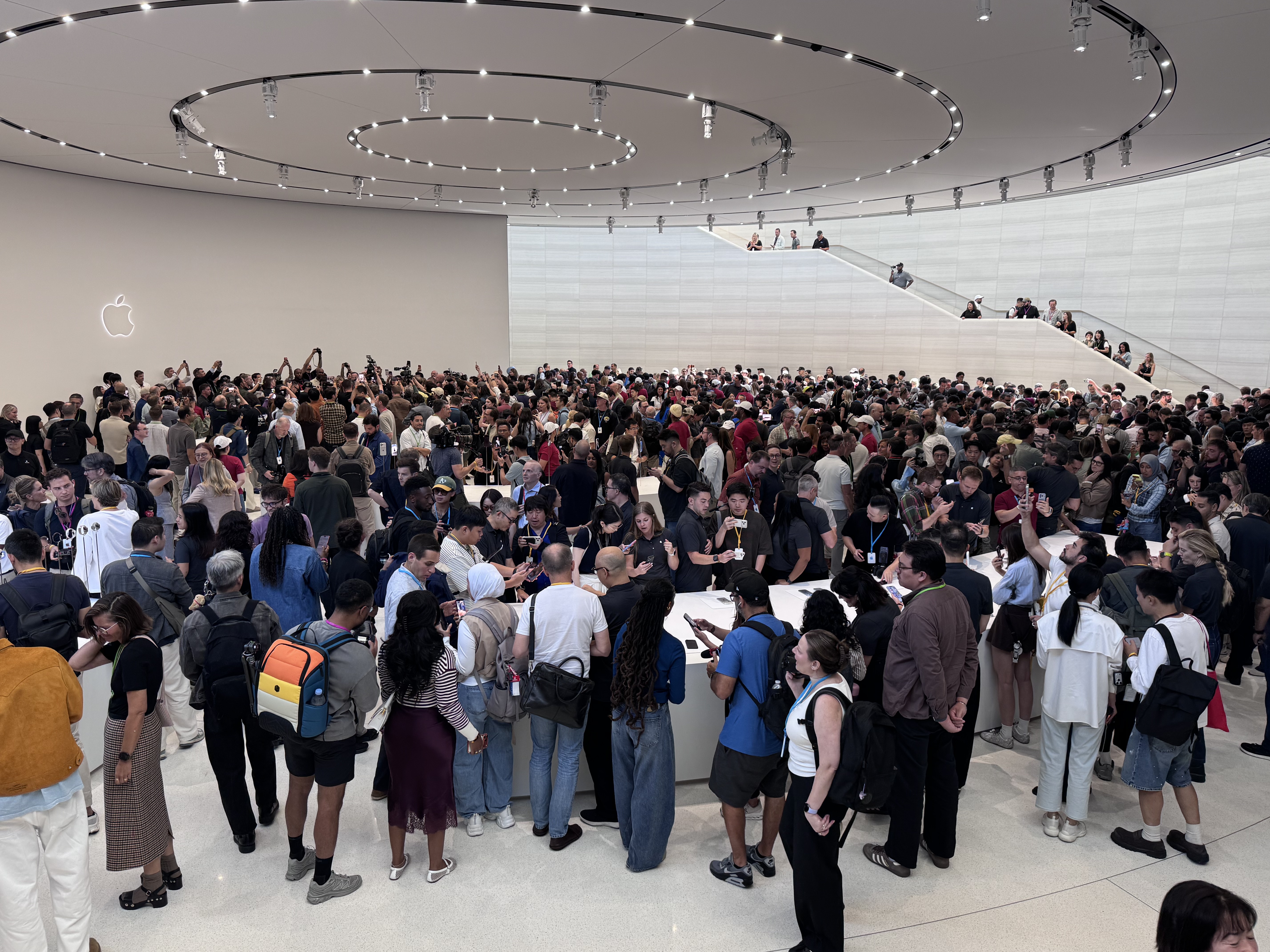
    I'm writing while still in the SJ Theater in Cupertino after the end of the event and the media frenzy around the demo devices.

    The atmosphere was noticeably more enthusiastic and the venue was packed. First impression was that John Ternus was already received as a "star" with a standing ovation to on-stage appearance and cheering at his video introduction from Tim Cook. Clearly the audience is already excited by his presence if not charismatic performance.

    The products were on par with outstanding polish and refinement. The details especially health and assistive features are truly transformative and profound even if, as usual, they are discounted by the markets. The idea that Apple devices are life coaches and now longevity assistants is simply indistinguishable from magic.

    The two surprises are:

    1. The prices across the board are holding in an ironclad way. I was really surprised that the AirPods were marginally cheaper, the watch held and the iPhone was up by $100 (base model.) I'll do a deeper dive later with an updated stairway to heaven.
    2. The iPhone Duo is stunning to behold. I was mildly skeptical that it would be a necessity. A nice-to-have, sure, but a must-have, I doubted it. I'm now converted. I feel the Duo is going to become extremely desirable. Mostly because to see one is to want one. The more they sell, the more they will be seen and demanded. It's the ultimate gift and object of desire.

    The Apple engine is running on all cylinders and the only question is if there is enough fuel in the form of supplier components to satisfy the demand. The iPhone Duo will instantly sell out and the 18 and 17 will run strong for another year. The 17 already is the best selling iPhone in history and will stay strong into the spring. A new cadence that will probably tweak sales across the year and create a bi-seasonal burst.

    This is all without mentioning AI. All reviews of Apple Intelligence are positive and the thesis that 80% of users will discover AI through an Apple device holds. The results will be seen in the language: in response to a question, people will say "My iPhone says this". Not Google, not ChatGPT, not Claude. My iPhone is the authority. And my assistant.

  11. Deploying Enterprise AI on Apple Hardware is Suddenly a no-Brainer

    Research · 7 comments

    Apple's AI angle in the enterprise

    There was a time when Apple's point to the Enterprise buyer was that Apple products were ultimately more cost effective and productive. The total cost of ownership was lower as the products were cheaper to maintain and lasted longer and users were more productive as the user experience frictions were lower than Windows.

    The problem was that Apple devices were at odds with IT policies and standards. Everything from device management, software licensing, identity and authentication management, migration, training, security were built excluding the Apple platforms. The Microsoft world was interlocking and impenetrable even if it was sub-optimal on metrics of performance.

    It began to change with the subversive iPhone and iPad. As not only some early adopter employees but management itself began to bring their personal devices to work and ask IT to make the "systems" work through them. Thus the infiltration was not as much through the "grass roots" but through the top of the food chain. The canonical example was the CEO demanding to use an iPad to speed run meetings all day.

    And from that crack Apple penetrated enterprises to such an extent that today the MacBook Air is the world's best selling enterprise laptop. The iPhone and iPad are also the best selling enterprise phones and tablets. More Apple devices are purchased in enterprise than any other brand.

    Though MacOS and iOS are still not the majority platforms, in some verticals such as surgery, Apple Vision Pro has been established as the only viable option.

    But now that AI is becoming a new wave of software/service for Enterprises, Apple is surprisingly in the driver's seat for being the best platform for deployment.

    By "best" I mean objectively best in performance, security and, most shockingly, cost.

    Best Performance

    Though there are lower cost alternatives, the top of the line Mac Studio in a cluster configuration can provide 2TB of unified memory, 1.2 TB/s of bandwidth and handle up to to 1.6 trillion active parameters.

    It's hard to visualize these numbers but what it boils down to is that enterprises can deploy vast models to run locally. Why locally? Because many examples from healthcare to aviation to transportation to financial services require privacy, off-line or compliance which disallow cloud-based services.

    By one estimate, 50% of Enterprise AI inference will be processed locally by 2030. Half of the market for enterprise AI will be on device. This is profound.

    Best Security

    Apple offers built-in security at every layer: Service layer, Network, App, Data, System, and Silicon hardware. This is religion for Apple and not an after-thought. As such, the frameworks were ready before even the new AI as a service has been invented.

    Best Price

    This is the most surprising and most consequential development.

    Apple devices already have the higher residual value, highest employee affinity, lowest operating cost (due to security mainly), lower energy cost and lower support cost.

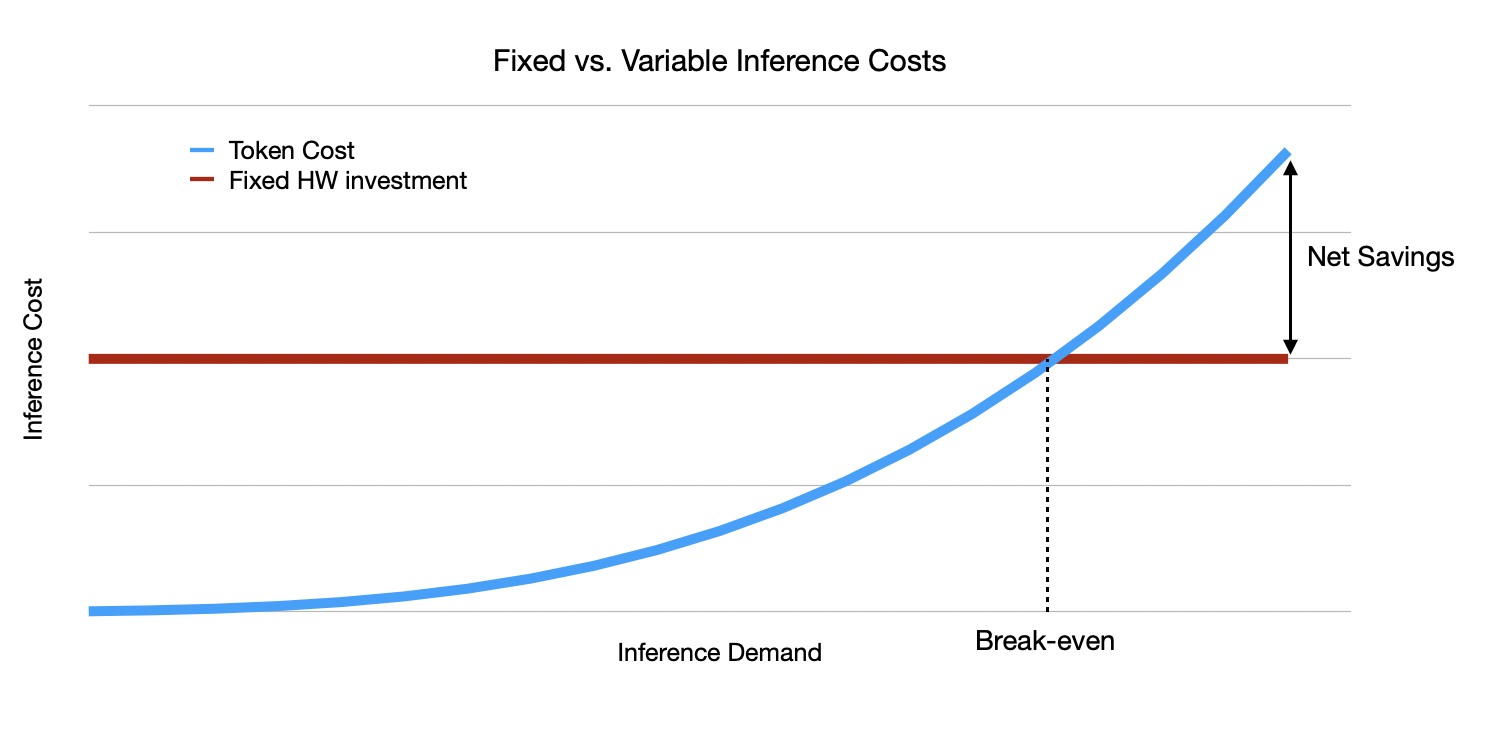
    But now, when running AI, localized inference delivers a capped cost structure vs. an unlimited risk for token costs. The math is shocking.

    Two examples:

    1. A 26B parameter business analysis model running for 4 hours a day consuming 150 million tokens a month results in a cost of between $450 and $850 per user per month. The alternative is to buy a MacBook Pro and run that same model at zero cost. The acquisition cost of a 16" M5 Max with 40-core GPU and 128GB of unified memory is $6500. The payback period is 7 to 14 months. Thereafter the savings are $5400 to $10,200 per year.
    2. Agentic coding using an 80B parameter model running 12 hours a day and consuming 300 million tokens a month will cost between $900 and $1500 per user per month. The alternative is to buy a Mac Studio M5 Ultra 80-core GPU and 256GB 4TB storage for $11,219. The payback period is 7 to 12 months, saving $11,000 to $18,000 every year thereafter.

    The graph at the top of this post illustrates that this net savings is available above a certain threshold. These are serious numbers when the number of possible users is in the hundreds. The fixed hardware investment is a significant game changer in AI implementations.

    The questions changes from why should we use Apple devices to why shouldn't we?

    History has shown that computation tends to distribute itself to "the edge" of the network. It's been so since microprocessors were first developed in the 1970s. The logic at first is one of control and flexibility but it soon becomes one of cost. Early PC users in the enterprise loved the ability to have local spreadsheets and word processing at their fingertips and under their own ability to operate. Later it was desktop publishing and image editing and a multitude of applications.

    That has been Apple's story in the enterprise: first it was a set of really unique experiences and degrees of creative freedom. Now we are at the stage where it just makes enormous financial sense. That is a watershed moment.

    The corollary here is that AI is not much more than computing demand. If that demand is local or remote is a question of requirements. It so happens that local is desirable for a lot of people, and not just consumers.

    The counter-argument is that the model must always evolve and thus the local becomes outdated or stale. But there are many forms of intelligences which do not require global or world models. The information an enterprise relies on for operations is not going to constantly change based on factors outside of its control.

    When we look back on this period we will probably be amazed at how Apple was able to "pivot" to becoming the platform for Enterprise AI. The real magic is that it was always on the same path.