We plan to hold our annual event on or around the first week in June 2026. Stay tuned for details. If you have any requests or comments, feel free to reach out. Use comments below or email contact (at) asymco.com
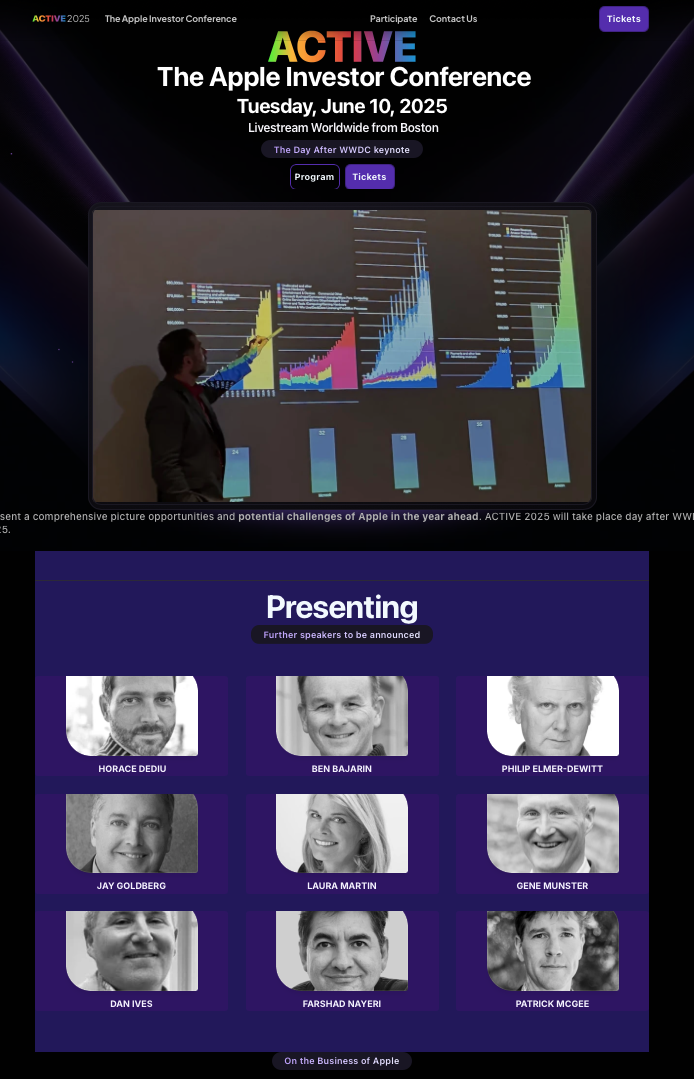
I’m pleased to announce the next Apple investor event, taking place on Tuesday, June 10, 2025, timed to coincide with Apple’s Worldwide Developers Conference (WWDC25).
ACTIVE: The Apple Investor Conference
ACTIVE is an in-depth examination of Apple as a business. The event is designed for individual investors, analysts, developers, and others with a stake in the Apple ecosystem. We move beyond the headlines to analyze the company’s operating model, portfolio of products and services, competitive position, and strategic trajectories. We will examine how Apple may navigate emerging macroeconomic volatility, evolving AI dynamics, and a shifting regulatory environment. Participants will also get a sneak peek at a new predictive modeling for Apple's performance.
Topics
Topics we’ll cover:
Financial Performance: Trends in revenue, margin, and customer value
Valuation Logic: From users to markets to multiples
Platform Dynamics: Hardware, software, and services in sync
Global Levers: Tariffs, China, supply chains, and macro forces
Strategic Maps: The next S-curves and adoption inflection points
Externalities: Regulation, risk, and reputational capital
Competition: Platforms, partners, and substitutes
We’re preserving the tight-knit format that makes the event special—limited in-person seats and deep interaction. For those unable to attend in person, we have arranged for a worldwide livestream. Remote participants will be able to view live presentations, pose questions, and engage in discussions in real time.
We hope you’ll join us—in-person or via livestream.
ACTIVE: The Apple Investor Conference
Tuesday, June 10, 2025 (the day after the WWDC25 keynote) Boston (in-person) & Worldwide via Livestream
Learn more and register at ACTIVEconf.com. Early bird tickets are now available. Use code asym27 for an additional discount.
Apple Investors are keen observers of metrics of financial performance. We have to track top line, bottom line and many lines in between. Updates to the data are delivered every quarter through official documents such as the 10K and statements made in conference calls. These data are then analyzed and opinions are formed on the viability, sustainability, and prospects for the company.
The community of investors changes rapidly, with shareholders able to enter and exit with a click of a button. All it takes is capital. Therefore many critics of shareholders as stakeholders point out how fleeting the commitment can be. Though there is skin in the game in the form of committed capital, there is no requirement for staying committed.
This is not the case for another set of stakeholders. In a previous post I pointed out how important employees are to the company and my belief that their commitment is probably management’s greatest concern.
But if one were to sum up the total population of a stakeholder group multiplied by its required level of commitment, there is a case to be made that the most vested community is that of Apple’s developers.
This group numbering in the millions makes an enormous contribution to the prosperity of the company and indeed of the other stakeholders. And they do so through tremendous personal risk. If you are a developer you know this, but perhaps other stakeholders do not. So let me elaborate.
An Apple developer must spend years becoming versed in the developer tools, purchase membership and equipment, navigate getting their software accepted and hope that someone, anyone buys the result. Afterwards, they need to maintain the code and update it frequently as the underlying software and hardware changes.
This adds up to enormous personal opportunity costs. Developing means not doing something else and developing for Apple means (typically) not developing for some other platform.
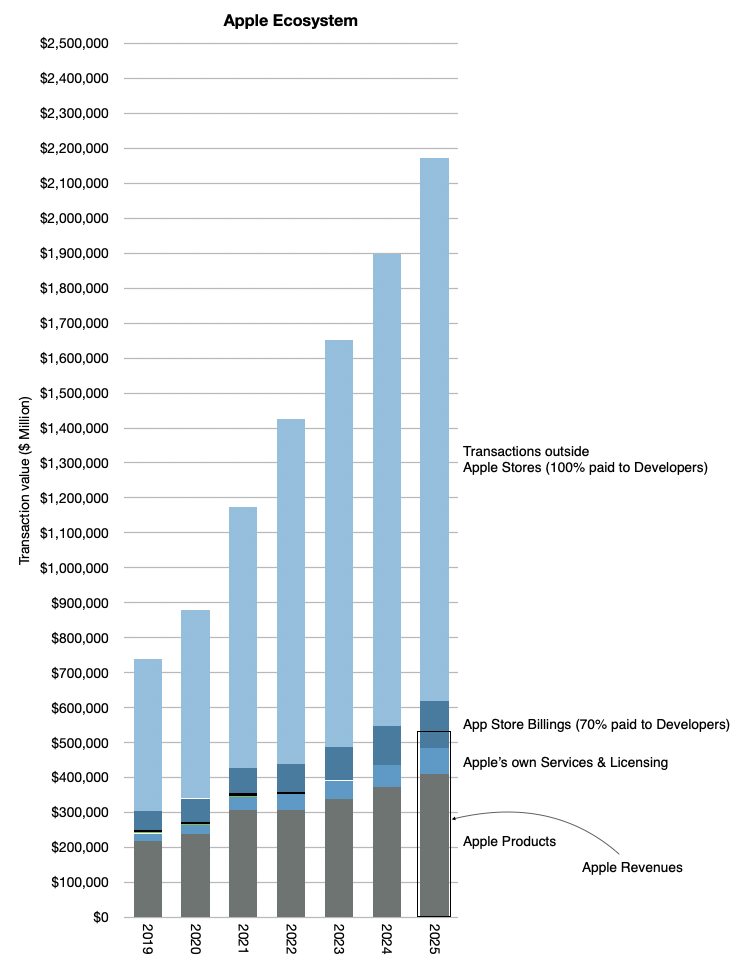
The benefits can be significant however. Apple publishes the amounts paid to developers. That is part of the graph shown below.
The dark blue area shown as “App Store Billings” includes about 70% paid to developers which I would estimate at about 100 billion in 2023.
But these are direct payments based on App Store transactions. A great number of transactions and economic activity takes place outside the App Store. That is over $1.1 trillion in 2023. It should grow to over $1.3 trillion this year.
And then there is AI. As Ben Bajarin and I discussed recently, the integration of AI is shifting the risk/reward equation for developers to include capital spending or monetization of computation itself.
A lot is at stake. Not only in terms of upside but also downside. Developers need to understand the “state of the union” for Apple as a platform and ecosystem from a financial point of view. Conversely, investors need to understand the degree of dependence and commitment being made by the developers.
There has been no forum for this to happen. Until now.
At the first Apple Worldwide Investor Conference ( WWIC ), we will bring together individuals with a stake in Apple's future—investors, analysts, and developers—to foster a meaningful conversation about Apple's ecosystem, and a better understanding of Apple as a business.
The event will take place on September 19th, in-person in Boston with limited seating, and via remote livestream globally, where you can watch, ask questions, and discuss, live.
Tickets are available now. Asymco followers can get an additional discount using code asc24.
I’m thrilled to announce the next Apple investor event, September 19, 2024. Henceforth the events will be called the Apple Worldwide Investor Conference (WWIC). WWIC will examine Apple’s business in-depth using the latest data. In addition to financial review, we will also cover technology, externalities, company culture, brand and competitive stance.
Focus: Apple Intelligence.
State of the Union
Products & Services: Financial performance and market overview
Valuation: Measuring customer creation and retention
Growth: Opportunities in Products, Services, and Geographies
Externalities
Legal and Regulatory Review
Competition
Macro
China
Big Picture: Adoption Rates, Sustaining and Disruptive roadmaps
Wild Card: Reading the Buffett portfolio decision
We’re maintaining the intimate atmosphere of last year: same venue in Boston and limited in-person seating allowing for seamless interaction and enquiry. In addition, we would like to address a wider, global audience. So, for the first time, we will also be offering remote participation where you can watch the livestream, ask questions, and discuss topics live.
Tickets are available now. Asymco followers can get an additional discount using code asc24.
With location is in an area known as the Innovation District, this very new building is walking distance from Boston's South Station which is a terminus for direct trains from New York City and points south. It's also walking distance to the World Trade Center stop for the free Silver Line connecting to Boston's Logan Airport, making it a car-free destination. Local parking garages are available for drivers.
The venue is a media room with intimate access to a very large projection screen.
The agenda has been expanded to include the following topics:
Overview of recent performance (product/services)
Valuation
Growth potential
Limits to growth
Determinants for share price appreciation/depreciation, i.e. signals to look for in deciding your position relative to your risk appetite.
There will be opportunities for private meetings and after-hours networking. Depending on interest, I'm available to conduct a walking tour of historic Boston Waterfront, one of the most interesting historic sites on the continent.
I'm super excited to announce the Apple Investor Event 2023. This will be the third Apple Investor Event I've hosted but it's been a long time since the last one.
The event will take place November 9th, 2023 in Downtown Boston Area (precise location will be announced soon.)
The program is a series of talks with data/visualizations on the following topics:
Products: Financial performance and market overview.
Services: Understanding synergies with products
Valuation: Measuring customer creation and retention
Growth: Opportunities in Products, Services and Geographies. Emphasis on new products in Spatial Computing.
Limits to growth: Market Saturation, Apple Silicon headroom, GDP growth.
Technorati and I are proud to announce the first investor summit dedicated to the long-term investors in Apple.
We will host folks interested in discussing the fundamentals of Apple as a business and how it operates as a recurring revenue model.
Titled "The Goose That Lays The Golden Eggs" it was inspired by a blog post from 2013 foreshadowing how human nature instinctively discounts Apple and yet how that nature is mismatched to how Apple actually works.
If you are curious about why Wall Street says "Sell" and Warren Buffet says "Buy" on Apple you might want to spend some time with us.
Agenda:
How to read the company’s performance given its published results. We will review how to build a model of the company’s financials and how it can be used to forecast the next quarter. We can go line-by-line through the income statement.
How to think about the markets Apple considers important. This is the best way to forecast the company’s performance beyond its current portfolio. This requires calibrating your sense of timing of innovations. What is too early, what is too small, what is something where Apple can’t exercise control? Innovation theory is essential to this understanding. If you know where Apple could go next and where it won’t it helps you build patience into your planning.
How to understand Apple’s culture and its resources and processes. This gets into the critical management question that leadership at Apple is concerned with. I’ve had a few conversations with and have some great insight from former managers. Curiously, this is Apple’s greatest competitive advantage and its sustainability is the key “moat” question. Most people don’t even realize that this is the most important question for investors.
How to understand the market’s reaction to Apple. If you understand the three points above it becomes necessary to juxtapose how others see the company. There is a compelling case of asymmetry of information even though “everyone” is watching the same data. I use the fable of “The Goose that Lays the Golden Eggs” to best describe how most people react when they observe Apple. Apple is something which cannot possibly exist and therefore it is fragile and must be treated as a transient system. It leads to deep discounting in the market. This cognitive illusion has an opposite: monopolies are over-valued because they are seen as invulnerable and permanent even though they are brittle. I use antifragility as another metaphor. Many anecdotes from Steve Jobs also indicate that he understood this asymmetry and instilled it in the company. Investors need to understand this dynamic in order to profit from it.
The following is a transcript of the comments from Tim Cook (CEO) and Luca Maestri (CFO) at Apple's Q1 2018 Earnings Conference Call February 1, 2018. I color coded my interpretation of the comments into four categories:
Grey: Background and promotional commentary
Red: Strategy and signals of what management considers important and may include data beyond the regularly reported numbers.
Green: Financial data
Black: Commentary.
Blue: My commentary, in brackets.
For a quick read of Apple's strategy, read the Red text. These comments are not repeated in financial reports. Highly recommended.
For a quick read of Apple's financial performance, read the green text (which are replicated in financial reports). Read this if you don't want to wade through the financial reports.
For marketing or product material, read the grey text.This is sometimes unique but also repeats product launch information.
---- Tim Cook: Thanks, Nancy and thanks everyone on the call, and welcome to everyone today. Before we dive into the quarter, I'd like to take a moment to talk about a significant milestone we recently crossed.
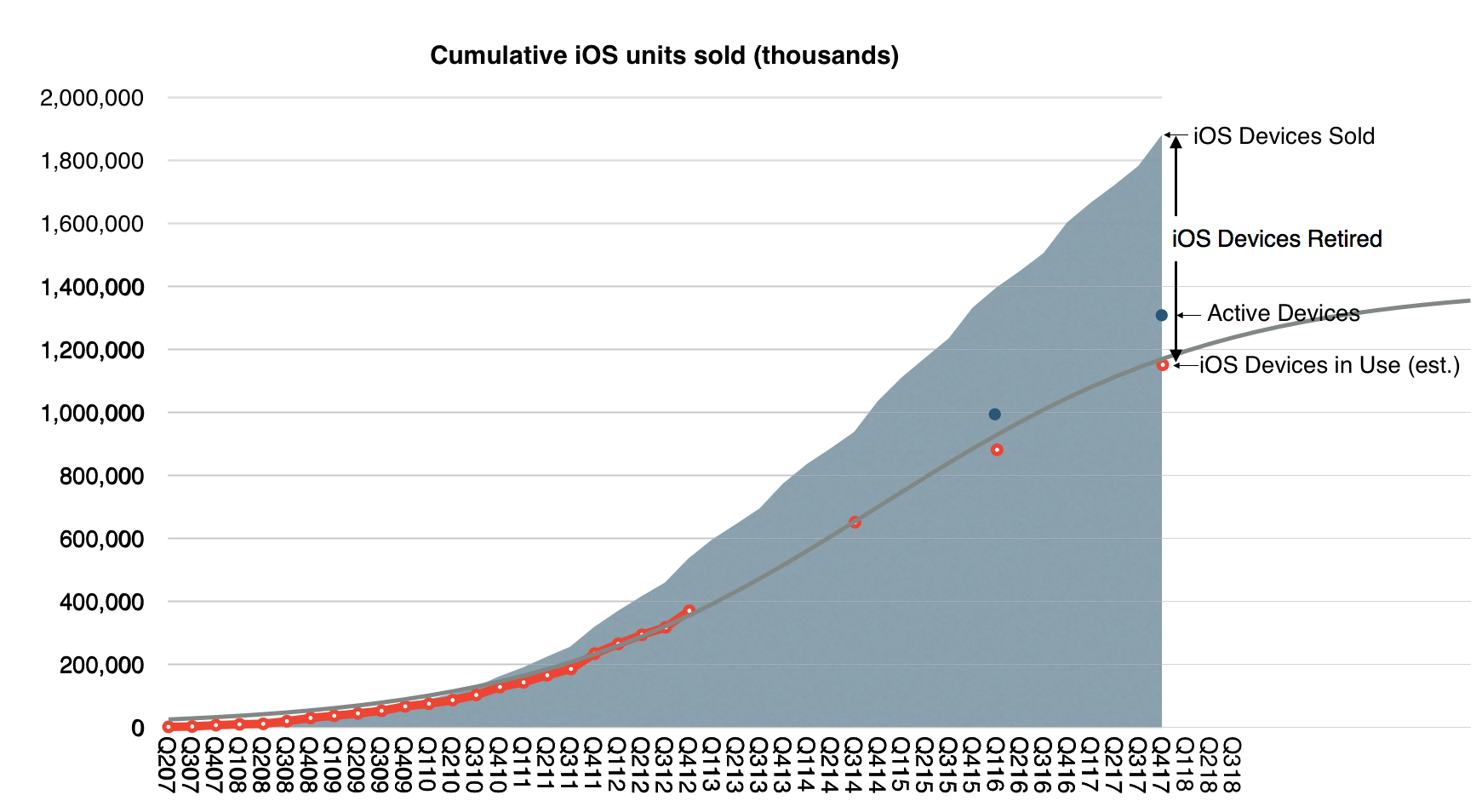
Apple's active installed base reached 1.3 billion devices in January and is at an all-time high for all of our major products. 1.3 billion devices represents an astonishing 30% growth in just two years. It speaks to the strength and reliability of our products and our ecosystem, as well as the loyalty, satisfaction and engagement of our customers. It's also fueling tremendous growth in our services business, which I’ll talk about a little later in the call. [This is probably Apple's most important number. For at least the next 20 years this is the key performance metric and it can be used to derive company's valuation. A summary of the history of active devices vs. units sold is shown in the graph below:]
Turning to the December quarter. We're thrilled to report Apple's biggest quarter ever, which set new all-time records in both revenue and earnings. We generated revenue of $88.3 billion, which is above the high-end of our guidance range, and it is up almost $10 billion or 13% over the previous all-time record we set a year ago.
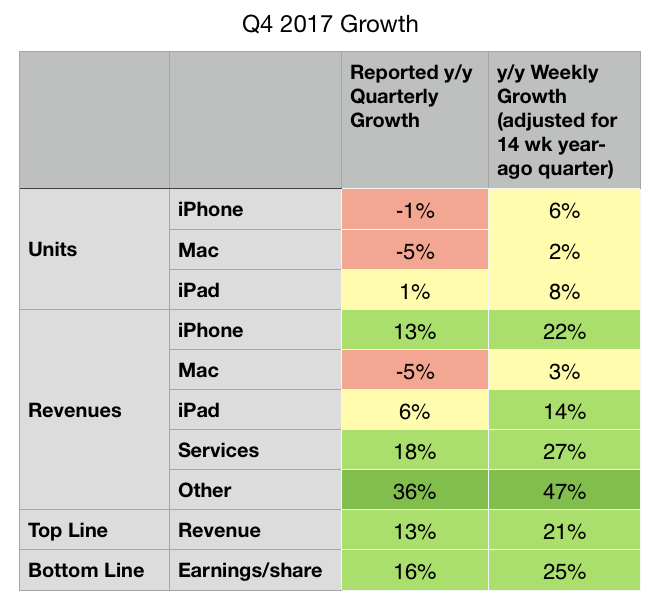
It's also our fifth consecutive quarter of accelerating revenue growth with double digit growth in each of our geographic segments around the world. What makes us even more remarkable is that the quarter we're reporting today was 13-weeks long, while the year ago quarter was 14-weeks. When we look at the average revenue per week in the December quarter this year compared to last year, our growth was a stunning 21%. [The 13-week vs. 14-week year-on-year comparison is repeated several times. The summary differences are shown in the table below:]
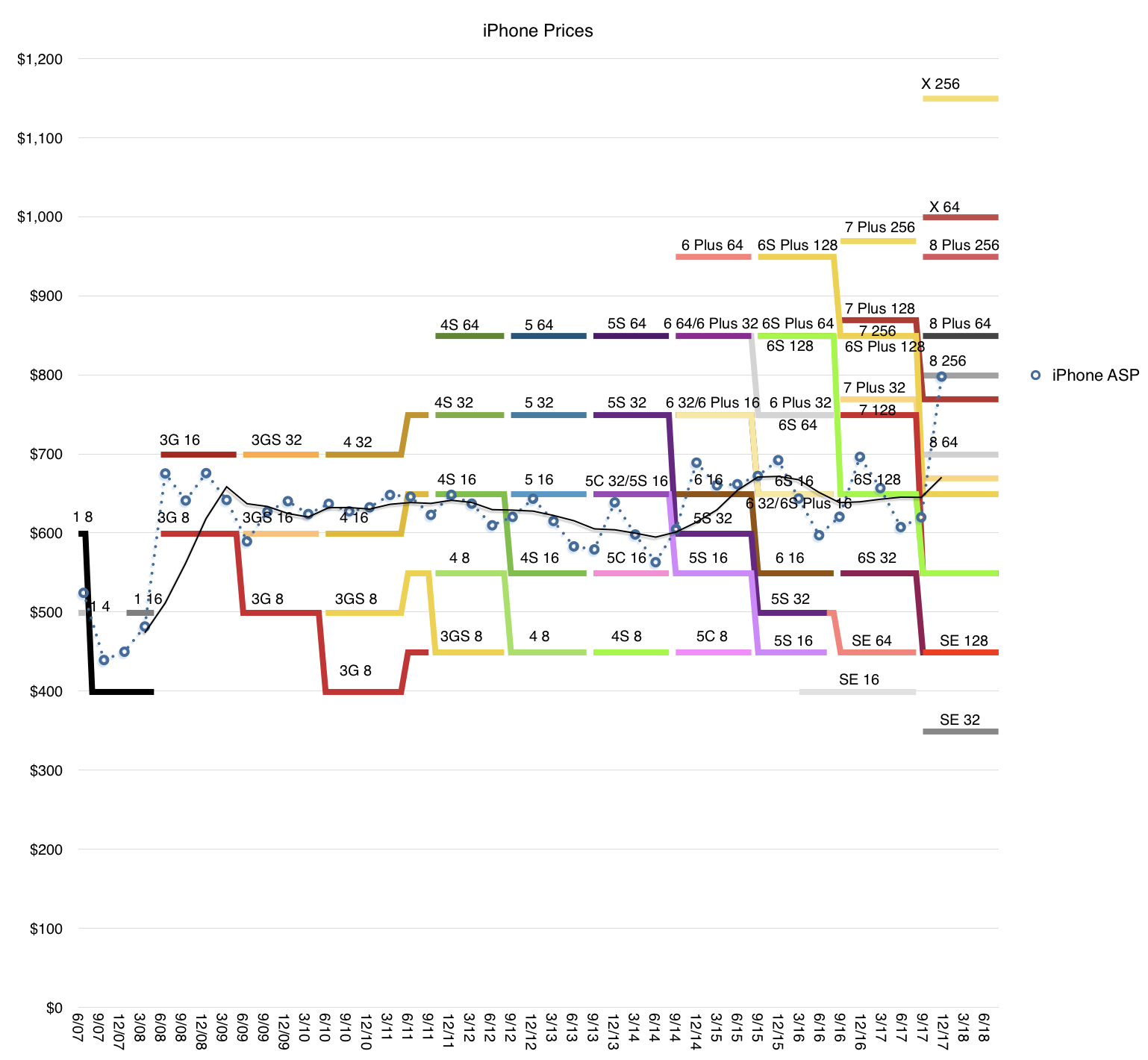
Our growth was broad-based and a key driver was iPhone, which generated its highest revenue ever. iPhone X was the best-selling smartphone in the world in the December quarter according to Canalys, and it has been our top selling phone every week since it launched. iPhone 8 and iPhone 8 Plus rounded out the top three iPhones in the quarter. In fact, revenue for our newly launched iPhones was the highest of any lineup in our history, driving total Apple revenue above our guidance range. [The iPhone X is a huge hit. It drove the average selling price $100 higher y/y. This is not only unprecedented for Apple but for the entire Industry. The average smartphone sells for less than $300 while iPhones sold for $800. The gap is widening. The following graph shows the product mix and the average resulting price.]
I want to take a moment to recognize the tremendous amount of work that went into creating iPhone 10. Our teams carried out an extremely complex launch from both an engineering and operations perspective, executing an outstanding product ramp that required years of research and development; one that introduced innovative features like an edge-to-edge Super Retina Display and the TrueDepth Camera, which enables face ID. Our customers love these new features and the new gestures like simply swiping up from the bottom, which make using iPhone even more intuitive and enjoyable.
Our team has put the technology of tomorrow in our customers’ hands today, set a standard for the next decade of smartphones and we are very proud of their achievements.
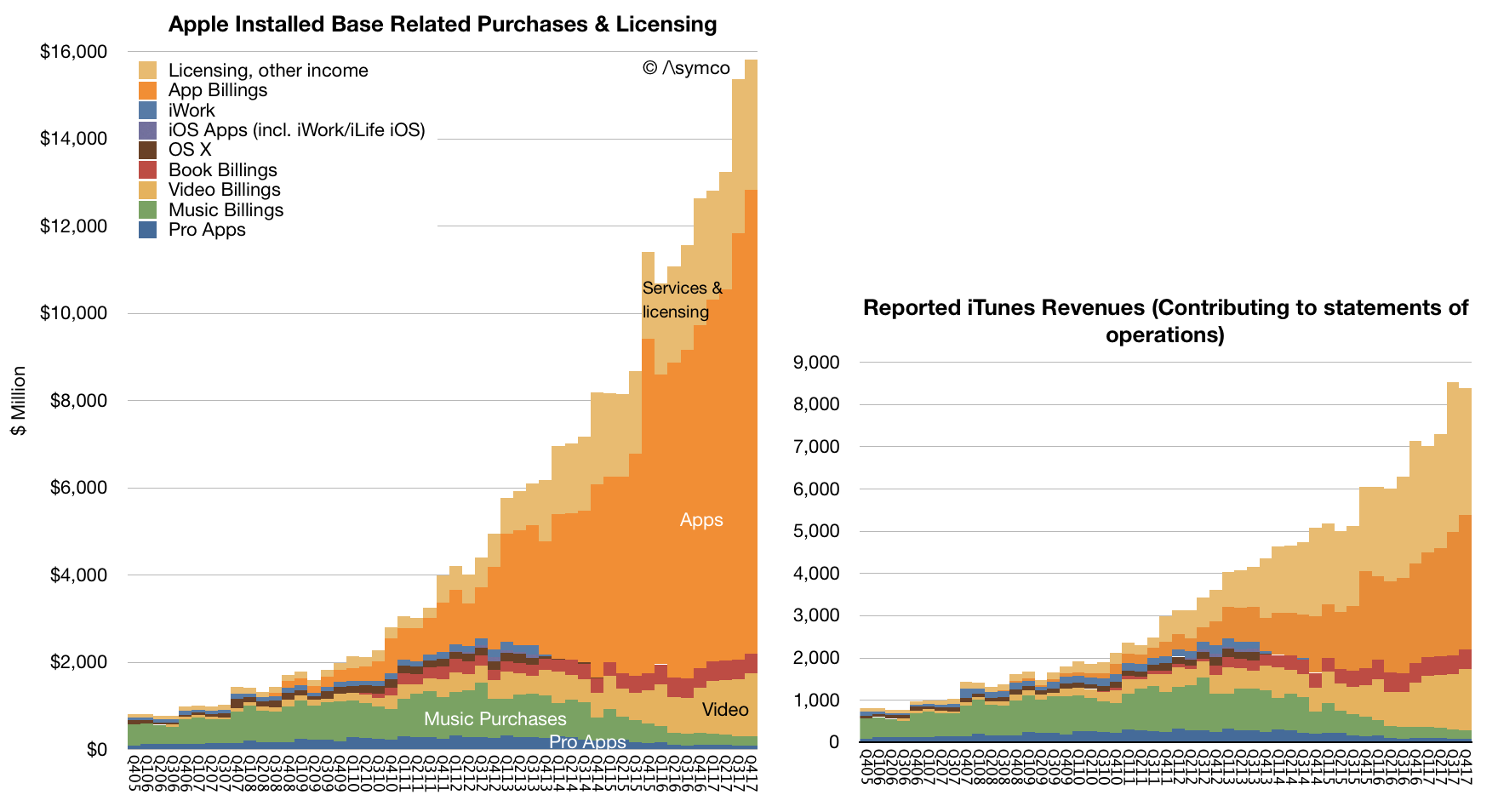
It was another very strong quarter for services with revenue of $8.5 billion, up 18% over last year, and we’re on pace to achieve our goal of doubling our 2016 services revenue by 2020. The number of paid subscriptions across our services offerings passed 240 million by the end of the December quarter, that’s an increase of 30 million in the last 90 days alone, which is the largest quarterly growth ever. [Services has been growing relentlessly for over a decade. This steadiness of growth makes is a juggernaut. Apple is increasingly speaking about subscriptions as the key metric and 240 million is reaching record territory. The rise of Services is shown below (both revenues and consumer spending.)]
We had an all-time record quarter for the App Store with our best holiday season ever. We’re seeing great excitement around augmented reality with customers now enjoying over 2,000 ARKit enabled app, spanning every category in the App Store. In December, when Pokémon GO released its new augmented reality features built with ARKit, it jumped the top of the App Store charts. Last week, on a stop in Toronto, I met developers who are hard at work on creative applications using ARKit from art appreciation to ecommerce, and I was very impressed with what I saw.
Just for months after ARKit launched to the public, we’ve already released ARKit 1.5 in beta to developers around the world, and the response has been tremendous. Augmented reality is going to revolutionize many of the experiences we have with mobile devices. And with ARKit, we’re giving developers the most advanced tools on the market to create apps for the most advanced operating system running on the most advanced hardware. This is something only Apple can do.
In addition to the App Store, several other services had their biggest quarter ever, including Apple Music, iCloud and Apple Pay, all of which saw growth in both active users and revenue.
Apple Pay has reached an important milestone in the U.S. As a result of 50% year-over-year growth in merchant adoption, it’s now accepted at more than half of all American retail locations, which includes more than two-thirds of the country’s top 100 retailers. Now available in 20 markets, global Apple Pay purchase volume more than tripled year-over-year and we’re delighted to be expanding to Brazil in the coming months. [There are no absolute data points on Apple Pay but we do have some scattered growth data. The US data is cited here but in my experience it's more popular in select countries like UK where users are using it habitually]
Today, you can use Apple Pay to take the subway in Guangzhou, China, see a concert at London’s Wembley Stadium or buy a souvenir in Yosemite National Park. In the U.S., we launched Apple Pay Cash in December, and it’s off to a terrific start. Millions of people are already using it to send and receive money with friends and family quickly, easily and securely; to split a bill, pay someone back, or send last minute gift right from the messages app.
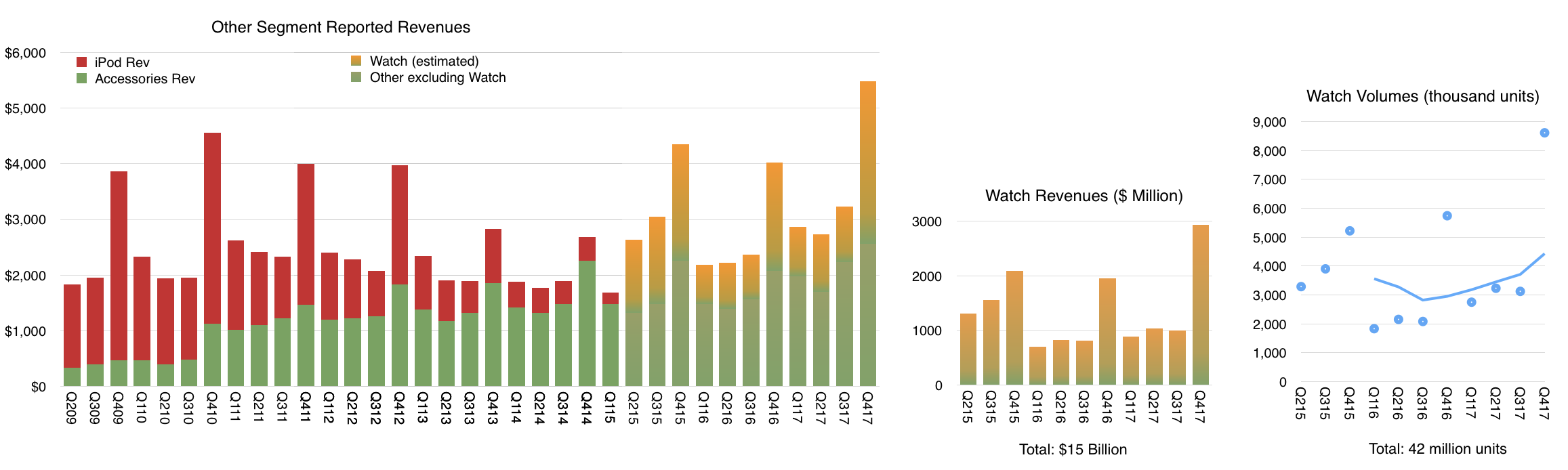
It was our best quarter ever for the Apple Watch with over 50% growth in revenue and units for the fourth quarter in a row and strong double-digit growth in every geographic segment. Sales of Apple Watch Series 3 models were also more than twice the volume of Series 2 a year ago. Apple Watch is the most popular, smart watch in the world and gained market share during the quarter based on the latest estimates from IDC. [Apple Watch is growing consistently. The following graph shows my estimates of volume (total 42 million to date) and revenues (total $15 billion) based on all available data and commentary from management.]
It was the third consecutive quarter of growth for iPad revenue, thanks to the strength of both iPad and iPad Pro. Based on the latest data from IDC, we gained share in nearly every market we track with strong outperformance in emerging markets.
Worldwide, almost half of our iPad sales were the first-time tablet buyers are those switching to Apple, and that’s true in some of our most developed markets, including Japan and France. In China, new and switching users made up over 70% of all iPad sales.
For Mac, we launched the all new, iMac Pro in mid-December. It’s an entirely new product line designed for our Pro users who love the all-in-one design of iMac and require workstation class performance. It's the fastest, most powerful Mac ever, delivering incredible computational power, for simulation and real time 3D rendering, immersive VR and complex photography audio and video projects. Worldwide, 60% of our Mac sales were the first time buyers and switchers and in China, that number was almost 90%.
We're looking forward to getting HomePod in customers’ hands beginning next week. HomePod is an innovative wireless speaker, which delivers stunning audio quality wherever its placed in the home, thanks to the advanced Apple engineered hardware and software.
Together with Apple Music, HomePod gives you instant access to one of the world's largest music catalogs. And with the intelligence of Siri, it’s a powerful assistant you control through natural voice interaction. We're very happy with the initial response from reviewers who've experienced HomePod ahead of its launch, and we think our customers are going to love this new product.
We believe one of the key issues of the 21st century is education. And because of that, we've strengthened our commitment and investment into initiatives like everyone can code. To find the innovators of the future, we need to nurture the students of today. Our App Development with Swift curriculum, which is available free on iBooks, has been downloaded more than 1.2 million times worldwide with almost half of those coming from here in the United States. It’s also being taught in dozens of community colleges across the country, putting practical skills in the hands of today’s jobs seekers.
I was in London two weeks ago as we announced that the program was expanding to more than 70 colleges and universities in Europe. Millions of students around the world will have the opportunity to add Swift to their coding vocabulary and gain skills that are essential for today’s economy.
This is an exciting time at Apple and with the best lineup of products and services we've ever had and a set of initiatives that show how business can be a force for good in the world. We could not be more excited about our future.
Now, for more details on the December quarter results, I'd like to turn over the call to Luca.
Luca Maestri: Thank you, Tim. Good afternoon, everyone. Our business and financial performance in the December quarter were exceptional, as we set new all-time records for revenue, operating income, net income and earnings per share.
Starting with revenue, we’re reporting an all-time record, $88.3 billion, up nearly $10 billion or 13% over the prior record set last year. It is our fifth consecutive quarter of accelerating revenue growth. As you know, the December quarter a year ago spanned 14-weeks compared to 13-weeks this year, which is important to consider as we have set the underlying performance of our business this year. When we look at average revenue per week, our growth rate was even higher at 21% with growth across all product categories for the third consecutive quarter.
Our results were terrific all around the world with double digit revenue growth in all our geographic segments, an all-time quarterly record in the vast majority of markets we track, including the U.S., Western Europe, Japan, Canada, Australia and Korea, as well as Mainland China, Latin America, The Middle East, Central and Eastern Europe, and India.
In Greater China, we were very happy to generate double digit revenue growth for the second quarter in a row and in emerging markets outside of Greater China, we saw 25% year-over-year growth.
Gross margin was 38.4% at the high end of our guidance range. Operating margin was 29.8% of revenue. Our net income was $20.1 billion an all-time record, and up $2.2 billion over the last year. Diluted earnings per share were $3.89 also an all-time record and cash flow from operations was very strong at $28.3 billion.
During the quarter, we sold 77.3 million iPhones, the highest number ever for a 13-week quarter. Average weekly iPhone sales were up 6% compared to December quarter last year with growth in every region of the world despite the staggered launch of iPhone 10. We established all-time iPhone revenue record in nearly every market we track with double-digit growth in all of our geographic segments. iPhone ASP increased to $796 from $695 a year ago, driven primarily by the launch of iPhone 10 and the success of iPhone 8 and 8 Plus.
We exited the December quarter towards the lower end of our target range of five to seven weeks of iPhone channel inventory with less than 1 million more iPhones in the channel compared to the December quarter a year ago, in line with our growth in average weekly unit sales. Customer interest and satisfaction with iPhone are very, very strong for both consumers and business users.
The latest data from 451 Research indicates U.S. customer satisfaction ratings of 96% or higher across iPhone models. In fact, combining iPhone 8, iPhone 8 Plus and iPhone 10, consumers reported an amazing 99% satisfaction rating. And among business customers planning to purchase smartphones in the next quarter, 77% planned to purchase iPhone. Our customers are also incredibly loyal with Kantar's latest U.S. research, reflecting a 96% iPhone loyalty rate, the highest ever measured. [Customer satisfaction is the second most important figure after active user base. Combining these two figures yields the recurring revenue value of the company. Remember what Deming said: the most important measurements for a company's value are the multipliers of a satisfied customer and a dissatisfied customer--these numbers never appear on any financial report but they are applied to all the numbers on every report].
Turning to services. We had a terrific quarter with revenue of $8.5 billion, up 18% year-over-year and up 27% in terms of average revenue per week; that is an acceleration to the 24% services growth run rate that we experienced in the September quarter.
The App Store set a new all-time revenue record. The Store’s all-new design is off to a fantastic start with quarterly store visitors, transacting accounts and paying accounts, reaching new all-time highs. During the week beginning December 24th, a record number of customers made purchases or downloaded Apps from the App Store, spending over $890 million in that seven-day period, followed by $300 million in purchases on New Year’s day alone.
And according to App Annie’s latest report, the App Store continues to be the preferred destination for customer purchases by a very wide margin, generating nearly twice the revenue of Google Play. Across all our services offerings, paid subscriptions reached $240 million with growth of 58% over last year and they were a major contributor to the overall strong growth in services revenue. [Apple has half the user base of Google Android. This is based on Google's May 2017 report of 2 billion active devices vs. the 1.3 billion that we just got from Apple. And yet these users collectively spend twice as much on apps. This ratio of "half the users, twice the spending" has been cropping up in individual developer anecdotes and can also be seen in other metrics of engagement and consumption. This should not be surprising as it conforms to the Pareto distribution of economic value.]
As Tim mentioned, it was our best quarter ever for Apple Watch. And when we add to this us from Beats and AirPods, our total revenue from wearables was up almost 70% year-over-year. In fact, wearables were the second largest contributor to revenue growth after iPhone, which is impressive for a business that started only three years ago. In total, our other products category set a new all-time record with quarterly revenue exceeding $5 billion for the first time. [Wearables now includes more than watches but watches are likely still the dominant product.]
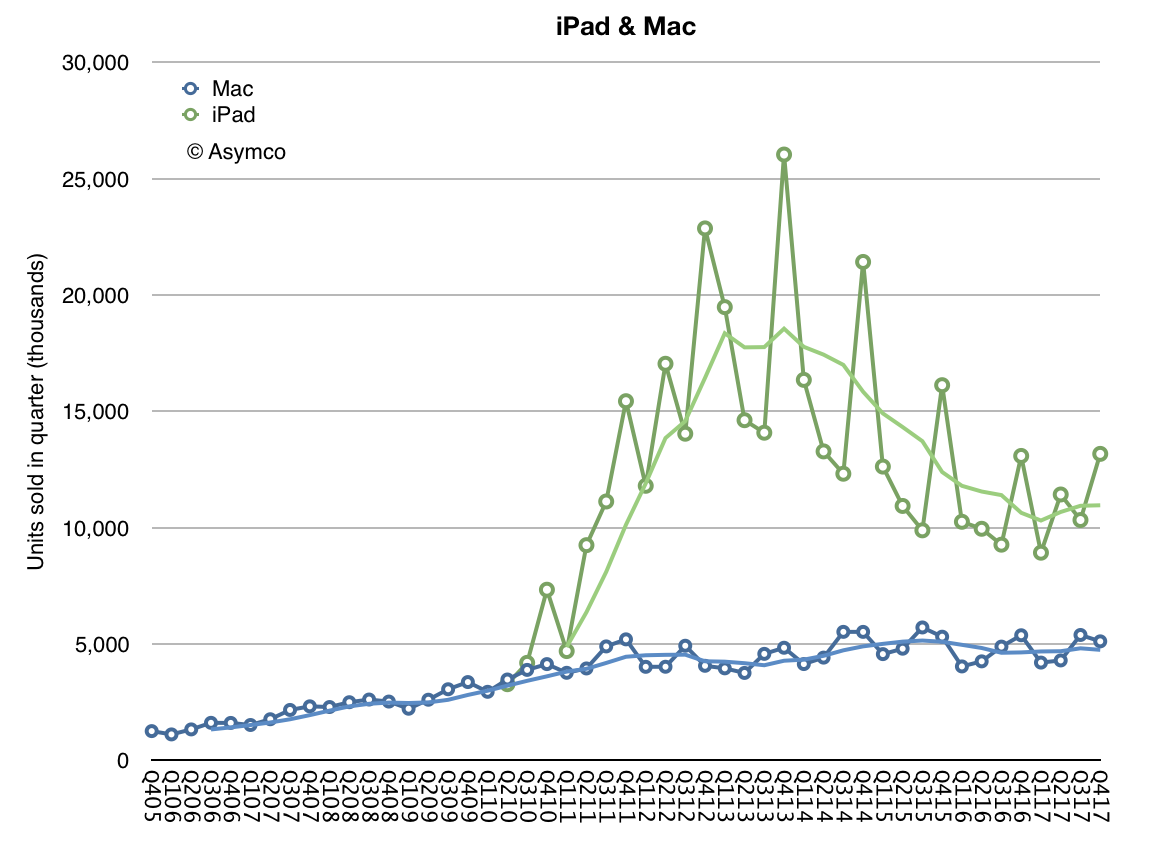
Next, I’d like to talk about the Mac. We sold 5.1 million Macs during the December quarter, which translates to a 2% year-over-year increase in average sales per week. Mac performance was particularly strong in emerging markets with unit sales up 13% year-over-year and with all-time records in Latin America, in India, Turkey and Central and Eastern Europe. On a worldwide basis, the active install base of Macs was up double-digits year-over-year to a new record.
It was also another growth quarter for iPad. We sold 13.2 million units with average iPad sales per week up 8% over last year’s December quarter. iPad sales grew strong double-digits in many emerging markets, including Latin America, the Middle East, Central and Eastern Europe and India, as well as developed markets, including Japan, Australia and Korea. The active install base of iPad has grown every quarter since its launch in 2010, and it reached a new all-time high in December, thanks to extremely high customer loyalty and large numbers of first-time iPad users. [iPad is clearly recovering from a long decline. ASPs are rising as it's being positioned as a PC alternative. Its low end functions are being absorbed by large screen iPhones.]
NPD indicates that iPad had 46% share of the U.S. tablet market in the December quarter, up from 36% share a year ago. And the most recent surveys from 451 Research found that among customers planning to purchase tablets within 90 days, 72% of consumers and 68% of business users planned to purchase iPads. Customer satisfaction is also very high with businesses reporting a 99% satisfaction rating for iPad.
We are seeing great traction in enterprise as businesses across industries and around the world standardize on iOS. For example, Intesa Sanpaolo, one of Europe’s leading banks, has chosen iOS as the mobile standard for its entire 70,000 employee base in Italy; choosing iOS for its security, user interface, accessibility and reliability, Intesa Sanpaolo will deploy native apps to improve employee productivity in customer support, human resources, and marketing across the company.
And LensCrafters, one of the largest optical retail brands in North America, will be using over 7,000 iPad Pros to enable digital eye exams and digital optical measurements in a personalized and interactive experience. We’re also rolling out a new initiative, called Apple AtWork to help businesses implement employee choice programs more easily and offer Apple products company-wide.
Resources from both Apple and our channel partners will enable enterprise IT and procurement teams to buy or lease Apple products more efficiently, streamline the setup of iPhone, iPad, and Mac, and deliver a seamless onboarding experience for employees. We launched the program with CDW in the U.S. last week, and we would be expanding to more channels and regions later this year.
The December quarter was extremely busy for our retail and online stores, which welcomed 538 million visitors. Traffic was particularly strong during the four-weeks following the launch of iPhone 10, up 46% over last year. And across the quarter, our stores conducted over 200,000 today at Apple sessions, covering topics including photography, music, gaming, and app development, and art and design. Just last weekend, we opened our first store in Seoul, Korea and we’re looking forward to opening our first store in Austria in a few weeks. These newest openings will mark the expansion of our retail store presence to 21 countries.
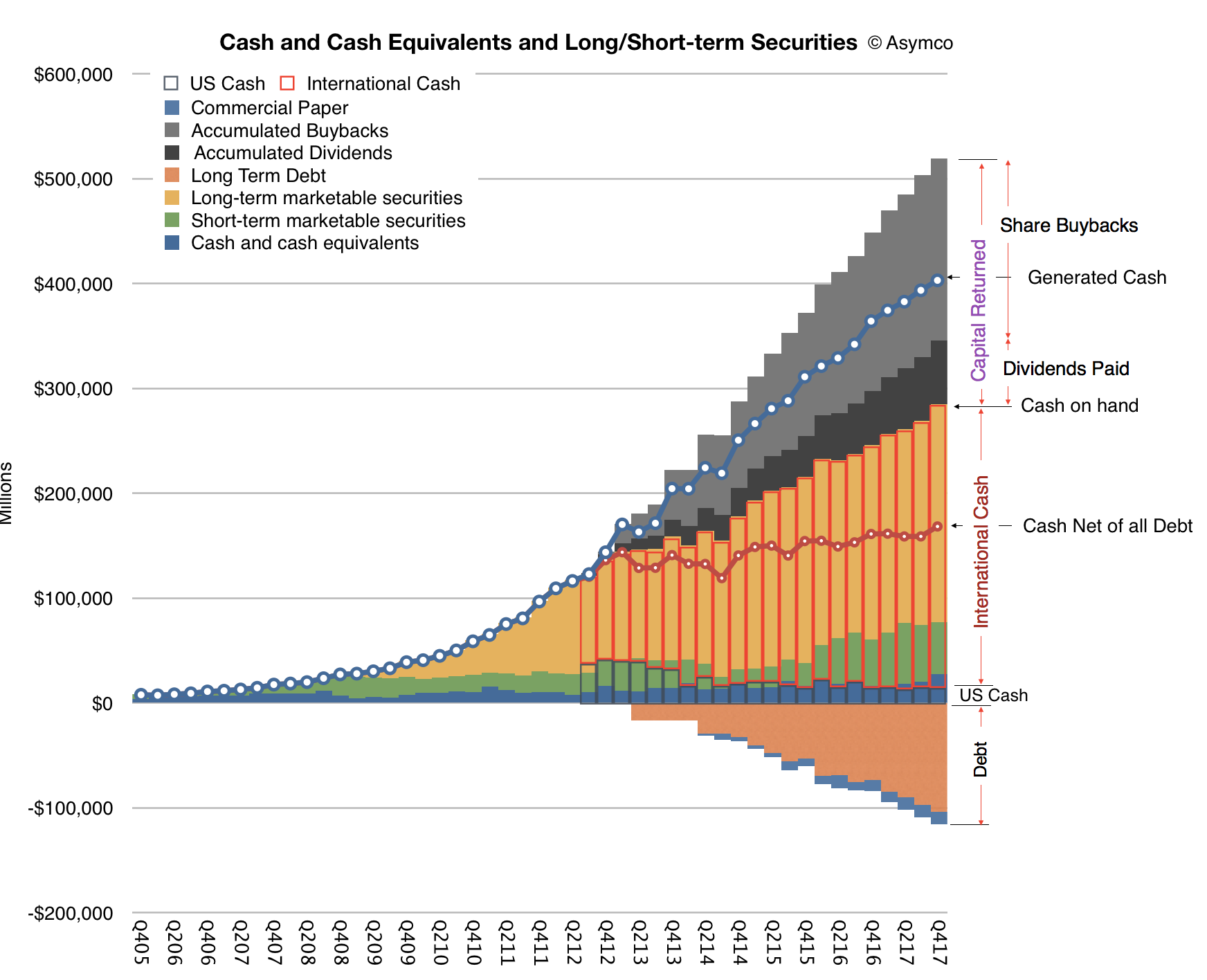
Let me now turn to our cash position. We ended the quarter with $285.1 billion in cash plus marketable securities, a sequential increase of $16.2 billion. $269 billion of this cash, or 94% of the total, was outside the United States. We issued $7 billion in debt during the quarter, bringing us to $110 billion in term-debt and $12 billion in commercial paper outstanding, for a total net cash position of $163 billion at the end of the quarter. We also returned $14.5 billion to investors during the quarter. We paid $3.3 billion in dividends and equivalents, and spent $5.1 billion on repurchases of 30.2 million Apple shares through open market transactions.
We launched a new $5 billion ASR program, resulting in initial delivery and retirement of 23.6 million shares and we retired 3.8 million shares upon the completion of our 12th ASR during the quarter. We’ve now completed over $248 billion of our $300 billion capital return program, including $176 billion in share repurchases against our announced $210 billion buyback program with $34 billion remaining under our current authorization. [An updated look at Apple's cash is shown below]
Turning to taxes. Due to the recently enacted legislation in the U.S., we estimate making a corporate income tax payment of approximately $38 billion to the U.S. government on our cumulative past foreign earnings. This amount is very similar to what we had been accruing on those earnings in our financial results through fiscal year 2017, including the $38 billion payment. We will have paid over $110 billion of corporate income tax on our total domestic and foreign earnings during the last 10 years for a cash tax rate of about 26%. [Apple has paid more tax than any company in history, and is about the make the largest single payment to the US Treasury.]
Our tax rate of 25.8% for the December quarter was close to our guidance of 25.5% as the lower U.S. statutory rate from the new legislation was effective offset by the remeasurement of deferred tax balances.
As we move ahead into the March quarter, I'd like to review our outlook, which includes the types of forward looking information that Nancy referred to at the beginning of the call; we expect revenue to be between $60 billion and $62 billion; we expect gross margin to be between 38% and 38.5%; we expect OpEx to be between $7.6 billion and $7.7 billion; we expect OI&E to be about $300 million; and we expect the tax rate to be about 15%.
Tax reform will allow us to pursue a more optimal capital structure for our company. Our current net cash position is $163 billion. And given the increased financial and operational flexibility from the access to our foreign cash, we are targeting to become approximately net cash neutral overtime. We will provide an update to our specific capital allocation plans when we report results for our second fiscal quarter, consistent with the timing of updates that we have provided in the past.
Finally, today our Board of Directors has declared a cash dividend of $0.63 per share of common stock, payable on February 15, 2018, to shareholders of record as of February 12, 2018.
I will be presenting my latest analysis of Apple at the Sustain event in San Francisco on Thursday Sept 8th, the day after Apple's keynote, along with Ben Bajarin, Carolina Milanesi who will alsob equipped with their latest market insights.
There is a time to disrupt and there is a time to sustain.
Sustain event is about understanding Apple's levers of control to sustain the iPhone as it moves into direct competition with Android. We will also examine positions of top five technology brands: Apple, Amazon, Facebook, Google, and Microsoft.
We are ready to roll out Airshow 2.0, a redesigned curriculum for motion-based data presentations.
Three years ago, we created the Airshow concept as a study of how stories come alive using data. We drew inspiration from cinematography and combined with the work of Welles, Tufte and Rosling to build a new theory of presentations. We offered explanations of:
How and why are presentations different from one-on-one interactions?
Will new user interface metaphors such as touch help tell stories better than the slide advance clicker?
Are motion and interaction an effective ways to present? If so, how are they to be choreographed and directed?
How does “camera position” affect a data story?
Since that initial concept, we have learned far more.
Airshow 2.0 moves beyond executing a story in pixels to the writing and directing process. As before, we teach using the process itself: through stories presented as data.
Some say that advertising keeps the internet lights on. Advertising is a great business model for services but it has limits. There are only so many ad budgets to go around. What will fuel an internet that outgrows all the ad money in the world?
This is the topic that Ben Bajarin and I will explore in our next event: SUBSCRIBE: The Future of Online Services.
We will explore:
How will the online services business models evolve?
How will VR affect entertainment and communications?
How will AI affect shopping?
How will blockchain affect economics?
How will hardware affect software and services and vice versa?
How will users, usage, and capital connect?
Join us to learn more about the internet economy by studying the economics of the internet.