Asymco

Asymmetric Intelligence

Latest from Asymco

  1. The best worst case scenario

    Research · 4 comments

    Measuring bundle strength to estimate potential for iPhone disruption

    A fasces, from the Latin word fascis, meaning 'bundle' is a bound bundle of wooden rods, often including an axe with its blade emerging. The fasces is an Italian symbol that had its origin in the Etruscan civilization and was passed on to ancient Rome. Its core message is that a single rod is easily broken, but a bound bundle is unbreakable. Thus it is the symbolic version of the phrase united we stand, divided we fall .

    The iPhone was introduced as a bundle: an iPod, a Phone and an Internet Communicator. It went on to bundle a camera, a game console, an email client and literally thousands of other functions which used to be separate products. A calendar, a flashlight, a magnifying glass, a measuring tape, an emergency beacon, all the world's maps, travel assistant, shopping and food delivery, etc. Many of these components created empires for the developers who built them, building separate markets unto themselves.

    The competitive analysis for the iPhone was always about another bundling option in the form of an Android phone. That platform offered to do all the same things, at perhaps a lower price point or a more diverse choice of devices.

    However that competition failed to make a dent in the iPhone. To date, the iPhone continues to grow both in user base and in product variety and price points. Swithing from Android to iPhone is still more common than the alternative.

    But lately, a new competitive thesis has emerged: that of the AI enabled device which is simply an agent that is asked to do things.

    Muse from Meta is the latest example, though we've seen similar arguments for Alexa, Humane, or a future possible set of devices from OpenAI. Less well known are Rabbit R1: A pocket-sized AI hardware device designed to handle tasks and app interactions without a traditional smartphone screen. Smart glasses like those from Meta but also from Solos that integrates artificial intelligence, audio features, and language translation directly into glasses. Abeye: Smart eyewear developer known for health- and wellness-focused optical products like Lexilens and Spectalert.

    Then there are AI-Enhanced Smartwatches: Various next-generation smartwatches and voice-first wristwear serving as screen-light alternatives to standalone AI pins.

    The premise is that if you can ask a microphone-enabled device for anything, it would answer (or act) and it won't need a screen even to interact with. The device is just a passive wearable or even embedded in the environment. Just speak and it will recognize your intent and act.

    The idea is that if you had one of these, you would not need a phone anymore.

    To put it another way, these devices would unbundle the iPhone. They would take a subset of the uses for the product, carve those away and "steal" usage time/cycles/attention into a new platform.

    This is similar to how the original BlackBerry stole usage from computers. They took messaging, initially in the form of short emails, at a time when messaging did not exist as a standalone technology. By stealing messaging, usage of computers shrank to uses that were slow response only. The foothold of messaging arguably anchored the smartphone category.

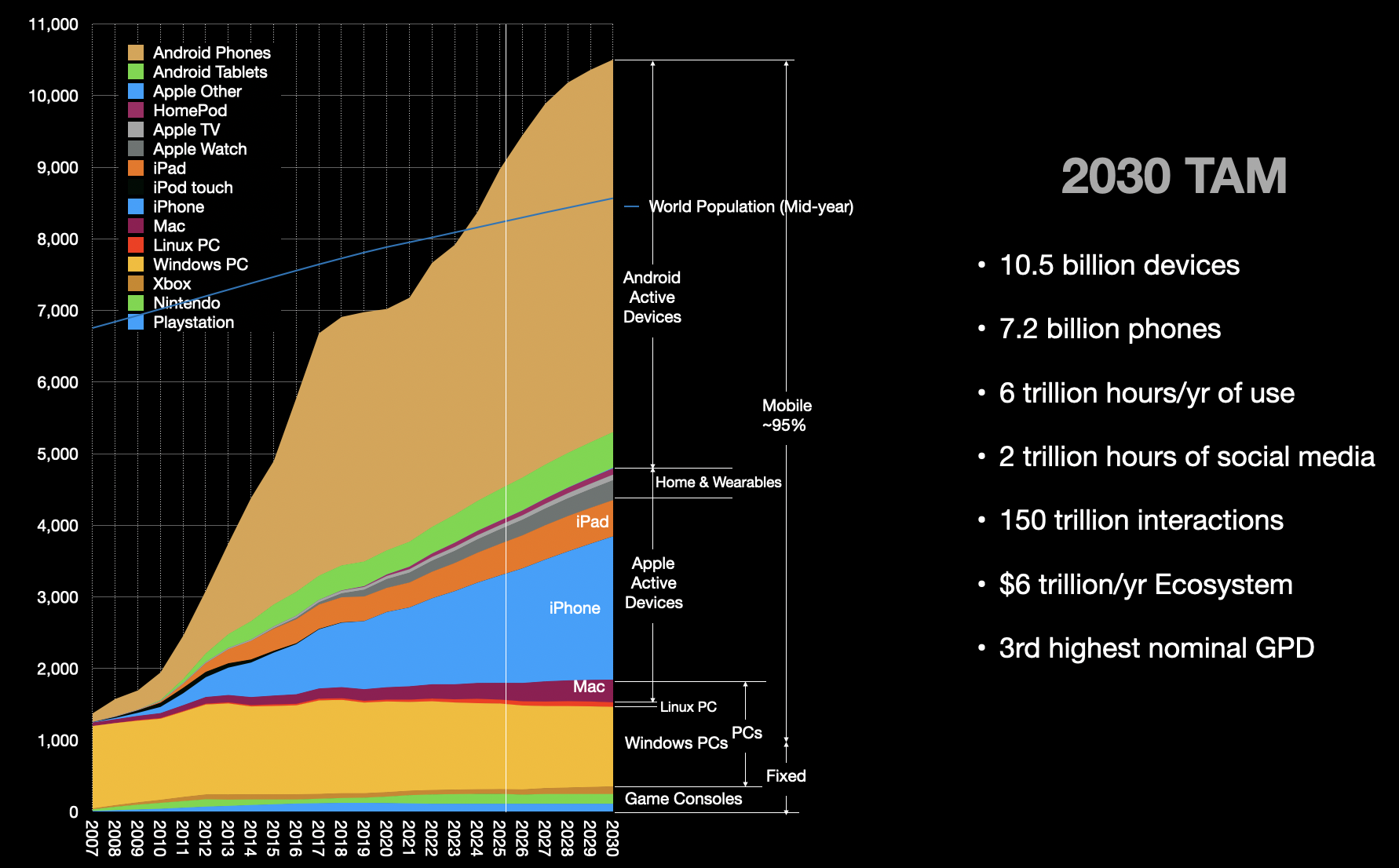
    However, eventually the smartphone grew into more and more capabilities and created its own. I mentioned photography and video but also social media itself, now consuming trillions of hours.

    But will AI devices really unbundle the phone?

    Clearly the phone can do what the AI tchotchke aims to do. Indeed so can the Apple Watch, iPad, Apple HomePod (and whatever is announced for the home). The idea that an internet-enabled microphone replaces the iPhone is not because the iPhone cannot do what the microphone can do. Nobody has more smart microphones in use that Apple.

    The premise for unbundling is that the less-able alternative, focused on one task only, will be more convenient, much cheaper and delightful to use than the bundled alternative.

    But assuming you do have a dongle that listens, what will you do about your social media habit, your camera, your messaging, your entertainment and all your digital life?

    The answer would need to be that the trinket "grows up" into a phone in the future. That is, that at first it seduces with voice but eventually delivers on visuals.

    That's a tough sell since the iPhone is not standing still. Apple is not averse to building delightful wearable devices. I expect we'll see home and vision line-ups that expand on the audio wearables (AirPods) and watches. These are best-in-class and have the polish that only Apple can deliver.

    To date, the premise was that the newcomers will be "better at AI" but here the race is one with commoditization. Apple can just pick the winners or the pieces once the market shakes out. AI is software and software alone has never been a strong business model. It's too easy to replicate, rebuild, remake, rebadge, redesign.

    The argument that the AI agent unbundles the phone is only the latest in a long list of bundle challengers. Although bundling and unbundling are two great ways to enable disruption, it's not an easy thing to pull off.

    I've had my share of attempts to unbundle the automobile but it's far tougher than just imagining it or realizing that it's necessary. The problem with the (un)bundling theory is that there is no clear way of predicting the strength of the bundle. Or the strength of the component separate from it.

    In the case of the car, the bundle is strong because of externalities such as infrastructures. In the case of the iPhone the bundle is strong because the object is dynamic, changing rapidly, diverse, with wearable accessories, part of network exhibiting network effects and has high value and satisfaction.

    Measuring the strength of a bundle and its resilience to unbundling would be a very interesting topic to research.

  2. Why do phones have cameras?

    Research · 6 comments

    Or, why do cameras have phones?

    In a retrospective on the iPhone Uno, I noted that the iPhone was launched with three "tentpoles:" a widescreen iPod, a Phone and an Internet Communicator. Effectively, a music player, telephone, and browser. All in one device. This positioning in 2007 bundled what were considered to be individual products: an iPod, a Phone and a laptop. By bundling these, value would be created in not having to select which you would take with you at any given time. You would have all three with you always.

    I then noted that none of these tentpoles were the most popular uses for the product today.

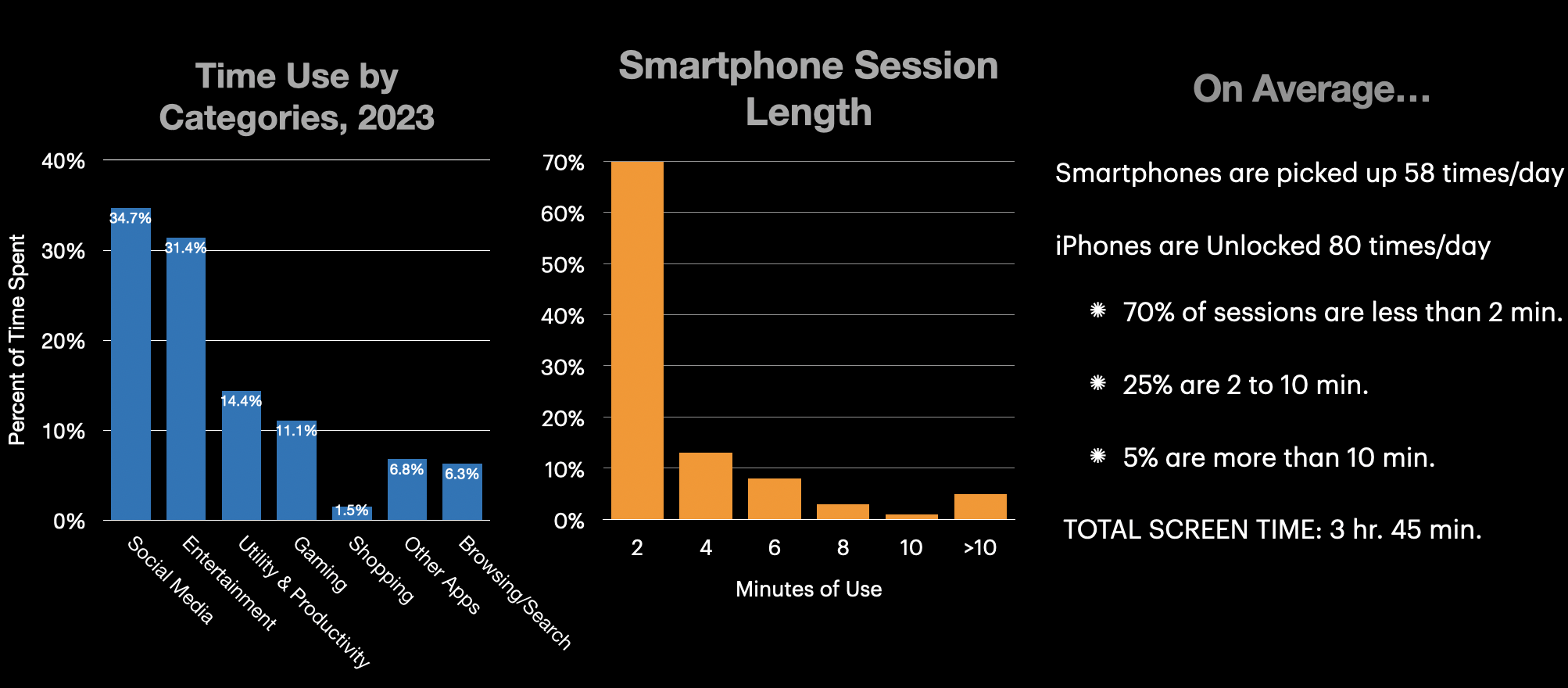
    Social media and entertainment are by far the most popular, followed by utiliy/productivity and finally gaming to round out the top four uses. You can check your own usage patterns using the Settings app on your iPhone.

    By checking Pickups you can also see the time division of usage. On average, smartphones are used in a log-normal distribution with the most common time being less than 2 minutes. The number of pick-ups and their distributions add up to almost four hours of use per day.

    Based on this analysis, it would seem that the iPhone developed in ways unforeseen by its creators. Most of these activities did not exist on phones at all. There were games and there were messages and perhaps a bit of email but phones were mostly used for phone calls. Today, phone use does not usually show up in the top 10 activities.

    The lesson is that truly transformative products create their own demand and their own use cases. You must be humble in your assumption of how buyers will use the product and also provide a platform for new use cases to be created by third parties. Apple did not create social media apps or games or YouTube for the iPhone. It enabled them.

    But one thing missing from this analysis is the camera. Whereas Apple invested in development of a better screen and processor and storage and services to support the apps to became the "killer" apps, it disproportionately invested in the camera.

    Consider the latest iPhone 18 Pro. The cameras are the most prominent design element, shown in all photos of the product. The obverse of the camera view has no distinguishing feature. Cameras are featured as the primary differentiation of the product in advertising. "The ultimate performance and camera of any iPhone." The tentpoles of the iPhone 18 Pro are: 48MP, variable aperture, f 1.48 lenses. The copy reads: "48MP Fusion Main camera with variable aperture. Improved low-light photos and video. Impressive depth of field."

    The latest cameras on the iPhone make it beyond good enough for professional use. It is very capable as the only camera a video or still photographer would need to earn a living. For the consumer it seems to over-serve by a mile.

    But the camera is not what appears in the usage logs and is in a different world from the original tentpoles.

    So why does the iPhone have a pro camera? Why is photography even something to consider in a phone.

    When we look back, the idea of a phone with a camera was only put on the market in 19991. First seen in Japan, it was popularized by Nokia and by the time the iPhone launched it was already considered normal to have camera in a phone. It was no longer a "camera phone" but just a phone.

    By 2007 disruption of traditional cameras was already underway. Digital photography moved quickly to displace analog or film photography. Point-and-shoot cameras quickly overtook every category and DSLRs had been booming. However, phones with cameras quickly overtook all others and the number of photos taken by them exploded by multiple orders of magnitude. Use in messaging, cloud storage and then social media itself came to embody photography.

    New social media emerged around photos: Snapchat, TikTok, YouTube and Instagram were image-first social media while Facebook came to embody it. Now it's hard to see any social media content which is text only.

    In that way, the social media category became an "imaging" category. The camera's improvements were social media improvements.

    Today's pro cameras are used to allow amateurs to appear pro in their posts. The value is in allowing a billion people to become both models and fashion photographers. Vanity is a bigger business than productivity.

    But throughout this period Apple was not valued for being a vanity enabler. Its products and users were measured with dollars and gigabytes. Even today there is no "vanity market share" for iOS or Android. The contrast between what we measure and what people buy could not be greater.

    It behooves the investor to understand this.

    Jobs to be done theory helps explain what is happening. The jobs buyers hire phones for are very numerous. It's not one thing, it's many. So many that we cannot enumerate them. A common theme that runs through the data however is that the iPhone is an indispensable social construct. It is, for better or worse, the medium for communication and that embodies all human frailty.

    The segmentation by the seven deadly sins holds.

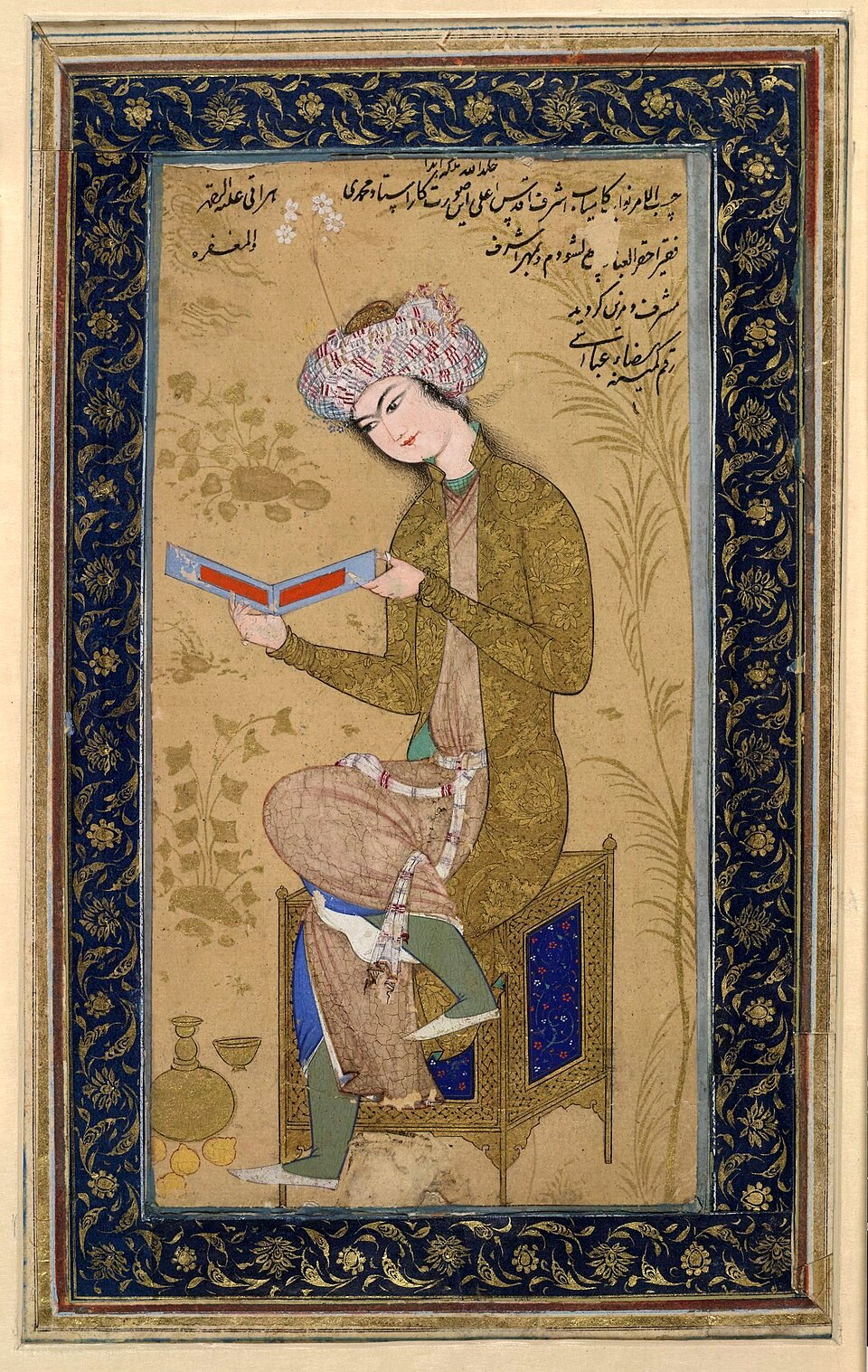
    This is not a biblical construct. The fourth-century monk Evagrius Ponticus (pictured above) reduced the forms of temptation to eight (in Greek), Evagrius's list was translated into the Latin of Western Christianity in writings of John Cassian, one of Evagrius’s students; the list thus became part of the Western tradition as follows:

    Avaritia (greed, avarice)
    Tristitia (sorrow, despondency)
    Ira (wrath)
    Acedia (sloth)
    Vanagloria (vanity)
    Superbia (pride)

    Most of the activities on Social Media fall into these categories and Vanity and Pride clearly are enabled by the cameras.

    The value of each of the "sins" or perhaps more euphemistically "temptations" is missing but I'd venture to guess that Vanity and Pride are worth at least $1 trillion in market capitalization.

    1. The first commercial camera phone was the Kyocera Visual Phone VP-210, released in Japan in May 1999
  3. iPhone 18 Pro demand jumps nearly 20% in India, rises 12% in China

    Nota Bene · 6 comments

    As prices rose, demand among 2.5 billion consumers rose

    iPhone 18 Pro is estimated to have had a 12% y/y sales increase in its first week on sale in China, placing first in weekly smartphone rankings, according to Counterpoint Research.

    Though the iPhone 18 Pro was only available for only three days, Apple took about 33% of share that week.

    Overall China’s weekly smartphone sales fell at a double-digit year-over-year pace since July. Overall sell-out in Week 38 was still about 17% below the same week a year earlier.

    Meanwhile in India, demand for the iPhone 18 Pro has risen by nearly 20% compared with the iPhone 17 Pro at the same point last year.

    The iPhone 18 lineup went on sale on September 18 and drew long lines in major cities. Some customers traveled for hours to reach Apple Stores in places such as Mumbai, with waits stretching as long as 10 hours.

    Counterpoint Research director Tarun Pathak expects Apple’s volume market share in India to reach 10% in 2026 — the company’s first full calendar year in double digits. That would represent a sharp rise from just 4% in 2022.

    The base iPhone 18 Pro costs the equivalent of about $1,700 in India.

    As iPhone sales grew, makers of lower-priced smartphones reportedly saw a sharper decline this year.

    Anyone see a pattern?

    Let's look at the data.

    The iPhone 18 Pro Density of pixels reduced for a portion …

    for IR sensors in order to support a 25% reduction in the size of the Dynamic island. It has much better thermal performance due to a new vapor chamber architecture. It has a 48MP variable aperture camera with a minimum of f 1.48. The battery life is greatly improved.

    The Pro allows truly professional photography.

    So why did the Phone do so well in India?

    Are we to believe Indians have been clamoring for better vapor chambers and f-stop?

    If we just look at what Apple itself promotes about the product or the cynics who know the price (but not the value) of the product, there are no clues. If we listen to the market analysts they say things like:

    'but that dip was attributed to supply constraints rather than fading demand. Sales had otherwise grown for four years.

    India is also becoming a more important manufacturing base for iPhones, and recent tax breaks could further strengthen Apple’s position. The current surge in iPhone 18 Pro demand suggests Apple’s high-end strategy is connecting with aspirational buyers, though the company will need to keep balancing premium pricing with accessible payment options if the momentum is to last.'

    Neither the feature set analysis nor the market mechanicals explain why the iPhone is growing while the market is shrinking in a market defined by lower incomes and higher share from low-end competitors.

    The missing data is that there are millions of middle and upper income individuals in a population of 2.5 billion (nearly one third of humanity), even if they are in India and China (or even in Africa.) The iPhone is an aspirational product with an enormous amount of utility. Luxury goods do well in emerging markets, as long as there is a sense of prosperity that is growing. But they will pull back in times of anxiety. Apple's products are not luxuries. They embody necessity and are used continuously throughout the day, and every day as long as they are owned.

    Apple has a remarkable position and one wonders how well this is known inside the company while remaining unknown outside.

  4. The best selling product of all time

    Research · 1 comment

    Measuring the iPhone Uno

    Ten years ago, I noted that the iPhone was the most popular product of all time. At the time, it had just crossed 1 billion units sold. This exceeded the quantities of other categories I considered comparable. In the comments there was a furious debate on whether I was measuring popularity correctly. In my defense I pointed out that consumables should not count, nor free products or pieces of content. By the metrics of 2016, I argued, one billion sold exceeded any of the other candidate 'bestsellers'. And it wasn't even one thing...

    The iPhone is not only the best-selling mobile phone but also the best-selling music player, the best-selling camera, the best-selling video screen and the best-selling computer of all time.

    I noted that it did all that in less than nine years and challenged readers to wonder what it will do in the next nine.

    Well, wonder no more.

    Since then, another 2.4 billion iPhone have been sold. That is to say, after becoming the all-time best-seller, it accelerated to sell at 2.5x the previous run rate. Moreover, the first billion iPhones sold for an average price of $655 while the next 2.4 billion sold for $780 each.

    To date, iPhone revenues have totaled $2.5 trillion.

    One can again argue whether there are better candidates for "best-seller" but it would be futile. Not because of the quantity sold, nor because of the value created but because of the consequences of these sales. Quantities can be measured, qualities can't.

    The iPhone changed culture and behavior. It's become an indispensable utility. It is infrastructure. And with anything so consequential, its value is hard to measure.

    For this reason I'm always surprised by the discussions around pricing. The idea that users won't spend more than $x for a "phone" as if it were a discretionary expenditure. As the Covid period showed, these products are not nice to have. They are must-haves.

    The utility has only increased: over 100 "pickups" per day, over 4 hours of use per day, over 5 billion (including ersatz iPhone) users. Trillions of Services and activities are built around it. And it's not finished growing.

    That means that it's the most used product of all time. And if you are so attached to it, why would you not spend a bit more for a better version? It's literally the thing you hold and keep with you more than anything. It is more attached than our clothing or our housing and we don't hesitate much to obtain better versions of either.

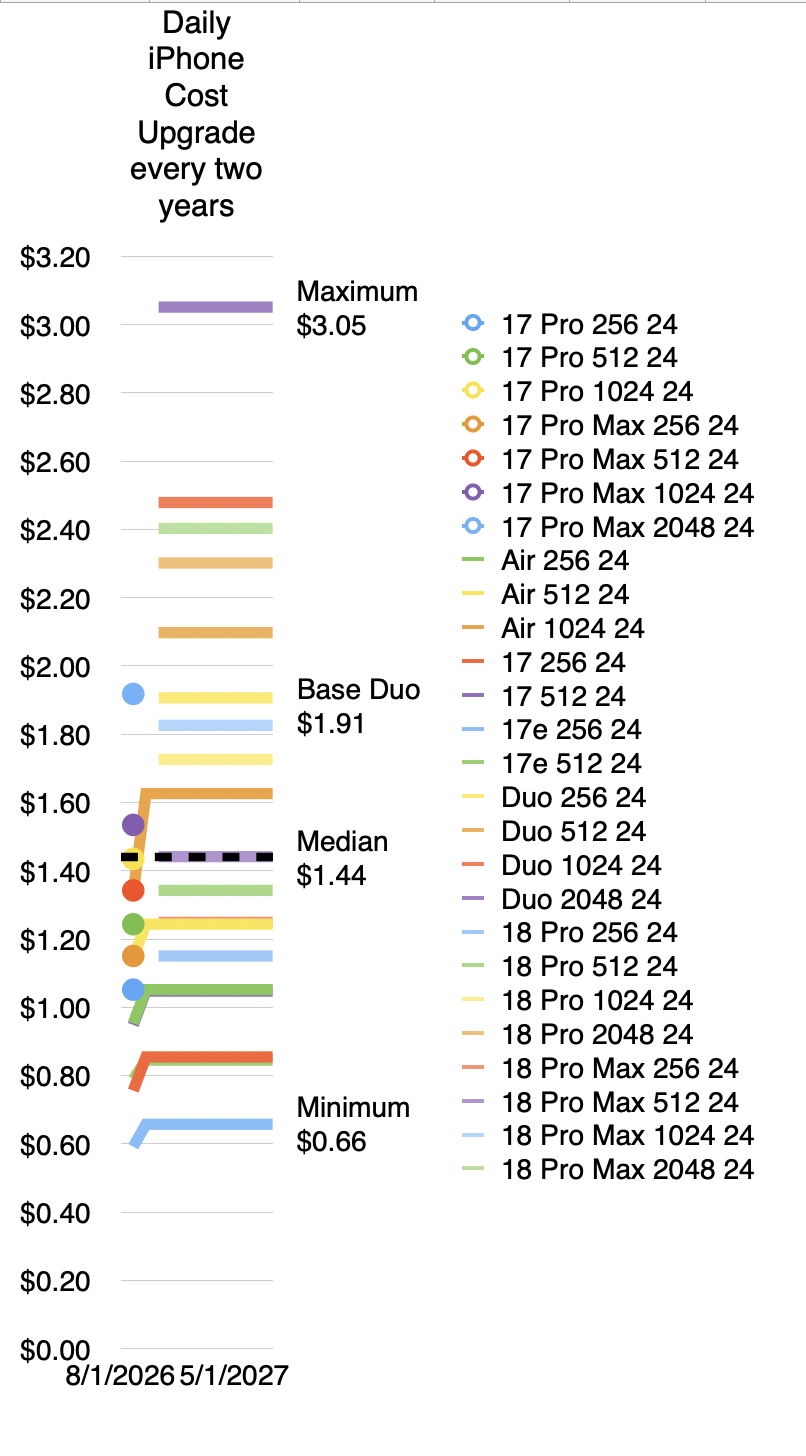
    The iPhone Uno was the quintessential $1/day product, or one penny per use. Now the iPhone Duo is offered for $2/day. But will it be used more or be better to use? If it is to gain another hour of use, or a dozen more pickups a day, or increase dwell time then surely the extra dollar is worth it.

    Let's reflect on this in another decade but I have become convinced that the Duo is version 2 of the iPhone and as such it will become even more habituated to us and vice versa.

  5. Remember Netflix? Stock Downgraded As YouTube Harvests Viewers

    Nota Bene · 3 comments

    Disrupting the disruptor. The Curse of Cassandra strikes again.

    Netflix stock has "a growing YouTube problem," a Wall Street analyst says. Alphabet's YouTube is taking increasing viewer share.

    Netflix (NASDAQ:NFLX) shares slipped Tuesday after HSBC downgraded the streaming giant to Hold from Buy and slashed its price target 21%, warning that weakening engagement and intensifying competition from YouTube could make a near-term recovery harder to deliver. Analyst Mohammed Khallouf cut his target to $76 from $96, leaving only about 3% upside from current levels and putting renewed focus on whether Netflix can defend viewing time without materially increasing content costs.

    Netflix stock fell more than 1% at Tuesday's open following the downgrade.

    HSBC's central concern is engagement. Khallouf said near-term recovery in engagement looks unlikely, citing a declining reception for Netflix original content and the growing share of television viewing captured by YouTube.

    That competitive pressure is increasingly visible in the numbers. YouTube reached a record 14.2% share of U.S. television viewing in July, while Netflix accounted for 7.8%, according to data cited by HSBC. Netflix's own engagement metrics also weakened: viewing hours for English-language programs appearing on its weekly Top 10 lists declined roughly 17% year over year across July and August.

    "YouTube has been benefiting, in our view, from a declining reception to Netflix's original content," Khallouf said in a client note. "Near-term recovery in engagement looks unlikely."

    Netflix has shifted more into YouTube's space with video podcasts, sports and other content.

    "YouTube has been rapidly expanding its living room footprint, having captured a record 14.2% share of U.S. TV time this July," Khallouf said. "This momentum is increasingly coming at the direct expense of Netflix as its share fell to a multiyear low of 7.8%."

    Netflix Stock Cut To Sell Rating

    Meanwhile, rival Apple's (AAPL) Apple TV+ subscription service is riding high after dominating the Primetime Emmy Awards last week with 29 wins for critically acclaimed shows such as "Widow's Bay," "Pluribus" and "Slow Horses." Netflix scored 16 Emmy Awards.

    On Friday, Wells Fargo analyst Steven Cahall lowered his rating on Netflix stock to underweight, or sell, from equal weight, or neutral. He also slashed his price target to 57 from 80.

    "Engagement trends look worrying to us," Cahall said in a report. He also noted competition with YouTube.

    Source: Investor's Business Daily

    NB: You wait years and years for the obvious to happen. So long that you give up. Then it happens.

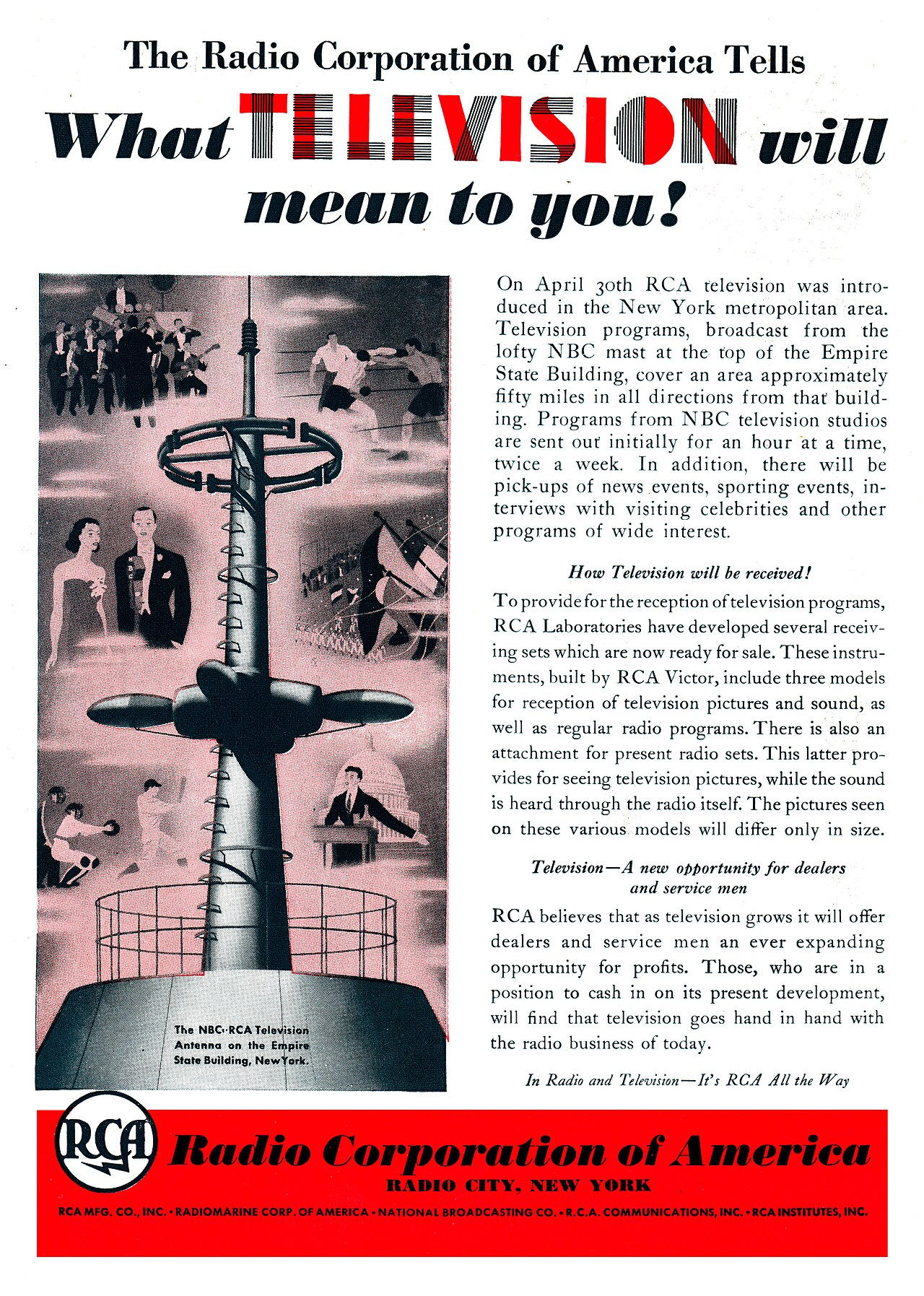
    YouTube was the writing on the wall for all forms of TV. That much was clear more than a decade ago. So long ago that I forgot all that I wrote and thought about it. You just move on to other things, like transportation. This was in 2014.

    In the meantime the trajectory takes its parabolic course. You just don't know where the peak is. We may have reached that peak, finally.

    The power of YouTube was always there, the numbers have been compounding for years.

    Personally, I never subscribed to Netflix, leaping directly to YouTube long ago. It may not appear comparable, but the jobs are the same: fill downtime with content that's easy to digest. Initially not good enough but good enough soon enough and more than good enough eventually.

    The Curse of Cassandra strikes again.

    But what about Apple?

    The article notes that Apple keeps piling on the awards. What seems to be happening is that Apple saw the disruption and decided to fly well above it. The premise of Apple TV+ is that it's a provider of content of the highest, award-winning level only.

    This may be eventually matched by YouTube but perhaps not. The production quality has no monetization equivalence in YouTube. The marginal dollar spent on quality has no return beyond a certain point. At least that's the calculus.

    The best shows will just be on Apple TV. For everything else you can use YouTube.

    This assumes that there are people who will seek out quality. That they are not ever going to just settle for filler and junk and ads and short-twitch triggers. The market bifurcation into "super premium" and "slop" follows the 80:20 rule.

    Sounds familiar.


  6. Apple's Unpretentious Moonshot

    Research · 2 comments

    An Office Hours question, September 11, 2026.

    Q: Aside from the iPhone Pro & Duo, what was significant with Apple's latest?

    We've had a lot of betas since WWDC, leading to OS 27. That'll be big. People overall have been giving good reviews. It is much better than many people expected.

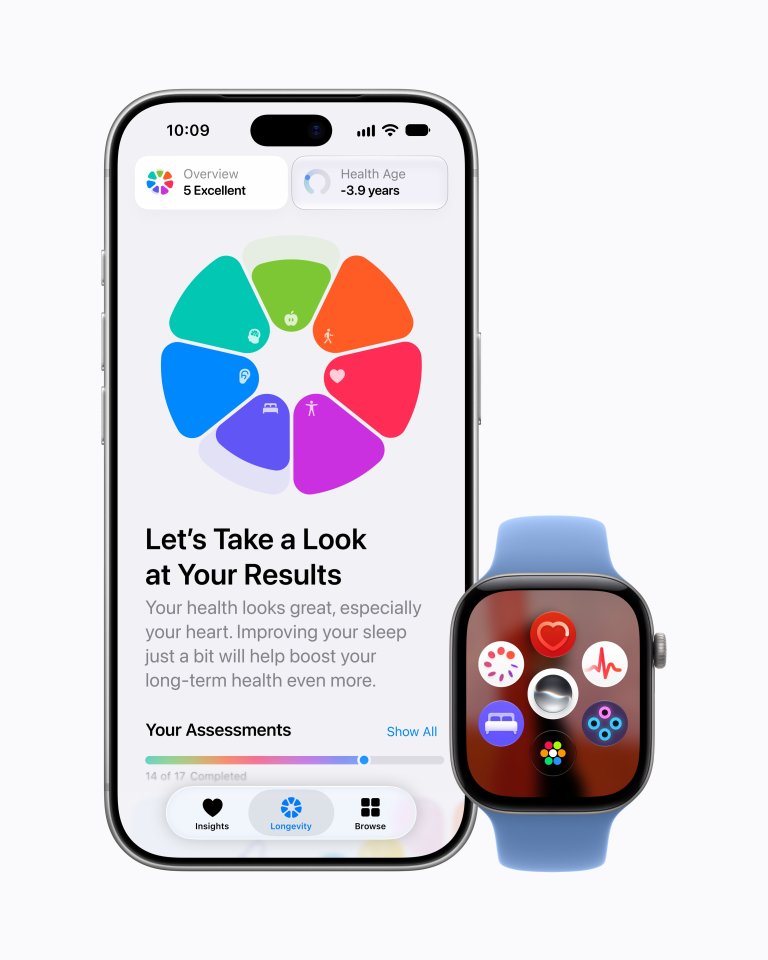
    But the big news of the event, to me, was the Watch, health in general, and how it's going to end up leveraging AI. That is one of those things that keeps compounding.

    The story of health and Apple continues to be a drumroll that gets bigger and louder, and it's still getting ignored. It's getting ignored the way services were ignored ten years ago, when Wall Street didn't think it was worth paying attention to. It was a hobby. Even the most famous followers of Apple would have said Apple's no good at services, that it was Google's game, that Apple was too slow, bad at building data centers. No one's saying that now.

    Tim has a lot of quotes, but the one I like most is where he said that Apple may be known most for its contribution to health. That's a bold claim, and it flew over people's heads. But think about it: would I rather have a device that keeps me healthy? Not just fixes me, but keeps me healthy. That's health maintenance. As a coach, it does all the things that lead to a good lifestyle, and maybe not just health but happiness. What would be the value of that machine versus one that was an AI? We focus entirely on AI being some kind of magic, whereas health is another kind of magic that doesn't seem to be considered very valuable. If I were to do the math, the health industry, including wellness, exercise, apparel and diet, is far bigger than knowledge-based assistance.

    Now, I'm not discounting AI at all. But people are more likely to say: we want to preserve and be healthy. There are big problems with that, in motivation and so on. We like GLP-1s because we like pills. Simple answers, quick, but expensive. Doctors like them because they're easy to prescribe. You don't have to rely on the habits or the mind of the patient.

    But what if you could change people's behaviors? What if you had a machine that was effective in guidance, without the side effects?

    The case in point is exercise. If exercise were a pill, it would be a miracle pill. Every doctor would prescribe it. So the question to ask is: how do I make exercise into a pill?

    Making it into something so reliably delivered and so easily administered: whoever does this will reap enormous rewards. That's where I think Apple is thinking they'll be in twenty years.

    We're seeing continuous progress, always flying under the radar, everyone glazing over: more sensors under the Watch, what's the big deal. But that Watch is collecting so much data. I'm shocked, scrolling through my Health app, at how many different things it's able to infer. It's now tracking your heart rate at five-second increments, as close to real time as possible. What about blood pressure? Glucose? Your hearing, your eyesight? And then the biggest things of all: exercise and diet. Apple will eventually conquer these domains, and then it'll be a thing you have that's as important as an AI assistant. How about my health coach?

    They just did an acquisition of a company using electromagnetic fields for what I first read as intent sensing but now think is biosensing: possibly determining blood sugar or other metrics of your health. It's not going to be neural implants, but they're going to get all this data. This is a moonshot. This is the human moonshot. It's solving something bigger than AI, in my opinion.


    One of the questions asked in Asymco Office Hours. The full recording and transcript are available to Asymco One subscribers.

  7. Mac sales in Mainland China grew 63% in Q2

    Nota Bene · 4 comments

    Apple sold 1.2 million Macs in China for 10% market share in the second quarter of 2026. That compares to sales of 700,000 Macs and 7% market share in the second quarter of 2025. That’s annual growth of 63%.

    For full-year 2026, Omdia expects mainland China’s PC market to decline 6% YoY, with consumer shipments falling 10%. Meanwhile, the tablet market is forecast to contract 10% in 2026, reflecting weak demand and continued supply constraints.

    Source: Apple World Today [my emphasis]

    NB: This is a few months ago and baked into the results already posted (29% revenue growth for the Mac segment).

    The refrain of growth while the market contracts repeats across all products and all regions and predates the product launch cycle that began in September. It's quite extraordinary.

    I estimate China made up about 16% of all Mac sales and there is plenty of room to grow.


  8. John Ternus Defends the Vision Pro

    Nota Bene · 3 comments

    It's an anomaly. Pay attention to anomalies.

    In a new interview, Clique TV’s Mouloud Achour asked Ternus: “The Vision Pro: for you is it a test, a flop, or the first step to the future of what’s going to be…a computer?”

    Here’s what Ternus said:

    "Vision Pro to me is an amazing device. It’s an absolutely amazing device. But I think of it as like the early days of computers. It is the early days of a long journey. That’s how I feel about Vision Pro. What you see, if you think about the early days, people found different reasons where the computer allowed them, the Mac allowed them to do something never before possible. Like desktop publishing, and it became a big thing in that industry.

    What you’re seeing with Vision Pro now is, certainly there’s early adopters who love it and they’re using it and they’re enjoying it, but you also—surgeons are starting to use it in surgery because it’s just a fundamentally better tool for them than a monitor that’s kind of sitting over here. And so it’s growing in that area. In film production people are using it for set development and things like that. So we’re going to continue to grow and find more and more compelling use cases. And I think there’s a very bright future."

    Source: 9to5Mac

    NB: Tim Cook launched and supported the Vision Pro while…

    … many said it should cancelled due to poor sales. I argued recently that it's an anomaly. A phenomenon that has no explanation using the theories we currently have. When an anomaly emerges it should be studied carefully because either it refutes our theories or it enhances them by refining them.

    Apple's interest in this category of visual computing (or spatial computing, as Apple calls it) is deeply seated. Apple exists at the intersection of humans and computers and the visual representation of information is the most compelling and highest bandwidth way of interacting with machines. We are fundamentally vision-based lifeforms and interfaces that maximize stimulation of the visual cortex are most likely to be adopted. For a simple demonstration of this one can simply ask about the physiology of reading and why we have binocular vision and how cave paintings came so early in our history.

    The interest in this product is not for its revenue potential but for its guidance into how we will connect with and through machines. The learning required perhaps cannot be obtained entirely in a laboratory.


  9. Asymco Bulletin 031 - Sep 20, 2026

    Bulletin

    The Asymmetric Weekly, for the week ending Sunday, Sept 20th.

    Research

    The Dawn of Gestural Computing

    The more one one thinks about the iPhone Duo the more the Duo branding appears to be signifying something beyond two screens. Perhaps Duo is marking iPhone 2.0, a new epoch in the history of Apple devices. Consider that the premise of folding the screen isn't just to afford a larger surface, but physically transforming to form factors of a book, a mini laptop, a notebook (with Pencil!), a tablet, an alarm clock, a movie screen... →

    Duo dollars a day, Duo cents an unlock

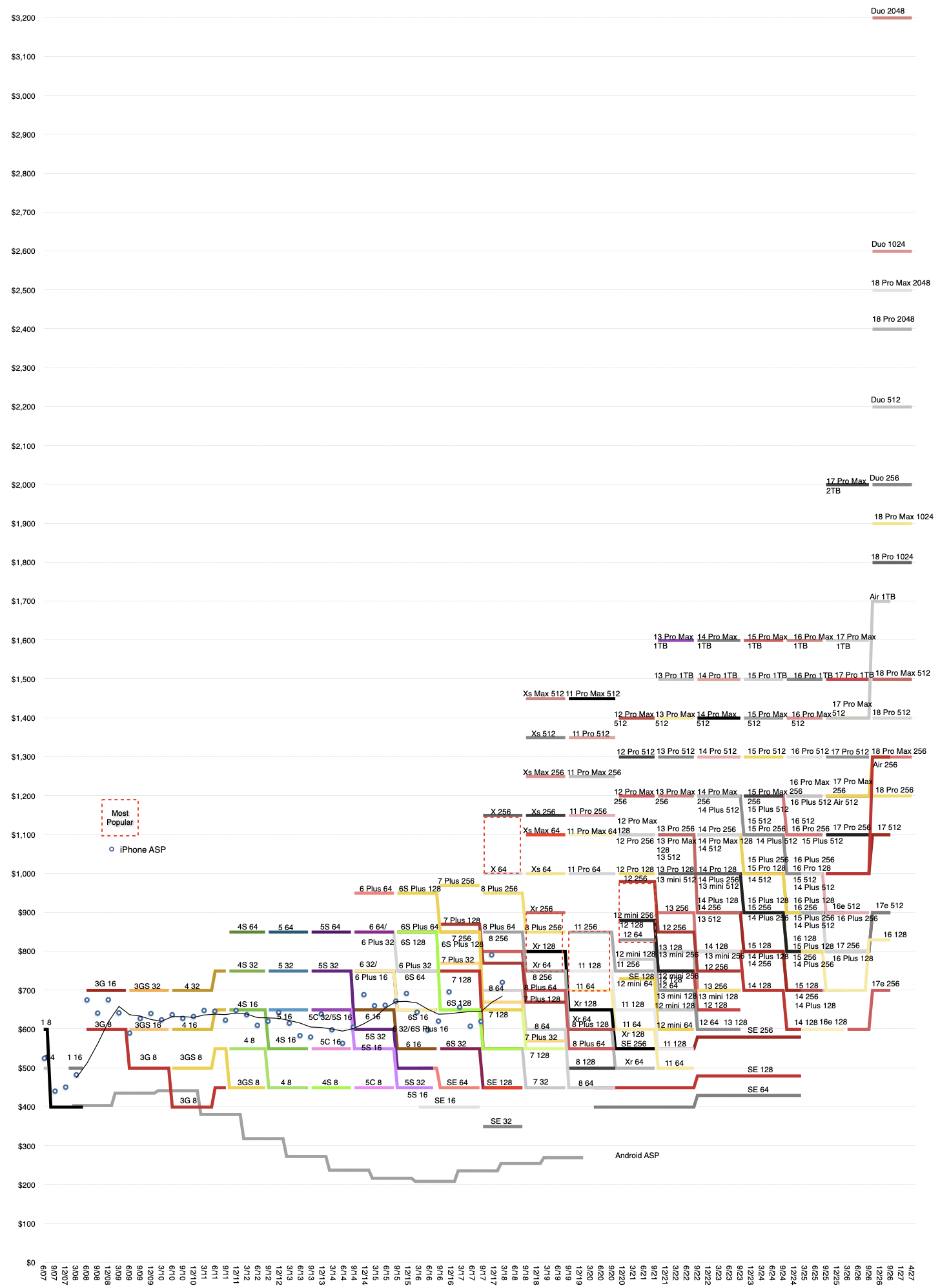
    The Duo's price range is $2000-$3200. How should we think about this? →


    Nota Bene

    The iPhone Duo: pathos, not specs

    One theme about the iPhone Duo seems underreported: pleasure, prestige, the pride of ownership. It's always been there with Apple products, but being the first to get a foldable, after everyone's been talking about it for so long, might be a bigger driver than the practical aspects. →

    Stairway to the $3200 Heaven

    The top price in the iPhone Stairway to Heaven chart is now $3,200. How does this affect iPhone ASP? →

    What happens when smartphones become too good? → Katharine Sorensen of The Beiruter interviewed me on the shuttle bus to Apple’s September event, two days before the Duo existed. Her question was the more profound one: what happens when phones are good enough, when replacement cycles stretch to four years and the installed base grows regardless. The industry has spent its history persuading people the device in their pocket could be substantially better. Apple’s answer arrived that Wednesday with a hinge. →

    Siri, not a companion, by design. → People have gotten used to AIs being wrong, so folding intelligence into the OS adds little brand risk as long as the experience is as expected. The product manager for Apple Intelligence told me Siri is built not to be a companion: an advisor and a concierge with a professional persona that keeps its emotional distance. The exposure Apple actually guards against is not hallucination but a violation of privacy or security, where a single leak brings lawsuits and regulators at once. Managing that risk is the cost of doing business. →

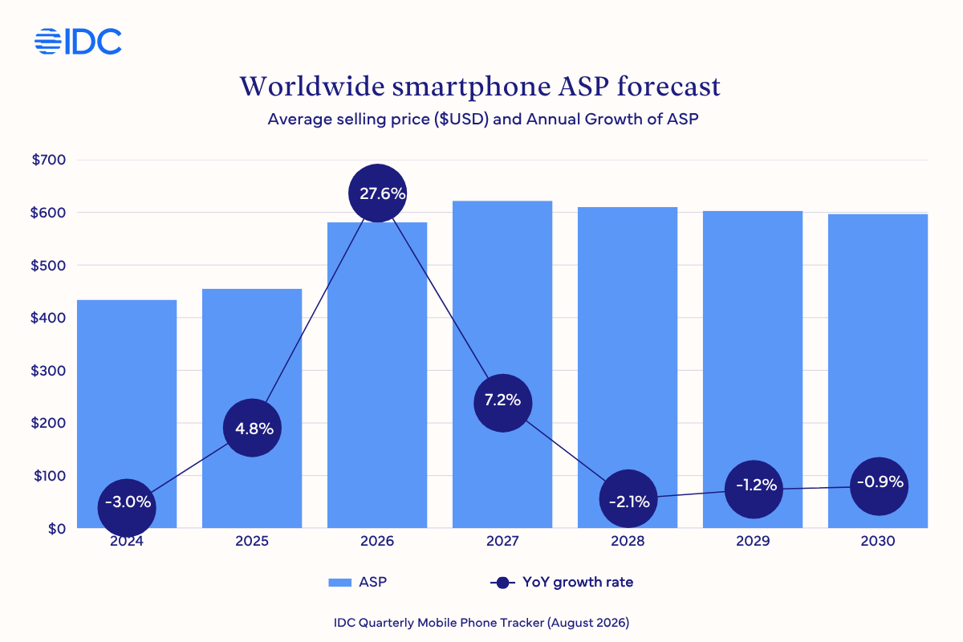
    Refurbishing the Innovator’s Dilemma → Apple already sells refurbs, but at small scale, and refurbishment is a scale game. Lease returns change that: one and two year old phones taken back in volume, refurbished and resold at minimal profit, because the point is not profit but visibility into a secondary market Apple otherwise has to sample. The lowest priced new iPhone is now in the $800s, and the $400 slot belongs to the used market, just as only 12% of Americans can now afford a new car and the auto industry has dehydrated itself of visibility into everyone else. My advice to Apple is to not fall into the innovator’s dilemma: more profitability is not always the right answer. →


    Live Events

    Asymco Office Hours Duo: The First Ternus Keynote – Sunnyvale Session Recording & Transcript, September 11, 2026 → Recording and transcript of the Sunnyvale session, held two days after Apple’s September event and the first keynote under John Ternus. Inside: the Duo as a pricing decision made seven years ago, the attraction of moving objects, two cents an unlock, the 1.2 billion puzzle of the iPhone ASP, why launch the iPhone 18 in spring, Siri designed not to be a companion, Apple’s unpretentious moonshot, and what follows the memory famine. Full recording and transcript for Asymco One subscribers. →


    Asymco One gives you full access to our research, analysis, and commentary. Subscribe with code BULLETIN for a discount.

    Feedback: Have questions or comments? Reach out to us at contact@asymco.com. We’d love to hear from you.

  10. Refurbishing the Innovator's Dilemma

    Nota Bene · 3 comments

    An Office Hours question asked by Fred S., September 11, 2026.

    Q: Will Apple follow what carmakers have done with certified pre-owned, taking the phones returned through Apple Upgrade, putting them in a nice package and selling them?

    They do, on the Apple Store, but at small scale, and refurbishment is a scale game. Today the refurbs come from the refund policy: someone returns a phone a month later that they barely used, and Apple resells it, almost new, at a slight discount. What you're referring to is lease returns, one- to two-year-old phones. They will probably take those in huge numbers, refurbish them in a very high-volume facility, and pump them back out at minimal profit. I don't think it's about profit. I think it's about knowledge of the market. Once a phone goes into the secondary market, Apple doesn't know much about it or what pricing people are getting; they have to sample it. Leased products that return to Apple are under their control and visibility. That information is super important. The lowest-priced new iPhone is now in the 800s. It used to be 400. That slot is now taken by the used market.

    The auto market is the key question, because there are four used cars sold for every new car. The used market is now becoming the primary market, because cars are so expensive. Only twelve percent of Americans today can afford a new car. It used to be sixty or seventy percent. Prices have exploded, so one in six Americans are buying new cars, and that determines why the cars we find available are all enormous SUVs: that 12% is the wealthiest 12%, and they're saying no to economy cars.

    This is a very important observation, because a lot of classical disruption theory depends on the low end and the mass market being interested in good enough. The problem is that the auto industry has completely dehydrated itself of visibility into that market. The challenge for Apple is not to fall into the trap of making things for the rich few, and yet not compromise on quality. If there's one thing I would advise Apple on, it's not to fall into the innovator's dilemma. It's a trap to think that more profitability is always the right answer. Apple being a premium brand, people already assume it's an exclusive, frivolous type of product, but they're not thinking fully about what's going on there.


    One of the questions asked in Asymco Office Hours. The full recording and transcript are available to Asymco One subscribers.

    See the proceedings at asymco.com/live.

  11. Asymco Office Hours Boston: TODAY at 4pm ET — In Person or Remote

    Invitation Office Hours

    Today · 4:00–5:30pm ET / 1:00–2:30pm PT · Boston Seaport, and online

    The second half of the Asymco Office Hours Duo took place on Friday, September 18. See the proceedings at asymco.com/live.

    In person: Boston Seaport. 4:00-5:30.
    Hang out with Horace & Co afterward at Asymco Happy Hours.

    Remote: Join online.

    Register: In Person

    Register: Remote


    Venue details and the remote join link will be posted to registrants. Asymco One subscribers are guaranteed seats, may bring a guest, and may participate in the live Q&A.

    The session will be recorded; recording and transcript will be posted at asymco.com/live shortly after to Asymco One subscribers.