Why Huawei and Apple Grew While China's Smartphone Market Fell Again in Q2 2026
by Horace Dediu
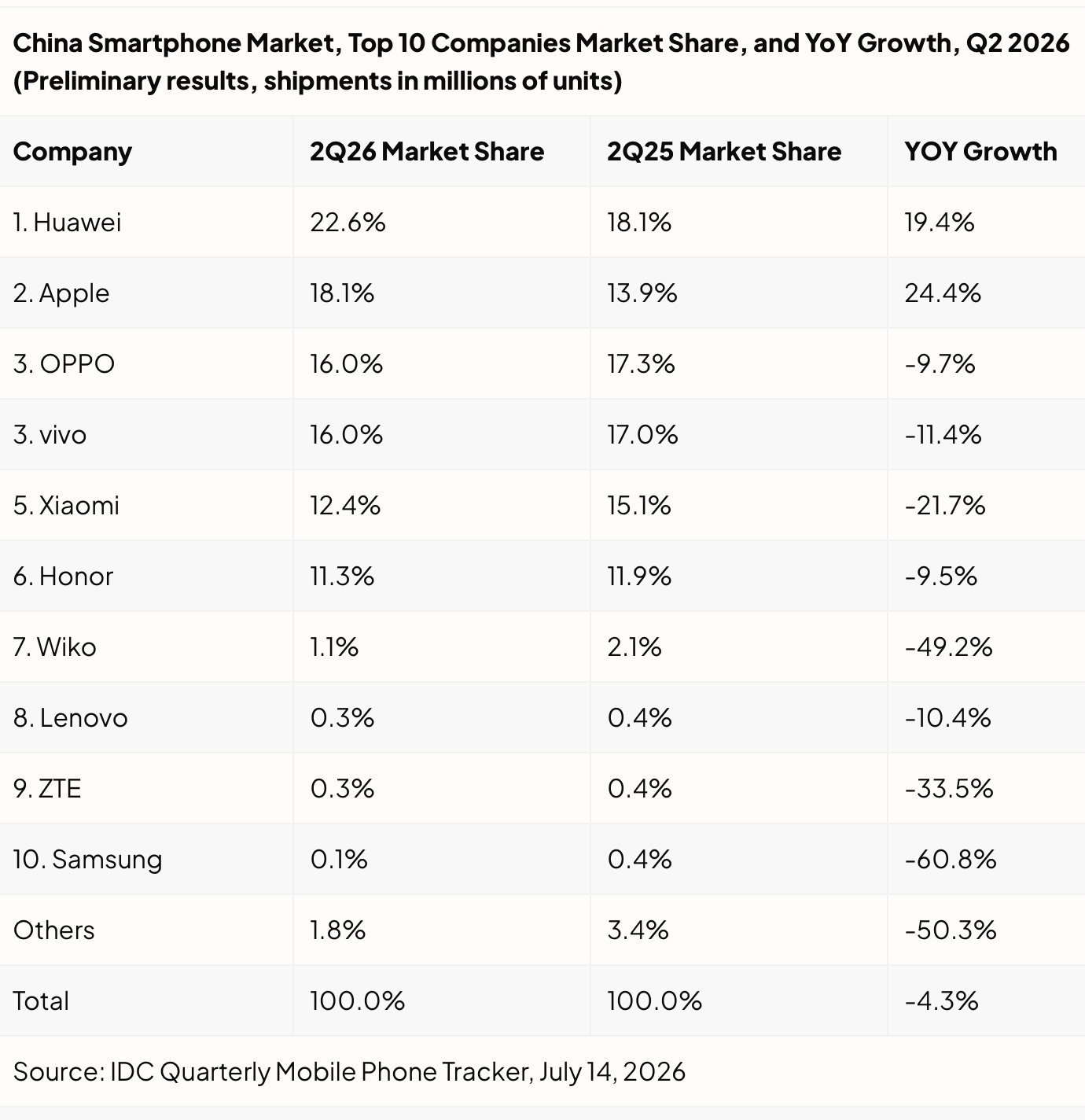
Apple gaining share in China
China’s smartphone shipments came in at roughly 66 million units in the second quarter of 2026, down 4.3% year over year and the fifth straight quarter of decline. Rising memory and component costs pushed most Android vendors to raise prices, which cooled upgrade demand. Huawei and Apple were the exceptions, growing close to 20% and 25% respectively.
Huawei and Apple moved in the opposite direction for reasons that were just as concrete. Both held prices steady while the rest of the Android field raised them, and both layered on targeted promotions. Huawei kept widening its lineup to cover more of the market, while Apple’s early signaling of price increases on its second-half products pulled some buyers forward into the iPhone 17 series sooner than they might have bought otherwise. Strong brand pull helped as well.
The top six vendors now hold about 96% of the market, which keeps squeezing smaller and mid-sized brands and pushes concentration higher.
China Smartphone Market at a Glance, Q2 2026
Total shipments: about 66 million units, down 4.3% year over year
Fifth consecutive quarter of year-over-year decline
First-half 2026 shipments: about 134 million units, down 4.2% year over year
Huawei and Apple: each up roughly 20% year over year
“618” festival smartphone sales: down close to 15% year over year
Vendor tiers: Huawei and Apple lead, followed by OPPO and vivo, then Xiaomi and Honor close behind
Top six vendors: about 96% of total market share
Source: IDC
NB: Other analysts are reporting similar story globally but with Samsung instead of Huawei as growing (apart from Apple.)
The data sounds repetitive but it should be considered in light of the discontinuities we are experiencing in supply chain pricing. The challenge will be pull-forward demand into the next quarter and the price increases on the iPhone line into the holiday quarter. Note well however that the line-up will probably be split into two launch quarters, with China probably being targeted with the later (spring) quarter.
Comments