Asymco

Asymmetric Intelligence

AirPods

  1. How not to over serve; The machinery of vanity

    Research · 6 comments

    The Asahi Shimbun Interview Part 4

    Godfrey Kneller - Portrait of John Locke, 17th-century British Age of Enlightenment philosopher

    Horace Dediu / Takeshi Narabe & Dylan Weir / Asahi Shimbun Interview, April 2026

    Takeshi Narabe • 22:44
    Japanese companies always follow and concentrate on seeking additional functions so that is very in contrast to Apple so there is a growing concern that Apple might be falling into the same spec trap that runs parallel. Japanese firms you know focusing on incremental hardware improvements like you know iPhone's more thinner and thinner...

    Horace Dediu • 23:34
    It's true. But I will say to the defense of Apple, of course, they need to maintain some improvement. Otherwise, people may not consider buying it. They do think hard, though, about what needs to be improved. And many times they don't improve things that many people ask for. They'll say, "Oh, you need a refresh rate of hundreds of hertz." They don't bother with that. Or they [won't offer] more resolution, more than even the eye can see. They don't do that. But they'll do a lot with the camera.

    And they'll probably do more. They do amazing things with audio. They do really, really interesting things as far as... Like face ID was something that was nobody asked for. But now it's a very, very useful thing. People recognize the value. So I do think there's a roadmap there that's kind of interesting.

    But here's the bottom line, you know, Christensen said, that the trajectory of what performance people expect is not as steep as the trajectory that companies can deliver. And that's why you overshoot. What Apple has been able to do, at least through the lifespan of the iPhone so far, is to cause people's interest in more improvements to rise a little bit.

    And so the theory basically says that there is a flat trajectory to the user demand of performance. But my [observation] is that eventually you do drag people up, just like with non-consumption. People don't ask for a better camera, but once you give it to them, they're like, oh, yeah, I really want an even better camera.

    [The performance demand] it created... I mentioned the short video TikTok format, It was the phone's camera that allowed [average] people to suddenly become filmmakers. And it allowed people to become "vanity machinery"[1]. It became all about vanity, all about selfies. And [as a result] you have to have a front camera and a back camera and you have to have editing software and you have to have a more powerful processor and you need a huge amount of storage when you're dealing with video.

    So suddenly, the phone needs more and more and more. But the demand for video editing on a phone was created essentially from nothing. It was created by the supply of camera. And so, yes, that is a theory that you have a problem if you overshoot. But I think in the old days, a consumer electronics company would add buttons.

    I was at Nokia for a long time, and we had buttons and buttons and buttons. We had one phone with over 100 buttons on it.[2] That wasn't very useful. So the idea of Apple is that they remove buttons. They make it even cleaner in that design, and they make it easier. So face ID is an example, and privacy is important.

    By the way, that's another thing that they sold to people. If you think about it, nobody asked for privacy because everybody was okay with sharing. But the fact is, it's like the automotive industry has safety, and nobody asked for safety either. But you should deliver safety, you should protect the passenger. [Today] it's considered hygiene. [If] you don't have it, it's bad, but if you have it, nobody cares. But in the case of Apple, they're pushing on privacy.

    So yes, it is a concern that you overshoot. However, one more defense of Apple is that they introduce these wearables. So if you take the AirPods, for example, again, not a product anybody asked for. And when they were first introduced, they were made fun of because it was [so funny looking.]

    The AirPods are a very clever new product, [they are] an extension of the iPhone. They're not the iPhone per se, but we have a wonderful must-have accessory. I feel like I'm naked without taking my AirPods with me. The same with the watch. Another product extension. Again, it's an option. You don't have to have it, but once you have it, it becomes addictive.

    There are many things on the watch, which again, from health reasons, from managing information that I only need to look at for a few seconds, all of those things. (I'll give you a simple example. I never check the weather on my phone. I only check the weather on my watch because it's there with the temperature always on the home screen. And if I want to learn more, I tap on it. I don't even know how to do it on the phone anymore. You know, I have to find the weather app and then scroll and things like that. Never do that anymore.)

    So there are things you do now with accessories that the phone has essentially been disrupted by. But it's still at the heart of the network of Apple. It used to be the Mac was at the center. Now it's the iPhone. So again, this is cleverness.

    I was a student of Christensen, and Christensen always thought that Apple was not disruptive, and that Apple would be disrupted by the low end. [I was not so sure.] I was a bit sensing that there was a disturbance in the theory because in many ways Apple's behavior is so atypical to a normal company. And most companies would do the wrong thing, but somehow Apple managed to not step on those mines, not to fall into those traps.

    Why? I'm not quite sure. And we continue to have the discussion. I really think it's culture. I really think that they've solved the Innovators Dilemma. Not by reading a book, not by taking a university class, but by always being extremely nervous, extremely careful and extremely passionate and extremely paranoid. All of these things.

    Which points out the vulnerability of Apple. If that culture breaks, if the management, the next generation doesn't know how to do it, then suddenly it might fail. Because it's held together by such a force that it's hard to write it down. It's public information actually, that they have Apple University, which is meant to teach internally how things are done to the next generation of managers.

    So this is something they are trying to codify and to preserve. And that's an experiment, I would say, because it's not easy. But again, that's a self-critique, an introspection, looking at yourself and asking, why am I good? How do I make sure we continue? Few companies do this. Founder-led companies might, because the founder is the company, in a sense. The founder is the culture. The founder's personality is more or less how everything is done. So those companies, to speak of, let's say, Meta with Zuckerberg, even Google, and those companies, or Amazon a little bit with Bezos, although he's mostly gone.

    [But], that's not an answer, because the founder doesn't last 50 years in that job. And as we talked about one century, no way is it possible. It's beyond the human lifespan.

    Next in series: Part 5: Succession, study of the firm vs. study of the person

    Previous in series: Part 3: Low-end, Game consoles, Secondary Markets, Displays and AI

    Interview as published: 聞 Asahi Shimbun on Apple & Innovation

    1. The word I was looking for was "influencer" but "vanity machinery" came out. Perhaps that's a better term.
    2. I had the Nokia Communicator in mind, which was a clamshell with a full (but tiny) keyboard plus a full numerical keypad on the outer shell. The idea of mechanical keyboards was not only popular with Nokia but with the RIM Blackberry as well.

  2. Forecasting The Past

    Research

    The last quarter of 2020 was a remarkable quarter for Apple. Every line in the income statement increased by double digits. Net sales up 21%, iPhone sales up 17%, Mac sales up 21%, iPad up 41%, Services up 24% and Earnings Per Share up 30%. This had not happened in over 10 years. The last time being the first quarter of 2010.

    Take a look at the table below which color-codes each line based on the rate of growth. The darker the green the faster the growth (blue being above 100%).

    A shockingly good performance is made all the more remarkable by its happening in a time of uncertainty. The company has refused (rightly) to issue guidance as long as a pandemic is raging world-wide. The disruptions in supply chains, demand and changes in behaviors due to new limitations on mobility and interactions between people are unprecedented and consequences are still to be estimated.

    The growth surely, you say, is precisely because of this disruption. The "work and study from home" and lockdowns have forced people to buy more technology. Phones, Laptops, tablets are not just tools but lifelines for a society denied other forms of contact.

    But this was not at all obvious at the beginning of the crisis. The months leading to pandemic caused the share prices of most equities to fall, and tech was not immune. Apple's shares fell in March 2020 to $57/share. I heard comments suggesting that Apple would collapse as a business with unemployment reaching 25% and nobody willing to pay for luxuries like iPhones.

    The crisis has proven that technology is not a luxury but a necessity, and technology that works better is far more valuable than technology that works barely. Spending on better machines has increased.

    Some of that is of course helped by stimulus programs but growth was not only in countries which gave out cash. The growth for Apple was in all regions of the world, breaking new records even in poorer countries.

    Far more likely, the economic fuel for Apple's growth came from disposable income being unspent on other high-ticket items like dining, vacations and entertainment. Much cash sloshing around the economy surely ended up in an Apple cash register.

    But this is all old news. The question into 2021 is what will this year look like. The first quarter already ended and the data is dribbling in: Apple has 1 billion customers, 88% of US teens have an iPhone, 70% have AirPods, China is growing at crazy rates, Foxconn reporting 40% growth, production of next generation iPhone chips starting early (May), etc.

    There does not seem to be a let-up in growth, despite some component shortages postponing some non-iPhone product introductions. Apple's cautious comments 3 months ago are probably moot now.

    We are providing some directional insights assuming that COVID-related impacts of our business do not worsen from our current assumptions for the quarter. For total company revenue, we believe growth will accelerate on a year-over-year basis and in aggregate, follow typical seasonality on a sequential basis.

    At the product category level, keep in mind two items: First, during the March quarter last year, we saw elevated activity in our digital services as lockdowns occurred around the world, so our services business faces a tougher year-over-year comparison; second, we believe the year-over-year growth in the Wearables, Home and Accessories category will decelerate compared to Q1.

    As you know, we were chasing demand on AirPods last year as we expanded channel inventory from Q1 to Q2. This year, we plan to decrease AirPods channel inventory as is typical after the holiday quarter. We expect gross margin to be similar to the December quarter.

    We expect opex to be between $10.7 billion and $10.9 billion. We expect OI&E to be up around $50 million and our tax rate to be around 17%.

    Luca Maestri

    Given this, I am tentatively projecting top line growth of 15% (vs. 1% a year ago and 21% last quarter) and EPS growth of 11% (vs. 3.8% year ago and 25.6% last quarter.) A goldilocks quarter.

    More details will be forthcoming.

  3. iPods Pro

    Research

    At time of writing (December 12, 2019) AirPods Pro delivery wait time is over 4 weeks. It's been like this since they shipped. I tried stores in several countries and although units can make an appearance on a shelf, they sell out immediately.

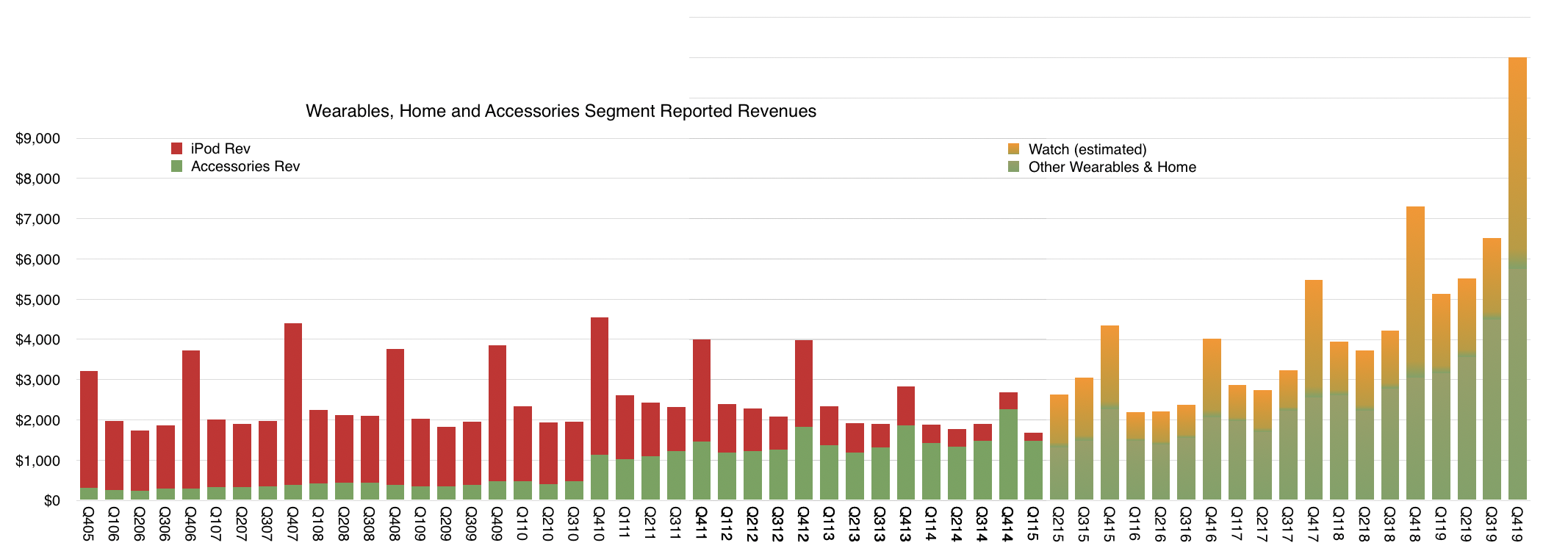
    AirPods are part of the "Wearables & Home" category for Apple which used to be called Other Products and include also the Watch, iPod, Apple TV, Beats and HomePod (among other items.) iPod revenues were broken out as recently as 2015 but as the graph below shows, there have been no specifics on any product in "Wearables & Home" since then.

    Wearables, Home and Accessories in a historic perspective with the iPod.

    It therefore falls upon us to estimate how much of the entire category is any one product. It's been very difficult as the only clues lie in growth rates, sometimes cited for the Apple Watch and sometimes for "Wearables" alone. As far as I can tell from the available clues, the split is roughly as shown between the Orange and Green areas. Orange reflects estimate for Watch and Green everything else.

    This analysis helped me conclude the Apple Watch overtook the historic "peak iPod" which occurred in the fourth quarter of 2007 at $4 billion. My Watch revenue estimate was $4.2 billion in the fourth quarter of 2018. This conclusion was confirmed by statements from the Company.

    The problem lately has been that AirPods have become huge unto themselves. There is literally no information about AirPods sales as a product category. The only option is to guess Watch and subtract it from Wearables and then guess again the portion of "non-Watch Wearables & Home" that is AirPods.

    Looking forward to the next quarter, I am expecting a 51% increase y/y for Wearables and 24% growth in Watch. This results in a Watch revenues about $5.2 billion and non-Watch $5.7 billion. Now if we assume $1.7 billion for non-Watch-non-AirPods (i.e. Apple TV, HomePod, Beats, iPod, other) then this quarter AirPods will have overtaken peak iPod.

    Remember that iPod was the phenomenon which reset all expectations for Apple. It caused Apple to cease calling itself Apple Computer. It (at least psychologically) laid the foundation for iPhone and everything else that followed. In 2005 and through 2007 Apple was "the iPod company". I remember people working in a large search engine company calling Apple "that media company" as a result of over-intellectualizing iTunes.

    (One more footnote on the AirPods Pro is that at $250 a pair and $300 for Apple Watch, throwing in a case puts these attached accessories for an iPhone at roughly the same average selling price for the iPhone of a few years ago.)

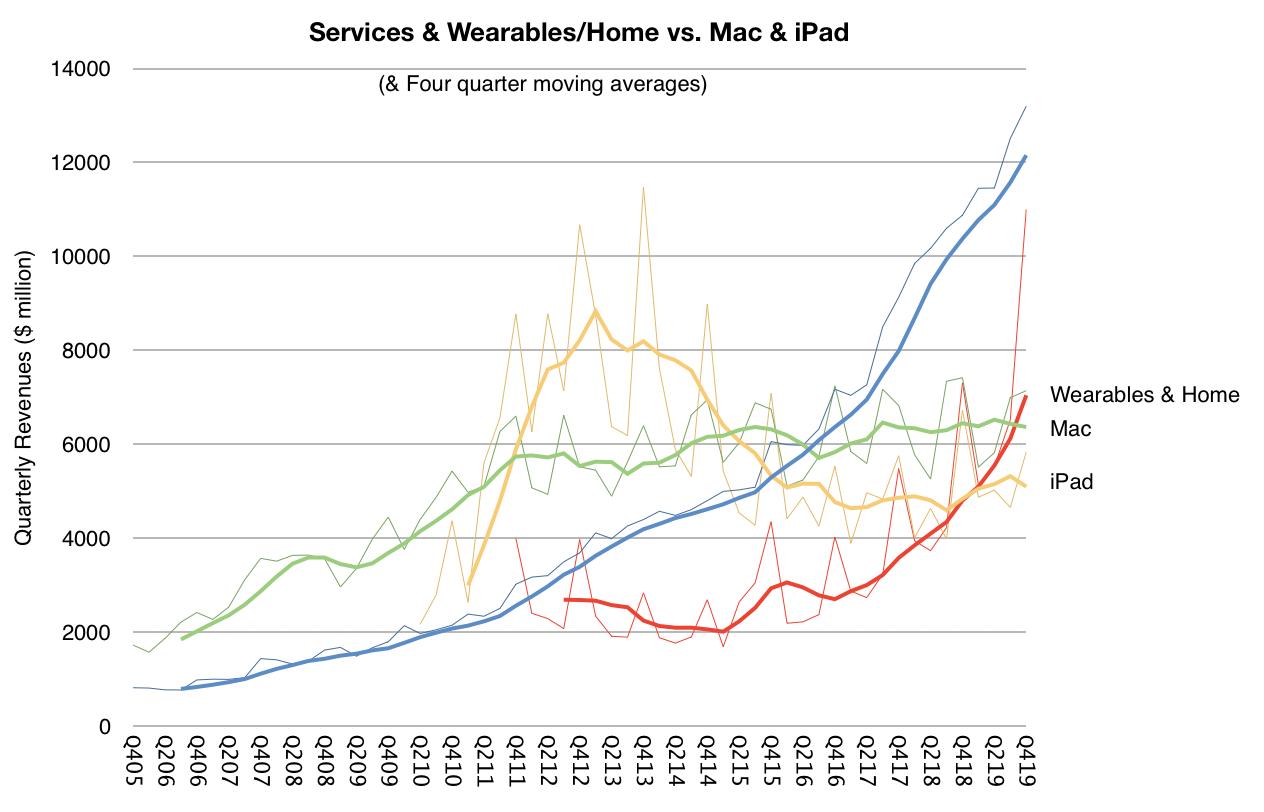
    For the AirPods to overtake the iPod highlights just what a phenomenal category Wearables has become. In combination with Home and other accessories the category is going to decidedly overtake the Mac, having already passed the iPad.

    And so it goes, something dismissed as inconsequential–"does not move the needle"–ends up becoming a massive force of change. The iPod was that, the original Apple II, the Mac and yes, also the iPhone. It's the asymmetry of humility that this happens over and over again.

    To hear more about the profundities of AirPods Pro tune in to the next Critical Path podcast.

  4. AiriPods

    Research

    The Apple Watch is now bigger than the iPod ever was. As the most popular watch of all time, it's clear that the watch is a new market success story. However it isn't a cultural success. It has the ability to signal its presence and to give the wearer a degree of individuality through material and band choice but it is too discreet. It conforms to norms of watch wearing and it is too easy to miss under a sleeve or in a pocket.

    Not so for AirPods. These things look extremely different. Always white, always in view, pointed and sharp. You can't miss someone wearing AirPods. They practically scream their presence.

    For this reason wearers, whether they want to or not, advertise the product loudly. Initially, when new, they looked strange, even goofy. But the product's value to the wearer overcame any embarrassment and for those courageous enough to wear them, they became a point of pride. As all things distinctive enough, the distinction rubs on the user and that distinction begets new users and new distinction, and so on. So now we have a bona fide cultural phenomenon.

    I have both my son and parents angling to get these things. I have not seen this universal appeal recently, even for the watch. You have to explain the watch. The AirPods explain themselves. The only thing which AirPods do remind me of is the original iPod. The iPod-and-white-earbuds had a similar signal/function ratio. Looks distinctive, works well, nails the job to be done and is self-describing. The "iconification" of white was the phenomenon of its decade.

    One wonders how much of this behavior is by design or, more precisely, engineered by designers. Did Jony Ive's team plan on users "flexing" with their AirPods? Did they make them distinctive on purpose with the stalks pointing down vs,, for example, wrapping around the back of the ear for a more discreet look? Was it just good luck and the form followed function? It's hard to imagine that taste could be engineered but here we are.

    Whether planned or not, the newest AirPods offer a functional upgrade with no visual upgrade. This is noteworthy because whatever they got right with the original design they decided not to mess with it. You can't tell if someone is wearing the newest AirPods or the originals.

    As far as the added functionality it is typical Apple: faster connections due to a new chip, longer talk time, longer listen time, voice-activated Siri and wireless charging. Broadly speaking they are just better in ways that need to better and not better in ways they are good enough.

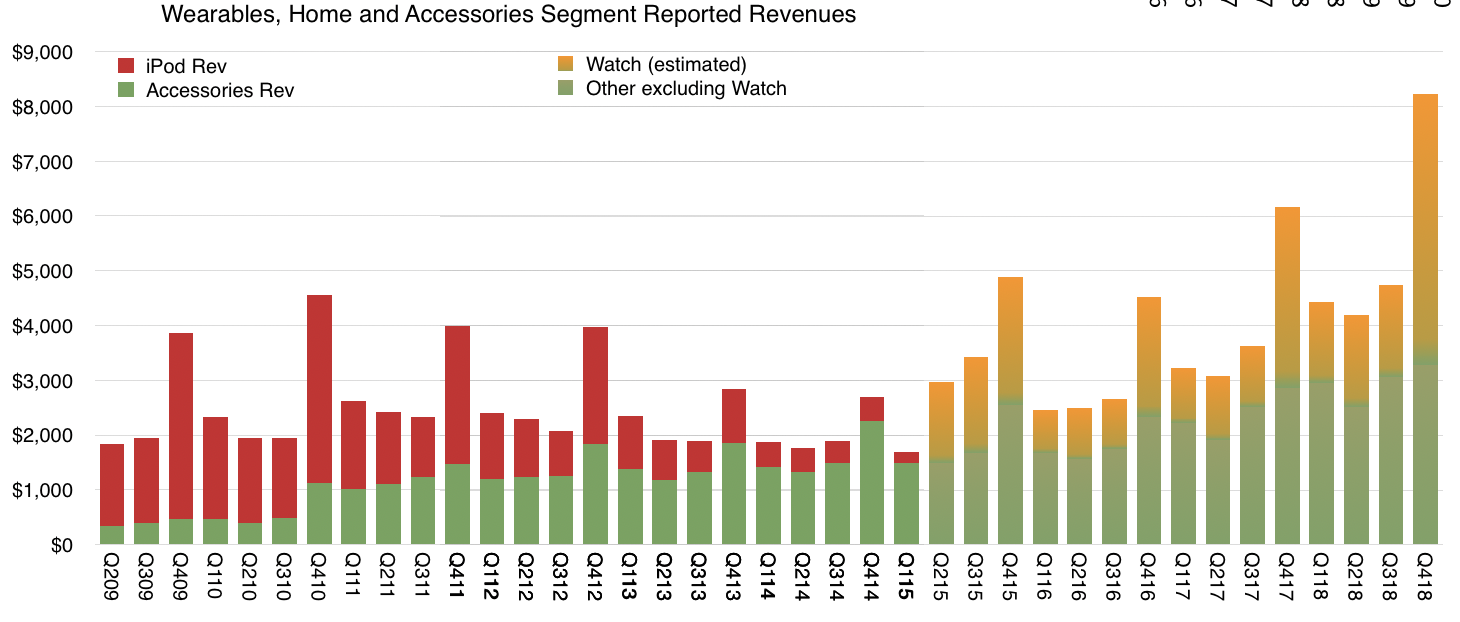
    The product is part of the "wearables" category at Apple which includes watch and is growing almost 50%/yr. and not from a small base either. The following graph show the history of the segment since 2009 (before the iPod peaked).

    As can be seen, Wearables and Home segment grew out of the iPod segment, through "Other" products and is now almost double what the iPod used to be alone.

    It should be noted that the AirPods can be paired directly with the Apple Watch and used independent from the iPhone. If not from this point alone, culturally the iconic white AirPods and jewel-like Apple Watch embody the spirit of the iPod.


  5. mini

    Research

    We want things to get better. The desire of improvement and an increase in performance is seemingly innate. The old adage goes that using the word "new" is the most effective way to increase sales. "New & Improved" if you want to be redundant.

    For many in technology, New & Improved means faster with more of every measurable parameter. More memory, more pixels, more storage, more bandwidth, more resolution. In devices, the tendency has been to communicate "new & improved" through an increase in screen size. We are subject to this to such an extent that phones are becoming unusable with one hand, stretching screens to the edge of the device and then wrapping those screens around the edges and then even folding the screens so that we have to unfold or unroll to use the product. Maybe an origami phone is in the works.

    But there is a parallel movement where "New & Improved" means smaller. This is the trend to miniaturization. Smaller is better because it's more portable, more conformable. Things sold by the ounce are better than things sold by the pound. The best computer, the best anything, is the one you have with you and having it with you is more likely if you can take it with you. So that which you can take with you is the best. QED.

    Apple has had a great history of miniaturization. The original Macintosh was tiny compared with personal computers of its day. It had a handle so you could take it with you. Apple pioneered laptops with breakthroughs in utility and form which made them truly portable. The iMac followed with a degree of integration and portability which made it iconic. Of course the iPod and iPhone were marvels when they first appeared.

    Over the years these products expanded into ranges with "good, better, best" type segmentation. The bigger being the best in performance and the smaller typically being the most convenient. However it seemed that the positioning was toward "bigger is better" for a lot of these products. The iPhones Plus, the iPads Pro, etc. As even the largest were getting thinner, the "mini" versions appeared to be neglected. You could get "good enough" portability from the larger products so why bother with the minis.

    It came to a head when the iPhone SE was discontinued last fall. Its demise felt like the end of an era. I always considered the SE as the "Steve Edition". It was the last design Steve Jobs was involved in and it pained me to see it go. With it seemed to go the positioning around "mini".

    But also last fall we saw a re-boot of another almost-forgotten mini: the Mac mini. For me the Mac mini was quintessentially Jobsian. I remember that he loved tiny products. His launch of the iPod nano was spectacular; reaching into his jeans' watch pocket to pull it out on stage. Holding the Mac mini up as if a tiny tray. Even the iPod shuffle was a quirky and lovable idea ((probably the first Apple wearable as you could actually pin it to your clothes)). And let's not forget the Mac Cube which made the iMac look huge.

    When the Mac mini was released last fall in Brooklyn with a huge spec bump and a thunderous reveal I thought something was up. When the MacBook Air was also out at the same event I felt that the company was signaling something. Perhaps a re-dedication to the low end.

    Also in parallel there is the wearables product line. The AirPods and the Apple Watch are jewelry. The essential qualities of products you wear are that they be small and beautiful. The smaller the better. Above all, both the Watch and AirPods are marvels of miniaturization. They pack so much in so little volume and that volume is shaped in such an aesthetically elegant way that they become daily essentials. I use my Apple wearables more than any other Apple product. Watch glances and time with AirPods exceeds the iPhone unlocks and iPhone use time. The fact that we don't even realize that the smallest Apple products are also the ones we use most is a testament to their conformability to us.

    So the Mac mini that is suddenly the Mac Maxi in performance, the MacBook which is an extraordinarily small laptop, the wearables success, all pointed in a direction that the iPhone did not: that "mini" was back.

    And now we see the iPad mini being re-launched with a huge spec bump. We should take the hint. The iPad mini is just charming. I have been trying it out for a few days and it has worked its way into my routine. I have an iPad Pro that I use on a desk to design presentations (and to deliver them). I use it with a keyboard for dealing with email on my lap or on a plane and take it instead of a laptop when going to meetings.

    But the iPad mini worked its way to my nightstand. It the one I reach for when on a couch. It is like an iPhone but when you're at home it's better than the iPhone because you can linger on that new true tone screen. It works well one handed. It now has Pencil support so it can be used for sketching and doodling.

    I am an analyst not a product reviewer but I sense how it fills a gap between iPhones and larger devices--in a home setting. Of course it can be used in an office. It is much easer to take with you if you carry a laptop in a bag.

    Fundamentally explaining mini is pointless. mini is something that is felt more than it is perceived. You can see the attraction of a tiny product only when you come face-to-face with it. In a picture it's hard to get it--there is no frame of reference. What draws me to a MacBook or to a mini or a Watch is when it's touched and held and carried or worn. The experience of the product is not how it works but how it works with you. You have to be part of it. It's not asking "Does it look good?". It's asking "Does it look good on me?" mini means more personal.

    That is the nature of mini and that is why I love the new minis: the iPad mini, the Mac mini, the MacBook (mini) and that is what I dare to hope that there is an iPhone mini coming.

  6. The Sound of Music

    Research · 34 comments

    One of the more common statements out of Apple is that "Music is very important to us." This is one of those easily dismissed Apple platitudes. Like caring about products or customer privacy or other such nonsense. But if you pay attention you notice music is always a consideration for the company. The obligatory music act at the end of Apple events, the multitude of speakers and audio accessories in an Apple Store, the headphones branded Apple and Beats, the music-heavy ads. It's as if Apple's brand had a musical score.

    And of course there is the history.

    Steve Jobs not only put music at the heart of the brand but he re-built Apple's business around music starting in 2001. The Rip, Mix, Burn campaign, the iPod and iTunes which not only oriented the company away from Computers but also disrupted the "record industry," unbundling the album and destroying peer-to-peer sharing at the same time.

    Apple was so powerfully oriented around music that I remember someone at Google in 2006 dismissing Apple as "that media company".

    So there is some good reason to honor music at Apple. If it wasn't for music, Apple would probably not exist today.

    But it seems that music has faded in importance or at least in mindshare. Music is the least exciting media type in an age of increasingly pervasive visual stimuli. AR, VR is what we're supposed to dream of and of course screens, screen are everywhere. I note that at least in the US TV screens are now placed in public spaces bombarding us with imagery instead of speakers pumping out muzak.

    Music has been relegated to offering personal space. We only use it through headphones to isolate us from the auditory pollution around us. Racks of audio components and enormous speakers are gone from our living rooms replaced with outrageously large screens.

    And so pundits are calling for Apple to "do something" about video. To buy Netflix or to chase after content and build or buy properties. Look, Disney just bought Fox and Amazon is making movies and so is, apparently, everyone else.

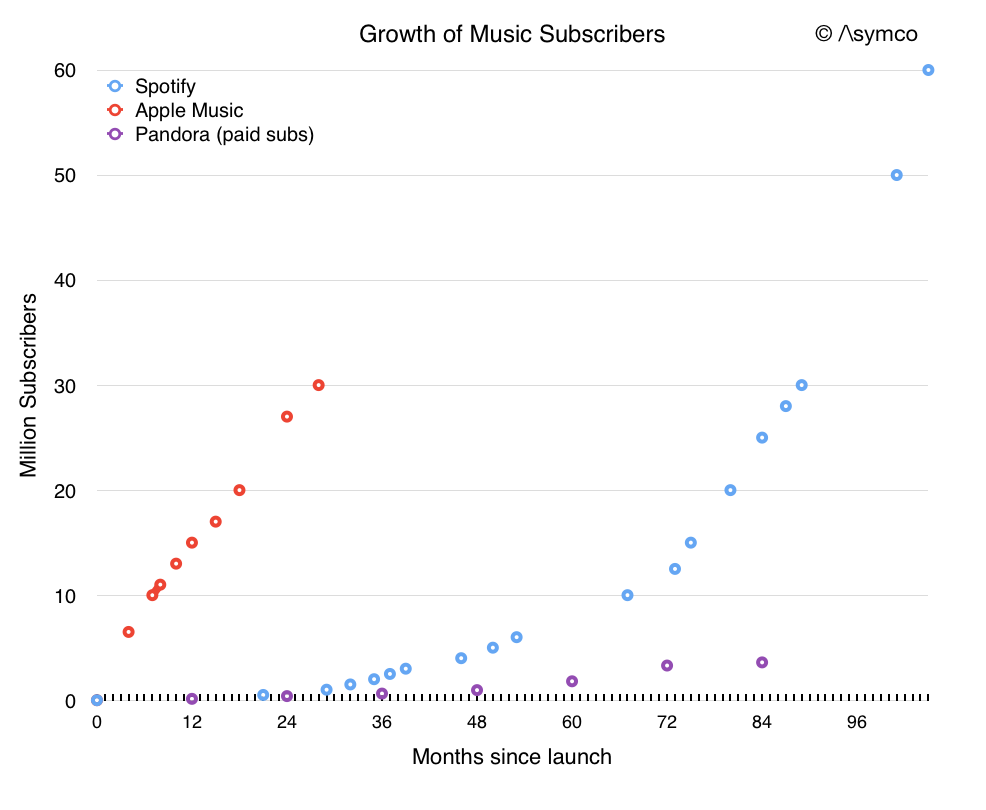
    But instead Apple sill sells songs and has a radio station. And it has a streaming subscription with "only" 30 million subscribers.

    Even when it comes to original video content it rolls out a Karaoke show, of all things. It still maintains an app called GarageBand. It goes and buys Shazam, and paid $3 billion for Beats and still makes AirPods and is about to launch a speaker. Yes, a loudspeaker called HomePod.

    How quaint.

    But all the cynicism around music is tone deaf to the sheer emotion that music can create. Music touches people like nothing else. I've seen young and old cry and burst with joy listening to music. For its low bandwidth, music delivers enormous emotional bandwidth. It always has and always will. It's not obsolete and will never be. Music imprints itself in hearts and remains there for a lifetime.

    It's poetry for the senses.

    Business models for music will come and go but music consumption is increasing. Access to the long tail has meant genres proliferated and production has spread to everyone who cares to try to make music.

    And so it is that more people listen to music on their widescreen iPods in more places and more times than ever before.

    Apple realizes this and the acquisition of Shazam and the launch of AirPods and of HomePod are to serve music.

    Siri or intelligent assistance are nice new services but they are not in lieu of the need for music. Chatty robots are appealing to intellect. Music appeals to the soul. These new products are in service of music because music is what people hire far more than advice.

    HomePod will surprise not because it will be a better at chatting. It will surprise because it will cause you to sit down and listen in awe.

  7. Other Products

    Research · 6 comments

    From the way Apple reports its revenues you might think that the company has several operating segments. There are the iPhone, the Mac, the iPad for which units and revenues are reported. Then there are Services and Other Products for which we have revenues only.

    Services is a collection of all non-hardware revenues and is (finally) being recognized as a non-trivial business. With reported revenues of $26.6 billion in the last twelve months, it's big enough to be a Fortune 100 company and set to double in four years. ((Although a non-zero business, the valuation of Services continues to confound observers who cannot separate it from the hardware businesses it attaches to--which themselves are considered near commodity value--thus paradoxically valuing the overlying asset of Services near or precisely at zero. Incidentally, Facebook is Fortune 98 at $27.3 billion and it is also one of the top 5 largest business by market capitalization.))

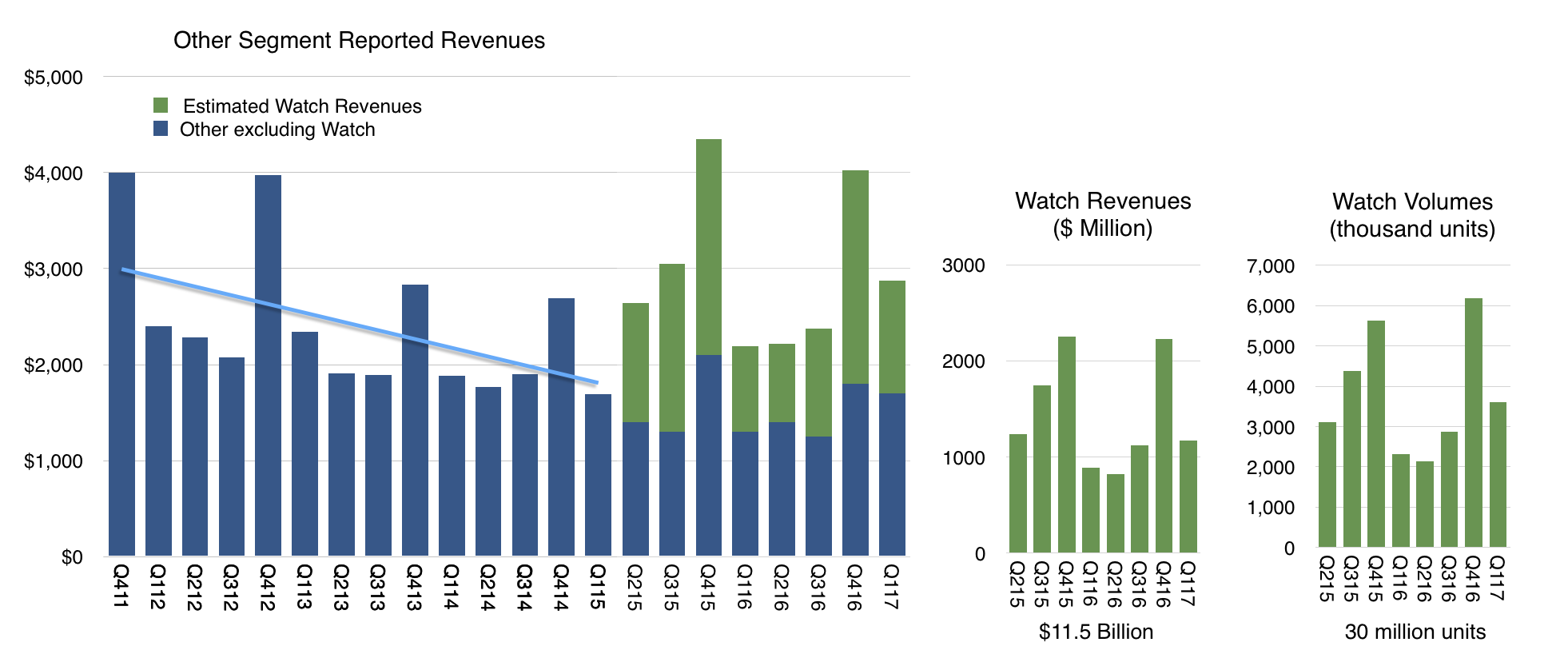
    That leaves "Other Products" which now becomes the revenue segment that is  "most likely to be ignored." This segment had revenues of only about $11.5 billion in the last 12 months which would place it at only a Fortune 245 ranking, equivalent to a Toys "R" Us or Biogen. How should we value Other Products?

    Other includes many hardware products including iPod, Apple TV, Beats, Apple Watch, AirPods and, soon, HomePod. Each is a significant product, with Watch probably the largest single contributor. But since we don't have specific unit numbers, we are left guessing at the contribution of each.

    The Watch itself has been a point of scrutiny as it could be initially teased out of the mix through an observation of the before-and-after launch vs. trend-line as shown below:

    This separation of Watch became harder to discern after the launch of AirPods. Though they are still very hard to obtain, they might be "moving the needle" by now with a contribution that would muddy the Other category further. Same with updated Beats headphones.

    This separation will be harder still with the launch of HomePod later this year. This product is priced at a point similar to the Watch and the quantities sold will be very hard to estimate without Apple's revealing of actuals.

    Fundamentally however, all the "Other products" will have a common relationship to the iOS and MacOS hardware: attachment to and integration with a "parent" platform. Apple TV might be stand-alone but I strongly doubt there are many sold into offices or households which don't have iOS usage.

    This means that "Other Products" are very similar to "Services" in that there is a dependency on a primary platform and, as it has been argued, they are therefore fragile. If the core platform declines then the Services and Other Products decline as well.

    Given this dependency it makes little sense to carve these categories out as separate businesses. They cannot stand alone. They are very much the "children" of the parent platforms.

    This is why it's assumed that Services, (a Fortune 100 company) and Other Products (a Fortune 250 company) can be discounted to zero. By focusing attention on the iPhone one can capture all the essential value of Apple. This is in contrast to the "sum-of-parts" valuation that could be applied to a set of independent business units in other companies.

    And yet I started this discussion with the point that you might be tempted to look at Apple on the basis of these reported revenue segments. The choice of what Apple reports is arbitrary. It could report no segment revenues at all and publish just one revenue number. This is roughly what Google Amazon and Facebook do. Or it could report segments in some other way. For instance, app store revenues and AirPods could be reported as part of "The iPhone Division". Or maybe it could bundle all iOS devices and services and accessories into another segment called "The iOS Group". Or it could create a "Devices group" and a "Personal Computing" group. Microsoft famously shuffles its revenues into creative segments based on various organizational structures or choice of what it wants to project as its focus.

    There is no limit to the ways Apple could slice revenues into segments. The reason Apple does it the way they do is mostly due to historical reasons. The company used to report the iPod separately as a segment but it no longer does. It also used to report Software separately, because, presumably,  it charged for it but now it no longer does. It also separated laptops or portables from desktops.

    The current reporting system is tempting us to draw certain "business unit" conclusions. These boundaries are illusions because Apple does not have business units. It has only one Profit and Loss statement (P/L) and is organized functionally. There is no "head of iPhone" or "head of Mac" responsible for each siloed revenue and cost structure. Instead, the entire business should be seen as a whole because it is managed as a whole.

    This is easily evident in how the products are designed and marketed and how they are engineered. The iPhone may spawn AirPods and AirPods may have no value outside the iPhone but the iPhone is valuable precisely because it has AirPods and Apps and Music and iCloud. And Apple TV, and HomePod and whatever comes next. The reason the iPhone can be sold at three times the price of competitor products is because of the Services and Other Products and iPad and Mac symbiosis. This integration drives the satisfaction, loyalty, price and brand value. There there are the Apple Stores and the launch events and the countless details that make up the ownership experience.

    The fact is that you can't slice and dice Apple.

    There is one Apple and it must be analyzed as a unitary entity. That analysis is therefore difficult. It is easy to pick up the numbers given and study them in isolation. The iPhone, the iPad, the Mac. We all do that.. However we miss a great deal in doing that.

    The lesson is that data we obtain leads us to see something but it also blinds us by taking attention away from what we cannot see. All data lies by omission. That which is left unmeasured may be where all the truth lies.