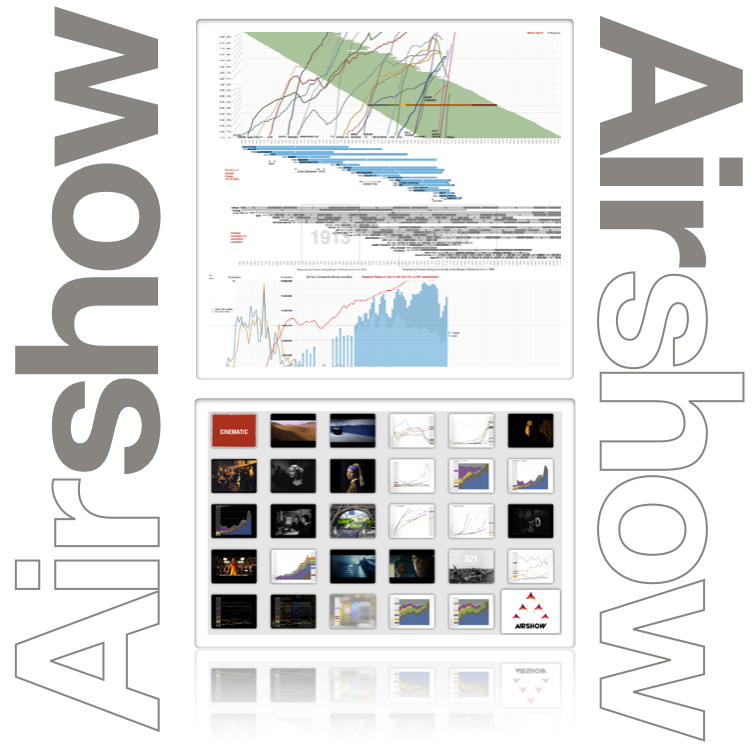
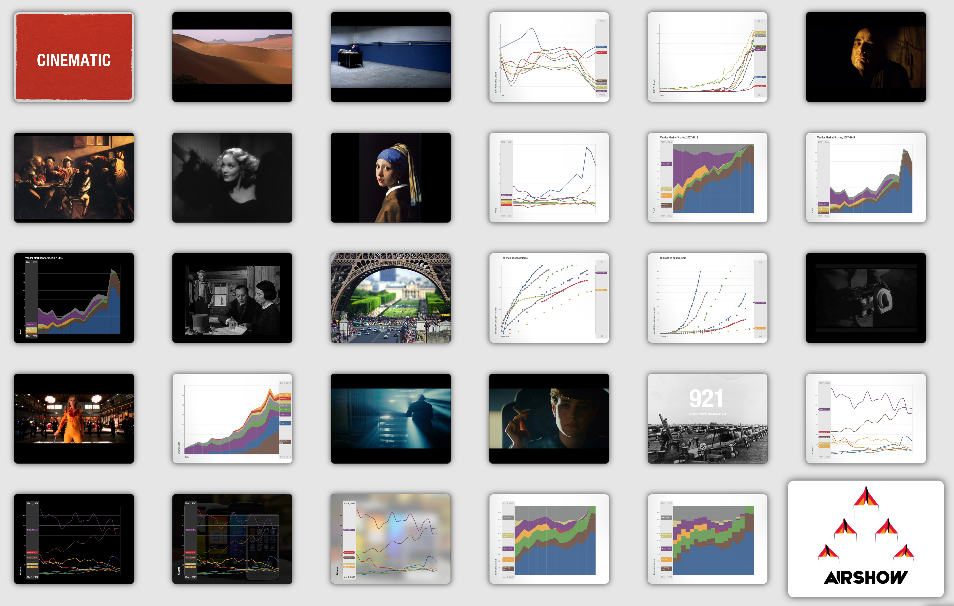
We are ready to roll out Airshow 2.0, a redesigned curriculum for motion-based data presentations.
Three years ago, we created the Airshow concept as a study of how stories come alive using data. We drew inspiration from cinematography and combined with the work of Welles, Tufte and Rosling to build a new theory of presentations. We offered explanations of:
How and why are presentations different from one-on-one interactions?
Will new user interface metaphors such as touch help tell stories better than the slide advance clicker?
Are motion and interaction an effective ways to present? If so, how are they to be choreographed and directed?
How does “camera position” affect a data story?
Since that initial concept, we have learned far more.
Airshow 2.0 moves beyond executing a story in pixels to the writing and directing process. As before, we teach using the process itself: through stories presented as data.
Understand how data can be used to persuade through an appeal to logic as well as through empathy.
Understand the basics of "data cinematicism" including the techniques analogous to cinematography and direction.
Understand story development techniques including how to facilitate the audience's entry into the story.
Learn how to build a cinematic presentation.
The method we devised borrows heavily from the techniques of cinematography and screenwriting to impart meaning to the audience beyond the literal words spoken or images shown on screen. These techniques are demonstrated with "feature presentations" and then deconstructed in interactive lectures. Throughout we also weave Aristotelian rhetorical tips and present from the Asymco repertoire of stories.
Given the cinematic nature of the event, we thought it would be fitting to use a screening room, so we have reserved the the Auditorium at Fry Art Museum. See Airshow Seattle event page for more information. Discounted registrations for readers of this site are available. Students and teachers may register with an academic discounts.
Horace and Anders discuss Opening Weekend Sales of iPhone 6, Accurate Timekeeping Device, the 3rd tentpole of Apple Watch, leading to a brief history of wristwatches, a study of Job-to-be-done for the watch and what it signals about Apple's future.
Horace also announces his new role at the Clay Christensen Institute, and the resumption of Airshow World Tour starting with Airshow Seattle on Nov 8.
Understand how data can be used to persuade through an appeal to logic as well as through empathy.
Understand the basics of "data cinematicism" including the techniques analogous to cinematography and direction.
Understand story development techniques including how to facilitate the audience's entry into the story.
Learn how to build a cinematic presentation.
The method we devised borrows heavily from the techniques of cinematography and screenwriting to impart meaning to the audience beyond the literal words spoken or images shown on screen. These techniques are demonstrated with "feature presentations" and then deconstructed in interactive lectures. Throughout we also weave Aristotelian rhetorical tips and present from the Asymco repertoire of stories.
We will be conducting our 9th Airshow event in Vancouver next Wednesday, March 26, 2014.
The purpose of Airshow is to:
Understand how data can be used to persuade through an appeal to logic as well as through empathy.
Understand the basics of "data cinematicism" including the techniques analogous to cinematography and direction.
Understand story development techniques including how to facilitate the audience's entry into the story.
Learn how to build a cinematic presentation.
The method we devised borrows heavily from the techniques of cinematography and screenwriting to impart meaning to the audience beyond the literal words spoken or images shown on screen. These techniques are demonstrated with "feature presentations" and then deconstructed in interactive lectures. Throughout we also weave Aristotelian rhetorical tips and present from the Asymco repertoire of stories.
We will be conducting our 8th Airshow event in London next Wednesday, 26 February 2014.
The purpose of Airshow is to:
Understand how data can be used to persuade through an appeal to logic as well as through empathy.
Understand the basics of "data cinematicism" including the techniques analogous to cinematography and direction.
Understand story development techniques including how to facilitate the audience's entry into the story.
Learn how to build a cinematic presentation.
The method we devised borrows heavily from the techniques of cinematography and screenwriting to impart meaning to the audience beyond the literal words spoken or images shown on screen. These techniques are demonstrated with "feature presentations" and then deconstructed in interactive lectures. Throughout we also weave Aristotelian rhetorical tips and present from the Asymco repertoire of stories.
In a world where everyone needs to present, few know the power that lies under their fingertips.
Whether one-on-one or in front of millions on TV, presentations are the primary means of persuasion in business.
Have you ever cringed at text-only slides or puzzled over graphs that made no sense? Steve Jobs saw "PowerPoints" as "rambling and nonsensical" and had them banned internally. But he used visuals for all his keynotes. What made them tolerable, even persuasive?
The problem is that most people receive no training in how to compose the most crucial images they project to an audience and the tools available do not take advantage of motion, touch, processing power, mobility and high resolutions.
Airshow teaches principles of visual persuasion using techniques of cinematography and visual storytelling.
Airshow shows how tablets create a new stage for your performance.
Airshow applies Aristotelian rhetoric, Cinematographic theory and Cinematic storytelling as well as Tufte design principles into a new medium.
You’ll learn how to:
Persuade with logic, empathy and credibility.
Present rich data as compelling and emotionally engaging
Get hands-on experience with modern tools of persuasion including tablets and interactive, touch-based interfaces.
You have the data. You have the audience. All you need is a story and a screenplay. How do you build them?
There are techniques which are proven to work. They’ve been used by writers, performers and playwrights for centuries. Professional presentation coaches will teach you far less and at greater expense.
Airshow is better and less expensive, especially in terms of time.
Airshow is an intimate experience. Audience size is limited.
All the tools and techniques needed in one day of intense, inspirational and engaging training.
Here's how it works: For every month in 2014 an Airshow event will be hosted. The location for that month will be locked-in when the first 20 registrations for that city will be recorded. Any registrations that take place before the location is locked-in will be half-price.
In other words, early registration means you get half off! ((If your registration is not part of a quorum (fewer than 20 total) then it's automatically re-issued for the following month. You may also request a refund.))
Now is the time to learn presentation skills for the post-PC era. Just like there is no writing which does a movie justice, I can't write here how it's done, you have to see it live.
“Airshow was amazing. Business stories with cinematic impact made easy with perspective” — Paul Brody, Global Business Leader, IBM
“Airshow has fundamentally changed how I give client and industry presentations. It is an important tool in my toolbox which allows me to showcase my data and my story in ways that help audiences gain deeper insight and perspective.” — Ben Bajarin, TIME, TabTimes, Techpinions
“Nobody brings numbers to life like Horace Dediu does.” —Philip Elmer-DeWitt, Fortune/CNN
“The unhurried nature of Airshow is just terrific and in contrast to many other events. Anyone who goes will gain their own purposes.” —Steve Crandall
“Airshow is a treat [...] showing how to make the audience wonder.” —Bertram Gugel
“Airshow is surpassing my expectations. Very interesting deep content.” —Ryan Singer, 37signals.
Fresh off of back-to-back AirShows, Horace discusses the future of his "cinematographic" presentation style and announces Airshow World Tour. We also look at episode #103's prescient prediction of Amazon's move into delivering their own products.
Cinematic is to film as Literary is to prose. It's not a measure of quality or of beauty. It's mainly the application of technique to impart an additional layer of meaning to the writing, performance and direction of the medium. Cinematic technique lifts the viewer to another, more profound point beyond the literal.
Whether it's film, literature, verse, stagecraft or other visual arts, techniques vary but they have the same purpose. They make the audience feel more than what is said.
The quality of a good work of art is that it tells a truth without saying it.
And this, I believe, is what the analyst should also strive for. It is at least what I try to do and, having practiced for a while, I think I can convey some of the techniques I learned.
We don't have a better word for describing these techniques than "cinematic". They allow the presenter of complex and rich data to convey meaning with an economy of rhetoric. They draw the audience into completing the picture thus making it their own. They persuade without pleading. They teach without lecturing. They create, in a way, a poetic language for data that combines techniques from several arts, especially cinema.
The means for teaching this is a workshop called Airshow.
Together with IBM, we are proud to bring Airshow to Boston, New York and Helsinki this year.