Asymco

Asymmetric Intelligence

Apple Vision Pro

  1. First footage of X-Plane 12 on Vision Pro

    Nota Bene

    Including an ARKit trick in action

    Yesterday we learned that the “world’s most advanced flight simulator” will soon work with Apple Vision Pro. Now we have a first look at how the experience will look, including how ARKit intelligently handles physical controls.

    X-Plane 12 is coming to Apple Vision Pro through a companion app this spring. Support will be enabled by visionOS 26.4, which supports Nvidia CloudXR 6.0 technology. The flight simulator will stream in mixed reality to Apple Vision Pro from X-Plane 12 on the Mac, Windows, or Linux.

    Now Spatial Insider creator Justin Ryan has shared a first look at how X-Plane 12 works on Apple Vision Pro.

    Source: 9to5Mac

    NB: A complicated product for a demanding audience.

  2. Apple unveils new Studio Display and all-new Studio Display XDR

    Nota Bene

    Don't ask me, my only monitor is an Apple Vision Pro

    Studio Display XDR is the world’s best pro display, featuring a 27-inch 5K Retina XDR display with a mini-LED backlight, 2000 nits of peak HDR brightness, and a 120Hz refresh rate

    Source: Apple Newsroom

    NB: These numbers are not for most people. They certainly are...

    Join us at Asymco Office Hours, for a Live Q&A about Apple with Horace Dediu & Ben Bajarin.

    Today, Wed March 4, 3pm ET / 12p PT.

  3. A resource for AVP news

    Nota Bene · 1 comment

    AVP VIP

    Every week I compile a week's worth of interesting news, reviews, findings in a page that is visually pleasing and easy to digest without clicking all over. Full page with photos/videos/commentaries located here (free with no ads).

    Last Week in AVP #107: Apple Could Demo Immersive F1 on Vision Pro at Its March 4 Event, New Chapter of the Elevated Series Coming Next Friday, Top Dogs On Apple Immersive and more!

    Source: Last Week in AVP #107

    NB:    I use AVP every day  ...

  4. YouTube Finally Releases an App for the Apple Vision Pro

    Nota Bene

    YouTube is the new TV. Now finally on Apple Vision Pro.

    Starting today, an official YouTube app is available on the Apple Vision Pro, allowing you to watch videos on a theater-sized screen with immersive visionOS Environments.

    Every video on YouTube is available in the new, standalone visionOS app, including standard videos, 180° videos, 360° videos, and YouTube Shorts. And on the newer Apple Vision Pro with the M5 chip, you can even watch YouTube videos in 8K.

    Read the original article →

    NB: Finally. Using a browser to watch YouTube on an immersive device was a big failure, we just don't know whose.

  5. A Retro Video Game Arcade in your Home on Apple Vision Pro

    Nota Bene

    Imagine trying to explain this to yourself if you lived during this era.

    "Retrocade turns your room into a playable retro arcade. You can place a lifelike arcade cabinet in your space or jump into a full virtual arcade and play classic games like you’re actually there.

    In this video, I show Retrocade running on Apple Vision Pro, from placing the arcade cabinet in mixed reality to stepping inside the virtual arcade and playing. You’ll see how it looks and what the experience is like once you’re in it.

    Retrocade includes classic arcade legends like Pac Man, Galaga, Frogger, Space Invaders, Asteroids, Bubble Bobble, Centipede, Breakout, Track and Field, and Haunted Castle. Retrocade is included with Apple Arcade and requires a compatible game controller to play.

    If you love retro games or just want a fun, instantly impressive Vision Pro experience, this one is worth checking out. Retrocade launches on February 5, 2026 and is one of the coolest Vision Pro experiences I've tried yet. You’ll find it here on the visionOS App Store: https://apps.apple.com/us/app/retroca...

    Source: You Tube Link 

    NB: It's hard to describe these Vision Pro Apps and videos don't do them justice. We will need a new camera language.

  6. The Joy of (new) Numbers

    Research

    In the latest, (Fiscal Q3, Calendar Q2 2025) conference call, Tim Cook made a welcome announcement: "We also recently marked a significant milestone. We shipped the 3 billionth iPhone since its launch in 2007."

    This was welcome because the company has not been providing iPhone unit shipment numbers since Q4 2018. What it has meant is that the number of iPhones sold and their average selling price had to be estimated. Active iPhones were occasionally provided but quite rarely.

    With this update, the veil has been party lifted. I, as well as you I'm sure, rushed to assess how well we have been estimating the iPhone economy over the last seven years. Prior to Tim's data dump, my own estimate for total iPhone shipments was 3.104 billion, including the last quarter. [Keep in mind that the 3 billionth iPhone may have shipped in the beginning of the quarter which amounts to more than 50 million units prior to announcement so my error of 104 million is minus perhaps 50 million.]

    In the worst case, my error amounts to about 3.4% over the entire lifespan and perhaps 5% over the estimate period. That is perhaps not criminal since, after all, what's 100 million iPhones between friends?

    I adjusted the estimated average selling price to reflect this error and shaved essentially one quarter's worth of shipments from the data set. In other words, my estimate would have been that 3 billion was reached in March rather than June. Mea culpa.

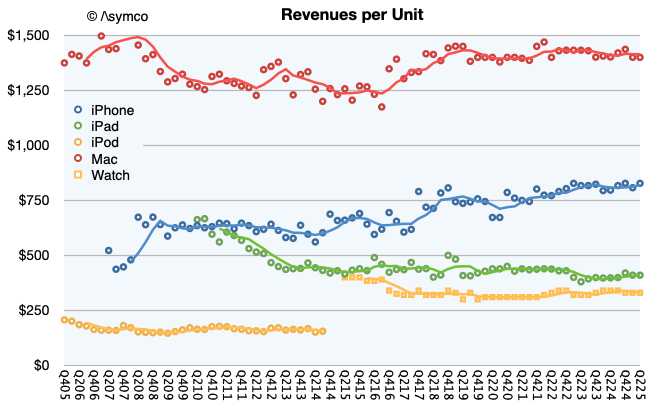
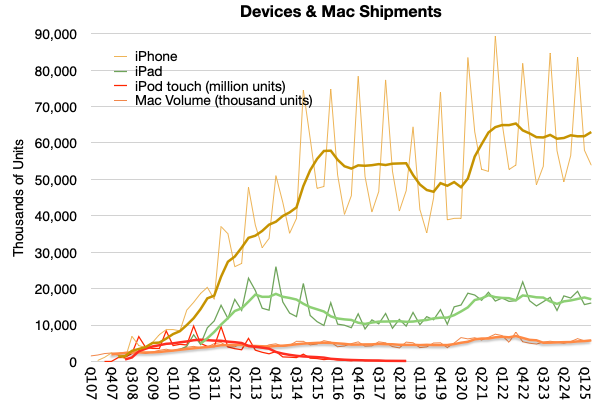
    The new view into the entire iPhone shipment history is shown below. Also below is the impact of adjustment in the revenue per unit (i.e. average selling price.)

    Note that I used trend lines to show the four-period (12 months) running average to remove the seasonality. Perhaps there is something to be read in the pattern. I would say that there are some notable surges as during the initial uptake, during the first "supercycle" in 2014, the surge during Covid and perhaps the "China recession" of 2018.

    Clearly we are not at the highest sales levels today, as the Covid surge will take some time to grow into but at the same time the volumes are not decreasing. You can see the contrast to the iPod touch when an alternative was available, namely the iPad. The demise of the iPhone has been greatly exaggerated.

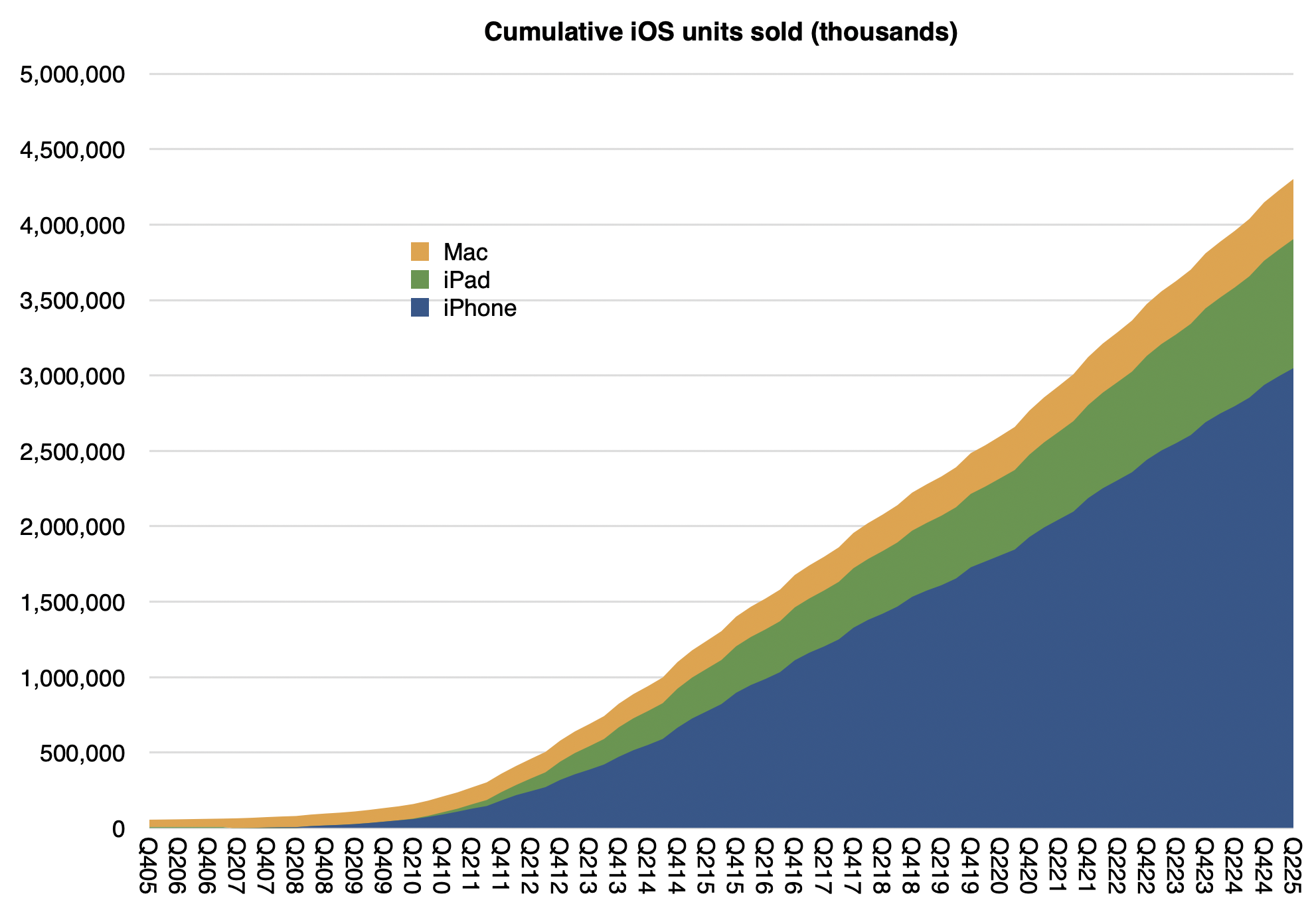
    Note also that I also included the iPad, Mac and the iPod touch for comparison. You can try your hand at reading the patterns there. For the record, my cumulative Mac estimate (since Q4 2005) is 398 million[1] and the cumulative iPad is 855 million. Here are the iPhone, iPad and Mac cumulatively with a current total of about 4.3 billion:

    Not shown are iPods (touch alone is about 114 million), Watches (probably at least 250 million) and Vision Pro (single digit millions) or wearables and home. If we did include those, it's a safe bet that Apple has shipped over 5 billion devices.

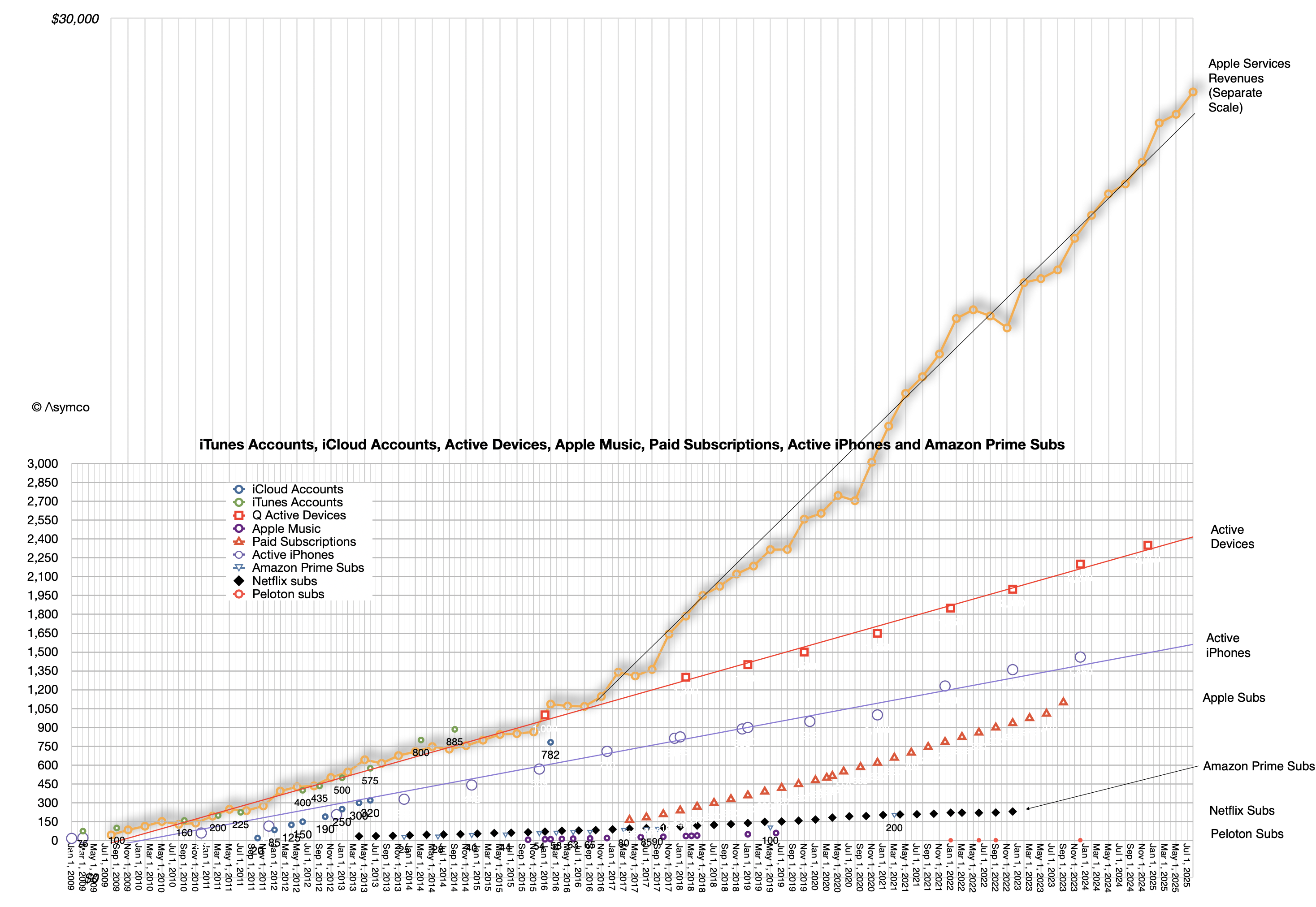
    Interesting, but not as interesting as how many are active (in use at least once a month.) For that estimate we have another set of data:

    The linear extrapolations for active devices, active iPhone and, on a separate scale, actual Apple Services revenues can be seen. Also subscriptions, as long as they were available, plus other data sets for comparison such as Amazon Prime subscriptions, Netfilx and old Apple Music and iCloud account data.

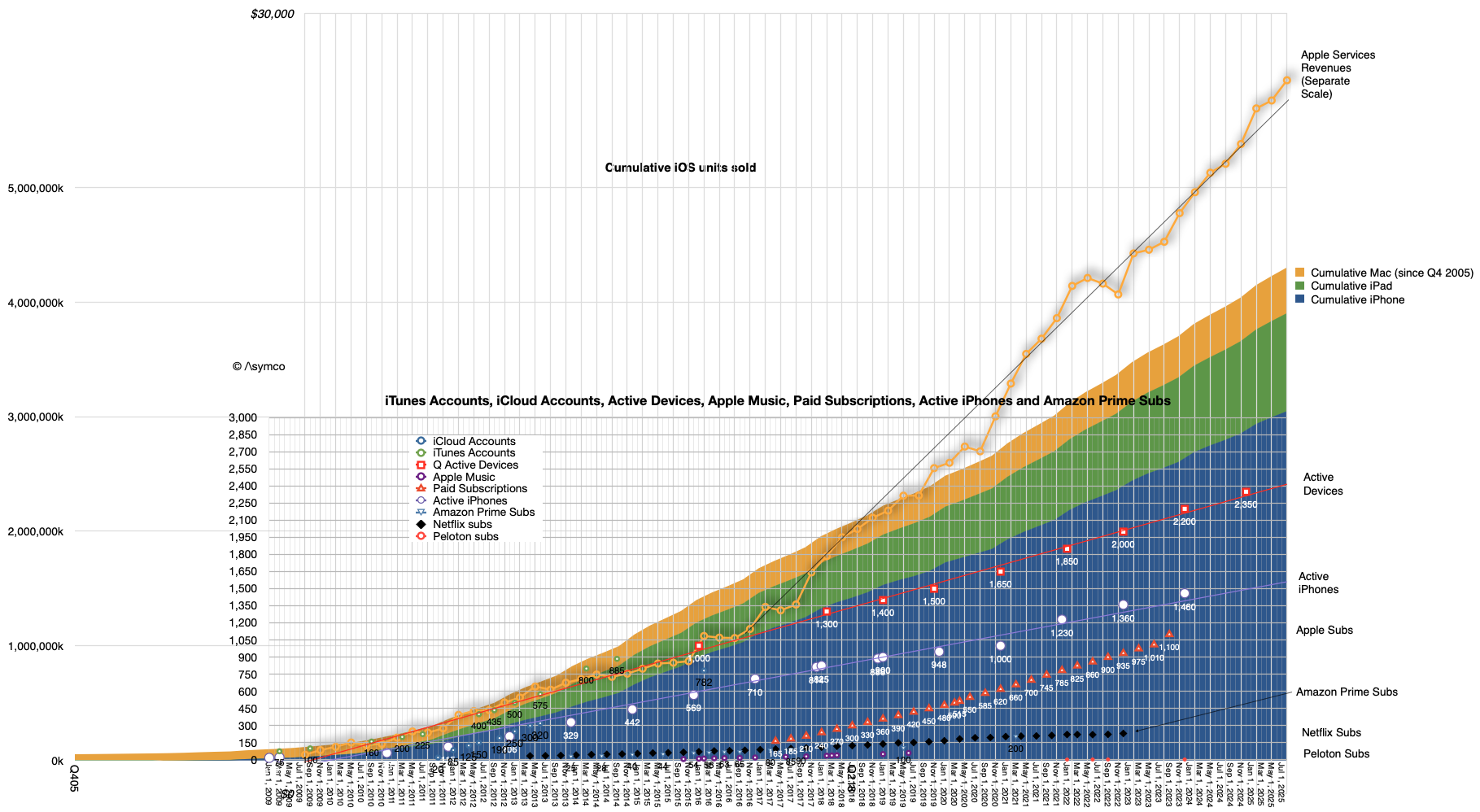
    At the risk of overloading an already busy graph, it might be interesting to show cumulative devices vs. active devices:

    The Composition of Active Devices

    The top of the area graph seems to be not too different than the top of the red dotted device line. What might be instructive is to calculate the ratio between these two: the active devices and the cumulative devices during the period from 2016 (when 1 billion active were reported) and the beginning of this year when the last figure was reported (2.35 billion active devices on Jan. 30 2025).

    Again, excluding wearables, iPod touch, Apple TV and Apple Vision Pro we have these ratios:

    DateRatio of Active devices to Cumulative iPhone, iPad and Mac sold
    Q4170.66
    Q4180.63
    Q4190.60
    Q4200.60
    Q4210.59
    Q4220.58
    Q4230.58
    Q4240.57

    What this suggests therefore is yet another way to forecast the value of Apple as an enterprise. We already know that the prediction of active devices, revenue per device and margin is sufficient to forecast the company's earnings. These all seem to be quite linear and thus predictable. Now we can add the relationship to devices sold as yet another way to calibrate or test assumptions.

    After diligently doing so, simply multiplying the results by a random number called the P/E ratio (aka "sentiment") allows you to predict the share price at any point in the future.

    Have fun.

    1. It would be interesting to consider that if, as it's been often claimed by Apple, half of Mac users and half of iPad users are new to the products, then there would be 200 million new Mac users and perhaps 400 million iPad users.
  7. It's Spacetime

    Research

    The Apple Vision Pro has had a very long gestation period. The first evidence for it emerged in 2015 when Apple acquired Metaio and Mike Rockwell was hired. That's almost 9 years ago. Even at this time, the product is in many ways incomplete and will take some years to develop into its potential.

    So why is this taking so long? How does it differ, it at all, from other product developments at Apple? And what was the decision process for the product? Was it different than other Apple products? Now that we have the product to use, it's possible to hypothesize answers to these questions and examine how Apple is evolving in its own long-term trajectory.

    After using the product for a few weeks my observation is that the development of the Vision Pro appears to have been an engineering-led heavy lift rather than a design-led puzzle solving. To suggest such a distinction between engineering and design is perhaps obvious but it's not so obvious for Apple. Historically the two disciplines were blended imperceptibly or forged into a whole by management. Not without difficulty but forged nonetheless. I therefore think that this effort is a departure.

    For the Vision Pro there were significant measurable performance requirements such as resolution, frame rates, tracking (eye and hand) accuracy, response times, weight/size, and power consumption which all needed huge leaps forward. Orders of magnitude. None of these were good enough for those nine years and some are still not good enough, especially for mass adoption. This is before considering the software and ecosystem which need to be built for an entirely new experience. All of these breakthroughs are against hard physical (biological) constraints. Engineering is all about balancing physical constraints, making tradeoff decisions in pursuit of some optimum. The Vision Pro was hard to develop because it requires all these inter-related constraints to be balanced.

    In contrast, design decision making has to consider purpose. It leads to more of the human and environmental (economic) factors: what is the user trying to do? What are the limitations of the person using it and what are the circumstances of the usage? What should be the goal? It's more a question of why than how. Design is answering the Job-to-be-done question whereas engineering is answering the how-to-get-it-done question. Apple's leadership in product over the years was due to their insight into both of these questions. As Jony Ive would say: saying no to a thousand good ideas and focusing only on what mattered, based on keen insight into the human condition. Another way of saying that a product needs to justify its existence.

    Design is not just how a product looks or feels. It's how the user discovers it and thus why it exists.

    The purpose of the Vision Pro is however all too brief: to enable a new human/computer interface. The very premise that created Apple: make computers easier to use and thus make them more useful and more used. The developments of silicon and optics and batteries and communications of the last few decades have suggested that there was a leap possible beyond the prevailing touch interface. Multitouch itself was a leap from the trackpad/mouse which was a leap from the keyboard input method. All these leaps cause Apple to surge forward, delivering a sequence of futures in a way that made them absorbable by many if not most.

    In addition, the Vision Pro is not a product that the user needs to look at while using it. It's completely invisible, having no physical presence to the user. You look through it rather than at it.

    Therefore there is no question of "Why" or "How to use it". These are self-evident. Consider the user's input. The interface of looking at something and touching fingers together is so direct that there is no need to learn it. You rather need to unlearn the "computer" interface to use it.

    Now consider the output: The canvas to paint on is not a rectangular screen with rounded corners and perhaps a pill-shaped cutout. It's the entire world. It's all that you can see. It's not in front of you. It's all around you. The place you use it is not in your hand, on a desk or a slice of time. It's anywhere and anytime. In other words, we don't need to have--as there was with the phone--"a conversation" with the user to discover what is missing and what can be fixed. If anything, the design surface is everything and everywhere.

    The premise of spatial computing is that computing is consciousness itself. All that you see, everywhere you are, with no friction of "interaction" or "input/output". There is no "user interface". There is only space, natural and synthetic.

    So it follows that this product is different. The Vision Pro is a project to develop not just a new computer but a new way that computers are used.

    Before going into how exactly, let's recall that when the phone was made mobile it made calling a person possible. Before the mobile phone, calling meant calling a place. To call a person meant guessing where they would be. Going to calling a person, and not just a place, meant all people were callable and also all people could be callers. Once data was provisioned to the phone then all people could not only consume but they could also publish. Anything and always. Which they did, for good and bad.

    The Apple Vision Pro is aiming to do even more. It's saying that computing is not something you initiate and terminate. Or that you do in a place. With a phone you stop, look, act and then go back to what you were doing before. Spatial Computing is ambient. It's wearable. The Apple Watch is also an ambient computer but it has limited output. It's so limited that it's essentially consumed with a single glance. The Vision Pro is the opposite. Every photon you see, it generates. To avoid it, you close your eyes.

    For this reason, the classical questions of design are moot, or at least they are moot on the device. They become relevant at the app layer. The device is bionic. It's defined by biology not consciousness. The questions of what to paint on the canvas the user sees, i.e. the world, is left as an exercise to the developer.

    The product strategy, go-to-market and all the details we are witnessing related to launch and packaging are a byproduct of this essential distinction. The development process, the ecosystem questions, the price points. They are all what they are because this is such a giant leap forward. It must be understood for its profundity and that will not be quick or easy. It's unintuitive really. Rather like Special Relativity was when Einstein proposed it. It is still unintuitive today because it makes sense only on cosmic scales (and the speed of light.)

    So I propose that those who might want to consider this new spatial computing era should call it something else: spacetime. The time spent in spatial computing but also this new era we are entering.

    Welcome to spacetime.
  8. Brief Comments on the iPhone 15 Event

    Research

    After the Apple iPhone 15 launch event of September 12, 2023 I was a guest on the Claman Countdown show on FOX Business News (FBN) and here is the video.

    https://www.foxbusiness.com/video/6337041605112

    In advance of the event I was asked for a few thoughts that might be topics I would like to discuss.

    My answer was:

    Apple has been pushing hard on imaging in their iPhone evolution. It has also released the Vision Pro that offers so-called Spatial Photos and Video. There is speculation that there will be some linkage at some level with Vision Pro and iPhone imaging. I do wonder if we’ll get hints of possible new optics that can support the Spatial Photography

    Remember that Apple hinted at Spatial capabilities with its iPhone Lidar sensor some time ago. Apart from better focus at night, there was little purpose for laser distance measurements in a 2D photo device.

    Additional Apple Watch health features are also always interesting. Apple’s efforts in health are hiding in plain sight and point to major value proposition to a large audience that skews older."

    Based on this, I'm rather happy to see the support for Spatial Photos and Videos in iPhone 15 Pro. The surprise on the watch was not a new Health feature per se but the Double Tap interaction mode.

    Also of interest to me was the Roadside Assistance via Satellite. This will be a very well received feature and many news stories will be written about it.

  9. How Vision Services Subscriptions Reach $3000/yr

    Research

    One of the biggest puzzles of my adult life was this question: Why do people pay to attend live events when broadcasts and/or recorded versions are free? Not only do people tend to pay for live events, the costs are extraordinarily high. Earlier this year, 32% of planned concertgoers expected to spend $500 or more attending events, a LendingTree survey found. The survey also revealed 38% of concertgoers were willing to pay more for better seats, up to $328 for their favorite artists. The average price for a Drake concert is $600 and for Taylor Swift it's $2,424(!) Adding travel, accommodations, opportunity costs and transactions costs, the live event costs can easily run in the thousands per event.

    And it does not end there. Live events offer an inferior experience. The seat location can be far from the action, acoustics can be poor and there is usually a lack of multiple angles or replays (in the case of sports) to see the details of the action. Often, spectators have to watch large screens in order to actually see what is going on. In other words, they pay a great deal to watch the event on TV even if they are at the event.

    This puzzle came back to me also when attending the Apple Vision Pro launch at this year's WWDC. Those of us watching it in person basically watched what everyone at home saw, but in a degraded outdoor screen experience complete with sun glare and wind noise. Of course, we also got to see the device up-close and some even got demos. But this was the exception. Most spectators at live events do not obtain access to the talent. They may get to chat with friends or meet new ones but that is entirely haphazard.

    Now I know all the arguments about "presence" and the feeling of being a part of the event itself and the sense of occasion and shared experience that it generates. It's something movie theater operates are trying to also convey even while they are screening recorded content. Clearly there is some value to this. But $3000 of value?

    Let's then assume that, since the market is always right, there is $3000 of value in a premium live event. Consider a season pass to top sports leagues. Consider concerts, night clubs and band gigs. Then there is the line of business that I happen to also offer: live talks and conferences. How does technology affect this particular form of content?

    Well, I believe Apple has an idea. Apple, after all, invented the product-release-as-an-event. That is, Apple created event marketing–and everyone followed. Apple was first to know the value of the technology show business and in particular live show business.

    But delivering such businesses is not reliably profitable. The more reliable business is ticketing–an annoying racket. Putting on the show is touch-and-go. It might be sustainable until costs rise due to the talent asking for a greater share, or other service providers following suit. It's also difficult to stay on top as crowds are fickle and tastes change.

    This is why I think Apple's Vision Pro is at least partly aimed at "performance conveyance," rather than the more crude "recorded media playback" job to be done. If this is so, then the business model that makes sense is to license rights to performances and deliver them. The same way that licensing rights to recorded content and delivery was the business model of screen-based devices.

    So what does Performance Conveyance mean? Well, we have to look at performer quality, brand and the experience itself. If they come together well then Apple can say they deliver on the job of "live". And if so, then they can charge accordingly. Hence, whereas Apple Music is $10/mo. or Apple TV is $10/mo. or a bundle of services is $30/mo., then why wouldn't Apple Live be $300/mo?

    If not subscription then perhaps à la carte payment for events: sports, concerts, et. al. In combination it's not unreasonable that Apple with Spatial Computing and Vision will offer a new tier of service bundle pricing with an average revenue per user of $3000/yr.

    That would certainly solve my puzzle.

    [Edit: I forgot to mention the value of theme parks and (ersatz) tourism in general. Clearly this is such a powerful idea that industries have been created around it.]