Asymco

Asymmetric Intelligence

iPhone

  1. Estimates for Apple’s first fiscal 2013 quarter

    Research · 130 comments

    I've postponed my estimates for the fourth calendar for a long time. The reason is that there have been conflicting data to deal with and I've been hoping for some clues to give clarity. Unfortunately, even though I waited, I have not received many clues. Here are the challenges we have to deal with in this quarter:

    1. Management gave very low guidance for the quarter's earnings and sales. Normally this should not be a concern since the long-term pattern has been for them to "sandbag" significantly. For example last year's fourth quarter was guided at $9.3 EPS while the company delivered $13.87, a 49% "beat" to their guidance. However Q2 and Q3 beats were only 7% and 13% respectively and if we assume a similar number (10%) for Q4 we get about $13/share which would be a year-on-year decline in earnings (down from $13.9). This has not happened for many, many years. Management explained this through a lengthy set of reasons including a shorter quarter (13 weeks vs. 14 weeks), new product launches, currency fluctuations, deferrals and unfavorable component pricing. Then again, similar explanations were used in the past with no reflection in what actually happened.
    2. Management also launched a large number of new products. This normally leads to a surge in sales. In fact, 80% of revenues would come from a new portfolio of products. Having such a broad launch quarter into a holiday, would normally imply huge growth. Not only is this a critical launch quarter for many products but they also rolled out the iPhone to more markets more quickly than ever: 100 countries in three months. The broad roll-out implies a steeper ramp in production and thus more volumes. This would also contradict the lowered expectations from the CFO. However...
    3. Production was constrained. It was quite a long time before waiting times decreased for the iPhone--longer than what we saw last year. In the earnings call Tim Cook said "It's difficult to predict when supply and demand will balance, but I'm feeling very confident on our ability to supply quite a few iPhones". This again implies significant acceleration but did they achieve the targets? He did also announce that they met their target of 100 countries during the quarter but it's not clear if this was as quickly met as they would have liked.
    4. Margins are complicated. Launch quarters have lower margins typically and this is well understood. However, we have new products in the form of a new iPad at a new price point as well as the new iPhone which may have had some difficult manufacturing issues (i.e. yield). So how much faith do we put in the perennial pessimism in guidance?
    5. There was a vast increase in CapEx in the prior quarter. Normally CapEx spending "leads" production and is in proportion to it. However, the surge in Q2 and Q3 seemed to be unmatched by vast new production, at least that's what we are led to believe by both consensus and by management guidance. Did this CapEx differ in character from previous CapEx? Was it more "strategic" and less "tactical"? Will the disconnect continue?

    There are also the deeper questions:

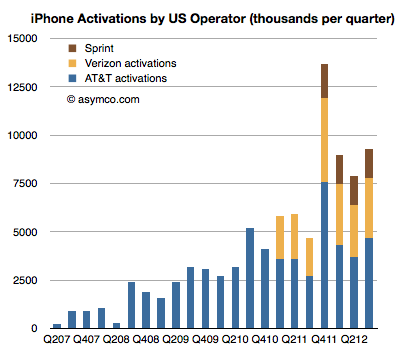
    • Why there are no new operators being signed? The addressable market has not increased in the last 6 months. Why?
    • Is there a faster product cycle in the works? Is there a shifting of gears to a new product development process?
    • What's the nature of the relationship with Samsung as a supplier? Is their replacement characterizing the new type of CapEx spending?

    All these currents make this quarter doubly difficult to forecast. And it does not help that it comes on the back of two weak quarters which were argued away as exhibiting transition effects.

    So I'm very uncomfortable with my forecast and find it hard to defend this quarter. I considered not publishing one at all because it gives too much confidence when none is warranted. However, I received so many requests to publish that I relent and offer the following:

    • iPhone units: 55.5 million (50%/62%)
    • Macs: 5.0 million (-4%/+3%)
    • iPads: 24.4 million (58%/70%)
    • iPods: 11.2 million (-27%/-22%)
    • Music (incl. app) rev. growth: 25%/38%
    • Peripherals rev. growth: 10%/19%
    • Software rev. growth: 5.5%/14%
    • Total revenues: $60.0 billion (30%)
    • GM: 39.8%
    • EPS: $15.74 (13%)

    I included two growth figures (in parentheses). The first is a straight y/y value and the second is adjusted by assuming there were 13 weeks last year (and that sales were evenly distributed over those weeks).

    [We'll get a chance to go over this forecast and what is actually reported at Asymconf. Don't forget to sign up.]

  2. Calibrating launch performance for the iPhone in China

    Research · 59 comments

    When the iPhone 5 launched Apple promised availability in 100 countries before the end of year. This was a very aggressive plan given the gradual release of previous products. Last year the iPhone 4S only arrived in China (along with 21 additional countries) on January 13th. This year it was almost a month earlier.

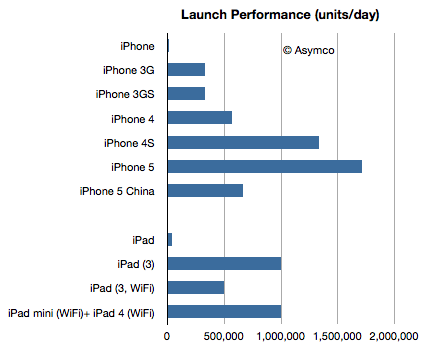
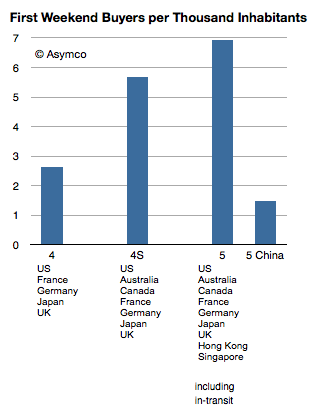
    Apple also announced for the first time this year first weekend sales for China: 2 million. This is, as far as I know, the first weekend sales data for a single market outside of the US. The time span was three days and therefore the daily sales rate was 2/3 million per day.

    The following chart compares the launch performance for the launches which Apple reported:

    Screen Shot 2012-12-17 at 12-17-2.44.04 PM

    If we normalize by population, the launch performance shows about 1.5 iPhones sold per 1000 inhabitants.

    Screen Shot 2012-12-17 at 12-17-2.47.07 PM

    It's a lot less than what we saw with the iPhone in the US and the first tranche of launch countries. But it's not far from the 2.6 achieved by the iPhone 4. The pricing and 3G penetration in China are far less favorable making this even more impressive.

    According to ISI's Brian Marshall, the iPhone achieved 1.5% penetration of the 3G subscriber base or 15 iPhones per 1000 3G subscribers. If we assumed the same basis (3G subs) that would make the iPhone 5 twice as popular on launch in China than in the US.

  3. The real threat that Samsung poses to Apple

    Podcast · 430 comments

    [The following is a post written by James Allworth.

    James is the co-author of How Will You Measure Your Life?. He has worked as a Fellow at the Forum for Growth and Innovation at Harvard Business School, at Apple, and Booz & Company. It follows and builds on a discussion we had on the 56th Critical Path podcast.

    You can connect directly with James on Twitter at @jamesallworth -ed]

    A lot of ink has been spilled in the wake of the recent Apple Samsung patent disputes, and the legal wars see no sign of abating any time soon. The rise of Samsung's phone business has been meteoric, and Apple is right to be concerned. But the real threat that Samsung poses to Apple has very little to do with the copying (or not) of Apple's designs. The lawsuits have simply been a convenient (if expensive and risky) way to attempt to quash a threat that is of Apple's own making. While there's no doubt that Google has played a key role in Samsung's success by handing out a free mobile operating system to pretty much anyone who wants to build one — it is actually Apple, more than any other company, that is responsible for Samsung's present success.

    How? By outsourcing as much work to Samsung as they have. And it's impossible not to wonder whether Tim Cook's announcement yesterday on bringing back Apple's manufacturing to the USA is the beginnings of an attempt to rectify the problem.

    But first, I want to establish why copying is actually less of a threat to Apple than you might think. Daring Fireball's John Gruber wrote last year on what he termed "The New Apple Advantage". Like most people who appreciate Apple and its products, the starting point for Gruber's appreciation of Apple is its design — he says as much in the article. But the realization that Gruber has in the article on Apple's true competitive advantage is what's really interesting:

    So let’s be lazy for a second here, and attribute all of Apple’s success over the past 15 years to two men: Steve Jobs and Tim Cook. We’ll give Jobs the credit for the adjectives beautiful, elegant, innovative, and fun. We’ll give Cook the credit for the adjectives affordable, reliable, available, and profitable. Jobs designs them, Cook makes them and sells them.

    It’s the Jobs side of the equation that Apple’s rivals — phone, tablet, laptop, whatever — are able to copy. Thus the patents and the lawsuits. Design is copyable. But the Cook side of things — Apple’s economy of scale advantage — cannot be copied by any company with a complex product lineup. How could Dell, for example, possibly copy Apple’s operations when they currently classify “Design & Performance” and “Thin & Powerful” as separate laptop categories?

    This realization sort of snuck up on me. I’ve always been interested in Apple’s products because of their superior design; the business side of the company was never of as much interest. But at this point, it seems clear to me that however superior Apple’s design is, it’s their business and operations strength — the Cook side of the equation — that is furthest ahead of their competition, and the more sustainable advantage. It cannot be copied without going through the same sort of decade-long process that Apple went through.
    (emphasis mine)

    The argument is beautifully made. The design part of Apple's equation is to their ability to redefine new industries as they did with the iPhone. Whether they go after the TV market next, or something else, it's this integrated design component that will be crucial to their initial success. But compared to the business side of Apple, design actually generates much less sustained strategic advantage in any one product category, once performance in that category becomes "good enough". The tech industry has always revolved around copying. Once folks work out how it's done, everyone piles on. And at that point, it becomes much less about design than it does about how you operate your business.

    It is the last part of the Gruber quote that really drives things home. "It cannot be copied without going through the same sort of decade-long process that Apple went through". He's right — it's very hard for a competitor to outright replicate what Apple has achieved without going through all the same steps. But it got me thinking of a concept — and a related story — that I learned from someone I was fortunate enough to have as a teacher: Clayton Christensen. Perhaps a competitor didn't have to copy Apple.

    What happens if Apple had already taught them?

    Christensen first wrote about the dangers of outsourcing in The Innovator's Solution, explaining how seeking to maximize efficiency by employing third party vendors to do the "low value-add" work for you can be a lethal strategy. In the Solution, Christensen and Michael Raynor gave the example of two fictional corporations—"Component Corporation" and "Texas Computer Corporation". I had the good fortune to work with Clay on his most recent book, How Will You Measure Your Life?, and we recount a similar story; only without any of the players being disguised. The story is that of Asus and Dell, and how by outsourcing its work—starting with just basic circuit boards—Dell equipped a competitor:

    Asus came to Dell and said, “We’ve done a good job fabricating these motherboards for you. Why don’t you let us assemble the whole computer for you, too? Assembling those products is not what’s made you successful. We can take all the remaining manufacturing assets off your balance sheet, and we can do it all for 20 percent less.”

    The Dell analysts realized that this, too, was a win- win...

    That process continued as Dell outsourced the management of its supply chain, and then the design of its computers themselves. Dell essentially outsourced everything inside its personal-computer business—everything except its brand— to Asus. Dell’s Return on Net Assets became very high, as it had very few assets left in the consumer part of its business.

    Then, in 2005, Asus announced the creation of its own brand of computers. In this Greek-tragedy tale, Asus had taken everything it had learned from Dell and applied it for itself. It started at the simplest of activities in the value chain, then, decision by decision, every time that Dell outsourced the next lowest-value-adding of the remaining activities in its business, Asus added a higher value-adding activity to its business.

    There are two sides to this story: the part that relates to Dell, and the part that relates to Asus. Dell, in its quest to maximize its financial efficiency, continued to outsource way beyond manufacturing components and assembly. They outsourced a long way up the value chain. But there's also the side of the story that relates to Asus — a small components manufacturer that was, in effect, nursed to success by Dell. The extent of the schooling delivered by Dell to Asus was pretty profound, given how far up the value chain Dell outsourced its operations.

    But here's a question: at what point did Dell seal its fate? When was it that Dell had outsourced enough that Asus, with a desire to simply get out of the low-value work, could have made it all the way to the point that it did? I'm beginning to wonder whether just component development and assembly was enough. In the case of Samsung, it seems that everything else they needed to learn, they did by entering the emerging market, which Apple has largely left alone.

    Now, it's obvious that there are some very clear differences between the decisions that Apple have made in terms of outsourcing, and the decisions Dell have made. Dell outsourced its business all the way up to the design of its products. In many respects, Apple is doing the opposite — going so far as to even bring chip design in house. Horace has done some fantastic work detailing the extensive amount of investment Apple has made in its supply chain and it's clear that they've spent a lot of money investing in equipment used in production.

    But there's also no denying that Apple has begun to rely extensively on a network of suppliers across Asia.

    It's when you start putting the two arguments together that you realize that Apple may have a more serious problem on its hands. I want to again recount the final two lines of Gruber's argument:

    It’s their business and operations strength — the Cook side of the equation — that is furthest ahead of their competition, and the more sustainable advantage. It cannot be copied without going through the same sort of decade-long process that Apple went through.

    He's right — generating that scale requires a long gestation period — one that Apple went through. And it can't be copied without significant time and effort on the part of a competitor. But there's one big implicit assumption here — that suppliers won't turn around and start developing their own offering. Because when Apple went through this transformative process, where the design whittled down the broad range of offerings to just a few, and they generated the scale on the business side that accompanied that — they weren't actually the only one to go through that process. Apple's partners — their suppliers — went through it with them. And they've got very big, and very good at what they do. Samsung, obviously, is among those partners.

    Now, the response I often hear to this line of reasoning is: Apple hasn't outsourced anywhere near as much as Dell has. How are the situations analogous? But I think it's actually the wrong question. Instead, the question is: has Apple already outsourced too much?

    For all intents and purposes, we're at a level of maturity in the smartphone market where I believe design — particularly on the hardware side — has largely become commoditised. Performance is now "good enough". Whereas it was not so long ago that consumers sat on the edge of their seats to find out what the new iPhone had to offer ("please, fix the battery life", or "please, make it faster") the recent release of the iPhone 5 seemed not to generate the same intense reaction. Now, I'm not saying it won't sell well — in fact, it will probably become the best selling phone of all time — but people aren't making these decisions based on huge design differences between the devices. The basis of competition has shifted. HTC recently learned this the hard way when it introduced the One X — a phone that, to the critics, at least, was considered the best Android phone available — "a masterpiece",  "one of the best mobile devices I've ever used". Yet it has been absolutely crushed in the marketplace by Samsung.  How? Well, Samsung used its business scale to, as Horace put it on Twitter, "invite operators to a better party with an eye-watering marketing budget". This has nothing to do with Samsung making a better phone (they probably didn't), or Samsung copying Apple (indeed, HTC may have just done a better job of copying Apple). Instead, it has everything to do with the fact that Samsung has had its business sucked along in Apple's slipstream.

    There's another way of seeing just how deep the problem lies. Jobs promised "thermonuclear war" on the copied devices, and so far, the biggest target of Apple's many legal warheads has undoubtedly been Samsung. Getting a $1 billion judgement certainly proves Apple was serious about it. But doesn't it seem strange to you that the target of such a devastating strategy on the legal side, just so happens to be… one of the most important suppliers for Apple's new phone?

    The problem that Apple is facing right now has nothing to do with their designs being copied. There is a long history of copying in the tech industry; patents being deployed in lawsuits by giants often signify desperation more than anything else. Rather, the problem that Apple faces is that it now is going up against at least one competitor that has been a beneficiary of the scale that Apple has achieved on the business side. Samsung has clearly demonstrated that, like Asus, it was not satisfied being a low-margin ODM — of doing all the menial work while somebody else made the big bucks. Suing Samsung over Android patents isn't going to change that — if Google's operating system gets too expensive to use, there'll be a switch made to Microsoft. Or to another operating system altogether. It doesn't really matter, because design in the smartphone space has been commoditized. It's good enough. Manufacturers are now creating performance that most consumers aren't able to absorb. Instead, as we've moved into a world where performance is now "good enough", the world has flipped into one where it's the business side — operational scale — that matters most.

    Apple have taken steps to minimize the ability of competitors to duplicate their business advantage. There's a great post here on Quora describing how Apple has used its supply chain as a competitive advantage and how competitors end up subsidizing Apple's use of the technology. But the approach of "locking in" key new technology so nobody else can get them works best in a world where consumers need more performance from their devices — a world is rapidly slipping away.

    So, what's Apple got to do? In so much as it is able to trust its suppliers of key components not to become competitors, it can continue to use them. But where it can't, or where those suppliers have already become competitors, it has only one sensible choice — replace them. It has two choices here: the first (and obvious one) is with another supplier. But that risks the same thing happening all over again — Apple nursing another supplier into a competitor. The second choice: for components and services that are critical to maintaining competitive advantage in the markets which Apple plays, Apple needs to build the components themselves.

    Most companies wouldn't be in a position do that. But Apple is almost already there. I also hear that there might be a country out there with relatively high unemployment rate, looking for some jobs to be brought back home. Funnily enough, it seems that's just what Tim Cook is doing right now. This approach might just be a good way of on-shoring some of those untaxed offshore profits (I imagine the tax benefits for building a few factories in the US would be quite high), all the while taking away business from competitors — both current and future.

    But there's one question that still remains. In the instance of the threat that Samsung poses to Apple: is it already too late?

    –

    Looking for more information on the renaissance of production and its effect on the technology industries? Then come to Asymconf and take part in the debate.

     

  4. Does S stand for Spring?

    Podcast · 78 comments

    John Sculley:

    "I think they're going through a very significant change now in terms of product cycles," Sculley explains. "Traditionally Apple introduces products once a year; now it's really introducing products twice a year. The complexity of that from a supply chain is immense, and Apple seems to be doing it well. So, I think that people are underestimating just how well Apple is run, and just how successful the company can be when it gets to that twice-a-year product introduction cycle."

    Former Apple CEO John Sculley: Apple is well-run | TUAW - The Unofficial Apple Weblog

    Suggesting that Apple is moving to a semi-annual cycle is a very provocative thing to say, but it's something I've also speculated is happening during a Critical Path podcast.  Sculley's comments prompted me to weigh the possible evidence that this is happening:

    1. All of the major products which Apple sells have been updated in the Fall. This is unprecedented. Not only were product launches scheduled in the spring, historically they had been spread throughout the year. The odds that they happen to coincide by accident are nil. Not only that but the move of iPad and iPhone and iPod and MacBook and iMac to launch all within Fall (once a year) seems risky because it leaves a vast gap for competitors to fill six months hence. Indeed, given the iPhone's launch predictability, many (most?) competing products already target launching in the Spring.
    2. Launch ramp for iPhone steeper than ever. The number of countries and operators launching the product in the launch quarter is nearly the entire distribution list. This is also the first time this has happened. Not only does it imply a very steep ramp, it indicates no channel fill will be happening past Q1. There will not be incremental sales to unserved customers as the fiscal year wears on. 
    3. Consumer anticipation. This year saw two quarters where sales were soft due to "product transitions" as awareness among the mass market of new product rumors caused growth to dry up. Too many potential buyers are now conditioned to wait for fall to buy iPhones thus sapping demand for half the year. Apple ends up with an inability to meet demand for half the year and a sales lull for the other half. Clearly this is suboptimal.
    4. Hon Hai production has shifted to locations closer to the sources of labor. This may not seem to be relevant but we have to appreciate that Apple makes up nearly half of Hon Hai's sales volume and hence labor demands. Until this shift, Hon Hai's production has depended on migrant labor which is difficult to manage. Moving production so that the labor is local means a steadier workforce with better economies from learning curves. However it also requires a more stable order book. Production for Apple has tended to be "bursty" with breakneck round-the-clock crush followed by periods of idle time and re-tooling. This is not only inefficient but it also creates strain and stress and lowers morale.
    5. Capital Expenditures de-coupled from volumes. This is a weak signal at this time and needs confirmation, but capital expenditures seem to be outpacing production. The recent bursts in CapEx may be transient or may have to do with tooling-up Samsung's replacements but it may also imply a move to a more rapid product cycle. A transition to a new operating model would require significant over-spending in advance of the shift.
    6. Rumors of 5S products in pre-production. This is the least valuable piece of evidence but it might indicate that the "S" variant is targeting spring launch. I should point out that the "facelift" model change is common practice at many phone companies. At Nokia the convention was to launch an "i" variant to a model before a bigger update. Even at Apple, the iPod was going through a re-fresh during February with a "Valentine's Day" variant being released. Then there's the case of the white iPhone 4 which seemed to take forever to launch but finally did so into an April time frame. Finally we just saw the iPad retina product go through a six month cycle.

    Admittedly, these are circumstantial pieces of evidence but they do corroborate Sculley's claim of a six month product cycle.  Put another way, if Apple is not switching to a six month cycle then there seems to be a lot of stress for no benefit.

    I would also add that this change in cycle time is an enormous undertaking. Since Apple is an integrated company, not only production but marketing, design, hardware and software engineering must be re-configured. To put it in perspective, when Ford changed its operating mode from producing one model to a flexible mass production method pioneered by General Motors, the company had to shut down for production for six months.

    The operational aspects are daunting and would affect almost all employees in the company. Therefore if it is happening it's also possible that there is some knowledge of this change dissipating outside the company, perhaps explaining Sculley's confidence in the claim.

    --

    Looking for more information on the renaissance of production and its the effect on the technology industries? Then come to Asymconf and take part in the debate.
  5. Validating the Android engagement paradox

    Research · 52 comments

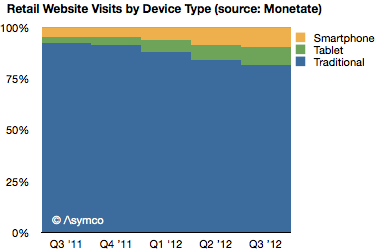
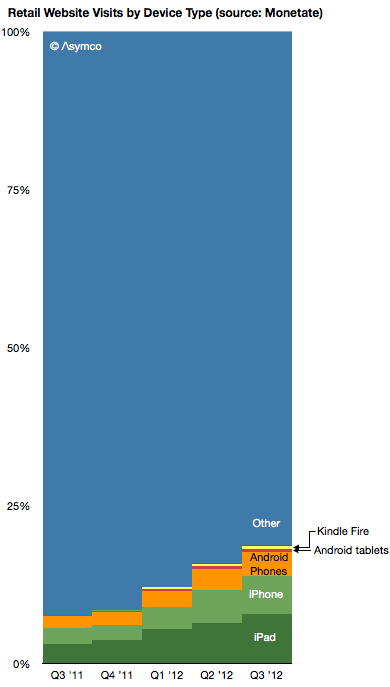
    Following yesterday's IBM data, Monetate released a new study showing similar data related to retail browsing but covering a period of dates from Q3 2011 to Q3 2012.

    This data also shows an acceleration of mobile shopping, from 7.7% of online in Q3 2011 to 18.8% in Q3 2012.

    It also shows tablets growing to take about half of mobile traffic in a very short time frame.

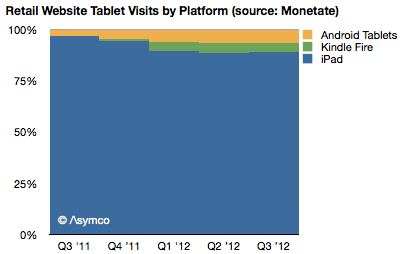
    The data also shows the iPad taking the vast bulk of traffic among tablets (88.9% vs. 88.3% from IBM).

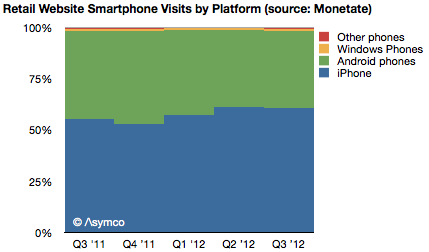
    The data also shows the iPhone taking 61% of phone traffic (67% from IBM) with the rest being Android.

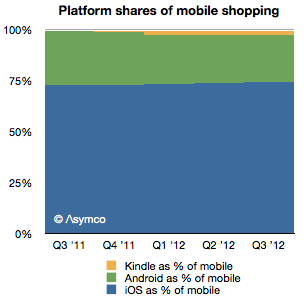
    The data shows the share of iOS being 74% in Q3 while IBM reports 77% for Black Friday.

    The data also shows a very small participation from Kindle and Android tablets.

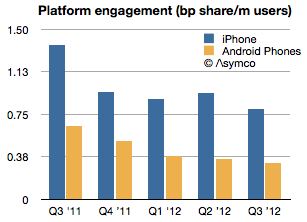
    Finally, by using the install base data from ComScore, the data shows an absolute and relative decline in Android engagement. Android phones went from 0.47 of iPhone engagement to 0.4 in one year.

    ---

    If you'd like to learn more about the Asymco method, come to Asymconf. The next Asymconf will be at the end of January near San Jose. Not only will you learn about how mobile is disrupting computing, you will also get to hobnob with the likes of Om Malik, Jean-Louis Gassée and Michael Lopp.


  6. The Android engagement paradox

    Research · 180 comments

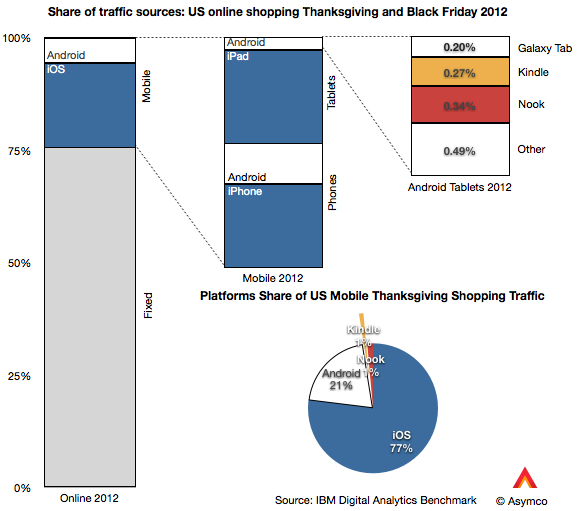
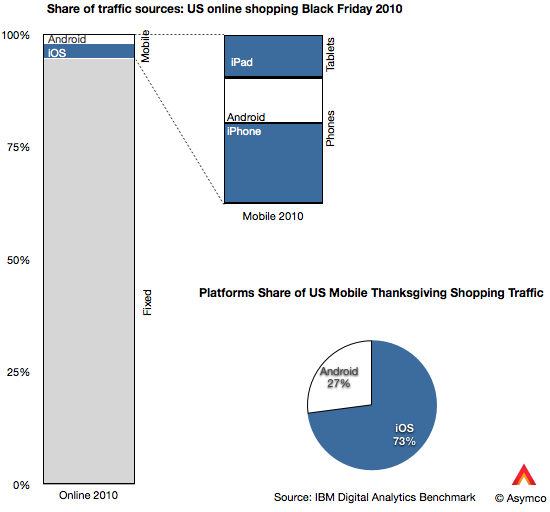
    IBM's Digital Analytics Benchmark reported US Black Friday sales and the news is reasonably good. Overall online sales grew by 17.4% while mobile grew to make up 24% of traffic.

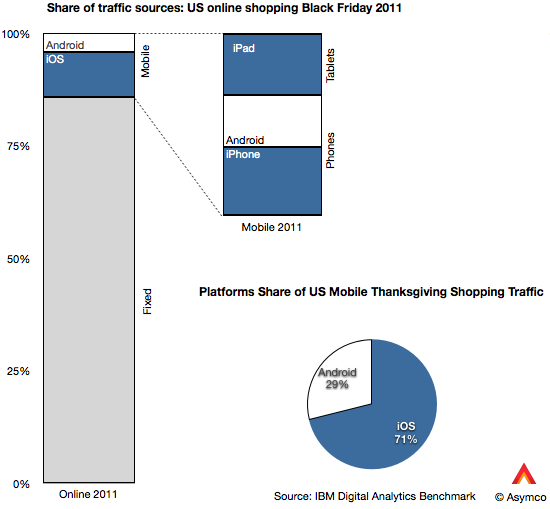
    The data goes further to show the split between device types. I illustrate this split with the following graphs:

    Of the 24% of traffic made up by mobile devices, phones contributed 13% and tablets 11% (or 54% and 46% of mobile respectively). Of the phone traffic, iOS devices were about two thirds of traffic and Android one third. Of tablet traffic, iPad was 88%, Kindle and Nook were 5.5% Galaxy Tab was 1.8% and other tablets were 4.4%.

    Overall, iOS was 77% generated mobile traffic and Android (excl. Kindle, Nook) was 23%.

    That's an interesting snapshot of the consumption of mobile devices, but is there a pattern here? I also took a look at the same data from 2011 and 2010.

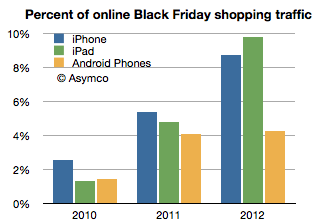
    Besides the pattern of significant mobile growth (from 5.2% to 24% of online in two years) there is the curious effect of iOS growth outpacing Android growth. Android went from 1.43% of Black Friday shopping traffic in 2010 to 4.92% in 2012. In same time iOS went from 3.85% to 18.46%. In other words, while Android is up by a factor of 3.4, iOS is up by a factor of 4.8.

    The reason is evident in the graphs above: the iPad is now the predominant mobile shopping device. You can observe the pattern in the following graph:

    Two years ago the iPad was trailing Android usage but this year it was more than twice Android usage. Curiously, the iPhone seems to also be pulling ahead of Android.

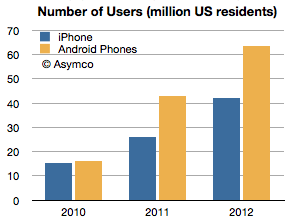
    Curiously because the number of Android users in the US has gone the other way. That data is available from ComScore, though only for phones. (ComScore data for periods ending November each year, Nov 2012 is my estimate):

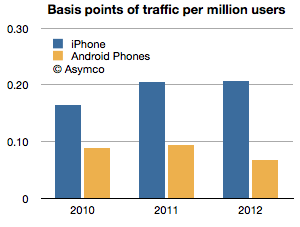
    Having the number of users and the traffic allows us to measure consumption per capita, so to speak. That is, the percent of traffic per device user:

    The ratio shown is basis points of usage (1/100 of 1% of shopping traffic) per million users of smartphones. iPhone users are about three times more engaged in shopping with their devices than Android users. Two years ago the ratio was two to one.

    Overall iPad is changing shopping habits, but it has a near monopoly in its form factor at this point. The bigger question is what is causing phone users to behave differently based on the devices they own. The phone market is more mature and has had several years of competition to be able to discern differences in platforms. The pattern is pretty clear with respect to Android: engagement is down as ownership is up. This pattern has not exhibited itself with iPhone, even though it has had a longer time in market.

    Of course, one would expect that later adopters would engage less, but I find it surprising that US Android users would behave so differently only two years after the platform began to be widely adopted. That pattern is not happening with iOS even after five years and certainly not with the iPad which is about as old as most Android brands.

    This I consider to be a paradox: Why is Android attracting late adopters (or at least late adopter behavior) when the market is still emergent? We've become accustomed to thinking that platforms that look similar are used in a similar fashion. But this is clearly not the case. The shopping data is only one proxy but there are others: developers and publishers have been reporting distinct differences in consumption on iOS vs. Android and, although anecdotal, the examples continue to pile up.

    And engagement is not a frivolous platform attribute. It is highly causal to success because it correlates with all cash flows associated with ecosystem value creation. Especially when a platform like Android depends more on engagement than "monetizing hardware."

    I'm not satisfied with the explanation that Android users are demographically different because the Android user pool is now so vast and because the most popular devices are not exactly cheap. There is something else at play. It might be explained by design considerations or by user experience flaws or integration but something is different.

    ---

    If you'd like to learn more about the Asymco method, come to Asymconf. The next Asymconf will be at the end of January near San Jose. Not only will you learn about how mobile is disrupting computing, you will also get to hobnob with the likes of Om Malik, Jean-Louis Gassée and Michael Lopp.

  7. The iPhone Addressable Market

    Research · 125 comments

    The iPhone is a severely constrained product. We're used to thinking that it's production constrained—and it is, but it's also distribution constrained. It has a business model that is almost completely dependent on operator subsidy. Few end users pay the $650 average price that Apple obtains and that price point has held for a remarkably long time. This price point is largely invisible to the user.

    In this regard it's very different from all the other products Apple sells. Historically, the company has preferred having its customers to also be its users and maintained a direct relationship with them, strengthening that relationship through its own retail channel for the last decade. Pricing is used by Apple as a signal to clearly illustrate value to the user and pricing is part of the communication about the product that Apple makes very explicit. This has been true for the iPod and Mac and is still true of the iPad. But this is not so for the iPhone. The entire marketing strategy for the iPhone (and hence the entire product concept itself) is "off message".

    Why is this?

    Before we get into causes, let's try to measure the distribution channel for the iPhone. Apple occasionally reports the total number of carriers it has relationships with. The last update was in the summer when Peter Oppenheimer, Apple CFO discussed the quarter ending June:

    We added several small regional carriers during the quarter and now have iPhone distribution through over 250 carriers in over 100 countries.…

    We added China Telecom as the second [Chinese] carrier in March…

    We also don’t expect to add any significant new country or carrier additions in the September quarter…

    In addition, Apple publishes the list of operators it sells through on its web site. The last time I counted I got 227 listed operators.

    If we contrast this with the total number of global operators (excluding MVNOs) there might be a way to measure distribution penetration. I compiled a list of all such operators based on information available in Wikipedia. You can browse the list here (Google Docs [1]).

    This global list includes 802 operators. The list is not current, being mostly based on 2009 data but it's pretty close. I've read that a more recent (non-public) estimate is 816.

    By this measure we can say that Apple has distribution through about 30% of the total operators. Consider also that RIM reports that it sells BlackBerry through 565 wireless carriers in over 175 countries. By this metric alone BlackBerry has twice the addressable market of the iPhone.

    But we can do better than counting operators. We should account for the fact that some operators have more subscribers than others.

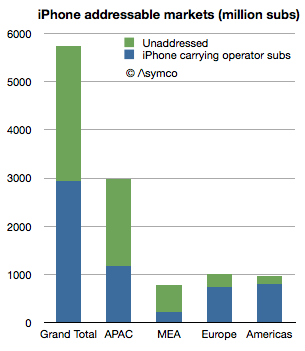
    Using the same database, I measured the subscriber count of iPhone distributing carriers vs. overall subscriber count. The ratio was about 50%.

    iPhone "addresses" about 2.8 billion connections whereas there are about 5.7 billion available connections. Note that this is not users but subscriptions—essentially SIM cards.

    The ratios vary by region:

    • Middle-east/Africa has 29%
    • Asia/Pacific is at 39%
    • Europe 73%
    • The Americas 83%


    We can take it a step further and identify which countries hold the highest opportunity for iPhone distribution. The top 5 are:

    1. India: 658 million
    2. China: 622 million
    3. Pakistan: 116 million
    4. Russia: 102 million
    5. Nigeria: 89 million

    But the opportunity is not only in emerging markets. Japan is a 69 million subs opportunity and even the US has 80 million subs without direct (i.e. subsidized) access to the iPhone.

    So we can now return to the question of why the iPhone is sold the way it is.

    First I should point out that the addressable market of Samsung or Android in general is larger than that of the iPhone. Samsung has relationships with far more operators, at least on the scale of RIM or Nokia, perhaps even more. It might be safe to assume that Android is completely unconstrained in distribution and therefore its addressable market is the entire subscriber space (meaning that Android has twice the addressable market of the iPhone.) For Apple to compete on the basis of volume or market share it would make sense to broaden this network. So what's holding it back?

    I think the answer is the other constraint mentioned: production. The company is still iterating the product on a yearly basis and needs to ramp production to reach all its carrier partners in a timely fashion. The carriers use the iPhone as differentiation and a way to uplift their core business. Therefore they want the latest version as quickly as possible. To satisfy this, Apple needs to manufacture the latest variant very quickly. But that's not easy. Peak production is one thing but getting there quickly is another. This is the problem which Apple's vast capital expenditures is trying to solve.

    So far the production capacity has been increasing at nearly 100% per annum. This is an astonishing achievement but it's still not enough. The product is supply constrained during much of the launch quarter. Therefore, to summarize, the entire business model for the iPhone revolves around this question:

    Can enough units be shipped in a sufficiently short time frame to allow a limited (but large) subset of operators to create competitive advantage which sustains a generous up-front subsidy.

    At this time the answer seems to be that the model can work for about 30% of operators serving 50% of subscribers. The crucial question for the business is how much higher can these numbers get?

    Note that this is not a debate about market share or consumer preference but about delivering a particular value proposition to network operators, (which sustains a premium price point.) The iPhone is built around this business model and to alter it would alter the very essence of what the product is. The addressable market is one piece of the product but it interconnects with the price, margin, design, production and breadth of offering. You cannot change one without changing the others. It's a product whose distribution model is part and parcel of its design.

    I believe that the particular way this product translates into a business is very rigid, which is why it has not changed much during the life of the product. This is in contrast to Apple's other products which exhibit more market flexibility. Inter-dependency is not a new concept for Apple products (e.g. iPod/iTunes, Mac/MacOS) but the iPhone shows a level of inter-dependency with distribution and production the likes of which has never been seen.

    This topic will be further discussed at Asymconf in January as the fourth quarter data will then be available and there will be an opportunity to debate it live with an august audience.

    ---

    Notes:

    1. The database is neither current nor complete. If you would like to help maintain the data based on local (public) information, please get in touch and I can grant access to edit it.
  8. On not being boring: A dramatic reading of Apple's share price

    Research · 128 comments

    Apple's renaissance began with the iPod. This was not evident right away however. The product was unveiled on October 23, 2001 at a time when Apple's share price had just fallen 70% from year-earlier levels. It was perhaps a good point from which one could expect a recovery to begin.

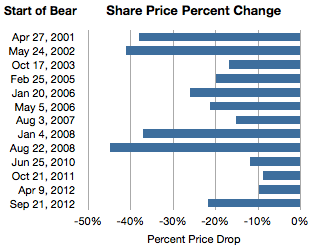
    It was not to be. One year after the iPod's launch the stock price had fallen another 20%. Indeed during 2001 the company was in the throes of a "bear market" in its shares. If we measure a time of persistent share price reduction as a bear market, then the one in 2001 was significant. For 154 days, between April 27 and September 28, 2001 the shares fell 38%. This represents the first bar in the following graph showing all the Apple bear markets since then.

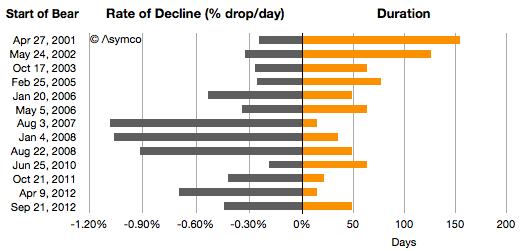
    I also illustrated these bear markets in terms of their duration and the average %drop/day.

    Chronicling these periods:

    • From May 24th 2002 and September 27th, 2002 the stock fell 41%.
    • 2003 was less harsh but on the second anniversary of the iPod, for two months between October 17th 2003 and December 19, 2003 the stock fell another 17%.
    • By 2004 the iPod looked like a hit. The stock rose consistently during the year. Then, in early in 2005, from February 25th to May 13, the stock fell 20%.
    • In early 2006, January 20th to March 10th, the stock dropped 26%. The iPod was reaching incredible levels of popularity and the Mac was looking to be returning to prominence with the switch to Intel.
    • 2007 was the year the iPhone launched. Right after the launch for two weeks between August 3rd and August 17th, the stock fell 15%. That's the equivalent of 1% per day for two weeks.
    • As the iPhone was shown to be a hit (and before the credit crunch), for four weeks during January 2008 the stock fell 37%. Again, equivalent to 1% a day for 35 days.
    • Then after the iPhone 3G was launched and growth reached triple digits, Apple's shares fell for 50 days. From August 22 to October 10th they fell a total of 45%. Again, the equivalent rate was 1% every day for a month and a half.
    • In 2009 the stock recovered steadily but in 2010, again around iPhone launch season the stock fell 12% over a two month period.
    • Then in 2011 October, 9% was wiped out.
    • Then for two weeks in April 2012 10% disappeared.
    • Which brings us to September 21 to November 9th, 2012. This latest "bear market" has run up a loss of 21.7%, running for 49 days.

    Sounds dramatic. The even more dramatic twist is that in this same time frame the share price increased by 576 points or the equivalent of 6,294%. Nevertheless, there were 13 episodes when the shares dropped violently and sometimes persistently for long periods.

    Why does this happen?

    It's important to recall that at no point during Apple's ascent was there "consensus"  that Apple was being successful and certainly not sustainably so. Analysts gave it at best a growth prospect of 20%, and the risks were always obvious and prominent.  The company was always on the edge and everybody from the layperson to the experts could see that everything was wrong with Apple. Apple went from being irrelevant to being too big without passing through being boring.

    So there is a simple explanation for occasional panic: Apple is not predictable.

    But it also seems too consistent. Is the pattern of share price collapse actually rooted in some fundamentals, transient or otherwise? There is a clear failure in understanding the long term but were these downdrafts justified as the market "foresaw" or "discounted" the near future? Were these more than just crises of confidence? Was there wisdom in the drops because they were followed by earnings drops or slowing growth? In other words, if there was smoke, was there fire? Was the market being efficient?

    No.

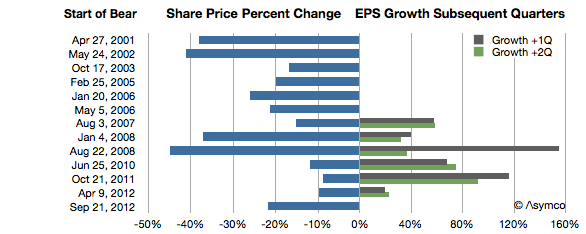
    The graph below shows the share price change in the more recent episodes above and the earnings growth during the current and following quarters.

    At least since the iPhone launched, every dramatic drop in share price was followed by a surge in earnings growth. One could even say the worse the bear, the better the growth.

    Sounds completely counter-intuitive, but there is some perverse logic in this as well. The market reflects crises (as well as over-abundance) of confidence. Unforeseen growth is what creates wealth and the crisis in confidence is a reflection of the improbability of continuing out-performance. When Apple's performance is foreseeable the stock moves slowly upward. When its performance is unforeseeable the stock moves dramatically downward.

    A pithy way of putting it is: No news is good news. Good news is bad news.

    When a product is understood the stock is mildly desirable. When a new product appears the future is hazy and the stock is undesirable. But that haziness hides potential but up and down. New products is what innovators produce. Bizarre new products is what disruptors produce.

    In other words, the paradoxical observation in the chart above of "the more drama in the market, the more success in the marketplace" makes sense when inverted.

    For disruptive companies, it should be "the more success in the marketplace, the more drama in the market."

    In that sense the current downdraft may be quite auspicious.
    ---
    Notes:

    1. Another set of similar observations were made by Eric Jackson in early October in Forbes.
  9. The iPhone and Apple's Margins

    Research · 17 comments

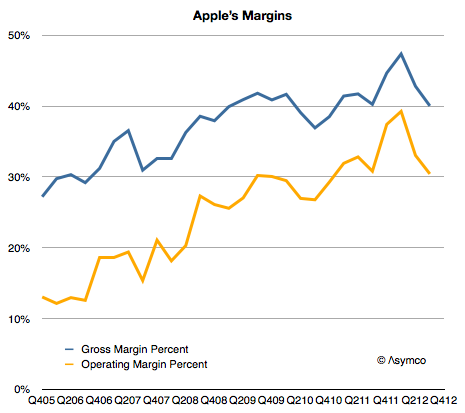
    As the following graph shows Apple gross margins and its operating margins have both been on a consistent upward slope since early 2006.

    The reason is that the company has moved to more mobile devices as a percent of products shipped. Whereas Macs have had decent margins by the standard of the PC industry, they are not as profitable on a unit basis as iPods, iPhones or iPads. As portable or mobile products grow rapidly, it would follow that margins would as well.

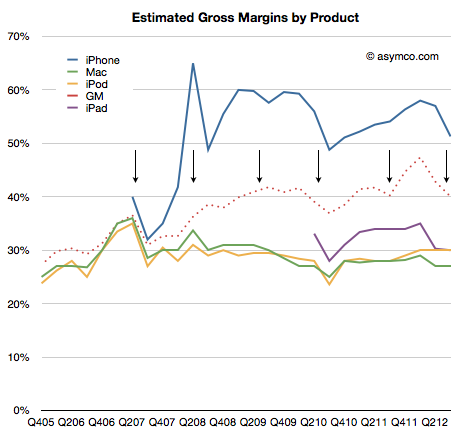
    However, the growth is not monotonic. There are occasional dips in gross margins. The cause is the launch of new device versions. On the following graph I show the launch times for the iPhone versions and the company's gross margin as well as my estimates for iPhone and other product line margins.

    The general pattern is clear: each new version of the iPhone causes a dip in gross margins. This is not surprising as the company forewarns of this (in a decidedly exaggerated manner.) But why does it happen?

    The iPhone is a profit monster, but when it launches there are many costs associated with it: components tend to be more expensive, there are more warranty returns, there are higher shipping costs are units are shipped in smaller lots to more points of sale. Tim Cook explains as "In terms of costs, with each new product we see learning curves associated with ramping production."

    Every launch causes an amplification of these learning effects. With each dip in margins however, comes another surge as the learning is complete and the volumes of the new generation product begin to dwarf the previous. And so the process continues.

    There is an asymptotic limit to margins as they cannot grow higher than whatever the iPhone yields but that's not yet in sight. The upper bound is probably in the 50% range.

  10. Apple's Growth Scorecard for third quarter 2012

    Research · 70 comments

    In the parlance of developers Apple keeps "throwing exceptions." This quarter the iPad surprised with a significant decline in sales growth. I placed a table showing the sales growth for this quarter as well as the previous 22 quarters at the bottom of this post.

    Here is a quick review of each line:

    1. The iPhone returned to a more customary growth rate (which I rate as Very Good--above 50%). The quarter was bound to be quirky due to it being both a transition quarter and a launch quarter. The launch of the iPhone 5 came quite late but not too late to make a contribution. It was also widely rumored and anticipated so there was slowing of the previous generation product. I expect growth to accelerate further in the last quarter of the year.
    2. The Mac turned in a commendable 6% revenue growth (1% unit growth) on the back of the new 15" Retina screen MacBook. The average sales price increased sequentially and the mix of portables to desktops reached a new high of above 80%. More about the Mac will be written in a future post.
    3. The iPod continued its decline. The 26% sales decline was in-line with other non-launch quarters. The company tipped its hand and let us know that iPod touch now makes up 60% of iPod volumes. At 3.2 million iPod touch units, it's a significant iOS contributor but still a declining number.
    4. The iPad was painfully underperforming. With only 9% revenue growth, it was a complete reversal of the torrid growth of the last two years. Management blamed both anticipation of a new product and a reduction of inventory ahead of refresh of the larger screen retina. The only silver lining was that the average price decline was moderate (down about $3/unit). Overall, I'm very disappointed with the pause in the product but the new mini could change the character of the product dramatically in a way similar to how the iPod mini turbo-charged the iPod line.
    5. iTunes had a very good quarter. It's the perennial growth engine with the most consistent performance throughout the time period shown. It was the second fastest growing line item firmly in the "High" growth bracket.
    6. Peripherals, including Apple TV had a moderate quarter. Management revealed that about 5 million Apple TV units shipped in the fiscal year. That adds up to a half-billion dollar revenue business. Peripherals had $2.8 billion over the same time frame so Apple TV was about 18% on a yearly basis. This does not include content revenues.
    7. Software had a modest growth of 22% but has come to be the high end of the range. Since changing the way it prices OS X updates, the era of Apple software windfalls is over. Still, at nearly $1 billion per quarter it's nice pocket change, especially as it's nearly all margin.
    8. The overall top line (net sales) was a bit improved sequentially (+4 points of percent) but still in the "transition quarter" range of moderate growth. The company may be shifting its launch cycles and as a result we're seeing a break in pattern. As pricing for iPhone and iPad did not change very much the slowing of top line growth is entirely due to a unit shipment reduction. Again, the primary cause is transitions in multiple lines simultaneously.
    9. The bottom line (earnings) followed the same pattern as top line (slight sequential increase in growth). There was a slight attenuation of margins (gross margins are down to 40%).

    Overall, the quarter was not up to the recent level of performance for Apple. Growth was overall "moderate".