More than 60 apps have been downloaded for every iOS device sold
Research #Market · 33 comments
by Horace Dediu
The iTunes App Store is about to reach 10 billion downloads. That makes this a good time to revisit app growth metrics and compare them with the other digital media store that we have data for: the iTunes Music Store.
First, the download totals as time series[1]:
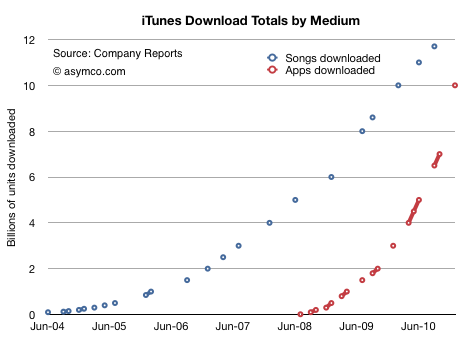
Assuming that 10 billion will be reached this month, we see how the steepness of the app curve implies that apps will overtake songs within a few months. I suspect by March.
In September I made the prediction that total apps would overtake total songs sold by the end of 2010. That has not yet happened, but it's close.
If we measure downloads as a function of the number of months since store launch, we can see that Apps reached 10 billion downloads in less than half the time it took songs (31 vs 67 months.)
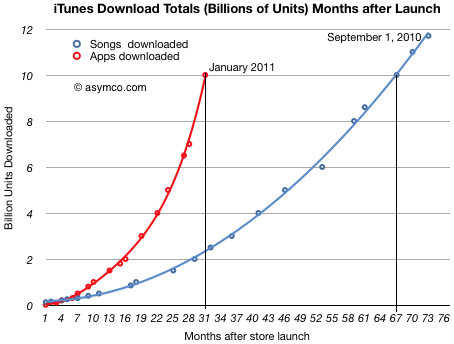
I used polynomial curve fitting to draw the lines.
The other way to look at the data is by measuring the daily download rate. The data is more scattered, but the trend is still clear:
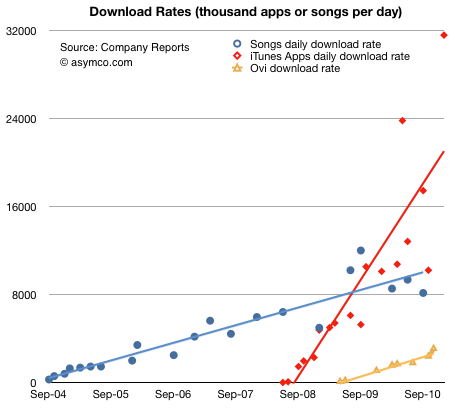
(The solid lines are linear trendlines. I added the known data from Nokia's Ovi for comparison.)
The amazing story of this chart is not that apps are running at above 30 million download per day, but that the figure is growing. Growth like this is hard to get one's mind around. Not only are downloads increasing, but the rate of increase is increasing.
There is one final piece to put in place on this puzzle. Some might argue that the reason these download rates are increasing is because the installed base of devices is increasing at the same rate. In other words, app consumption could be steady on a per user basis.
To answer this we need to divide the cumulative apps downloaded by the cumulative devices sold. Using a reliable estimate for iPod touch units sold, we can get a pretty clear picture:
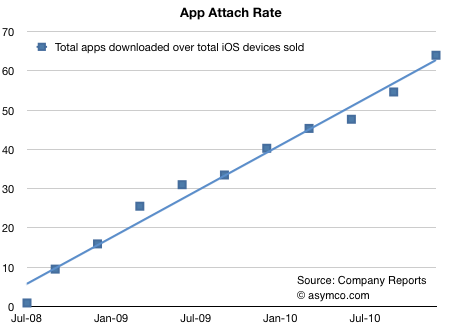
The number of apps downloaded for iPhone/iPad/iPod touch is running at more than 60[2].
In the fall of 2008, there were about 10 apps downloaded for every iPhone/iPod touch. Two years later the rate was more than five times higher. There are significant implications for the network effects related to the iOS platform. End user investment in apps is even higher than end user investment in music which created a very tight lock for iPod users.
I draw three conclusions:
- Apps overtaking digital music is a watershed event. Apps are a new medium: they will impact all other media.
- As the number of apps attached to any single device continues to increase, apps create increasingly higher switching costs for users.
- Apps consumption is increasing at a rate to overtake the PC software market.
---
Notes:
- The total apps does not include updates.
- The attach rate is actually higher since the figures above assume all devices are still in use.
33 comments
Andrew Swift ·
Don't forget that all apps are downloaded from the App sStore, but that only a very small percentage of music is downloaded from iTunes. Stiil, very impresive numbers.
Marcos ·
The vast majority of the music are paid downloads. I suspect that a large chunk of all apps downloaded are free. It would be interesting to know this information. It would also be interesting to know how music compares to apps from a number of dollars (not units) standpoint.
asymco ·
https://fnayeri-ulqtb.wpcomstaging.com/2010/09/09/it-takes-nearly-...
I'll be updating the data as more information is available.
RattyUK ·
Thanks for this information Horace and the hard work you put into answer thins question.
@BrianSHall ·
Great post. Though I've long touted the app as a future medium, not a fad, the chart revealing growth acceleration even factoring incremental device sales is surprising.
Long ago, I wrote a post that attempted to estimate *my* switching costs from iPhone to another platform. I could not get good enough data for users in general. I hope you do. It would be quite a coup to have a breakdown of smartphone platform switching costs.
Roger Nolan ·
Are you sure that you are comparing apples and apples? A single app will be downloaded multiple times - once each time the app is updated thus a single sale is represented by multiple downloads. This does not happen to music where each download event represents a sale.
We need to know the average number of updates for a app to get a real comparison.
Jaxian ·
Completely agree about the switching costs. I have over $450+ invested in the App store apps and games since 2008 (iPhone + iPad).
It would be hard for me to abandon the platform and go to Android. On the contrary, since Android's mantra is "Free apps" you're not losing much. The biggest sacrifice there is loss of on-screen widgets on iOS which some people truly love.
I tend to reject the argument that iOS = MacOS of 90's and Android is Windows. But there is one parallel which cannot be ignored. Switching from one platform to another is generally a one-way street. It's extremely rare to see someone switch to Windows after owning a Mac as their primary computer. The same is going to play out with mobile OSes when they become entrenched like on the desktop market.
alan ·
Note 1 claims that this data counts initial downloads only, not updates.
asymco ·
See Note 1. According to management statements, updates are not included in app download totals.
WaltFrench ·
free as in filled with ads.
I don't mind the ads I see in my iPhone apps but maybe in part because they're more like placeholders. Fr'instance, my firm pays a fair amount for my Bloomberg access; Bloomberg knows its clientele too well to trash the “free” app with annoying ads.
But from what little I know of CPM in ordinary app land, I estimate my time would have to be worth something like $4.98/hour to save money by switching to the ad versions. That might be a viable business model for Flash Zombies and Eggplant but darned if I can see it for the sort of consumer who can afford the $1K/year that a smartphone still costs.
WaltFrench ·
It should be noted that switching costs have been implicit in many of the “technical” decisions that Apple has made. None of this is unexpected, at least by Apple, although perhaps the takeup rate has been better than hoped.
21tiger ·
Very interesting dynamic going on here: when the iPod came out most of the songs came from customers' own MP3 collections and CD collections.
When it comes to apps, all of our Apps come from the App Store. Furthermore, Apps are WAY more interesting than 'songs'
dms ·
"Apps consumption is increasing at a rate to overtake the PC software market."
Can you explain this conclusion a bit further? How are you counting "consumption"?
m4rkus ·
The apps / device graph is cumulative. Would monthly downloads / device in instslled base look similar?
charlesarthur ·
"There are significant implications for the network effects related to the iOS platform. End user investment in apps is even higher than end user investment in music"
I suspect that the network effect really applies when you have paid-for apps, or free apps which don't have a replacement. (Or paid apps which don't have a free replacement - look at Angry Birds: paid on iOS, ad-supported and free on Android.) The switching cost from, say, iOS to Android will be higher if you have lots of paid apps, but irrelevant if you have lots of free apps, and can find corollaries on both platforms.
Even then I wonder if the cost of "lost apps" will simply be something to be figured into "buyer's remorse" - that someone will dump, say, iOS for Android on a phone, and only then realise that they can't run the same apps. I suspect sales people won't take a lot of trouble to explain the difference when they're selling the phones. "Oh yes, it has a lot of apps... is it like the App Store? Just like it!"
@tinyvox ·
Bravo, excellent article. When we started TinyVox, we had an inkling that this kind of trajectory existed. Thanks for lending us your data and insight as we plot our course.
timnash ·
Is Ping's real future app recommendation? That is, music was the way of finding out the problems with it.
asymco ·
I looked at quarterly (increase in apps/increase in units) and the slope is a bit higher, reaching 100 apps/device in the last quarter. I would not go with this data as conclusive because (1) the dates when apps are sampled don't match the dates when devices are sampled so I had to go with nearest match (2) we don't know whether new apps are purchased by new devices.
Overall, the conclusion seems to hold that the downloads per user are going up at a fairly steady rate.
Andrew Swift ·
@Marcos, do you have evidence that the vast majority of music is paid downloads?
iTunes music sales are declining in spite of an exploding iOS population.
The price of filling a 16 MB iPod with music is about $5000 if purchased legally -- are all those iPhones and iPods mostly empty? Or are all their owners getting all that music from Amazon?
According to the October 3rd Asymco post, Apple has sold about 120 million iOS devices. If they have sold 12 billion songs, that makes 100 songs sold per iOS device. But what about all the iPods?
According to the Wikipedia entry for iPod, Apple had sold more than 220 million iPods by September, 2009.
Obviously there is some overlap, but if we assume 300 million iTunes client devices for 12 billion songs, that only works out to 40 songs per device.
It would be great to know the average number of songs in an iTunes library. I'm guessing that it's higher than 40.
m4rkus ·
What I was thinking about was the daily ratio in installed base. E.g. Sept 2009 the download rate was maybe 10M/day to an installed base of maybe 40M(?) resulting in 7.5 apps/device/month. For Sept 2010 the download rate would be in the range of 30M/day and installed base maybe 75M(?) resulting in 12 apps/device/month. That's a big increase. Is my math correct?
Vega ·
"iTunes music sales are declining in spite of an exploding iOS population. " No, they are not.
"are all those iPhones and iPods mostly empty? Or are all their owners getting all that music from Amazon?" You never had an iPod, did you? People put all the music they have in CD format on them by ripping them using iTunes.
"The price of filling a 16 MB iPod with music is about $5000 if purchased legally" 2005 called, it wants its old misleading FUD back...
@RBthinks ·
Horace, the corollary of Note 2 would also apply ... many downloaded apps would no longer be installed on devices.
Another great article, thanks.
PimpMyiPhone ·
How does this compare to Android stats?
Andrew Swift ·
I was wrong, I had misremembered an article. According to Nielsen, digital music sales were up about 5% in 2010 -- much less than the increase in iOS sales. Sales per device are definitely decreasing. http://www.reuters.com/article/idUSTRE68Q2FM20100...
I've had five iPods. If iPods/iPhones are filled with music from CD's, that only makes the equation worse -- the average price per song goes up from $1 per song to maybe $1.30 per song. So make it $6-7000 worth of CD's to fill a 16 MB device.
Obviously not all devices are full, but many people have more music than will fit on their device. I couldn't find information about the average iTunes library size.
A point in your favor is that many many people have multiple Apple devices (myself included). So the average number of songs per person is much higher than the number of songs per device.
According to Sandvine, P2P accounts for about 8% off all internet traffic. Is iTunes even 1%? Also, the 8% doesn't include music downloaded from sites like RapidShare.
Mike ·
Your data is wrong. The iTunes store has been open since April of 2003. Unless we lost almost 2 months of every year for the past 8 years, that means that September 2010 was the 90th month that the iTMS has been open....
If... 31^x = 67^y = 10^10
x = ln 10^10/ln 31 = 6.70 y = ln 10^10/ln 90 = 5.117
33^6.70 = 15.2 billion (March 2011) 95^5.117 = 13.1 billion (March 2011)
poke ·
Here's a theory: the web has only ever been a "good enough" stopgap. The whole world was waiting for a way to get native apps in a fast, safe way and nobody knew it. Somewhere in an alternative universe Microsoft figured this out in the late 90s and the web never even got a chance to take off.
I think there's some truth to this theory although I'm not sure how much. What I'm interested to see in 2011 is how the Mac App Store does and whether it'll drive growth in Mac adoption. I think it could. Maybe a Mac App Store is what the Mac has been missing all along. Maybe this is the real way you make a viable platform.
KenC ·
I didn't realize that myth of multicounting app downloads was still going around. It made no sense then, for Apple to multicount app downloads, and it makes no sense now. Why this myth, which doesn't stand up to casual scrutiny, persists, is beyond me.
Peter ·
Great article! The strong growth of app installations per device will indeed raise the switching costs, which is good for apple. However, since android become an increasingly interesting alternative to apple users, they will realize the negative side of the app-lock-in too.
This is way one has to question whether apps will remain for a longer decade, or whether they are just a hype
KenC ·
"Not only are downloads increasing, but the rate of increase is increasing." aka exponential! ;)
I would also point out that the numbers are underrepresented, as a good percentage of the iOS population owns more than one device, and thus a single downloaded app can be loaded on all of those devices. Of course, this goes for music too.
I have an iPhone 4, and iPod touch and an iPad. One download for all three. While I do get iPad-optimized apps whenever available, I have installed some iPhone apps on my iPad as well. I know lots of other families with iPod touches for all the kids, and one iTunes account so that they can share all the downloads. This is especially good if you download a paid app as opposed to a free one.
asymco ·
A browser is an infinitely flexible interface, but is it the best interface for everything? I would argue no. Innovation in ways of accessing information continues and apps are the engine of experimentation.
Vega ·
1. A 16MB device will be filled very quickly 2. If we're talking about 16GB, Apps and movies can fill that pretty quickly 3. It is a mixture. Most people rip the CDs they already had, copy music from friends (which they themselves have ripped) and buy new music through iTunes.
unhinged ·
I refer you to the large intersect between the set of all people and the set of people who are idiots. :)
KPM ·
Actually, you should not consider what you have invested, but what will be the cost of switching. If you're an Android user with, say, 60 free apps, and that to get the same apps on iOS you have to pay $2 each, then it's an extra $120 out of your pocket if you want to switch. If you're an iOS user with those same 60 apps that you did pay $2, but they're all free on Android, then you don't lose anything by switching. So in the end, it's more a matter of "am I ready to accept ads on Android when I didn't have any on iOS". It's a user-friendly issue, not a money issue.