The Verizon small bang
Research #Market · 50 comments
by Horace Dediu
As Verizon has reported iPhone sales for one and a half quarters, it's time to try to discern the impact on the product. There were several hypotheses floating around prior to the "big bang" of Verizon.
Some assumed that there would be a large migration away from AT&T and that AT&T iPhone sales would slump. Others that there would be no Verizon iPhones volumes at all because there were so many Android users already converted. There were also suggestions that the iPhone would explode in growth with two major operators carrying it.
What really happened?
The first chart shows historic AT&T activation with Verizon activations added. It also shows sales to "none of the above", namely non-US sales of iPhones[1].
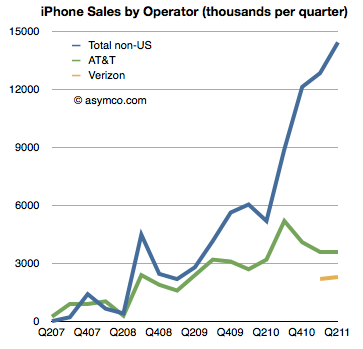
AT&T iPhone activations show no significant impact from Verizon and Verizon itself shows a modest start to sales[2]. What did not happen is an exodus from AT&T. We also did not see a rejection of the iPhone by Verizon customers long exposed to anti-iPhone Droid advertising. We also did not see a considerable impact of Verizon on growth.
Verizon did contribute (4.5 million Verizon iPhone users is nothing to sneeze at) but the contribution was to a degree that was nowhere near a big bang.
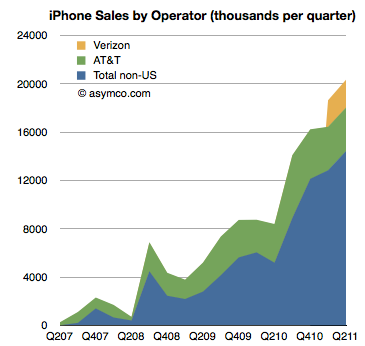
That was because the real big bang was from the rest of the world. The same data in the first chart is shown below as a stacked area chart and a share chart. Had Verizon not come on board the business would still have grown year-on-year over 100% (and sequentially).
The US activations have been decreasing as a percent of total iPhones sold. Before Verizon came online, the US share was decreasing (from an average of 45% share in 2008 to 33% in 2010). After Verizon, the US continues to slide to an average of 30% share (two quarters).
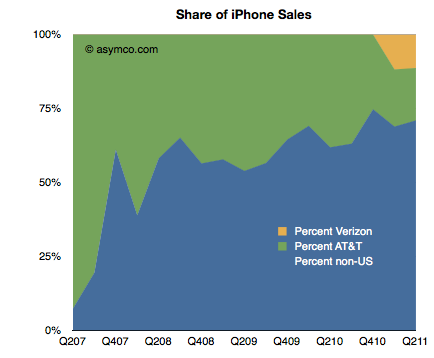
After waiting nearly four years, American observers of the iPhone could perhaps be excused for their obsession on the impact of expirated AT&T exclusivity. But the real impact is that by the time it came, it was moot.
It would be a mistake to look upon Q1 and Q2 and say that the explosive growth was due to Verizon or the end of US exclusivity.
The global market is far greater than the US and the iPhone business has simply grown to reflect that.
---
Notes
- Non-US sales are total iPhones sold minus activations in the US. There is the possibility that some of the unactivated phones were activated on T-Mobile or that there is some delay between purchase, channel inventory and activation, but the time frame shown should smooth out any of the noise.
- What we don't know is what was the impact of iPhone sales start on Verizon's other smartphone platforms. Unfortunately, Verizon does not report overall smartphone sales/activations so we can't conclude directly that iPhone has slowed other platforms on Verizon. Some other data (NPD, Changewave, ComScore) do indicate some slowing in Android growth in the US but we have no definitive data to prove it.
50 comments
@ecclespaul ·
Wow some tremendous growth for the iPhone 4 in global markets! I'm not surprised though, as with the iPhone 4, Apple really tried to capture a lot more operators globally. For example, here in South Africa they launched it on two major operators, whereas the previous models (3G & 3GS) were only available on one. They also made some more attractive contract offers..
The CW ·
US-centrism is probably why investors are so slow to correctly value Apple. The US market is the tip of their iceberg. Verizon seems Important if you're only seeing that tip.
Niilolainen ·
Nice data to show to my US centric colleagues and management, with full credit natch.
Footnote 2 is of course very interesting as Verizon could make a nice little vignette about the relative attractiveness of iPhone and Android if that data were available. The mainstream data vendors may take a swag at it at some point.
@WaltFrench ·
These as-usual-great charts might have something to tell us about iPhone seasonality, too: early sales, all thru AT&T, were heavily affected by Apple's early pivoting and significant model changes to get the formula right; that seems to have produced a boom and bust much larger than any seasonality of demand would suggest. (You wouldn't think that phones would tend to be driven by Christmas gifts many times more strongly than other consumer products/services; iPods might show more of a spike on 4th calendar Qtr.)
Now, with a worldwide distribution network, bumps in the total sales look to be smoothed out and should show more normal seasonal patterns. Looks like Apple can continue running existing production lines full-tilt as they ramp up whatever new product they are building up introductory inventories for. (People saw, I presume, a survey suggesting huge US pent-up demand for a successor iPhone.)
dragan0405 ·
I think that several things have to be account here. First lot of verizon costumers opted to wait for new model, second associated cost of early contract termination. We should be able to see seasonal upgrades from previous non smart models till October 17, 2011 since first Droid vas put up to sale in October 17, 2009.
@WaltFrench ·
Whoops, left it out: this smoothing is the actual “Law of Large Numbers” at work. Underlying demand is easier to see when any given specific channel issues is a smaller fraction of the overall volume.
David V. ·
An addition to footnote #1: Some iPhone "activations" do not have a corresponding "sale". For example, when my wife took my previously-used iPhone 3GS, AT&T counts that as an activation, but there was no corresponding iPhone sale. Anecdotally, I'm under the impression that passing earlier models to other family members is not all that uncommon -- perhaps it has a measurable effect on activation numbers?
Klaus ·
I do not really understand your point. Is it that Verizon sales are just a drop in the bucket compared to worldwide sales? Who claimed otherwise before? Your title suggests that the article provides an explanation for these three sentences: "AT&T iPhone activations show no significant impact from Verizon and Verizon itself shows a modest start to sales[2]. What did not happen is an exodus from AT&T. We also did not see a rejection of the iPhone by Verizon customers long exposed to anti-iPhone Droid advertising. We also did not see a considerable impact of Verizon on growth." In other words, why was the impact of Verizon sales smaller than expected for the US market?
But the following article contains no such explanation.
jonshf ·
This is a general phenomenon that's being seen with global companies. The market (analysts and reporters) is still touting US specific numbers that are becoming less and less important. Traditionally those numbers were good indicators because the US was the king of consumption. If the market was healthy in the US then the market was healthy. This is no longer the case.
stsk ·
I suspect there is another group behavior which impacts initial Verizon sales rates: the behavior of Verizon salespeople. For years, they've had to justify their existence by denigrating the iPhone. The taste of these sour grapes can be exptected to linger after their raison d'être has expired, slowing Verizon iPhone adopter rates. When you combine early-termination penalties for ATT and Verizon non-iPhones with behavior of Verizon sales personnel who've been trained to despise the iPhone, the result can be expected to be artificially constrained initial adoption rates.
@jandrewyang ·
Greater China at 6x growth YOY, and $3.8B working with the 3rd largest telecom provider. Apple is tracking to $13B in revenue for the FY. Figure in carrier expansion and more sales channel points, and it seems reasonable to expect the growth rate to accelerate further. I think the overwhelming demand for Apple product through a combination of scarcity and cultural drive for homogeneity is underestimated. I think the "fake" Apple stores that hit the news recently are a radical indication of the pent up demand. Consider the paradoxical situation, a fake store selling real product.
Siva ·
Prior to the iphone release, Verizon ended the free every two (ugrade program). So, the uptake has been slow
davel ·
Wow.
Non US really took off in the past year.
Thanks for the graphs.
______ ·
Agree a little with Klaus here. Somehow, I expected an explanation for why. However, re-reading this article, I realize that Horace states he is only answering the "What really happened?" question. However, later on he uses the sentence "because the real big bang..". Honestly, the use of the word "because" implies the question being answered was "Why?" but really the question he set out to answer was "What happened?" and not "Why did it happen?".
I don't think anyone has a real good answer to the why question, not even the great Horace.
skeptict ·
I'd like to see an explanation for AT&T's drop just prior to Verizon's iPhone availability. Were potential AT&T customers holding off one their purchase to change carriers? Was Apple shifting resources? If it wasn't Verizon's entrance to the market, I wonder what explains it.
asymco ·
Sales are driven by the iPhone launch cycle (and seasonality).
Westech ·
Post Christmas seasonality. The new product cycle has little to do with the March quarter, unlike the iPad 2.
pmoe ·
Who'd a thunk there was a rest of the world?
The only non-iPhone's I know of over in Australia (very small sample) were only chosen because they were given away free on a contract while you still have to pay for an iPhone.
You can put lipstick (full touchscreen) on a pig but in the end...
Hamranhansenhansen ·
Apple already said that when they refer to activations, that is only a new device. You activate your phone when you Restore it as well, but Apple is also not counting that when they say "activations."
Marco ·
I wondered why anyone thought that releasing the iPhone on Verizon would have a huge impact on total sales in the first place. The US are by far not the world. Adding 1 (one) carrier will make for a big bang? Nuts. Americans still need to realize that the us is just 300M people, no more. That Apple is an US company means nothing in this regard.
timnash ·
2."What we don’t know is what was the impact of iPhone sales start on Verizon’s other smartphone platforms."
A close read of Verizon's financial presentation with some calculations shows:- Smartphone user base increased from 32% of 88.4m users (28.9m) to 36% of 89.7m (32.3m). That is 3.4 million new VZ smartphone users. 9% of VZ base upgraded (bought new cellphones), that is 8m + 1.3m new VZ users = 9.3m cellphones sold 9.3m - 3.4m = 5.9m x 32% = 1.9m (existing smartphone users upgrading to another smartphone) Total VZ smartphone sales last quarter = 5.3m So Apple's 2.3m iPhones is 43% of that.
Not a bad small bang!!!
Lucian Armasu ·
So "the iPhone will kill Android when it gets on all carriers" was just a myth and wishful thinking. Ok, so now what? What is the "next" reason iPhone will kill Android? There's always another one (and it always turns out wrong).
asymco ·
I looked at those figures before I wrote the post but did not find them sufficent to conclude what you concluded. The figures of user base you cite (88.4) are listed as "retail" subs. Total subs are higher at over 100 million and include what I presume to be business subs. We can't use the smartphone penetration figure of retail to conclude which phones were sold. Verizon deliberately tries to obfuscate the actual figures of smartphones it sells and pointed questions during the conference call were unanswered.
addicted44 ·
The iPhone took away nearly half of Android sales on Verizon on its release despite:
1) Being an older model, with a newer one expected in a few months 2) Not selling the cheaper model (the 3GS, which AT&T has indicated forms a significant portion of their sales) 3) Hitting mid-cycle where many users are not up for an upgrade
I don't think the iPhone will kill Android (unless the price drops to something like $400 without contract, and free with contract, for the primary model) but it will achieve parity with Android by the end of the year for sure.
Tom Ross ·
You're thinking about daily activations. The term "quarterly activations" is never used by Apple, only by the carriers, and they include both old and new phones being activated on a new contract for the first time.
Tom Ross ·
Nielsen's monthly statistics also point to iPhone and Android reaching parity in the US by the end of the year. There will be a big jump for the new iPhone. How that (and the big lawsuits) affects Android in the first half of 2012 we'll have to see then.
timnash ·
Also mentioned was 63% of smartphone sales were new to category. 63% of 5.3m = 3.34m or roughly the 3.4m mentioned in the previous post, so for me the figures look right. Total subs certainly include connected devices and prepaid.
newtonrj ·
Lucian,
It appears you enjoy poking fun at iPhone/APPL. However, to answer the 'next' question, Android will kill itself - that is my answer. With the bottom cost coming up for the 'free' Android through IP payments and the top end coming down with BOGO giveaways, the market middle for Android is getting squezed. IMHO at least. -RJ
asymco ·
iOS is not interested in killing Android. The next Android is very interested in killing Android. http://allthingsd.com/20110728/look-out-android-a...
I would also look to Amazon and probably Baidu to launch Linux forks that run Android apps (and HTML 5) that will be better at virally corroding Android.
kevin ·
Because iPhones aren't sold everywhere yet, iPhone sales growth is still heavily dependent on carrier launches. In the last 2 quarters, Verizon has accounted for almost 12% of all iPhone sales (an even larger share of iPhone 4 sales, and an even larger share of the growth). That might not be a big bang, but it isn't very small either.
Another metric to see the Verizon phone impact is postpaid churn. Obviously, the phone itself doesn't account for all of churn - customer service, plans and rates also factor in. In any case, from the time of iPhone launch on AT&T until 1Q11, churn decreased yoy in every quarter (churn is seasonal so must look at yoy metric). In the last 2 quarters, it's increased by 10% or more yoy. On the flip side, Verizon postpaid churn increased yoy in every quarter through 4Q09, when Android finally helped to decrease churn.
When combining both points, one could conclude that in 2011, only a small number of Verizon subscribers would've switched to AT&T for an iPhone. Also, many of those who left AT&T to buy a Verizon iPhone probably would've held out for the next iPhone if they had stayed on AT&T. In other words, lots of sales likely would've been deferred or lost.
@jayartz ·
The most interesting time to compare Verizon and AT&T will come when there is a new phone available on both networks. I suspect there is a group of people who would be willing to switch but did not want to switch to an iPhone 4. It may even be as long as 2013 before the true numbers are known as some people who might have picked Verizon are locked into an AT&T contract through then.
skeptict ·
Thanks - that's clear now that I know what to look for.
Matthew ·
Verizon customers had their chance to switch to AT&T to get an iPhone long ago. If they stayed with Verizon for "Can you hear me now?" instead of the best phone, they don't really care which phone they have. That's why you won't see them getting iPhones at a high rate.
Andre Richards ·
Good strawman argument. Nobody (whose opinion mattered at least) was saying iPhone on Verizon would kill Android, but given that there are about a half dozen reasons for many Android users to wait it out (not the least of which was the awareness that a new iPhone release is near and Android users still being mid-contract with their current phone) I'd say you're a tad premature with the superiority dance.
Of the dozen or so Android owners I know, all but one bought their Android phone because it was the closest thing their carrier had to an iPhone. All the ones I know on Verizon are planning to jump to iPhone with their next purchase but are waiting until their contract renews. I know that's anecdotal, but I bet it's typical.
@WaltFrench ·
The ONE Android customer (version 1.7, bought during 2011 and with no hope of upgrading, yet!) just thought she'd get a nice BOGO phone with her mom. But it'd be silly to deny the large population of Android fan-atics who can't stand the idea that Steve Jobs will control their tech world.
Seth ·
AT&T may still be ahead, but it's pretty clear from these numbers that Verizon sucked the wind out of their sails/sales particularly when you compare AT&Ts growth rate to the rest of the world and even AT&T's past figures.
Given the massive growth in Apple's asia/pac revenue, it's pretty clear that China drove the rest of the world growth. Imagine what will happen when Apple get's a phone for China Mobile. Scary
barryotoole ·
+1. That's why Google only reports activations!
barryotoole ·
+1. I wonder why Apple is staying away from India. After all, its population is only 200 million shy of China.
barryotoole ·
Also, Android is open - like a sieve.
mrt3811 ·
Every time I had gone in to inquire about the iPhone at a Verizon store prior to purchasing it. The sales person ALWAYS without fail, tried to steer me to an Android device. If I was not an Apple fan there is no way I would have purchased one.
Lucian Armasu ·
ok, I see you've already found that "next" reason. Good! I was getting worried there might not be one for a second. I'll be happy see you're wrong on that one, too. Aliyun is the next oPhone, which also failed. The reason they fail is because they can't keep up with Google's pace, and they end up being several versions behind.
But even if they simply fork it, and they actually successful doing that (also one of the reason oPhone failed), it will only be for the China market, which granted is a huge market, but it won't really corrode Android in any way. Also, the China market is not the whole Asian market. So Android will remain at 50% market share instead of the potential 70% - what can I say, I'm not even sure I'd want them to go to 70%. That's too big for one company to have (just look at all the problems Microsoft created in the past by having 90% market share).
But Aliyun corroding Android in a big way is VERY optimistic of you, either way.
Lucian Armasu ·
I don't think you've watched the tech blogosphere for that long if you say people didn't believe iPhone on Verizon will have a huge impact on Android. In fact on this very site, Horatiu said that, or at least implied it.
I find it very amusing how everyone now thinks that i was so OBVIOUS Android would get this kind of market share. Perhaps the people commenting now about this aren't the same people commenting about 1.5 years ago, but I remember very well that the odds against Android were huge against Android and it wasn't a very popular opinion at all to say Android will overcome iPhone with 100k apps and 25% of quarterly sales for smartphones in USA, when Android had in the hundreds of several thousands of apps and like 2-4% market share.
In fact the sentiment about Android tablets right now is very much like the sentiment about Android smartphones back then. I imagine 2 years from now, people will say it was so obvious Android tablets will overtake iPad, too. Maybe I should save these posts somewhere for reference later :)
Lucian Armasu ·
I don't think you realize what you're saying. All the iPhone did to Android is to stop it growing over 50% market share for new quarterly sales. Android was at 53% the previous quarter and growing, and when iPhone appeared on Verizon it dropped back to 50%. Android's growth in USA is still 50% vs iPhone's like 26-29% (don't remember the exact number here).
Android's total user base is 39% in USA and keeps growing (to reach parity with the 50% quarterly sales), and iPhone's user base is 29%, according to the recent stat from Nielsen.
asymco ·
For the same reason they stayed away from China for three years.
asymco ·
Sales persons in Verizon stores are not working for Verizon. They are working for the company who pays their commission. Apple does not pay commissions.
asymco ·
Your question was: what is the next reason iPhone will kill Android? I wrote that it will not happen but you stated that I "found the next reason."
The conversation is about what will cause Android to be "killed". The answer has nothing to do with iPhone. I've always argued that the threat to Android comes from within (see Google vs. Android series).
KenC ·
I agree with your first two conclusions about 3.4M new smartphone users and roughly 9.3M cellphones sold. You have to take out the small number of prepaids to get a more accurate cellphone sold figure, but it's small enough that 9.3M should be roughly right.
It's the last conclusion, that I'm not sure about. We have no way of knowing whether the 5.9M upgraders breakdown along the average of all Verizon subscribers at 32% the previous quarter.
Having said that, I like your followup, as it does seem to imply that your original conclusion was correct. And, if you take a small amount of prepaids out of the original calculation, you would indeed come down to a smaller number in your last calculation making all the numbers even closer to confirming one another.
Lou Mannheim ·
Seen from afar this US centric approach to Apple sales obviously present when the market sets the price om this marvelous company is simply stupid. The vast majority of Apple sales is now abroad, and the share is growing. In Sweden where I live iPhone and iPad have in the last year moved from being the cool gadget for those who can afford them to being everywhere (!!!) present and it seems to grow month by month.
As for the "slow" adaption among Verizon users, surely this is because they are locked into two-year contracts already?
simon ·
There's really no reason to respond to Lucian. If you look at his history, he visits major tech blogs and keeps writing things just to be against Apple and that's his MO.
Granted I applaud him for not being a foul mouthed shouter but at his heart, Lucian is the epitome of the quality of discource at places like Engadget, not Asymco; In his mind it's either Apple vs Google and Apple is the evil one of the two so it must be criticized.
Peterrock8975 ·
Looking for a place to sell your iPhone / iPod? Sell iPhone - They will buy your used iPhones for cash. High Payout, Free shipping to send your phones, Quick Payments.