[Updated] Following up: When will Apple's share price reach $500
by Horace Dediu
Apple's valuation since October 2008 has been very highly correlated to its cash (R-squared of 0.91). This tight relationship to Apple's value is shown in the chart below:
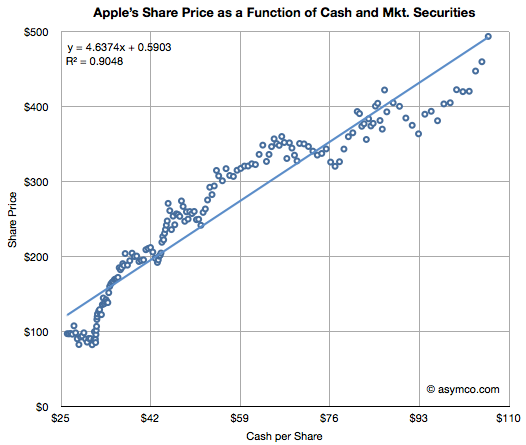
(The chart shows weekly, ending each Friday, share price (vertical axis) vs. interpolated weekly cash per share (horizontal axis) assuming linear growth between quarterly announcements. Share price data is current as of last Friday (Feb. 10) though cash per share is based on announcement date and hence delayed by about three weeks.)
I noted this relationship in May 2011 and followed up in September 2011. With current cash per share reaching $95 to $100 $103.66 it seems that the share price should be around $500 any time now.
69 comments
Tytus Suski ·
Well, it is :)
Anonymous ·
Is p≤0.05 here? Just curious, certainly plenty of data points.
Anonymous ·
You should have an updated/interim data point showing data as of yesterday or simply have waited till Monday to remain consistent.
Anonymous ·
WIth an R^2 of .92, I'd imagine it has to be at least a p of < .01.
jawbroken ·
How would putting in a specialised interim datapoint be remaining consistent? Seems like the opposite of consistency to me. Why do you feel this single data point is so important?
Mark212 ·
Because its the weekly share price "ending each Friday". The commenter is simply saying that Horace could have waited one more day (or to the end of today's trading) to update the chart.
Charlie ·
Here's a thought experiment: Let's suppose that Apple decided to pay out all its cash as a dividend to shareholders. What would the share price then be according to your analysis?
jawbroken ·
Sure, I completely understand it's updated on Friday but I don't see what that has to do with consistency or why it's so important to have that single extra data point out of hundreds.
Anonymous ·
Well, Apple now has pretty much exactly $100bn, and the stock was $493 on thursday, so the correlation is still spot on. Which makes me wonder...: If this trend actually continues, and Apple does in fact add another $50bn this year (low estimate). The using the formula in the graph: y=~4.9x-13, the stock price for AAPL should be $722. Pretty neat :)
Horace Dediu ·
The price would be zero because it can't be negative. This analysis concluded last May was that the company is priced as a function of its balance sheet and that the income statement is not relevant. See first link in the post for discussion. Of course this leads to an absurdity but that's a reflection of reality.
Rudolf Charel ·
When a company like Apple does not declare dividends its cash balance and therefor its cash-flow is a better indication of success than its income statement could ever be.
That is why Horace chose this marker and apparently shareholders, whether they know it or not, follow it so exactly.
Mark212 ·
Horace, your analysis is most useful in the negative: to refute the correlation between price and P/E, P/E/G, etc. So much digital ink is spilled talking about Apple's PE compression and head-scratching over why the Street doesn't see the true value of the company, etc. -- and your series of posts is data-centered clarity.
Anonymous ·
Quite the opposite. It explains the P/E compression. As Horace says, the stock is priced only on what Apple has earned. It is not priced at all on what Apple will probably earn in the future. That is continually driving the P/E ratio down.
That said, there is the possibility that as the P/E ratio sinks to more and more absurd levels, the average investor will begin to "see the light", and buy into the stock, thus creating a floor. It's possible a bit of this is what propelled the mysterious stock bump yesterday. Of course, it took the form of shorts frantically trying to cover their positions, but one would expect that.
Here's to the possibility of a P/E floor! (hoisting an imaginary glass of champagne)
Anonymous ·
after tonight's close isn't the next data point going to be way above the line?
berult ·
That cash hoard, a substantial part of it, should go right back where it was taken from. Apple should intertwine its own future with the future of young people.
They should erect an automated manufacturing/assembling facility devoid of underpaid, futureless manual labor, and build tablets ...at cost... for education, not just in America but in as many country as they possibly can. It would kill a whole flock of birds, ecological consideration notwithstanding, with one wizened up and foresighted stone.
A $99 tablet (iPod...?), minimalist in specs, minimalist in its manufacturing complexities, maximalist in its US manufacturing footprint, maximalist in its revoltionary educational outcomes, maximalist in its potential future return on investment ...mind, market, and profit share wise. And the moral high ground for a long time to come.
A loss leader, a future trailer, a 'radial' investment in youth development... however un-bequeathing to the present shareholders...
jawbroken ·
Even if it closed at $500 (very unlikely at this point) it wouldn't look like a particularly significant outlier. Plenty of historical data points approximately $50 above or below the line.
Nick Fellman ·
Thank God you have no real influence on important decisions within Apple.
Charlie ·
I understand the mechanics of your analysis of the relationship between cash and stock value but I'm not sure it gets us any closer to understanding what really is driving that value. (I'm not trying to be a troll here, just trying to understand).
Here's the way I look at it: If Apple were to liquidate itself today (i.e.sell its assets, not as a going concern) it would be worth the market value of it's assets net of liabilities – for the sake of simplicity let's call this $100 billion most of this cash which is easy to value. You can argue about the value of IP but I don't think that changes my argument. The market value of its stock is roughly $460B. So there is roughly $360B of value ascribed by the market to the future cash flows that Apple is expected to generate. (I think these values are correct, but it doesn't change my argument anyway.) The value of the balance sheet is a function of historical cash flows while the value of the stock is a function of future cash flows plus the liquidation value of the company.
It may very well be that the market is undervaluing the value of Apple either because they are underestimating it future cash generation potential or ascribing too a high risk factor to the probability of those flows. The correlation of share price with retained cash is interesting but only driving a small portion of the value of the company.
Bricajo ·
Interesting...how do you envision this thesis would be affected if Apple decides to pay a dividend?
Horace Dediu ·
This point of view was discussed on January 31st.
https://fnayeri-ulqtb.wpcomstaging.com/2012/01/31/pricing-paradox/
Anonymous ·
Well, watching sunrize ans sunset, I also conclude the sun rotates around the earth.
According to this chart, should Apple make a $50b acquisition, the share price will drop in half..etc etc..
One should never confuse correlation with causality.
r.d ·
Horace,
USA Today App statisticsusa-today-kindle-fire.jpg
r.d ·
static5.businessinsider.com/image/4f35680869bedd6e54000009/usa-today-kindle-fire.jpg
just add http : / /
Anonymous ·
"They should erect an automated manufacturing/assembling facility devoid of underpaid, futureless manual labor"
Yes, I'd love to strap on my jet-pack and fly over to that fully "automated manufacturing/assembling facility", so that I can watch all of the new holographic iPhones being produced... but unfortunately Earth's robotic overlords are still keeping us humans restrained, hooked up to the Matrix. ;-)
Anonymous ·
So if Apple paid of dividend that dropped the cash to $50B would the stock eventually tank, my bet is the dividend would be swamped by stock price drop. Until the market sorts out its stock value for Apple, paying a dividend is a big risk, aside from issues on taxes etc.
I have seen arguments that MS and INTEL give a dividend, but not that the dividend in the end was a real value enhancer for the stockholder.
Maybe the stockholder goes from maximize shareholder value, read tank the company over time, to something else if a dividend was given, my bet not.
Anonymous ·
Apple almost hit $500 today.
Walter Milliken ·
Jobs tried this at NeXT, at least the automated manufacturing. It didn't work, I'm not sure why. I suspect it had something to do with the fact that Chinese factory labor is cheaper and much more flexible than robotic manufacturing for many tasks. Also, a fair chunk of the products *are* made by robots, particularly the cases and the circuit boards. I think only the final assembly is done primarily by human labor.
You should also look at some of the estimates about the amount of money Apple spends on assembly labor in China. If I recall right, it's under $10 per device. Most of the price of Apple's products seem to be in: 1) profit (around 40%), 2) component costs (something like 30%), and then 3) probably overhead (shipping, R&D, sales), and finally 4) assembly costs. There's not a lot of room to squeeze prices down here except in the margin, probably. The other way to move the price point down is to significantly reduce functionality/quality, which hits the component costs, and then indirectly the other costs.
Basically, if it were possible to make an iPad-like device with razor-thin margins and minimal assembly costs, you'd see all the Chinese white-box manufacturers racing to do it now using very cheap human labor. The problem is, they can't do it and still produce a product people want to buy. Some of that is due to Apple's software advantage, but a lot of it also has to do with the fundamental limitations on size, function, and quality that driving down costs forces. Ultra-tech robot factories just aren't going to make things signifcantly cheaper.
The Kindle Fire is probably pushing the limits of reduced cost tablet devices, anything at $99 is going to be a lot less capable.
Frankly, if you're looking for a $99 price point, I think your best hope is for the iPod Touch line, since the smaller screen size reduces parts costs a lot, and fewer pixels also reduces demand on the batteries and processor horsepower.
Someday, the iPad line may be able to reach down to the $199 or even $149 price point, but I think they'd have to do a lot more integration of functions into the processor chip, and possibly even integrate the processor with the display -- not something that current technology is capable of, but might happen someday. The trick to reducing prices isn't robotic manufacture, but reducing the number and costs of the individual components.
Gordon ·
There is an almost 100% correlation between dividend payouts and drop in valuation. If Apple where to pay a dividend of $50 - they would be worth $50B less.
Anonymous ·
$100 billion dollars is a lot of money, but it is not fix-the-world money. Apple cannot avoid Chinese hardware any more than China or anyone else can avoid Californian software. China is where the hardware makers are. California is where the software makers are. PERIOD.
Labor conditions in China will improve as China improves. It has zero to do with Apple.
berult ·
A to-and-fro I would love to enter with you... But for now, I shall bask for a while if you don't mind in your civility...
As for the gist of my wishful hypothesis... Who deserves a tip-of-the-hat?
The investor who mistrusts Apple into perennial P/E puberty, or the consumer who thrusts Apple into 40% margin territory?The former trades dime-a-dozen on the commodity exchange, the latter stretches goals to encompass progeny...
It's five to midnight, time for Apple to channel past margins to sweet dream elegies...
berult ·
I'll take pondered idealism over pampered cynicism. I feel It gets me intellectually over the hump, and in good company, ...well into 40% margin territory.
berult ·
As for you...
Ric Fulop ·
Horace, this is my first post on your blog. What do you think we'll get first? $500/share or the iPad 3 announcement?
jawbroken ·
The only confusion is on your part. None of the articles on the site detailing this relationship say anything about causation, only correlation.
Anonymous ·
How kind of you - wishing that several hundred thousand Chinese people no longer have jobs that pay more than the Chinese average wage.
Anonymous ·
Depends if that $50 is an annual dividend or a one off payment.
$50 a year annual dividend would be a huge rocket for the share price.
Philip Elmer-DeWitt ·
Horace, didn't Apple's cash per share hit $105 on Dec. 31? ($97.6B / 932.37M)
deagol ·
Horace, as of Dec 31 cash/share was $103.66. How come there are no points anywhere near or over $100?
"cash per share is based on announcement date and hence delayed by about three weeks"
In that case we should have points over $100 by Jan 25, right? What am I missing?
berult ·
As a complement to yesterday's compliment:
This is strictly an 'investment in the future' project. It garners idealism, foresight, funds and makes them vibrate in unison with the future of Apple and the future of a child. Very powerful ...and meant to overarch existing corporate strategies, not to obsolete the profit motive and its derivative business practices.
Here are some of the questions this pilot project would have to answer:
Out of the present and near future liquidity, what proportion would I need to allocate for it to 'affect' a significant shift in the educational mindset?
What are the optimal specs for a tablet to be of fair use both in classroom and non-classroom educational environments?
At what price point does a tablet become, cost wise and utility wise, indispensable for a student...?
If $99 happens to be the tipping point, can we get an education-optimized 9,7 tablet in the hands of students in sufficient quantity to make a difference?
An optimization problem tagged with a few constraints:
the manufacturing process can't be labor intensive,
the manufacturing process has to be spread out on along the axis of Apple's long term investments(foreign and local),
a clear manufacturing footprint in the US(although the preceding constraint takes care of that)...
Anonymous ·
Tell that to Microsoft. Microsoft's stock has been flatlined by dividends.
Horace Dediu ·
I find stock markets unpredictable but Apple's performance very predictable. So my answer would be something like there is a 90% chance that we'll see an iPad 3 announcement in the next three months and a completely unknowable chance that the stock price will reach $500 at any time in the future.
Horace Dediu ·
I have in my spreadsheet a total of 941572000 diluted shares
Horace Dediu ·
I'm using weighted average of diluted shares (941572k shares). I believe that this is the figure used in EPS calculations and would be surprised that it's not used in CPS calculations.
Philip Elmer-DeWitt ·
Gotcha. I took 932.37 million shares outstanding from Yahoo Finance, which took it from Apple latest quarterly report. But as deagol points out, even your diluted share number yields a cash/share ratio of nearly $103.66.
deagol ·
Yes, me too.
I checked your original post on this relationship and it seems like you were using the total amount of cash in billions ($97.6b as of Dec31) instead of the cash per share ratio. Apparently the little b after the numbers on the horizontal scale went missing for this post, and caused this confusion.
Anonymous ·
I agree that the iPad would have revolutionary educational outcomes. I've been thinking about high schools -- and if every student could have one, there would be so many new possibilities for teachers. They could make videos of their lectures, have the students watch these at home, and use class time for discussion. Students could download iBooks Author and write term papers with interactive illustrations. Teachers could have message boards for students to participate in debate and learn to support their opinions. For courses like political science, there could be role-playing assignments to teach negotiation skills. I think the return on this investment would be huge.
Horace Dediu ·
My apologies. The original post was in error. I had been using per share data but it was labeled (and narrated) as total cash. I corrected it afterwards but did not mention the error. All data was/is cash per share.
Bert ·
Hi, an interesting correlation, but presumably not a causal relationship. If Apple gave shareholders $20Bn it's share price would presumably not drop 20%. Thus the interesting question becomes: what does drive the share price? Oops, gotta go, Bert
Horace Dediu ·
It turns out there were more errors. I had an incorrect figure for CPS in my calculations (forgot to update a cell that was hard-coded). I also updated to include Feb 10th price and cash estimate. The reversion to trend line is now more notable.
Anonymous ·
"erect an automated manufacturing/assembling facility devoid of underpaid, futureless manual labor"
Wouldn't it be better to actually give people jobs making the products so that they could buy things? Like food?
Apple has been leading the way in labour improvements in China, yet they've been getting all of the heat. I'm pretty sure that all of the Chinese employees at Foxxcon et. al. would rather have the job they have now then no job at all.
berult ·
Apple has had the financial leeway and clout to change the world through process innovations, ...which they've been doing amazingly well all along. By a tiny stretch of the imagination, we could envision a process that systemically and gradually moves the assembly line worker from a supplier of labor, up the human value chain, to a consumer of intellect-nurturing, innovation-unleashing technology. From one action verb to a higher yielding one, studying his way out of break-back laboring ...through the consumption of the very tool one was hard-laboring to assemble. An interesting drift to say the least...
I simply extol a prototypical educational twist to the tablet market, 'on the house' relatively speaking, ...and all things being equal. The present labor situation in China, or anywhere else for that matter, should be debated and acted upon of course, ...but within a much wider frame of reference.
What should Apple do with their cash-on-hand's 'overflow'? A dividend as a payoff to a chronic lack of faith ...or a patented 'airway' for the winds of learning to gently sweep ignorance with an early spring blow...
Walt French ·
Absurdities are indication that there are missing elements in the model.
There are also statistical issues, such as the autocorrelated residuals. Errors in one period should not have the same sign/magnitude as in the next period under the OLS assumptions. The usual suspect in this case is missing variables (earnings or cash flow, to name a couple of likely suspects).
If cash matters most to an ultra-high-growth company, it should be because cash — maybe because of a dangerously-constrained balance sheet — determines the high growth rate, not the other way around. This is clearly nonsensical for Apple.
I kinda always thought that your cash-only model was primarily to show how wacko the price is. The negative valuation extrapolation merely is one more way in which you've made that point.
Anonymous ·
thank you, that looks better.
Anonymous ·
Price to earnings, price to cash and what have you are only benchmarks used to compare companies, but really share price (and the price of most anything) is trade - the result of supply and demand. For every stock buyer, there is a matching seller who is acting 180 degrees the opposite and each is setting the share price for their own reasons.
Anonymous ·
Horace and Walt: Something has been bothering me about this chart, and I couldn't quite put my finger on it. Then I got to thinking: We know that cash and equivalents is growing exponentially of late, and we also know that stock price is growing linearly. Consequently, we should not see a straight line relationship between these two. And looking at your chart more closely, it seems as if at about $65/share, the "line" of Apple's cash growth does in fact change. From about $25/share to about $65/share, the line looks to be about a 5:1 ratio of price to cash, but from about $65/share to the present, the line looks to be about a 4:1 ratio of price to cash. One would indeed expect to see something like this if Apple's cash and equivalents suddenly began growing more and more exponentially starting around $65/share. In other words, the actual relationship between cash and price isn't a straight line, but a curve.
If this is so, then the disconnect between Mr. Market and Apple's true worth is much worse than would be the case if the stock price were tracking the cash.
Anonymous ·
The alternative possibility that this infers is that the stock price will start to grow exponentially from now on just to keep this relationship linear.
Anonymous ·
Correlation does not equal causation.
Microsoft paying a dividend is not the cause of its flatlined share price. its due to its core business (windows & office) being a very low growth/negative growth markets.
Apple on the other hand is experiencing EXPLOSIVE & MASSIVE earnings growth from product lines in fast growing markets (smartphones & tablets), and continuing to introduce succesful new product lines into new markets.
Pfranceus ·
I think that once and if Apple decides to pay a dividend, the stock will have to be evaluated in a different manner. It will attract new investors and probably turn away some others.
But It's remarkable how this has held for such a long time.
Davel ·
Test
Ian Ollmann ·
Whats more, it just goes to show how broken AAPL's valuation is. Investors should be paying money for earnings, not paying money for money at a 4:1 loss. You almost assuredly can get better returns than that from the money market, if that is what you wan to do! Cash on hand is probably correlated because it is a proxy for trailing earnings.
The jump a couple of days ago to $497 or so seems to have been due to several analyst upgrades. If we suppose the causation is actually there -- that is analysts price the stock not this silliness about cash on hand -- then I think Horace's past thorough documentation of analyst consistent under pricing of AAPLs future earnings potential is the last chapter of the story we need to explain pricing trends.
Makes you wonder what would happen if the analysts were better at their jobs.
Ian Ollmann ·
Some people lose jobs, some people gain jobs. I don't see the net loss. The Chinese can hardly argue that it is immoral to move jobs from one country to another. All and all, it is better to produce things in countries that have better controls in place for pollution, safety and working conditions.
Ian Ollmann ·
This part I never got. You can start a software business in this country on a very modest investment with two guys in a garage. If you can do it here for cheap, you can do it there for very cheap with a 10:1 manpower advantage.
I fail to understand why we are not swamped with inexpensive software offerings from India, China, etc. Is localization to English really that hard?
jawbroken ·
If you want to move jobs to the place with the best controls for pollution, safety, working conditions, worker's rights, etc then you wouldn't move them to the US.
Anonymous ·
ding ding ding!
Anonymous ·
Done. Not a long wait...
rashomon ·
Of course, this allows us to project $550/share after the next earnings announcement . . .
Anonymous ·
When you say "cases," do you mean the aluminum covering? I know very little about Apple, but I don't think that part is made by robots. There's a video with Jony Ive about the MacBook case, which is similar, and it shows people involved. Here's a link to it – it’s very impressive if you haven’t seen it. If the link doesn’t work, then here's a link to machoe .com – they have a few photos taken from the video.
Horace did a 5BY5 program (it was excellent) where he talked briefly about the unibody. He said Apple uses numerical control machines (CNC) that are normally not used for manufacturing in large scale, but for prototypes or small batches. The CNC has the precision to make the parts exactly how Apple needs them – the glass thin enough and able to bind to the touch panel beneath it, and everything in such close tolerances. With machines for prototypes, it kind of makes sense that human intervention would be required somewhere along the way. Am I wrong?
Here's links to the program in 5BY5 - The Critical Path #10 - The Means of Production – the unibody part is at 22 min or iTunes library of all Critical Path podcasts
Anonymous ·
I forgot to put the quote in from Walter that I was replying to. Here it is:
…a fair chunk of the products *are* made by robots, particularly the cases and the circuit boards.
Anonymous ·
Just confirmed that's the diluted shares number AAPL published for month ending Dec 2011. Page 2 of the 10Q here: http://files.shareholder.com/downloads/AAPL/1715487325x0x536523/381559d7-04a1-40d5-8e2a-236e3f867158/AAPL%20Q1FY12%2010Q%2001.25.12.pdf