How much will the new iPhone cost?
Research #Market #Theory · 82 comments
by Horace Dediu
The answer, regardless of when you ask, is: The same as the current iPhone.
Of course, this is the answer to the question of what will the average new iPhone cost. The average selling price (which combines the revenues and the volumes of all units sold and is reported every quarter) has not varied very much since early 2008. To the degree that there is variance (between $600 and $700) it is due mostly to seasonality and reflects a mix of more expensive units during the launch quarters and a cheaper units during later periods when the product is older and due for an update.
The graph below shows the average selling price as a dashed line and the corresponding prices of individual product variants available for sale in the US during the same time frame. ((Prices outside the US vary depending on duties, taxes and currency hedging but generally are based on the US price))
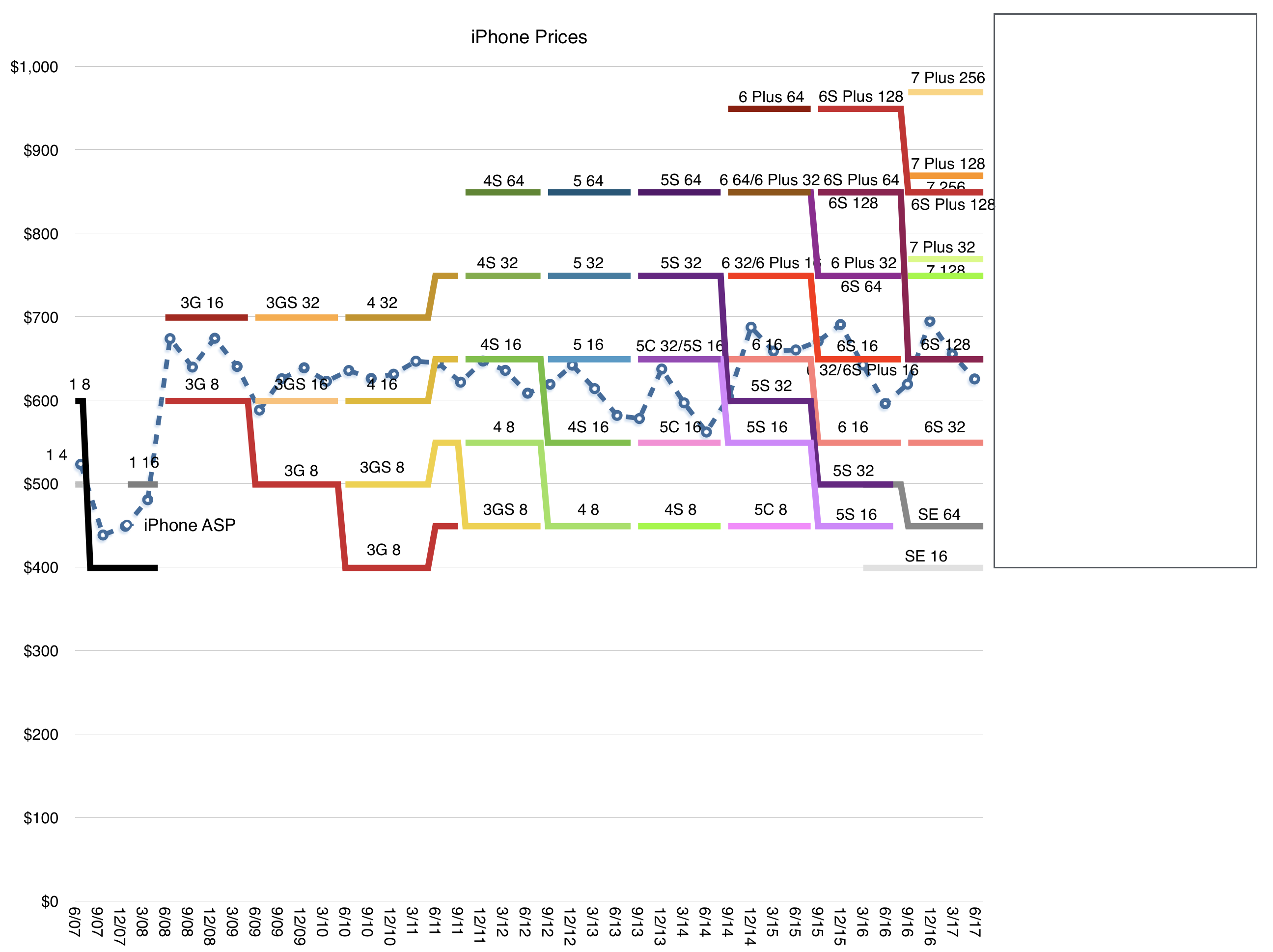
The graph shows a high degree of consistency of pattern: Every year a new iPhone is launched which replaces the one launched the year before. The older product is still offered at a reduced price. Price brackets are very firm and set at fixed intervals about $100 apart.
A few minor changes in pattern over the years can be observed:
- The original iPhone price changed due to a shift in subsidy model shortly after launch.
- An increase of $50 mid-2011 when the iPhone became available unlocked.
- Every three years a new, higher, price bracket is introduced, with a doubling of maximum memory capacity.
- The iPhone SE was introduced at a slightly lower price.
- The last year saw a slight increase in the highest price.
The overall pattern looks like a staircase with a widening price range where the lowest price remains constant and the upper price rises every three years by $100.
The "floor" of the range is a consistent $400 while the "ceiling" has expanded from $700 to about $950.
This year's ceiling is due for the fourth leg up and if the pattern persists, we should expect it to reach $1100.
This iPhone staircase has been built over 10 years and I don't see it changing over the next three. I therefore drew the blank box over what I thought would be the price range from now until late 2020.
This is what I call the staircase model of Apple pricing. The staircase model must be understood in combination with the flat iPhone average price as the product matures.
As the product matures the user base grows (to nearly 1 billion today). Later buyers will opt for the lower price points, but the availability of higher, more aspirational models (sustained by the brand) means that a minority will gravitate upward, mainly because they can. This ensures that although the median and mode of the price trend downward, the average price stays the same.
The flatness of iPhone pricing is also to be understood in combination with the flatness of Mac, iPod and iPad average pricing (shown below)
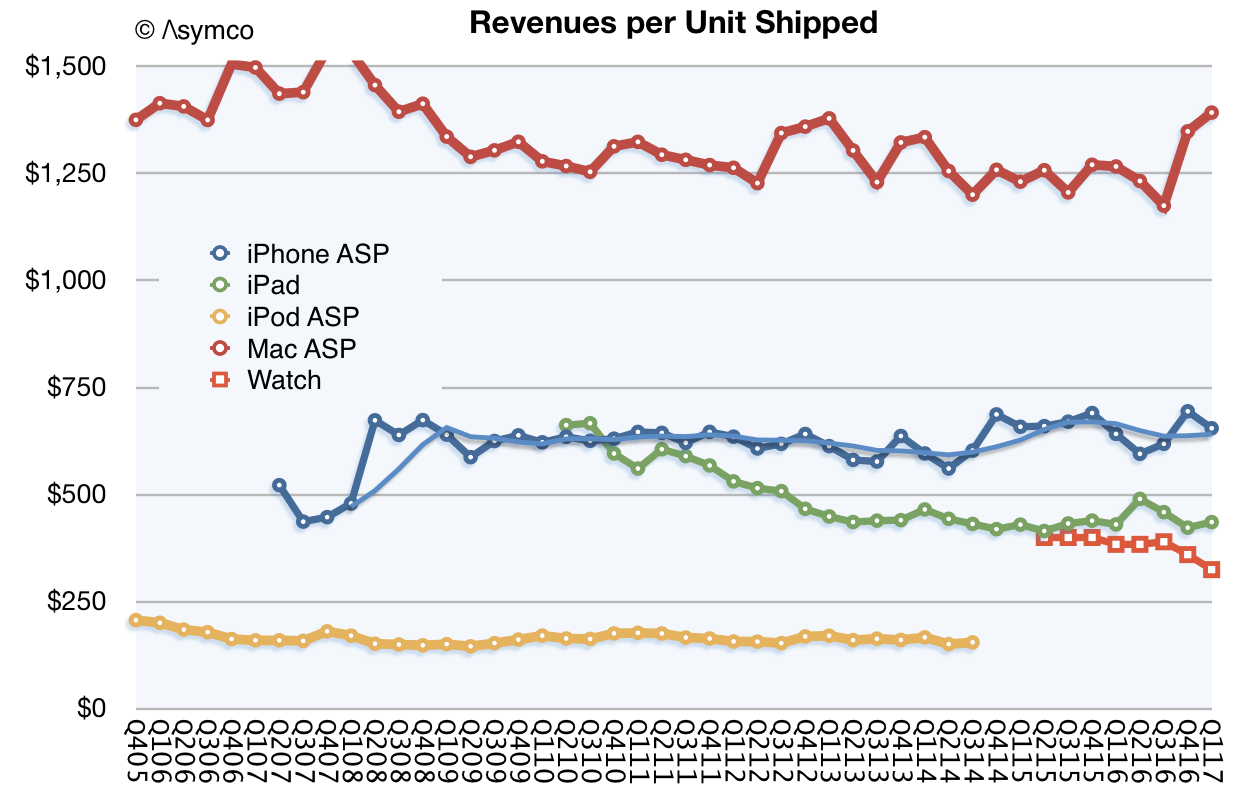
The technique of preservation of average price seems to be in effect across Apple. In other words, the evidence suggests that Apple prefers to keep average pricing for all products constant. Individual variants are priced so that, as the category matures, the changing mix leads to consistency in price ownership.
Thus the iPhone can be seen as controlling the $650 point, the Mac $1200, the iPod $200 and the iPad $450. This pricing signals the product's value and the value of the brand.
The signaling is not just to buyers but also to competitors. Ownership of price forces competitors to occupy adjacent brackets. This process begins at launch: the new Apple product is introduced in what is perceived as a premium stratum ((See for example the pricing of the new HomePod)) thus the reaction from competitors is to "undercut" it. But, as Apple climbs the price staircase, preserving the floor, it keeps competitors bunched up at the bottom. Competing in the same brackets with Apple is futile as other brands can't sustain the perceived premium position.
The result is a remarkable consistency of average pricing which, coupled with a remarkable consistency of competitive positioning, coupled with a remarkable consistency of customer satisfaction and loyalty, leads to a remarkable predictability of cash flows and ability to invest in new product creation..
Apple is thus quite easily understood as a remarkably consistent consumer products business. The only surprise that remains is how long it takes for that understanding to propagate.
82 comments
Space Gorilla ·
"As the product matures the user base grows (to nearly 1 billion today)."
Do you have any thoughts on how large Apple's user base can get? I've said for many years that Apple would likely level out just above one billion users, but perhaps I'm wrong about that. There seems to be a fair amount of room for growth in the user base yet.
Childermass ·
Yodobashi Camera, in Tokyo, have their "Apple store" on the first floor along with all the white goods. They understand. 'Computers' are on the upper floors with other hobby products.
So long as tech analysts and journalists are the ones who cover Apple, and so long as the tech fund managers follow them, they will not be understood.
And, as a dangerous p.s., so long as blogs and columns are filled with byte-counters and clock-speed-monitors, the blogs and columns will be full of the silly nonsense they are full of today.
graphex ·
Here's a WAG...an iPhone Pro with a ceramic or LiquidMetal body will have a price higher than $1100.
fstein ·
My guess is that Apple has created a hell for the under $400 Android clone makers. In addition to new iPhone SE's they have to compete wit excellent used iPhone 6 models, ranging from the mid $300's to below $200, and 4 inch models below $100. And when one Android clone maker takes aggressive pricing, the others must respond to clear inventory.
Thus only Samsung, Google, and Huawei can afford the R&D to make their products competitive. I'll go out on a limb and predict: 1) Huawei may fork Android for their market, and emerging markets. 2) Ditto, but less likely, for Samsung.
fstein ·
Great question. It would be nice to see a graph is iPhone IB over time. I've seen data that suggest it is in the mid 700M and growing. So 1B seems reasonable. Counting all iOS, we're likely there already. In Jan 2015, Apple had sold (not the same as IB) 1B iOS device.
fstein ·
I found it. We're about 2 years from an IB of 1B. https://www.ped30.com/2017/03/06/apple-deep-dive-installed-base/
Luis Alejandro Masanti ·
Thanks for a magnificent analysis!
Loooong time ago, when Apple's Ars Technica was still black on white (to show the pirate mood) they have a formula (half true/half joke) for Apple to introduce a product to the market: 1- Make a great ad. 2- Match a product to the ad. (Simplified version, it was longer.)
After your analysis, I have to recognize that the first step for Apple to lunch a new product is set the ‘premium point’ and the (future) base point desired, and then build into the internal steps.
As you said… the keep the average price constant so they have money flowing… 1997-near-bankrupcy experience let them to learn how to keep the business going.
Once again, magnificent article. Please, post more frequently!
Space Gorilla ·
I'm thinking of all users, iOS devices and Macs. I view Apple as a customer experience company which meets my needs in a variety of ways through a number of hardware products, software, and also services. Apple's approach isn't for everyone but I was always very sure the value/experience Apple delivers would resonate with somewhere north of a billion people.
Years ago, whenever I posted about Apple reaching one billion users the trolls would come out in force telling me Apple's user base was about to collapse Any Day Now (tm). I don't see those types of posts anymore :)
All that said, it'll be interesting to see where Apple ends up re: user base and how far north of one billion they'll get.
The next thing coming is what I've been calling the Apple Network of Things, and I think AR is going to play a large part in this. I don't see how Apple's user base contracts with what is on the horizon as far as customer experience/value. But doesn't it have to level off at some point? Surely Apple can't serve two billion users?
fstein ·
I like the way you think. It's fun when imaginations become real. That said, installed (and active) devices has likely exceeded 1 billion. Number of users may lag since US based users own multiple devices. Including "things" as devices with minimal or no UI, we'll see giant scale - beyond my ability to guess. One category, medical/health seems to be a great fit for Apple. Cook has talked generally about this. It will likely have excellent margin potential and privacy / security are paramount.
obarthelemy ·
"Apple is thus quite easily understood as a remarkably consistent consumer products business. The only surprise that remains is how long it takes for that understanding to propagate."
... because extrapolation is always the right move ? Especially when you've got correlation to prove causation ?
obarthelemy ·
Side note: I'm surprised, with all the analysts constantly opinionating on Apple, that there hasn't been much about Apple's China results. What's your take ?
Space Gorilla ·
I'm sure Apple's China results point to Apple's user base collapsing Any Day Now (tm).
Space Gorilla ·
I see the iPhone as an engine that drives the Apple Network of Things, and health devices are definitely going to be part of it. AR glasses seem obvious as well, coupled with Airpods for an immersive experience.
berult ·
If the iPhone ASP were nowadays' Evolution's prima facie metric, as I reckon it might actually well be, the arc of History is now being ever so slightly bended, by touchy touches and iffy 'for-crying-out-loud's, towards richly blended affinity. berult.
melci ·
Apple sold 1.43 Billion iOS devices worldwide as of Q2 2016 (1.55 Billion as of the end of 2016): https://fnayeri-ulqtb.wpcomstaging.com/2016/08/18/counting-apples-customers/
A quarter of a billion iOS devices sold since then (ref: Apple SEC quarterly financial reports)
1 Billion iOS devices in the last 4 years. (ref: Apple SEC quarterly financial reports)
Of these, over 1 Billion were iPhones as of mid-2016: http://www.apple.com/newsroom/2016/07/apple-celebrates-one-billion-iphones.html
Close to 900m iOS active devices worldwide (Benedict Evans Jul 2016): http://ben-evans.com/benedictevans/2016/7/25/platform-wars-final-score
Google reports 1.4b active phone and tablet devices (Sept 2015):
Google reports 2b active Android devices (May 2017): https://www.androidcentral.com/there-are-over-2-billion-active-android-devices-today
Google reports 1b active Google Play users (Sept 2015): same Youtube clip above
ABI Research reports 29% of Android devices are non-Google AOSP devices (Jan 2015): https://www.abiresearch.com/press/4q-2014-smartphone-os-results-android-smartphone-s/
Apple reports 1 Billion active devices (Jan 2016): https://www.apple.com/pr/pdf/q1fy16supplementalmaterial.pdf
Apple reports 80m active Macs (Jun 2014): http://www.trustedreviews.com/news/mac-install-base-hits-80-million-user-milestone
Apple nears 100m active Macs (Apr 2017): https://vanguarddaily.com/apple-reveals-mac-is-nearing-100-million-active-users/
Apple reports 885 million active iTunes users (Sept 2014): https://fnayeri-ulqtb.wpcomstaging.com/2016/08/18/counting-apples-customers/
Horace has a nice plot of the growth of many of these metrics: https://uploads.disquscdn.com/images/4016d1be5edb1c0d482b5d9eae370ca60e94934c50afff7ddcabad973cf516ae.png
melci ·
Horace has a nice plot of the growth of many of these metrics. Doesn't look like there is any plateau in sight does it?
https://uploads.disquscdn.com/images/4016d1be5edb1c0d482b5d9eae370ca60e94934c50afff7ddcabad973cf516ae.png
Apple sold 1.43 Billion iOS devices worldwide as of Q2 2016 (1.55 Billion as of the end of 2016): https://fnayeri-ulqtb.wpcomstaging.com/2016/08/18/counting-apples-customers/
A quarter of a billion iOS devices sold since then (ref: Apple SEC quarterly financial reports)
1 Billion iOS devices in the last 4 years. (ref: Apple SEC quarterly financial reports)
Of these, over 1 Billion were iPhones as of mid-2016: http://www.apple.com/newsroom/2016/07/apple-celebrates-one-billion-iphones.html
Close to 900m iOS active devices worldwide (Benedict Evans Jul 2016): http://ben-evans.com/benedictevans/2016/7/25/platform-wars-final-score
Google reports 1.4b active phone and tablet devices (Sept 2015):
Google reports 2b active Android devices (May 2017): https://www.androidcentral.com/there-are-over-2-billion-active-android-devices-today
Google reports 1b active Google Play users (Sept 2015):
same Youtube clip above
ABI Research reports 29% of Android devices are non-Google AOSP devices (Jan 2015): https://www.abiresearch.com/press/4q-2014-smartphone-os-results-android-smartphone-s/
Apple reports 1 Billion active devices (Jan 2016): https://www.apple.com/pr/pdf/q1fy16supplementalmaterial.pdf
Apple reports 80m active Macs (Jun 2014): http://www.trustedreviews.com/news/mac-install-base-hits-80-million-user-milestone
Apple nears 100m active Macs (Apr 2017): https://vanguarddaily.com/apple-reveals-mac-is-nearing-100-million-active-users/
Apple reports 885 million active iTunes users (Sept 2014): https://fnayeri-ulqtb.wpcomstaging.com/2016/08/18/counting-apples-customers/
unconvinced ·
I don't find that article very convincing. App usage stats show China users to be much more normal, in terms of number of apps used and the time spent in apps, than Thompson suggests. It's not a single app country, as his anecdotes suggest, and Chinese users spent a similar amount of time in WeChat as US users do in Facebook.
It also seems to completely neglect the financial downturn in China, for some reason, instead relying mainly on a single report of retention rate and some anecdotes. Without knowing the absolute values that make up the retention rate, for example, the iPhone users could be just extending their replacement cycle, rather than switching to other phones en masse. Or they could have lost 50% of their install base in one year. You have to decide which you think is more likely, or find a better source of install base data, which is much more valuable than retention rate estimates.
Space Gorilla ·
You bring up good points. I think WeChat is more of a platform on top of the OS than Facebook though, and that matters. Also, Thompson lives in Taipei so he's reasonably close to the issues at hand. Not to say he's always correct, but he's a pretty good analyst.
But again, I think Apple is going to do just fine in China, I'm not concerned.
Space Gorilla ·
Thanks. So maybe growth in the user base isn't going to level off for a while. It'll be interesting to see where this all goes.
Deserttrek ·
the worst person in most prisons has more value to society than the apple corporate leaders and the apple board of directors
Lanceman ·
I have an SE. 6 was too big for a workman. And nothing beats Apple's platform. I know too many with Androids that press the wrong button and accidentally install some battery-sucking app. Then I must go to Youtube and find out how to fix it for them. Needlessly complicated.
unconvinced ·
I don't see how that platform aspect matters if they spend their time across multiple apps, much as everyone else in the world does. If you want to argue that Apple Pay will never be that significant in China because of the WeChat payment network, then that would be reasonable.
All the analysts who lived in Japan were sure that the iPhone would never take off there because they already had advanced feature phones that could be used to watch TV on the train, etc. Now it is one of the strongest iPhone markets. Keep that in mind when you hear anecdotes like this.
Space Gorilla ·
Ben Bajarin tweeted that the retention rate in China is 74 percent, so you may be right that the Stratechery analysis isn't spot on. From what I've read Apple Pay isn't doing nearly as well in China as in the US, but that's just right now. Apple plays a long game.
The platform aspect of WeChat matters because of the jobs-to-be-done that are accomplished within that single app, and that diminishes the value of Apple's integration. But does it diminish that value enough to matter much? Maybe not. Last I read WeChat captures about 30 percent of app usage in China, so 70 percent of usage is not WeChat.
hannahjs ·
“Apple is thus quite easily understood as a remarkably consistent consumer products business. The only surprise that remains is how long it takes for that understanding to propagate.”
I take that to mean that the rest of the pundits, and Wall Street, and institutional investors are still rather clueless about Apple's nature, despite being lectured about it by you and a few others. How long? Until the graduates of Harvard Business School and its ilk are taught to think different.
hannahjs ·
iPhone qualifies as not just the most successful consumer product of all time, as Horace has it, but as solid evidence of punctuated equilibrium in social evolution, which itself is starting to become a driver of biological evolution. I would like to see this in my lifetime—becoming less of an animal, and more of a reasoning being, through our continued merging with machines. Technology may be our salvation, our ticket to immortality, our crowning achievement, and a way to join the galactic community on even terms. But I'll settle for curing our recurring leadership problem.
Raphael Tongoona ·
Possibly not of interest to may people here but in Zimbabwe (where the US$ is the official currency) a new iPhone will set you back US$1,200 or more due to transport, duties & taxes. Life is unfair.
http://www.techzim.co.zw/2016/04/how-much-the-iphone-se-will-be-priced-in-zimbabwe/
Matthew ·
Ben Bajarin tweeted that the retention rate in China is 74 percent
This is huge, and it suggests Apple's customer experience as "north star" approach applies well in China's fairly unusual market.
Space Gorilla ·
Yes, maybe humans just like nice things that work well and meet their needs. In that respect I think Apple should do fine in any market on the planet.
Matthew ·
Your sarcasm's (perhaps worse?) noted.
Yeah, I should have framed my comment more obviously within the overwhelming criticism Apple receives when the topic of their chances of success in China is discussed.
Here are just a few recent headlines drumming up insincere trepidation regarding Apple's flagging popularity in China, the iPhone's high price(s), the impact of government censorship, and its underdeveloped middle class, etc.
"Apple's biggest problem is China, where iPhone sales fell 20%"
"Apple's China revenues fall 10% as analyst claims iPhone has 'gone out of fashion'"
"China's Great Firewall hangs as a dark shadow over Apple's huge earnings boost"
"Cowen downgrades Apple, cites China concerns"
Space Gorilla ·
I suppose the strength of Apple's performance in the US has perhaps led the naysayers to focus on emerging or different markets in an attempt to paint a doom and gloom story. I am continually fascinated by people who root for Apple's failure and jump all over any tiny nugget that allows them to shriek "See, see, Apple is failing!"
But I think you're right, Apple's very simple approach of making good products that work well and selling them for a profit will work in China, and it will work in India, and it will work in other markets. There will of course be variations within different markets, different challenges, but at the core of it, as I said, humans actually do like nice things that work well and meet their needs.
That said, Apple products don't meet the needs of every human, and that's fine. We're allowed to make different choices without yelling at each other that those choices are stupid, uninformed, dangerous, and so on. Android works better for you? Great, go live your life with your Samsung phone. But that choice doesn't translate into "Apple is bad and evil". I digress :)
klahanas ·
Not being sarcastic, but what does retention mean in business circles. I understand it as percent remaining per cycle. If that's the case, at a constant 74%, after 2 cycles 54.74 remain, after 5 only 22.19%.
So it must mean that it's counter balanced by an adoption rate. Which means that market share matters.
No?
unconvinced ·
It generally means the number retained over the number “at risk”. I presume in the case of the Chinese survey/report above, the number of people at risk would be people who actually changed their phones during the year, not the entire install base. I can't read the original report, though. It definitely can't mean what you wrote, I think we can all agree.
Alexander Harrowell ·
Steady ASP in the context of scale economics implies improving margins.
klahanas ·
That takes very many accidental steps. I remain doubtful.
Lanceman ·
I know two cellphone illiterates (older people) in my immediate vicinity I have to remove things from somewhat regularly because they pressed the wrong stuff or followed some phony instruction. Apple will not let you do anything important without entering your password.
klahanas ·
Okay, that can happen, but it's not that easy. The default case for several versions of Android is to the installation from "Unknown Sources" be disabled by default. To install ANY App, also requires explicit permission.
Are the Apps you're removing in the Play Store? If so, what makes you think it wouldn't happen on the Apple Store?
melci ·
It is well known that Google does not vet apps uploaded to the Play Store with even a fraction of the vigilance of Apple. As a result, there is and has been vastly more malware in the Play Store than has ever made it into the App Store. For example, the Dresscode malware infected more than 400 apps on the Play Store.
However, the issue is far worse on Android as malware doesn't even need to come through an app.
For example, the various flavours of Stagefright only required an MMS message that the victim doesn’t even have to open or a web page hosting an infected media file that a victim merely views in passing or a chat app that simply receives said file.
This is one reason why Cisco, F-Secure and Kaspersky all report that Android users are the targets of 97-99% of the mobile malware in the world.
Symantec detected 9,839 cumulative Android malware variants in 2014. That year, it reported that 17% of Android apps were malware in disguise.
"Pulse Secure's Mobile Threat Report, based on data pooled from more than 2.5 million mobile applications, found that in 2014 almost one million individual malicious apps were released, almost four times as many as in the year before." "[There was] significant growth in Android malware, which currently consists of 97 percent of all mobile malware developed. In 2014 alone, there were 1,268 known families of Android malware, which is an increase of 464 from 2013 and 1,030 from 2012," it said."
"While Android is bashed repeatedly, Apple's iOS gets off lightly. The report said that there were just four iOS targeted attacks in 2014, and the majority of those were designed to infiltrate jailbroken devices."
What makes this worse however is Android's abysmal record for system and security updates. Cambridge University reported in 2015 that 87.7% of Android devices have unpatched critical rootkit-level vulnerabilities going back 4 years and that it takes 18 months for 30% of Android devices to be patched while the rest NEVER get patches.
klahanas ·
The person was describing unwanted apps by computer illiterate users. How do you or I know whether these were unwanted legitimate apps? That was not made clear.
But regarding the broader security question, subjugation to Apple's authority is but one answer. The PC was invented to get away from such authority.
Also, since Apple's authority is absolute and compulsory, they should bear full responsibility for each and every aspect of their ecosystem, including damages. They profit from such safety perceptions after all...
melci ·
If the OP wasn't referring to malware, then the example of users downloading legitimate apps that still suck the battery is still eminently valid thanks to the poorly implemented multi-tasking architecture of the Android OS.
On Android any app can for example continuously poll a data source every few seconds or minutes in case a value changes thus using up battery, CPU clock cycles and network bandwidth.
What Apple did instead was to implement a comprehensive Push/notifications architecture that developers can use that only pushes the updated data to the app when that value changes, thus eliminating all of the wasteful behaviour that is otherwise required. This is just one example of how much more intelligent Apple’s multi-tasking architecture is than the simple multi-tasking implementation of Android.
klahanas ·
Did not say it was not legitimate, just that it can happen in either store. And do not tell me Apples own Apps don't track. It's well documented that some did (cell towers for instance) and others still have to by their nature.
melci ·
I'm talking about Android apps draining the battery due to Android's poorly designed multi-tasking architecture. I believe that is what the OP was talking about - specifically unless you are technically literate, most users do not realise that far too many Android apps drain your battery if left running in the background.
And no, this does not happen on iOS thanks to Apple's well architected OS that aggressively ensures good battery life even for poorly coded apps.
klahanas ·
An App need not be malicious to suck battery life. Calculating Pi to large decimal places comes to mind.
Meanwhile, saying that it's an Android only experience is bull. All mobile users are plug huggers. At least Android offers models with thick form factors with huge batteries as well as models with replaceable batteries.
Your praise of iOS cannot and does not violate the laws of physics. For a given job a minimum energy is required.
melci ·
Actually, the physics of big batteries doesn't help you when the Android OS is so inefficient. https://uploads.disquscdn.com/images/755d1d12f84cf21c5906eb714a3574c315b1057d0cd598fe97789d1b789fc315.png
klahanas ·
I guess there's a point in there somewhere... If there is, I don't see it. 9:5 vs 8:22 vs 8. Not impressed. I see plug hugging for all, and you still have not addressed any models with replaceable batteries, and have grossly strayed from the original topic of installing unwanted apps.
melci ·
You seem to have forgotten the original topic was accidentally installing "battery-sucking" apps.
You also have not addressed external power packs and battery cases for iPhones that give vastly more battery life than replacement batteries. Because of the fragmented hardware form factors of Android phones and the fact that no individual phone sells anywhere as many units as the iPhone, it is the iPhone that has vastly more choice in such battery cases and other hardware peripherals and accessories.
You also ignore the fact that replaceable batteries reduce the structural integrity and strength of a phone chassis, increase the thickness and weight and reduce the water proofing of the phone.
Lanceman ·
I don't know. I have to Youtube their Androids because I don't know enough about the platform. AND I don't care to. I'll never own a droid.
klahanas ·
Fair enough. And I'm writing this to you on an iPad that I never would have owned if I already didn't have Android tablets.
klahanas ·
Any app that does any work at all is battery sucking. That's a law of nature.
It's true no single phone sells more than an iPhone. That's just fact. I prefer diversity and choice over conformity and uniformity. You can certainly self censor by choosing iOS, that's your right, as it is mine to desire that iOS not be as it is. Yes, I m willing to take the risks in the name of choice. You don't have to.
I don't understand the comment about waterproofing, the rest is technical choice.
melci ·
You're ignoring the elephant in the room klahanas. The problem on Android is when battery-sucking apps keep on sucking the battery when they keep running in the background because of Android's poor handling of multi-tasking and backgrounding of apps.
This is where iOS is significantly better. Android phones can drain their batteries all too easily simply sitting there asleep.
I prefer diversity and choice in hardware peripherals and accessories than the limited amount available for any one model of Android phone.
klahanas ·
Melci, you would think that my phone would be empty every 5 minutes from the way you describe it. The very data you presented clearly show they both lack battery longevity, with the iPhone admittedly gaining half to one hour out of 8.
The elephant you seem to ignore is what exactly are the underlying processes? What benefit, if any, do they give. Is it a brighter screen? Can you turn processs on or off, etc., etc., etc. btw, BSD is still at the root of iOS and Linux at the root of Android. Architecturally very similar.
Admittedly I focused on the aspect of accidentally loading unwanted apps. That would be a function of the user's ignorance more than anything else.
Your last sentence is paradoxical to me. There seems to be a "disconnect". Love your wired headphone choices for your iPhone! Meanwhile USB is USB, Bluetooth is Bluetooth, and so on. I will give you this however....It's far more prevalent that Apple accessories don't play with others. (Still got a USB DVD drive intentionally crippled to only work with a Mac). Who else has a lightning connector, btw...?
For me, I would never willingly be so beholden to a single supplier and a rigid, often unwanted, IT department that I don't control. Battery life be damned.
melci ·
You're ignoring the hippopotamus in the room now klahanas. ;-) Those battery tests only rank phones when being actively used. My point which you seem to keep missing is that when badly behaved Android apps are in the background or when the phones are inactive - asleep - these battery-sucking apps keep on draining Android phones flat while the iPhone keeps on keeping on far beyond the 9+ hrs of active use benchmark.
iPhone owners don’t have to worry about trying to turn off background processes to save power - the OS intelligently does it for them.
That is the difference that the OP was highlighting - non-technical Android users are in a world of hurt because of this.
In terms of peripherals, I know that being an Android user you are unfamiliar with the concept of many hardware peripherals and accessories being designed to mould to the physical dimensions of your phone as it is very rare in Android land due to such massive fragmentation of hardware shapes, connector locations and form factors.
However in the iOS ecosystem, there are huge numbers of docks, cases, Battery backs, audio mixers, medical instruments, ruggedised or leather folio cases, etc etc that are customised for the standard form factors used by iPhones and iPads giving much more variety in custom accessories and peripherals than any one model of Android phone has.
klahanas ·
Okay, I'll give you that. You do have more cases, yes, I prefer nude. I also prefer components that work with a breadth of devices. Now when it comes to dongles Apple is the undisputed leader.
PS-You did catch the part where this is written on a ipad. Didn't you? I'm aware. Reason for ownership is the pencil, and only the pencil. Now if I could only get a memory slot and independence from Apple, I would have a device that doesn't leave me wanting.
melci ·
Still no comment on battery-sucking apps - the original topic of the OP?
melci ·
Ah yes, independence for Apple - freedom to get as much malware as you like and into the bargain miss out on all the top tier Business apps only available for the iOS platform.
1 Billion iOS device owners find the pros of Apple's platform tend to outweigh the negatives. :-)
klahanas ·
I answered that. Both are at best good enough.
klahanas ·
Yes to me Apple is but another vendor not the only vendor. Thats how i like it.
melci ·
Except of course for the bit about apps draining the battery in the background and when asleep because of Android's poorly implemented multi-tasking architecture. Oh well, have a great day!
klahanas ·
One hour out if eight, at best. Sure. Give them the trophy.
klahanas ·
Competition within iOS would be better still, just as there is competition within Android. Oh well.
melci ·
Incorrect:
Talk time (wireless): Up to 21 hours on 3G
Standby: Up to 16 days
Internet use: Up to 13 hours on 3G Up to 13 hours on 4G LTE Up to 15 hours on Wi-Fi
Wireless video playback: Up to 14 hours
Wireless audio playback: Up to 60 hours
When users download any of many battery-sucking Android apps the OP mentioned, users get far less battery life on that platform on standby or any of the other use cases mentioned above.
klahanas ·
I used the data you provided previously. Now...show the equivalent for Android flagships.
melci ·
We all know that when there are battery sucking apps running on Android in the background or on standby, those Android flagships don't get anywhere near the same battery life as their specs. Not sure why that is so hard for you to admit?
melci ·
So you want fragmentation on iOS as well? No, that is why users move to iOS - to get away from the problems of Android.
klahanas ·
You have not made a compelling enough case. Not enough for me to be impressed enough to care.
klahanas ·
No one would be forcing you to buy anything other than Apple in any case. Why you would care, other than greedy stockholder reasons perhaps, escapes me.
melci ·
It doesn't take much of a Google to find proof:
"It’s no secret now that some Android apps are killing your battery. These apps keep working in the background all the time, even when you aren’t using them. They’re pinging the internet and using motion sensors, all of it sucking the battery’s life. While several apps do this, some are far worse than others. The biggest leeches are often some of the most popular apps. If you're getting poor battery life on your device, you likely have an app abusing your battery in the background. Find out how to identify those apps and solve your battery problems. We can also now identify these apps thanks to research conducted by mobile carriers, antivirus makers Avast and AVG, and tech enthusiasts. Here are the worst apps that drain battery on Android devices. 1. SnapChat 2. Tinder 3. BBC News (or Any News App) 4. Microsoft outlook 5. Facebook and Messenger 6. Amazon Shopping 7. Samsung’s Default Apps 8. musical.ly 10. LionMobi Power Battery and CleanMaster"
melci ·
iOS users care because Apple's curation and control of the platform results in a far more secure, lucrative, easy to use platform with more high quality apps, more custom peripherals and hardware accessories, and the best apps first and often exclusively. More than enough reasons.
klahanas ·
I use Facebook very lightly. I disable svoice. Working on disabling Bixby. I want the Google apps, but choice is good.
Any news app would drain if real time is desired. Meh...
klahanas ·
You have zero reason to concern yourself over my conformity to curation or otherwise. My compliance is not relevant to you. Worry about your device. If there were alternate ios devices or at least app stores it has zero impact on you except if you're a stockholder.
Simply put, my device is none of your business, but thanks for your concern.
melci ·
You're very welcome to whatever device you prefer. Have fun.
melci ·
Unfortunately the rest of the world Facebooks very heavily. Such is life.
Space Gorilla ·
Interesting that whenever klahanas (aka applecynic on macdailynews) is losing an argument he (or she) adopts the "meh I don't care anyway" pose and bails out.
klahanas ·
Good to see you still care.
TJKEI ·
Hi Horace! :) Could we ge an update for the price points? Cheers!
Sacto_Joe ·
Sure! https://twitter.com/asymco/status/907987556502953984
Sacto_Joe ·
From Kirk Burgess on Braeburn Group:
"Some further thoughts on pricing. 1. Apple has eliminated the 3 storage tiers - now it’s only 2 options for every model. 2. While the cheapest model of the iPhone 8 has increased by $50, and the 8 plus by $30, the 256GB model has stayed the same price for the 8, and actually is $20 cheaper on the plus model. 3. Also in regards to the 8/8+ entry level price increases - both models have had minimum storage bumped to 64GB (up from 32GB). Last year, if you thought 64GB was minimum needed, your only option was to get the middle tier 128GB model. This year you can instead get the entry level model, which is $50 cheaper on the 8, and $70 cheaper on the 8+. So with the above in mind I think the 8 entry level model might be more popular than I initially thought, at $300 less than the iPhone X."
This makes a lot of sense to me. Apple has dropped the 32 Gig model and gone straight to the 64 Gig model. Man, this reminds me of 1984, when the Mac first came out with 128 K of RAM - and it was considered ridiculous to have that much RAM in a computer! Apple promptly quadrupled that to 512 K the next year....
I should also mention that my wife and I bought a 128 K Mac in 1984, and that the Mac plus a dot matrix printer (and the two programs that came with the Mac, MacWrite and MacPaint) cost us over $3,000.
It was, bar none, the best investment we've ever made.
pk_de_cville ·
"If there were alternate ios devices or at least app stores it has zero impact on you except if you're a stockholder."
Apple owns and responsible for its hw/sw configuration. Thus, Apple and only Apple can deliver highest levels of security, privacy, reliability, ecosystem, and service.
There's a reason why NO ONE is interested licensing iOS to run on their hw: How would they match Apple's metrics, even approach Apple's metrics????
If Apple offered to give their iOS away, NO ONE would take that offer, unless they're looking to go bankrupt, that is.
pk_de_cville ·
"Huawei may fork Android for their market, and emerging markets. "
Good idea, different company: It's strongly rumored that Google will buy nearly bankrupt HTC. Now, the HTC/Google phone may very well be a direct competitor to iPhone.
klahanas ·
Respectfully, you misunderstood. I was not suggesting Apple license iOS, rather that Apple to allow, or not be allowed to restrict, other sources to purchase applications for iOS, at the discretion of the user.
I would ideally also like to be freed from Apple's shackles of protection if I choose, on my own Apple purchased device.
pk_de_cville ·
Sorry. I hear you.
I want and trust the App Store's significant investment in its safety app policies and the systems and professionals inspecting and approving all apps submitted. A few bad ones may get through, but iOS has a Kill switch capability. Apple can kill any bad behaving app instantly for all 1B devices.
Good enough for me. (Protection is good while having sex and computing.) : )
klahanas ·
That's fine for you, and I would not force you to buy from an alternate store, should such a thing exist. Again, my position does not impact you at all. I would like alternate stores that conceivably would offer things Apple's Store doesn't allow. You know, democracy and self determination.
fstein ·
Aha. That would be interesting and challenging. Ideally Google would keep to the high-end price range, i.e. not compete on price. Otherwise they risk alienating their Android ecosystem partners.
Still Apple's advantage is nearly a decade of serious CPU, MPU, GPU, and Neural Net chip design capability.
But really, Android and iOS are not competitors. Google/HTC would compete with Samsung and Huawei.