Teen Survey Update: What happens when teens grow up?
by Horace Dediu
What's the role of fashion in tech choice?
Apple's iPhone continues to be incredibly popular with U.S. teens, according to Piper Sandler's latest biannual teen survey. 88 percent of teens surveyed said that they own an iPhone, and 88 percent said they intend to purchase an iPhone as their next device.
Teen iPhone ownership numbers have increased three percent since April 2024, and are near record highs. The iPhone has long been the most popular smartphone among teens in the United States, and there has been steady growth in teen ownership. 10 years ago in April 2015, 66 percent of teens surveyed owned an iPhone.
Though teen interest in the iPhone is high, other Apple products and services are not as popular. Apple has not made inroads with Apple TV+, and it continues to trail Spotify as the most popular music service among teenagers.
45 percent of teens surveyed have a paid Spotify subscription, while Apple Music is the second most popular streaming service with 30 percent of teens reporting an Apple Music subscription. Because Spotify has a free tier, it's still the most popular service overall, with 65 percent of teens using it. Apple TV+ is not popular with teens, and less than one percent say they watch Apple TV+ shows. Netflix and YouTube were most popular with 31 percent and 26 percent of teens reporting usage, respectively.
Approximately 31 percent of teens own a virtual reality device, but most of those have an Oculus (25 percent). Just one percent of teens have an Apple Vision Pro, which is not a surprise given the price of Apple's device. Of teens that have a VR device, 60 percent said that they seldom use it, with just four percent reporting being a frequent daily user.
Piper Sandler surveyed 6,455 teens across 43 states for the spring 2025 report.
This data was collected in the spring of last year.
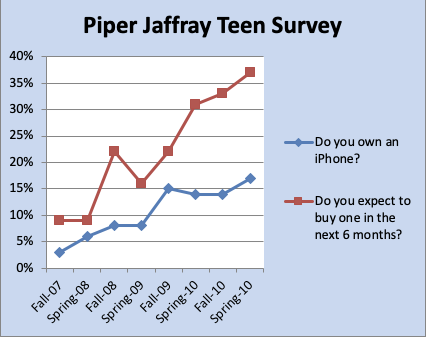
I found the above in my archives. Ownership in 2010 was about 18%, 2015 it was 66% and 2025 it was 88%. The saturation at 88% (for both ownership and intent) was achieved relatively quickly but most importantly, it remains steady.
Now consider that the teens of 2007 are having kids of their own. A 15 year old in 2007 is now 34 and a 19 year old is now 38 and some have a teen of their own.
At 19 years, the iPhone brand has transitioned across one generation with not only resilience but with deeper entrenchment. This cannot be said for other contemporary technologies, e.g. social media. While elders use Facebook the young have moved on. Perhaps to Instagram (25-34, 76% 18-29) or perhaps to TikTok (16-24) which has the strongest position for younger, Gen Z users.
Here are some additional data points on predisposition for social media:
Facebook (25-49): Largest group is 25-34 (31.1%), but also high usage among 30-49 year olds.
LinkedIn (30-49): Professional focus, ideal for B2B and adults 30-49.
YouTube (18-64+): Broad, with the highest usage (93%) in the 18-29 bracket.
Pinterest (30-49): Popular with older, female audiences.
There is quite a lot of divergence and only YouTube seems to be fairly steady across age groups.
Moreover, as the Piper Sandler survey suggests, Apple Services is not the same as the iPhone. The adoption of Music and TV are not a broad-based and that has a lot to do with disposable income. The mechanism for adoption should be the family plan whereby teens are automatically enrolled through their parents in to Music and TV+. After all, teen iPhones are likely purchased by parents. That services bundling is where Apple must focus its effort.
Comments