Asymco

Asymmetric Intelligence

iPhone

  1. Apple in Europe: How many iPhone switchers are addressable in the near term?

    Research · 2 comments

    An update using operating system market share

    Apple's performance in China is often noted and scrutinized. During the last quarterly earnings call Amit Daryanani asked:

    ... the other second question I have for you is maybe just touch on the China strength you folks had. I think this is very close to all-time high revenues you have had in China. What is driving the strength over here?

    To which Tim Cook gave the following answer:

    Greater China was up 38% year on year. It was driven by iPhone, where we set an all-time revenue record. So it was the best iPhone quarter in history in Greater China. It is driven by the customer enthusiasm for the iPhone 17 lineup. And I would tell you that during the quarter, traffic in our stores in China grew by strong double digits year over year. It was a terrific quarter. Our installed base reached an all-time high in both Greater China and Mainland China. And we set an all-time record for the upgraders, and we saw strong double-digit growth on switchers.

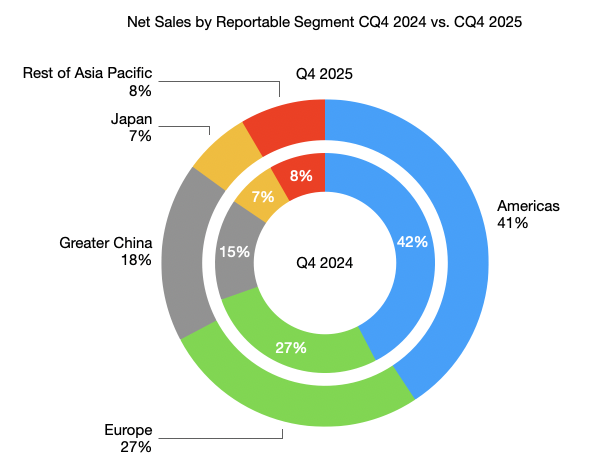
    That's remarkable growth and every quarter we get this sort of discussion. But I don't recall ever there being a similar discussion about Europe. This is strange because, and the following graph shows, Europe is a bigger market for Apple than China.

    Europe also grew, and at 12.7%, grew faster than the Americas and faster than Japan.

    Regional Sales CQ420252024Growth 
    Americas58,52952,64811.2%
    Europe38,14633,86112.7%
    Greater China25,52618,51337.9%
    Japan9,4138,9874.7%
    Rest of Asia Pacific12,14210,29118.0%

    So why is Europe not discussed. Management does offer some mentions:

    iPhone saw strength around the world, reaching all-time revenue records in many of the markets we track, including The US, Greater China, Latin America, Western Europe, The Middle East, Australia, and South Asia, as well as a December record in India.

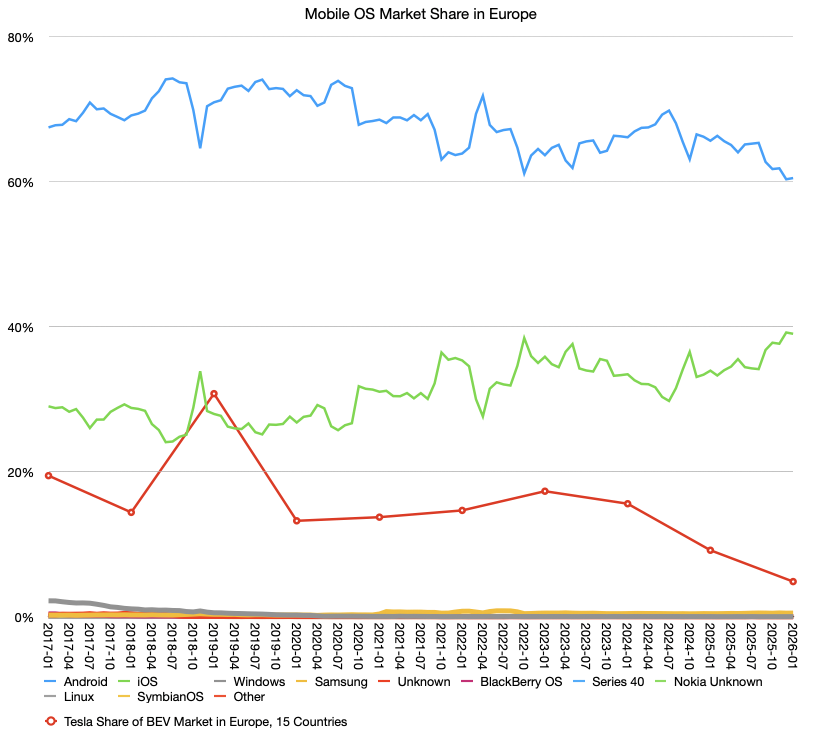
    Perhaps it's because Europe is considered a mature market, though surely China is not exactly emergent, with 114 phone numbers per 100 citizens (vs. 116/100 for the US). Even so, mature markets are still worth looking at. Though we don't have iPhone sales in Europe specifically, we can look at the usage profile of iOS as a proxy of iPhone market share. The following graph (via Statcounter) shows the mobile OS market share in Europe. The green line is iOS and the blue line is Android.

    Apple's share has increased significantly since 2018 when it was at 24%. In January of this year it's was at 39%. Correspondingly, Android fell from 74% to 60%. 15 percentage points is a significant share transfer.

    Europe, I might add, is an even bigger market than the US, with 459 million smartphone users vs. 300 million in the US, 329 million in North America. The opportunity to capture an additional 15% share there is equivalent to almost 70 million new users. The last 15% growth took 7 years so 70 million more in the next 7 would imply 10 million new users per year. That is a significant portion of the global pool

    NB: To contrast this growth, I've also added the market share of Tesla in the battery electric vehicle (BEV) market. Unlike Apple, Tesla is considered a dominant brand in the EV market and yet its market share is dramatically lower, and falling.

  2. Why not maroon? The Macalope ponders the power of color

    Nota Bene

    Never underestimate the power of color

    If a cheaper MacBook with a less powerful chip excites you, then you’ll love what else Apple is expected to ship soon! The iPhone 17e is expected imminently, adding an A19 chip and MagSafe charging, something the horny one did not realize the 16e did not have. A new base model iPad and iPad Air are expected early this year, but will just be speed bumps of the existing models.

    Source: Macworld

    NB: A cheaper MacBook with a phone chip does excite me. And so do new colors. We don't mention rumors on this site but anything the Macalope's research uncovers is worth ruminating over.


  3. Teen Survey Update: What happens when teens grow up?

    Research

    What's the role of fashion in tech choice?

    Apple's iPhone continues to be incredibly popular with U.S. teens, according to Piper Sandler's latest biannual teen survey. 88 percent of teens surveyed said that they own an ‌iPhone‌, and 88 percent said they intend to purchase an ‌iPhone‌ as their next device.

    Teen ‌iPhone‌ ownership numbers have increased three percent since April 2024, and are near record highs. The ‌iPhone‌ has long been the most popular smartphone among teens in the United States, and there has been steady growth in teen ownership. 10 years ago in April 2015, 66 percent of teens surveyed owned an ‌iPhone‌.

    Though teen interest in the ‌iPhone‌ is high, other Apple products and services are not as popular. Apple has not made inroads with Apple TV+, and it continues to trail Spotify as the most popular music service among teenagers.

    45 percent of teens surveyed have a paid Spotify subscription, while Apple Music is the second most popular streaming service with 30 percent of teens reporting an ‌Apple Music‌ subscription. Because Spotify has a free tier, it's still the most popular service overall, with 65 percent of teens using it. ‌Apple TV‌+ is not popular with teens, and less than one percent say they watch ‌Apple TV‌+ shows. Netflix and YouTube were most popular with 31 percent and 26 percent of teens reporting usage, respectively.

    Approximately 31 percent of teens own a virtual reality device, but most of those have an Oculus (25 percent). Just one percent of teens have an Apple Vision Pro, which is not a surprise given the price of Apple's device. Of teens that have a VR device, 60 percent said that they seldom use it, with just four percent reporting being a frequent daily user.

    Piper Sandler surveyed 6,455 teens across 43 states for the spring 2025 report.

    This data was collected in the spring of last year.

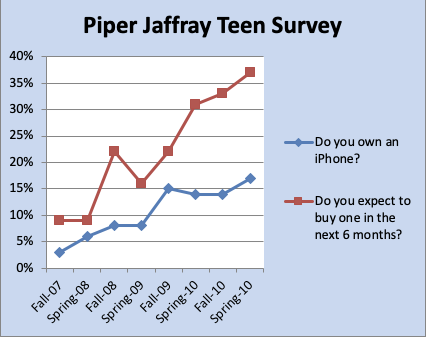
    I found the above in my archives. Ownership in 2010 was about 18%, 2015 it was 66% and 2025 it was 88%. The saturation at 88% (for both ownership and intent) was achieved relatively quickly but most importantly, it remains steady.

    Now consider that the teens of 2007 are having kids of their own. A 15 year old in 2007 is now 34 and a 19 year old is now 38 and some have a teen of their own.

    At 19 years, the iPhone brand has transitioned across one generation with not only resilience but with deeper entrenchment. This cannot be said for other contemporary technologies, e.g. social media. While elders use Facebook the young have moved on. Perhaps to Instagram (25-34, 76% 18-29) or perhaps to TikTok (16-24) which has the strongest position for younger, Gen Z users.

    Here are some additional data points on predisposition for social media:

    Facebook (25-49): Largest group is 25-34 (31.1%), but also high usage among 30-49 year olds.
    LinkedIn (30-49): Professional focus, ideal for B2B and adults 30-49.
    YouTube (18-64+): Broad, with the highest usage (93%) in the 18-29 bracket.
    Pinterest (30-49): Popular with older, female audiences.

    There is quite a lot of divergence and only YouTube seems to be fairly steady across age groups.

    Moreover, as the Piper Sandler survey suggests, Apple Services is not the same as the iPhone. The adoption of Music and TV are not a broad-based and that has a lot to do with disposable income. The mechanism for adoption should be the family plan whereby teens are automatically enrolled through their parents in to Music and TV+. After all, teen iPhones are likely purchased by parents. That services bundling is where Apple must focus its effort.

  4. Nearly 75% of iPhones are in use outside the US

    Research · 29 comments

    comScore reported that 15.4 million iPhones were in use in the US as of November. (25% share of 61.5 million total smartphones.)

    We also know that about 75 million iPhones were sold by November since the product launched. With about 17 million units older than two years, and assuming that half of those might still be in use and that all the iPhones less than 2 years old are still in use, we get an upper bound of 66.5 million iPhones in use globally.

    That means 23% of all iPhones are in use in the US and that 77% are in use outside the US.

    Can this be verified?

    The sell-through data we have supports a slightly lower figure.

    October 2010: 63 percent of iPhones were sold outside the US in Q3

    April 2010: Non-US iPhone sales approaching 70% of volumes

    This might indicate that comScore surveys under-represent the iPhone or that device attrition/retirement is significant. However, the data does seem to imply that the US is no more than one third and perhaps as little as one quarter of the iPhone's user base. Perhaps with Verizon, that figure will grow. But at the same time, new international markets (like China) may continue to outgrow the US.

    The 4:1 split could continue. After all, the US represents only 234 million out of about 5 billion mobile phone users globally--a mere 4.7%.

  5. The iPhone is not superfluous, not easily copied, not revolutionary and not a premium product

    Research · 61 comments

    The release of the iPhone is rightly acclaimed as a watershed event in the history of telecom. It was a sensation. But it was also a product that was widely underestimated and dismissed. Even today expert opinion is divided. The critics of the product transitioned directly from labeling it a superfluous bauble to an obvious and copyable sustaining innovation. Advocates of the product describe it as revolutionary and dazzling with the potential for capturing significant profit share due to premium pricing and positioning.

    So which is it?

    I'll argue that it's none of the above. The iPhone is not superfluous, not easily copied, not revolutionary and not a premium product. What it is is disruptive.

    First, we have to quickly define disruptive potential.

    A product is disruptive if it competes with an existing, incumbent set of products on a new basis. It competes along a new measure of performance. That means it's either "low end" and hence cheaper, simpler, more modular and conformable, or it creates a "new market" where completely new measures of performance or quality are relevant.

    In both "low end" and "new market" disruptions the product is usually wrapped in a business model that insulates it from incumbent response due to inherent asymmetries. Incumbents will find the economics of the entrant product unattractive and will be motivated to ignore it or actively avoid copying it.

    The consequences of disruptive product entires are often catastrophic for the incumbents because, over time, the disruptor product vacuums up all the profits in the industry, robbing the incumbents of the fuel to respond by the time they become motivated to do so. In essence, the transfer of value to the new basis of competition happens so slowly that the threat is imperceptible until it's too late.

    If we look at this definition, it's startling that the iPhone does not seem to fit.

    As a phone, it's not cheaper, nor modular and hence not "low end". It did not create a new market.  As a phone, although it did recruit more regular phone users into becoming smartphone users, it was not the first or last phone to do so. Its phone business model was not a radical departure. It was not ignored by the mobile phone incumbents who reacted with various degrees of urgency and vigor. It was actively copied in every way from the UI to the ecosystem to the pricing model and distribution.

    The only thing that seems to have happened according to the disruptive formula was the transfer of profits from incumbents to Apple, at least temporarily.

    So the iPhone seems to be correctly classified as a sustaining innovation. Something that moves the phone market forward and which, except for a temporary misallocation of profits, will entrench the incumbents after they manage to copy it effectively.

    However, here is where we have to dig a little deeper.

    Market analysis easily becomes myopic when looking only at a market defined by a product. I've argued in the past that strategic insight comes from looking at products that cross over their market boundaries. Especially products that are hired to do different jobs than the same products in their categories. The iPod may seem like an MP3 player but it caused catastrophic profit collapse in multiple industries. It knocked out the CD business, it crippled the component audio system "Hi-Fi" industry, it razed the music retail business and affected the entire music value chain. It's still pounding at the gates of video and TV production. And, almost as a side-show, it crushed the Walkman.

    Even though it was a music player, the MP3 device market was the smallest target for the iPod. It turned out to be far more dangerous to ancillary industries. The reason is subtle: it competed as an integrated ecosystem. You hired the iPod to serve you music everywhere, not just in your living room. And it did the job in an integrated way from source to earbuds taking what was a hodgepodge of modular components built around analog music and smoothly integrated them to deliver music in new, non-consuming contexts.

    The lesson is therefore that when looking at the iPhone one has to look at ancillary industries not just at phones.

    Phones have always been a component in a wider inter-related telecom value network. Even today they are often called "terminals" in the industry meaning that they are the end points of a network. Similar to the PC, the iPhone enables a migration of intelligence away from the center toward the edge of the network resulting in a de-valuation of the network itself.

    I argue that the real disruption of mobile computing (i.e. iPhone) is made possible not by the smartphone technologies but by mobile broadband. Once broadband became mobile with 3G the smartphone could shift its focus (jobs it's hired to do) from voice to data. That shift is disruptive to incumbents because they built their businesses around operator distribution and operator service economics. With apps, mobile computing brings with it services which allow all communications to be independent of operators. Selling ringtones, maps, email and video-on-demand are all dead business plans today. But operators clung on to these hopes for many years and forced vendors to comply to this strategy.

    The incumbents relied so much on the telecom value chain, where the value flows from the monthly service charge, that they would not deploy technologies or business models that were asymmetric to operator business models. This is the root cause for Nokia and Samsung and Motorola and LG "missing the boat" on smartphones. All the vendors had the pieces of technology on their shelves. But when they took these technologies to their customers, the customers rejected the package.

    This is why entrants like RIM and Apple could easily gain a foothold and grow. They had modest volumes, sold new concepts like business email and new UIs with iconic designs, but did not go after the core business model. This is similar to how iPod/iTunes got a toehold with the record labels. By the time the disruption took hold, operators were addicted to the new high-ARPU being generated even though they were all pure bitpipe plans. A bird in the hand is worth two in the bush, so the new device brands stuck.

    Do the incumbents still have time to respond effectively? It's less and less likely. They cannot build the new computing ecosystem without the distribution power of operators. Note that iPhone 'clones' in Android are still sold via operators and that nobody is interested in making either iPod touch clones or iPad clones sold independent of the operator channel/subsidy model. This is not because of technical or economic reasons but because of a lack of distribution (and lack of integrated content).

    When you step back and look at the phone in the context of the network business model as well as the shifts in consumer jobs to be done you realize the potential is far greater than taking share from incumbents. The iPhone is not divided into a portfolio of different phones, but it's a part of a portfolio of new mobile computing products. It just happens to be the only one which still depends on the cellular operator distribution network.

    Seen as part of a new mobile computing paradigm and following the trajectory of the mainframe, mini-computer, PC and laptop, the iPhone is an essential, non-superfluous device for a vast population of new users.

    Seen as an integrated app ecosystem with strong network effects, it's not easily copied. Responses that only account for it as a glass and metal object of desire will fall way short of being competitive. As the hardware was always available to competitors, it's not a revolution in hardware or even in user experience.

    Most importantly, seen as a computing alternative merged with a communication appliance, it and its siblings are not premium products. The pricing and service structure around it make it seem a low cost alternative for solving the jobs it's hired to do.

    In other words, it is as disruptive as it gets.
  6. In three years Apple will still have a minority market share in smartphones

    Research · 36 comments

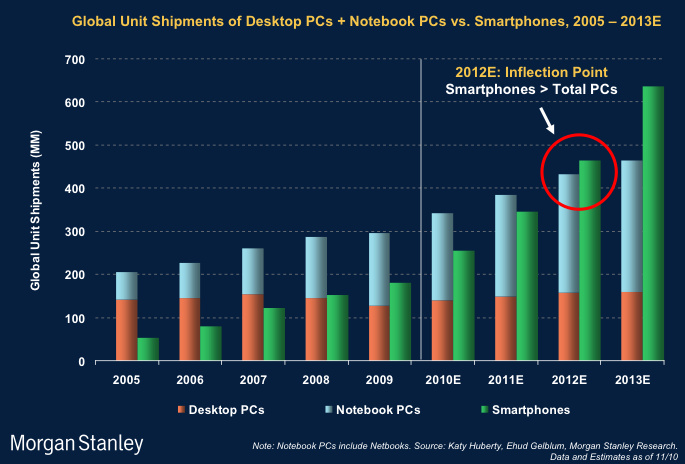
    Morgan Stanley's Web 2.0 update came out yesterday and it's full of nice charts. Here is one:

    Note that the expectation for smartphones to overtake all PCs (including netbooks) will happen when smartphones sell more than 450 million units per year.

    In 2013 nearly 650 million smartphones are forecast to be shipped.

    My estimate for the iPhone in that year is 180 million. That would give iPhone (excluding iPad and iPod) about 28% share. The last quarterly figure is around 17%.

    Perhaps 180 million iPhones per year will be defined as failure by those who consider over 80% share as a threshold for success but I still think it will be a healthy business.

    Even assuming a cut in ASP to about $350, Apple will still be able to get about $62 billion in sales from phones (a bigger number than 2009 total sales for the whole company).

    I would also add that by the end of 2013 Apple will have sold about 470 million iPhones. Though many will be out of use by then, the installed base will not be small (I'd guess about 300 million). Including all iOS devices, 500 million is a credible estimated audience for developers.

    It's entirely possible that Android variants, offshoots and forks will add up to a bigger number by then, but to pre-emptively declare the platform "war" won because the also-ran Apple will only have half a billion users seems disingenuous.

  7. iPhone share of all phones sold is now above 4% and continuing to rise

    Research · 22 comments

    I am dead serious. I am now convinced that we have enough data to determine for a fact that Apple will not only see a dramatic decline in quarter-on-quarter sales in units of the iPhone this January-March quarter (which is the predictable pattern and no surprise) but that we will also see a decline in iPhone market share against at least HTC and Blackberry;  that would be demoralizing news in itself. I know now that the numbers are clearly stacking up so, that the annual sales level of iPhone units, will result in a decline in iPhone annual market share in 2010.

    via Communities Dominate Brands: iPhone in Memoriam: A History from its Peak Moment of Success. But who copied whom?.

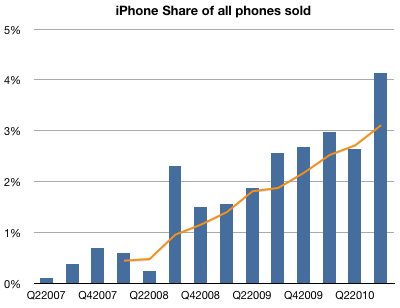
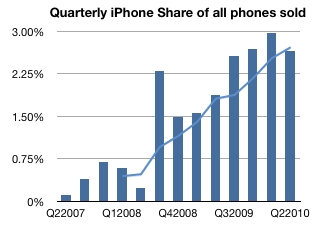
    Contrary to the loud and emphatic proclamations above, the data shows that the iPhone's market share gains have been steady.

    The following chart shows iPhone market share by quarter with a 4-quarter moving average. Total market size is reported by IDC.

  8. Turley Muller: Warranty Expense Crimps Apple's Margins in 4Q10

    Research · 3 comments

    If estimated warranty expense had remained constant in absolute dollar terms ($150M), GM would have been 38.4% vs 36.9%. If If estimated warranty expense had remained constant in as a percentage of revenue (1%), GM would have been 130bps higher at 38.2%.

    via Financial Alchemist: Warranty Expense Crimps Apple's Margins in 4Q10.

    Muller spots the culprit in the margin drop. He notes that this is money set aside and may have been in anticipation of returns of the iPhone 4 due to antennagate. Note how in 3Q cost of claims was 155 and accruals were 157, about a 1:1 ratio whereas in 4Q costs were 286 and accruals were 457 about 1:1.6.

    It's possible that if the costs this quarter do not materialize then we could see a margin upside surprise.

    (Contrast this insight with today's large scale sell-off in shares due to mass media repetition of earnings guidance from the conference call as shocking "news." See also evidence of unlawful trading behavior here.)

  9. iPad vs. iPhone: why we got the iPad forecasts wrong

    Research · 17 comments

    The iPad was announced to a loud chorus of disapproval and disdain. It's easy to forget the overwhelming scorn and insult poured on the product for months before and after sales start. Analyst forecasts were comical. At this time it looks like all 12 month iPad unit forecasts will have missed by more than 100% (mine included).

    As data on iPad performance was published for the first quarter's sales, the mood swung from ridicule to ridiculous.

    Without regard to the growth of comparable products, analysts seem to have latched on to production figures which are notoriously inaccurate. The problem with production numbers is that they are only very loosely coupled with shipment numbers to customers. There are questions of work in progress inventory, finished inventory and the actual accuracy of reports. Production also follows a ramp and is not constant over time.

    Another way to analyze a new product is to think about the distribution. Although late in the quarter some large distribution deals were made public, the channel did not have much time to be filled before the end of the quarter. Not only that but there is easily obtainable evidence that the iPad did not reach most international markets. Apple announced how they were rolling out a few countries every few months.

    This trickle of international sales indicated to me that the iPad sales pump was not yet fully primed. My initial estimate was for in-line sales of 3.3 million which I aggressively increased to 5 based on some of the production numbers being mentioned.

    This figure turned out to be 22% too high, but not as big an error as some of the other analysts.

    Another way to look at it is through comparable products. The nearest comparable product to the iPad is actually the iPhone. It was a similarly "revolutionary and magical" product launched with a similar constraint on production and distribution. It was also built and marketed by the same people. They've been down this road before and have honed the process from the iPod through the iPhone over a decade.

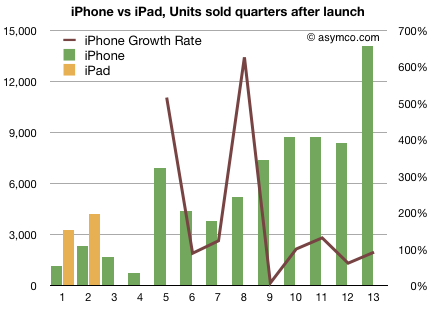
    If we look at the iPhone and compare it with the iPad, we see just how popular the iPad really is. It may not follow the same seasonal pattern as the iPhone, but it will probably ramp in a similar way. In the following chart I also show the iPhone Growth rate (right scale).

    The iPhone has been able to maintain over 100% y/y growth on average. I don't see a reason why the iPad can't repeat this pattern over the next three years.

  10. The strategic tension inherent in the iPhone franchise

    Research · 25 comments

    I don't write product reviews and I don't pass judgement on individual products but I do own and test various products. For example I have the Android powered Samsung Galaxy 5 (GT-I5500) and the experience is, in my opinion, better than for recent Symbian phones but not as smooth as for Apple's products.

    But that's not what this article is about.

    It's about the price. The price for the Samsung is one third that of the iPhone 4 (both devices unlocked and sold in Europe with a 23% VAT). It was also purchased in a department store with as much hassle as buying a pair of gloves.

    When it comes to the product, it may be a fair trade-off: one third the price for one third the product. The specs are not only worse but the whole experience is rougher and cruder. But that "one third the product" may be just good enough for a large population of users who are now satisfied even with "one tenth the product". The price point should be evaluated as a valid threat.

    But Apple can respond. It's not like this is asymmetric competition. As the iPod shows, Apple can make money with low end products. Easily. Is this entry price point (€200 unlocked) something Apple should cover? My answer would be an unqualified yes.

    For operator distribution, the subsidized price combined with a high-end offering is by far the best marketing mix (price, promotion, positioning, etc.) However, for non-operator distribution, a lower spec unlocked device sold through tens of thousands of points of purchase (like the iPod, and soon, iPad) makes a lot of sense from a platform point of view.

    These two channels are often in conflict due to subsidy and exclusivity clauses. This conflict makes the decision to ignore the non-operator channel compelling. The economics for the operator channel are always going to trump the non-operator channel. But as the platform expands across geographies and income segments not covered by the operator-subsidized channel, these populations will need to be addressed.

    So this is the inherent strategic tension for the iPhone franchise: Whether to use the iPhone brand to enable ubiquitous mobile computing outside operator channels, or use iPod/iPad as a complementary but separate brand to engage in an orthogonal attack.

    I suspect the decision has been made. We will observe the consequences next year.

  11. The iPhone growth rate

    Research · 14 comments

    John Gruber puts things in perspective:

    The key bit: “At the critical juncture […], when they should have gone for market share, they went for profits.” I think this encapsulates Jobs’s philosophy since taking over Apple in 1997. Take the high end of the market first, establish a brand and presence, then steadily start to expand.

    Daring Fireball: N92.

    I've long argued that Apple is in the phone business to win significant share (i.e. greater than the share they have had in the PC business).  Since the phone market is vast (1.2 billion phones sold in the last four quarters) iPhone volumes must be as well.

    So how has share evolved, and what can we expect? This is a graph of quarterly share for iPhone including a four period moving average:

    The trend is clear to see.  With seasonal variation due to the launch cycle, the share is likely to increase over 3% and keep going. How far can it go? That's a strategic decision for Apple's management. If we are to take Steve Jobs' word that their plan is not to be a niche player in any market they target then I have to conclude that Apple is aiming above 10%.

    The volume expansion in the US due to the end exclusivity is only the latest in a series of distribution deals that Apple has brought to bear: International expansion, dropping exclusivity in other countries and broadening the portfolio (including earlier models in current line-up) are all natural and obvious moves in a broader market push.

    Pricing might be considered another lever that Apple could use, though that seems unnecessary today.

    I conclude that growth in iPhone sales of 50% per year seems entirely possible for the next few years. Such growth would allow Apple to reach 10% of the world's 3G subscribers by 2013. That would still be only 4% of all phones and 20% of smartphones.