The Next 50
by Horace Dediu
Make no small plans
50 already? It seems only a blink of an eye since I wrote Apple at 40. Let's try copy & paste.
In Apple’s first 40 50 years it shipped 1,591,092,250 5,126,211,000 computers1.
This shipment total is higher than any other computer company in its first 40 50 years. Actually there are no other PC makers that are 40 50 years old. One computer maker (IBM) is older but they only sold PCs for 24 years and what they still sell they don’t sell in high numbers.
That does not make Apple the top seller in a given year. Looking at only the Mac, Apple’s traditional form factor personal computer, Apple is fifth fourth in market share. If including the iPad, it was the top computer vendor in 2011 and, including the iPhone, it was first in 2009.
The following graph shows the top computer makers by units sold since 1975, a year before Apple was founded. (Click on the graph to see a higher resolution.)
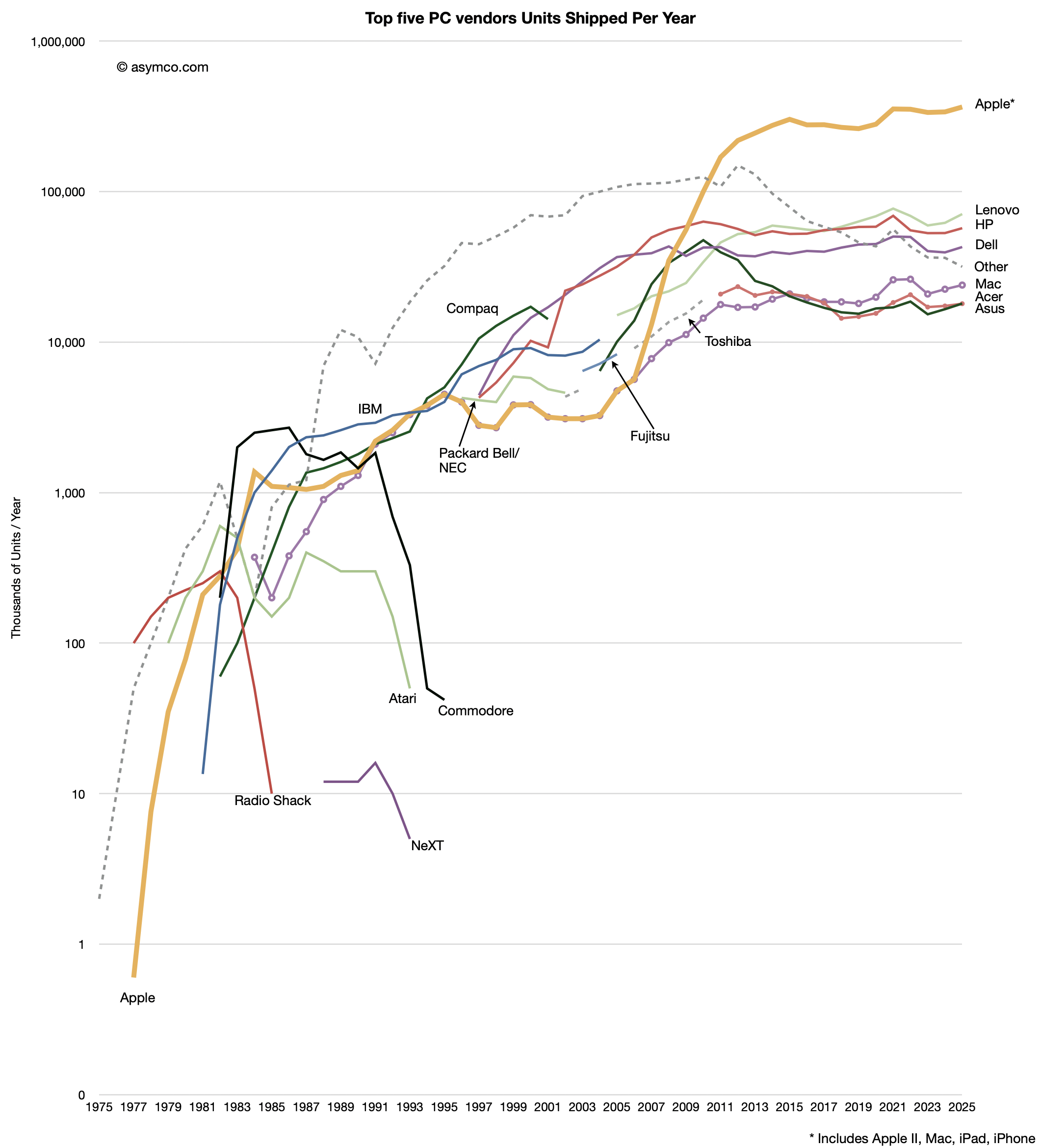
Note that the graph is log scale and in multiples of 1000. Following the yellow Apple line we can see how it started with fewer than 1000 units shipped in its first year to today when it is shipping more than 1 million computers every day2. It's also quite remarkable to count how many other companies have come and gone in this top five list and imagine how many came and went in the "other" category.
Who remembers Atari, Commodore, Packard Bell, Compaq? Few said that they were doomed while they were in the running. Going back to Apple at 40,
After having a 40 50 year run and after selling more computers than all American and Japanese computer companies put together, how should we think about the next 40 50 years?
First, clearly Apple shifted from being a “computer company”. It has already changed its name to exclude the word “Computer.” That [came to mean that] it sells devices (which happen to also include computers.) We don't use computers to compute anyway. We use them to make decisions, keep track of things, speed things up and to communicate and to entertain.
After convincing the world that it's a not just a computer company, the next challenge has been to convince the world that it's also not just a product company. It did so by launching Services as a group (formerly known as iTunes Software and Services) and then separating the financial reporting so that Services can be measured with its own gross margin. Year after year management emphasized Services growth in its commentary. Services has grown into the second largest segment, 26% of total revenues ($112.8 billion out of 435.6 billion in calendar 2025.)
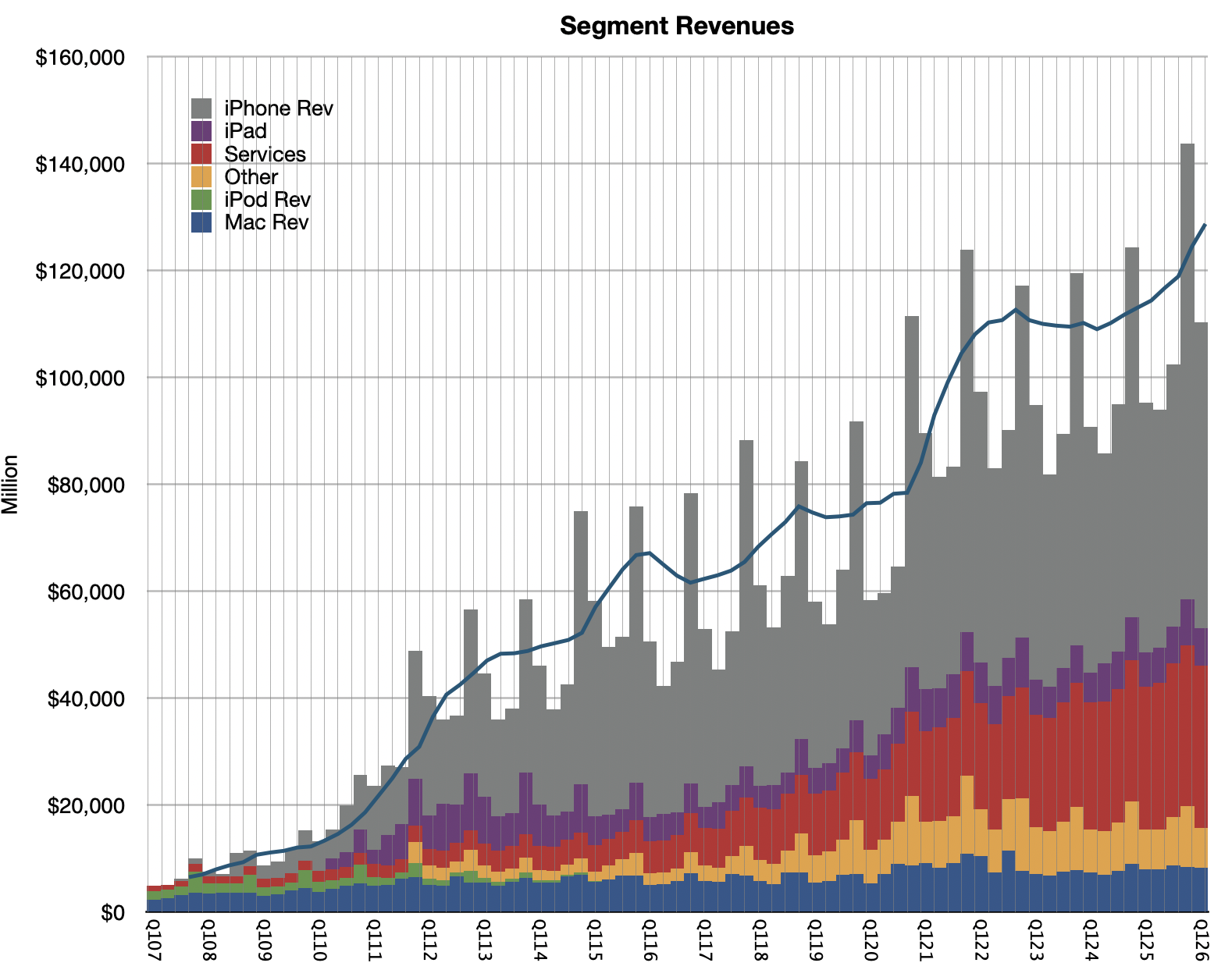
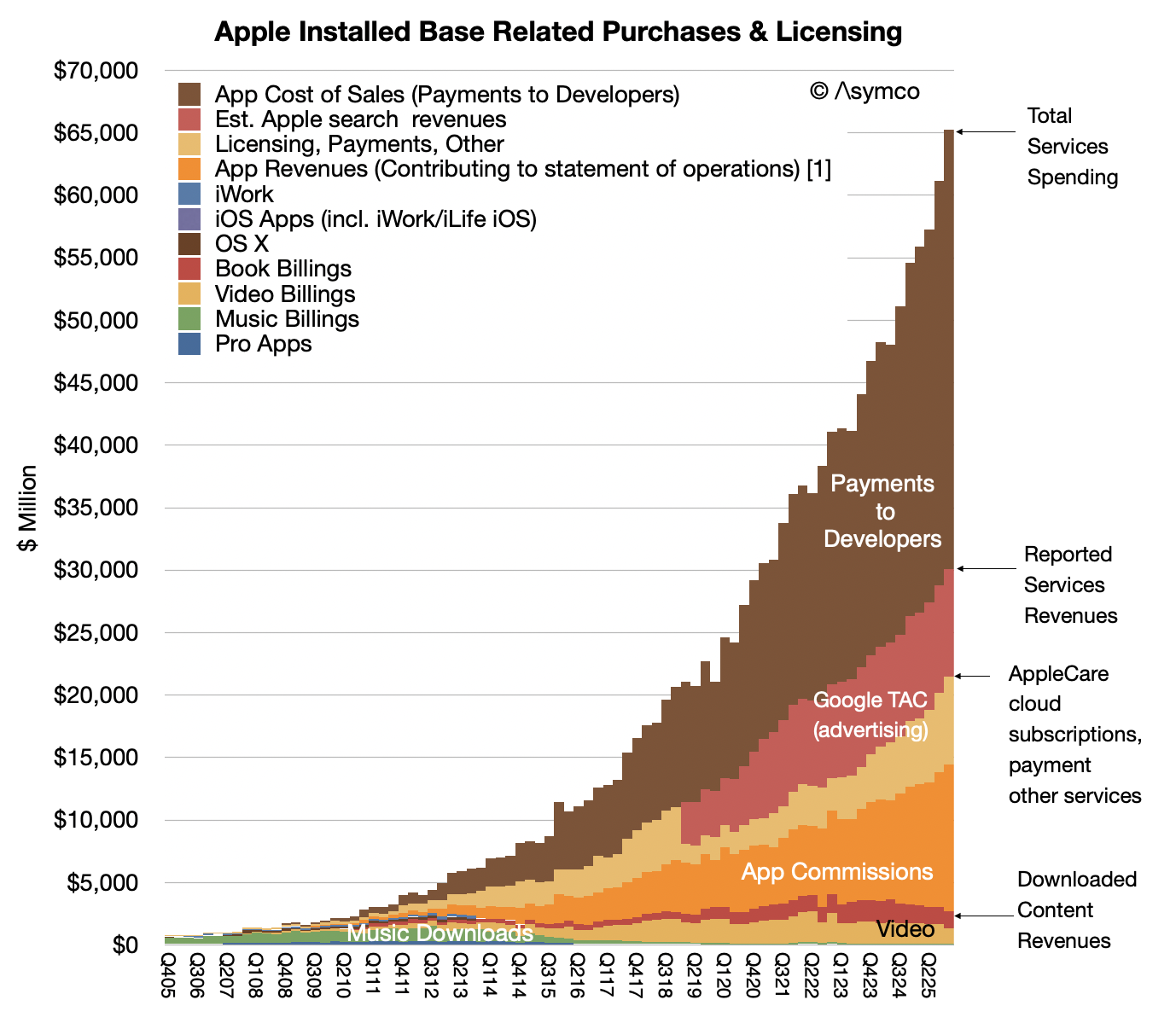
Services, if it stood alone, would be number 40 in the Fortune 500 list of largest companies by sales. It has been impossible to ignore it. Considering how much customers actually spend on Apps, Content and Services, the total is even bigger at $240 billion last year3. As a result, some, perhaps most, recognize Apple as a Products & Services company.
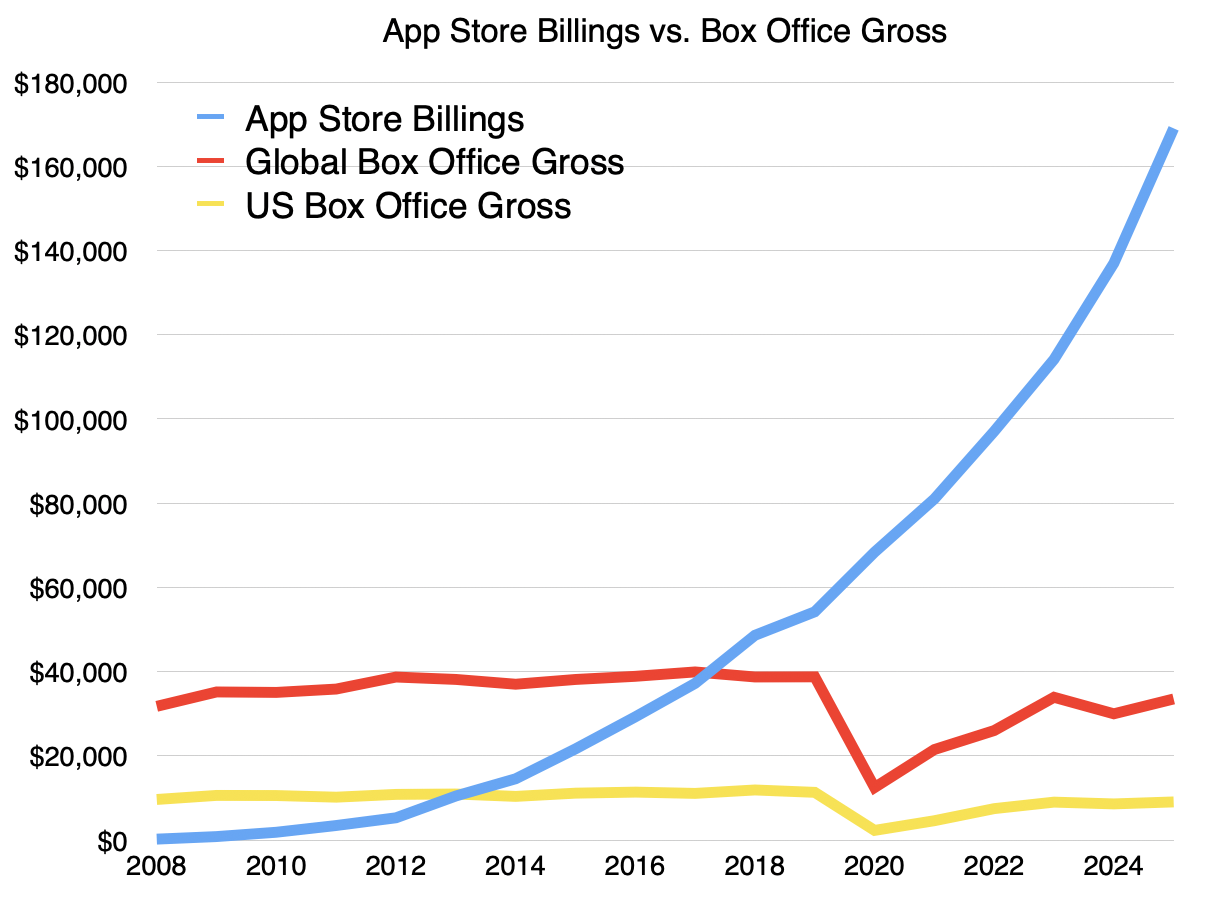
The App store alone attracts $169 billion in spending per year (2025) and that is now 5x what theatrical movie sales bring in world-wide.4
So if Apple is today at least a bundle of Products and Services then what will Apple be 50 years from now?
Again from Apple 40:
My simple proposal is to think of Apple as a customer creator. It creates and maintains customers. The more it creates, the more it prospers. The more customers it preserves the more it’s likely to persevere. This measure of performance for a company is not easy to obtain. It’s not a line item in any financial report.
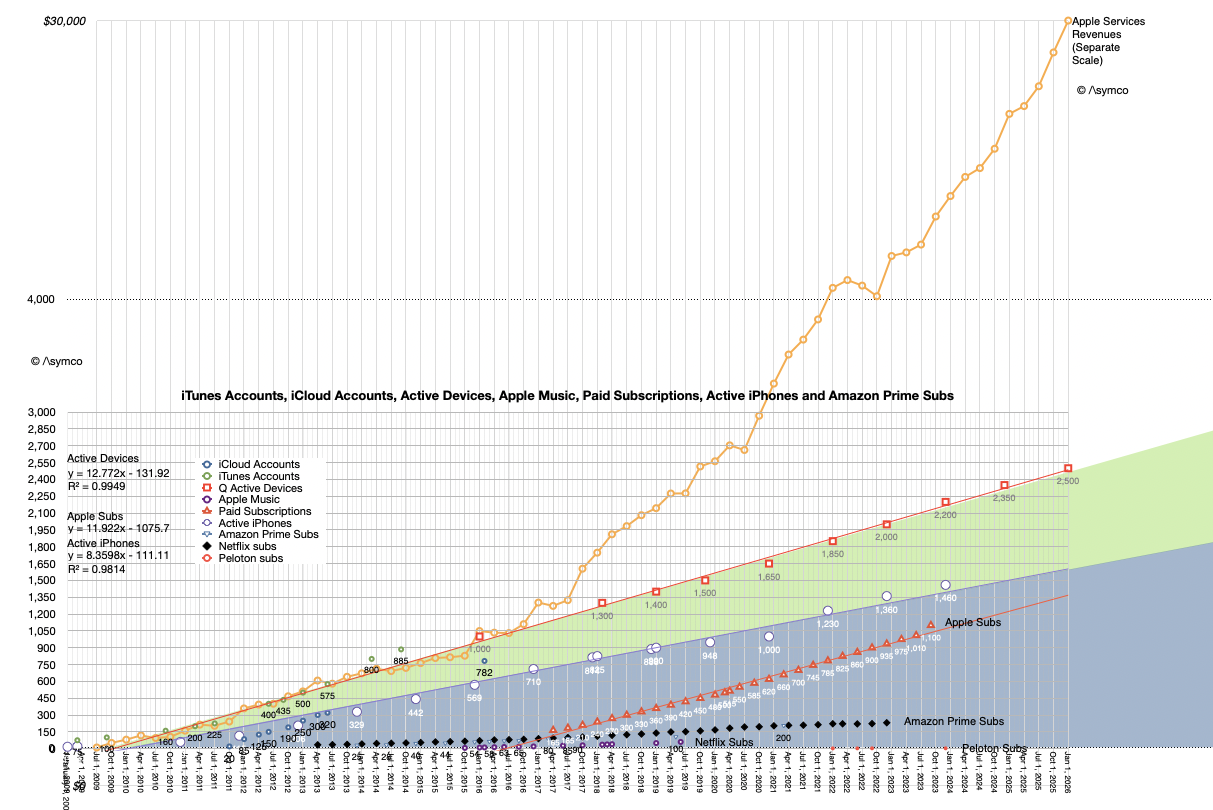
The closest figure we have is that today Apple has one 2.5 billion active devices in use. It has around 1.1 billion users 5. Using the devices as a proxy, we can say that this audience has more than doubled in the last decade.
So we know that at least Apple has created a large number of customers. Knowing total devices sold and number in use means that we can be sure that 63% of all the computers Apple sold are still in use. This means that most customers are recent customers. Are they going to come back?
If we then factor in the size and persistence of Apple’s audience (customer base) we might conclude that there are factors which will allow it to grow rather than shrink. My analysis based on public data shows that the customer base has been increasing steadily.
And here is a graph showing the size of device base and implications for subscriptions. services and comparisons with other consumer aggregators. Note the forward looking nature of a linear extrapolation of the historical data.
10 years ago, I continued:
Combining the history of customer creation and customer preservation with the value obtained from each customer implies that the next 40 years will be about creating another large tranche of customers whose willingness to spend on whatever Apple creates will be relatively unchanged.
We don’t know the limit. One billion was hard to imagine even one year ago. We might see two billion devices in short order. Perhaps not. Perhaps as we have a multitude of devices about us all day the number will become less meaningful. But if the number of middle class customers grows and as Apple keeps its products within their reach, there is no reason to think that there will be a reversal of the last 40 years in terms of customer acquisition.
This analysis contradicts the current perception of the company as reflected by its stock price. That price assumes the audience will wither ((With a P/E ratio of 11, without a change in revenue per user, the only justification would be the audience shrinking by more than 90% over the next 20 years.)) That is not insanity. It is what we could expect if Apple were unexceptional.
We did see 2 billion. We actually saw 2.5 billion. The assumption of a company in distress as reflected by the P/E ratio of 11 is gone. It's safe to say that Apple is exceptional.
But note that we are only 10 years into that 40 year forecast from a decade ago. Do we still feel confident that the company can last 30 more years given what we've seen so far? If one company could get through the next 30 I would say it is Apple. And if it is so then I think it will get through the next 50.
One more Thing
A journalist from The Guardian recently called to ask my opinion on what were Apple's greatest hits and what were its flops. I think it was for a piece on the 50th anniversary of the company.
I thought about it very little and said that the obvious big hits are iPhone, Mac, iPod, iPad, Watch and Vision Pro. The failures are products like wifi routers, PDA, camera, iPod speaker dock and anniversary products.
I went on to say that the pattern for successful products is that they re-defined human-computer interfaces thus inducing a new platform that sustained the company for at least a decade. Specifically, they introduced a new input method: iPhone with multi-touch, Mac with the mouse, iPod with the scroll wheel, Watch with the passive health sensors and Vision Pro with hand and eye tracking. The platforms that matched these innovations are: iOS, MacOS, iTunes (and Apple TV & Services thereafter), HealthKit and finally VisionOS and immersive content. Each platform recruiting an ecosystem of developers, content creators and users resonating in mutual benefit.
The pattern for failed products is that they were modules or components in a bigger network of devices. They may have been neat but they did not induce a new experience profoundly enough to attract their own ecosystems. They did not have gravity fields. Furthermore, as modules, they did not integrate software, hardware and services. They were one or the other. Something else had to integrate them and because of that they were easily substituted.
Now this might be a nice footnote to the story arc of Apple at 50 but I'd say that it's more than that. The pattern to be recognized here is that the success and longevity of Apple are entirely because it chose the right targets for its capabilities and these targets were sufficiently ambitious. In other words, it aimed for big things, it made big plans. In the words of Tim Cook, it chose something where it could make a significant contribution.
It was Machiavelli who said "Make no small plans for they have no power to stir the soul." It would seem perhaps fitting that Steve Jobs thought alike when he said he wanted to make a dent in the universe. That it has done.
So, the plan is to make more of the same. It's more than enough.
- Including Apple II, Mac, iPhone, iPad and iPod touch; excluding Apple Vision Pro, Apple TV and other iPods. Includes Q1 shipments estimated
- 2025 shipments were above 364.9 million excluding Apple Vision Pro, Apple TV, Apple Watch.
- A Fortune 15 ranking. This would be the case if payments to developers were counted as sales but that is not the case for accounting reasons. As a result Services margins are an extraordinary 76%, on the order of a software only business like Microsoft Office.
- As an aside, when I first started tracking this data it was early 2015. The App store had just overtaken US Box Office revenues and the outrage at my comparison and the skepticism that this sustainable was impressive. Much of the outrage was due to my choice of the headline "Bigger Than Hollywood". You can still read the 72 comments. App store billings are now nineteen times bigger than US Box office billings. I still stand by the idea that the App Store is Bigger than Hollywood. It is in fact bigger than many other forms of entertainment combined--more about this later
- Stay tuned for a detailed exposition of this audience
2 comments
deemery ·
Well, in 'flops' I'd replace "routers" with "Home automation." I loved my Apple routers, and I still have an Airport Express running on the home network. But I've never had any luck getting a Matter device to work with Home.app (granted, I haven't tried too many times, but this is a case where a little frustration sends me away.) I was a relatively early adopter of X10 devices, but those were unreliable over home wiring. So I've been disappointed Apple hasn't done better.
farshad ·
Home automation seems like a perfect use case for AI.