Melius highlights FCF while reiterating buy on Apple
by Horace Dediu
Measuring valuation in an era of AI.
“Given Apple’s free cash flow and we are about to embark on one of its most lucrative product rollouts since the big screen iPhones in 2014 - there is a case for Apple’s stock regaining some ground,” Melius analysts wrote in a note to clients.
Lately, Apple has announced the iPhone 17e and a refreshed iPad Air, a new MacBook Air, a MacBook Pro, new Studio Displays, the MacBook Neo, and an updated version of its over-the-ear headphones, the AirPods Max 2.
Apple shares were modestly higher in premarket trading but have lost some 8% year-to-date. Over the past 12 months, shares have gained 12%.
Source: Seeking Alpha
NB: Free cash flow (FCF) is the amount by which a business's operating cash flow exceeds its working capital needs and expenditures on fixed assets (known as capital expenditures). It is that portion of cash flow that can be extracted from a company and distributed to creditors and securities holders without causing issues in its operations. As such, it is an indicator of a company's financial flexibility and is of interest to holders of the company's equity, debt, preferred stock and convertible securities, as well as potential lenders and investors. It has come recently into vogue when the bill for AI infrastructures has come due...
... To calculate FCF, look at the Income statement, start with earnings before interest and taxes (EBIT), add depreciation, subtract taxes and CapEx. The elephant in the room is that CapEx. Normally, investors are concentrating on earnings and can generate a picture with Price/earnings. But when CapEx is extraordinary then EV/FCF become a better picture.
By this measure, Apple looks to be not only reasonably valued but the only company among the largest companies that is normally valued (i.e. where P/E and EV/FCF are roughly the same).
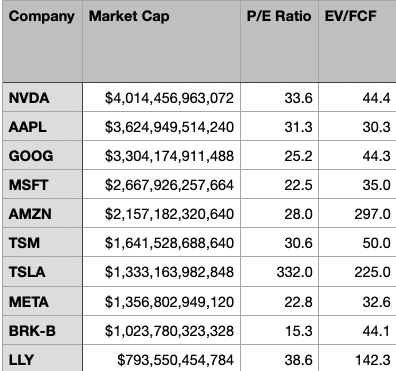
The table above shows the P/E ratios vs. the EV/FCF ratios of the top 10 largest market caps in the world.
3 comments
deemery ·
I've read this a couple of times, and there are things I don't understand. (1) what is "EV" in "EV/FCF"? (2) When P/E is greater than EV/FCF, is that A Good Thing or A Bad Thing? I think it's a bad thing, it implies the price is ahead of the EV/FCF measure. But I could be -totally wrong- on that!
AAPL ·
EV is Enterprise Value aka Market Cap. Depends on your viewpoint but lower is better for both. Low P/E represents low investor expectations and low EV/FCF may represent strong FCF to market cap ratio.
Horace Dediu ·
EV is Enterprise Value. Let me explain it this way: You might think that Market Cap is enough to know how much a company is worth. For example if you want to acquire a company, just pay the price for the shares and buy all the shares you can buy. But that does not account for things like cash and debt. You buy the company but you could end up with a lot of debt (bad) or a lot of cash (good.) So what is the company really worth? That's why EV is a better measure. But if you want to create a ratio, you don't just do EV/Earnings. That EV should be paired with he part of the creation of EV which is FCF. It excludes the "funny stuff" like depreciation and interest and other things which are dilutive of what shareholders can really hold on to. EV/FCF is *the* gold standard of what a company is worth. It just more difficult to calculate and P/E is used as a proxy or rule of thumb.