Can a company outlive its founder? Microsoft at 51, Apple at 50 and The Auteur Theory of Business
by Horace Dediu
On April 4, 1975, Bill Gates and Paul Allen founded Microsoft, a software company destined to become a tech behemoth (and key Apple frenemy).
Perhaps the most interesting thing about Microsoft and Apple is just how similar the companies were in several ways. Gates and Steve Jobs, the CEOs who came to represent the two companies, were both born in 1955. Both later dropped out of college.
Gates and Allen created Microsoft when they saw a gap in the market following the launch of the Altair 8800 kit computer. In Silicon Valley, the Altair inspired the creation of the Homebrew Computer Club, where Jobs and Steve Wozniak first showed off the Apple-1 computer.
Source: Cult of Mac
Much more was said of Jobs' departure signaling the end of Apple than of Gates' departure signaling the end of Microsoft. And much more was celebrated of Apple 50 than Microsoft 50. Why is that?
If you were to structure an experiment to determine the influence of processes and personalities on the outcomes of a company, you would be hard pressed to find a better pair to study. Apple and Microsoft were founded almost at the same time, due to the same enabling technologies (microprocessors) and led by two iconoclastic founders of the same age acting out of similar impulses.
The divergences were that one concentrated on software while the other on hardware. But rather than pairing up in a match made in heaven, both tried to outmaneuver the other in order to avoid dependency.
For many decades, Microsoft's approach of modularity for hardware (Processor/components) but integration of software (OS/Core apps) seemed to win vs. the integration of Apple's hardware and OS. The licensing of Microsoft software to commodity hardware builders was far more successful than the Apple's insistence on quality of experiences. At least in terms of PC users, Windows overwhelmed the Mac.
This lasted until mobile computing demonstrated that integration was the only way to deliver the experiences that consumers would use in narrow time slices. Mobility meant that the pendulum swung towards the device and the device was good enough only with a high degree of integration.
But stepping back from the titanic clash of architectures, what strikes me is how much more personified Apple appears to be in the public perception. Apple *was* Jobs far more than Microsoft *was* Gates.
I think this perception is wrong but it indicates something about how we think about causality of business managment. I call it The Auteur theory of business.
Auteurism originated in French film criticism in the late 1940s. In this theory, film is an art form and as such it must have an author, and that would obviously be the director. "The best films are personal ones, made by forceful directors" - James Agee, critic. The film is therefore art only if there is a singular mind behind it and, conversely, if there is no such singularity of mind then it's not art. Unartistic film was merely staging or placement of performers.
But films are complex and multi=causal with many "artists" involved, any one of whom could make or break the film. Critics of auteur theory demonstrated that all the films that were celebrated as "auteur" masterpieces were inherently collaborative.
And so it is in business. The premise that "the best companies are personal ones, made by forceful founders" means that the best companies cannot outlast their founders and surely something that lasts only as long as the duration of a career cannot be considered great.
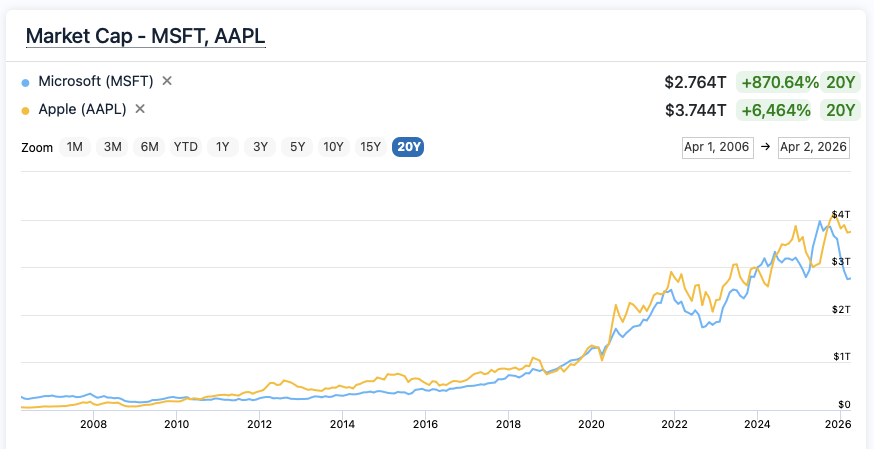
In the case of both Microsoft and Apple, we have seen successful transitions from founders to successor managers that not only preserved but broadly expanded the companies. Cook, Ballmer and Nadella outdid their predecessors as measured by every metric of financial performance. They both reached the pinnacle of business success as measured by market capitalization.
It's romantic to think that business are embodiment of people but in reality they are the seemingly sterile combination of resources, processes and priorities. These are heavily influenced by the people who assemble or define them but ultimately the processes must outlast biology or we are doomed to have to re-invent everything.
Put another way, if a founder builds something that does not outlast him then what has he really accomplished?
4 comments
Josh ·
John Gruber's "The Auteur Theory of Design" is similar.
deemery ·
That's not just about CEOs. Anyone who has been a 'change agent' inside an organization needs to measure success on whether that change survives the individual's departure. (Once or twice, I've been successful, seeing changes I helped bring about remain after the instigators moved on. I've also seen that fail, where the changes were tossed when the advocates moved away.)
And that's part of what makes successful technology transfer, which is where I studied this. We were asked to write a paper on how to accomplish tech transfer. One of the observations was that you had to have a set of advocates, support from management, and the ability to persist the transfer when the advocates, or the bosses, changed.
Sacto Joe ·
I used to be very involved in theater. Nearly all theater is inherently collaborative/communal.
When Steve Jobs returned, he found that the "Apple community" was still alive (long suffering, but alive), which made his job far, far easier. Yes, he was the maestro, but that's a vast oversimplification of what really was going on.
Steve Jobs knew in his deepest being that computing was going to change the world, and he designed a company that could focus like a laser on being at or very near the cutting edge of that change. Of course, there was also the little matter of net income, which was, during Steve's time there, a daily battle.
No more. Apple, after years of trying, STILL can't say that its quarterly debts and its quarterly spending are in balance - they still make more than they owe, because net income just keeps increasing.
And the odd thing is - they haven't sold their soul to get there. They deeply respect their users, and their users deeply respect them in return. They are continually improving their products and services (Thanks, Mr. Deming!), which means their customers get increasing value for their hard-earned dollars.
It's a virtuous cycle that has a huge net cash byproduct simply because, ironically, the net cash isn't the product as it is for so many other companies.
FredHS ·
Thanks for bringing the topic.
From reading Isaacson's biography, one thing stood out. Jobs repeatedly acquired and inspired talented people to achieve greatness, legacy status. First it was Woz. We can list Apple before he left and after, plus Pixar and NeXT. The famous ads, 1984 won't be 1984, and Think Different were produced by third parties.
We can remember Tim joined Apple after meeting Steve.
We can ponder where Apple would have been without these picks; And where would these talents be without Steve.