What are the odds of Apple surviving?
by Horace Dediu
A tale of two Apples
What are the odds of it surviving another year, ten years, 50 years?
Companies don't last long. A recent study that analyzed thousands of European firms yielded a corporate life expectancy figure of 12.5 years. The Boston Consulting Group analyzed the entry, growth, and exit dates of 35,000 publicly listed companies and determined that one in ten of all public companies fail each year, a fourfold increase since 1965.
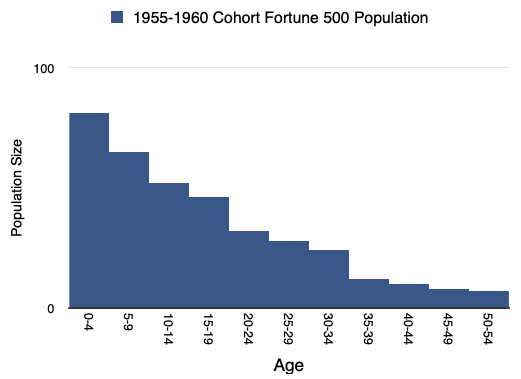
As I illustrated many years ago in a talk titled "The Unfortunate 500" most companies die not long after adolescence. Of the Fortune 500 1955-1960 cohort, the 81 companies which joined the index in those years, only 7 remain there today. One third of the corporations on the 1970 Fortune 500 list were no longer in existence thirteen years later. Broadly speaking, as a population, large companies that make it to the Fortune 500 listing have life expectancy within that group of 17 years.
To illustrate further, here is the list of the companies that joined the Fortune 500 In 1976, the year of Apple's birth:
| Entry | Company | Exit |
| 1976 | SuCrest | 1976 |
| 1976 | International Systems & Controls | 1977 |
| 1976 | Kewanee Industries | 1977 |
| 1976 | Hunt International Resources | 1979 |
| 1976 | Peabody Holding | 1979 |
| 1976 | Consolidated Aluminum | 1981 |
| 1976 | HP Hood | 1981 |
| 1976 | Envirotech | 1982 |
| 1976 | Peabody International | 1984 |
| 1976 | Hughes Tool | 1987 |
| 1976 | Cameron Iron Works | 1990 |
| 1976 | Foxboro | 1990 |
| 1976 | Tektronix | 1994 |
| 1976 | Mapco | 1998 |
| 1976 | Molson Coors Brewing | 2009 |
| 1976 | Baker Hughes | 2014 |
| 1976 | Masco | 2014 |
| 1976 | Ball | 2014 |
| 1976 | Ecolab | 2014 |
| 1976 | CF Industries | 2014 |
Not one of those in the 1976 cohort are on the list today. The longest to survive managed to stay on for 38 years.
Apple joined the Fortune 500 in 1983. Here is a list of all the other companies that joined the index in 1983.
| Entry | Company | Exit |
| 1983 | North American Coal | 1983 |
| 1983 | Datapoint | 1986 |
| 1983 | MEI | 1986 |
| 1983 | Mobay | 1986 |
| 1983 | Coleco Industries | 1988 |
| 1983 | Liquid Air | 1988 |
| 1983 | AH Robins | 1989 |
| 1983 | Sipco | 1989 |
| 1983 | Wilson Foods | 1989 |
| 1983 | Oxford Industries | 1991 |
| 1983 | DR Holdings Inc of Delaware | 1992 |
| 1983 | Media General | 1992 |
| 1983 | Wisconsin Dairies Cooperative | 1992 |
| 1983 | Ametek | 1994 |
| 1983 | Hanson Industries NA | 1994 |
| 1983 | Meredith | 1994 |
| 1983 | Snap On | 1994 |
| 1983 | Sun Diamond Growers | 1994 |
| 1983 | Universal Foods | 1994 |
| 1983 | Worthington Industries | 1994 |
| 1983 | AMDAHL | 1994 |
| 1983 | Dr Pepper Seven Up | 1994 |
| 1983 | Diebold | 1994 |
| 1983 | Echlin | 1998 |
| 1983 | Stone Container | 1998 |
| 1983 | Tyco International | 1998 |
| 1983 | Flowers Industries | 2001 |
| 1983 | Cooper Tire & Rubber | 2005 |
| 1983 | Tribune | 2008 |
| 1983 | Holly | 2011 |
| 1983 | Apple | -- |
Apple is the only survivor from that cohort.
Out of about 2500 companies that existed in the Fortune 500 index since 1955, 50 are still in it. That's a survival rate of only 2%. Approximately 87% of all people born globally between 1955 and 2026 are still alive today. This is why I titled my talk The Unfortunate 500. If this was a human population it would be considered chronically unhealthy.
However, unlike people, large companies that make it past age 50 tend to stay alive (or independent, as most who exit the index do so because they are merged or acquired--another distinction from biological entities).
But the way they manage to be resilient is by adapting to a changing world in some fundamental ways. The environment a business lives in (technological, market, economical) changes more rapidly than the biological environment (genetic, radiological, reproduction).
Companies have to essentially re-define themselves and become something that has little to do with their initial conception.
In the case of Apple there are clearly two separate entities. The original and the one that was reborn in 1998 when Steve Jobs returned. When you look at the company closely, it's pretty clear that the second Apple was fundamentally different even though the original founder returned.
In some ways one could argue that Apple 1.0 eventually strayed from its original culture and the reset in 1998 returned it to a core that was resilient but it's more complicated than that.
To measure "distance" in terms of corporate culture you need to think of culture as a three dimensional vector. it's a composition of resources, processes and priorities (RPP). The combination of these forms what we call the "DNA" or the "culture" or the unwritten constitution of the firm.
The vector of RPP for Apple changed dramatically in Apple 2.0 in terms of resources (capital, software, silicon), processes (engineering, operations and marketing), and priorities (focus, integration, product/service cohesion)
I would summarize it as there being a tangible "theory of the firm" for version 2. The first version was very much a theory of the team: a group of great people without a binding operating model.
Stay tuned as we explore the Theory of Apple.
2 comments
FredHS ·
Tim Cook often says, "Enhancing people's lives". That's leadership.
It creates self governance regardless of rank or internal politics. It obviates the need for artificial, cumbersome governance.
That gives investors confidence by reducing downside risk.
Sacto Joe ·
The present "doom-bombing" of Apple is that it missed the AI boat, but the more I read, the more I see that they didn't. They did mess up by overpromising a Smart Siri, but in some ways it became a wake-up call for them, and thus on balance that most beneficial of mistakes; one where you actually learn something valuable from the experience.
"Behold the tortoise: He maketh no progress until he sticketh out his neck." One of my father's favorite sayings....