iPhone vs Android Switching Rates
by Horace Dediu
Bitchin' ain't Switching
SellCell’s Smartphone Loyalty Survey 2026 shows iPhone and Android loyalty at record highs, but Android users still switch more.
Key findings
iPhone loyalty stands at 96.4%, up from 91.9% in 2021
iPhone switching stands at 3.6%
Android loyalty stands at 86.4%, with switching at 13.6%
Android users are nearly four times more likely to switch than iPhone users
Samsung loyalty stands at 90.1%, up from 74% in 2021
Samsung switching stands at 9.9%
Google loyalty stands at 86.8%, up from 65.2% in 2021
Google switching stands at 13.2%
The loyalty gap between iPhone and Android now stands at 10 percentage points
Price and value are the biggest drivers of switching
Technology is the second biggest driver
Overall, loyalty has increased across all major brands since 2021
Source: SellCell.com Blog
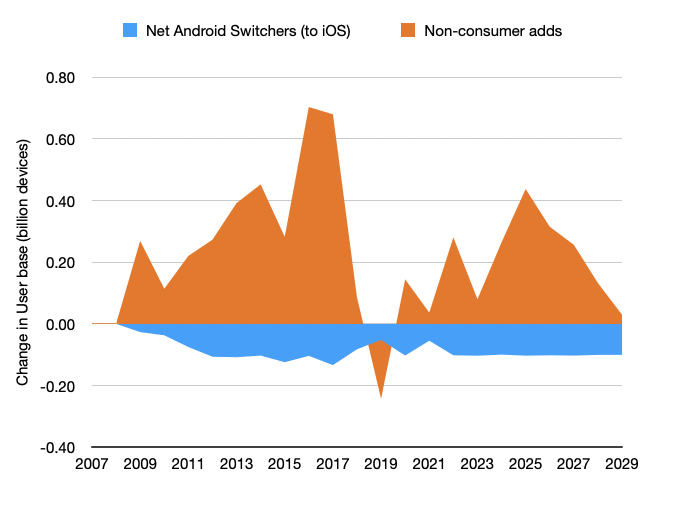
NB: I did a deep dive into the data and came up with graph above. The original report shows intention numbers which seem quite high. For instance, the net switching rate between iOS and Android is 10% in favor of Apple. This would imply that the entire user base would flip in 10 years. It would also imply...
... that Apple gains over 400 million new users every year as Android base is about 4 billion. But we know that Apple gains about 100 million a year based on the active device tally (now at 2.5 billion active devices and 1.5 billion active iPhones).
Therefore, based on the known install bases and growth therein, we can determine that the actual switching rate from Android to iOS is about 2.6% for any given year and the switching rate from iOS to Android is about 0.9%. Android still gains overall users since new users are converted from non-consumption.
About 300 million are still being added to Android while 100 million are lost to iOS.
As time goes on and saturation is reached (near 5 billion active smartphones) then the churn will imply that Android will eventually become a net user loser.
That probably won't happen before 2030. When saturation does happen however, I will be watching to see if Apple chooses a different strategy to accelerate switching similar to what it is doing with the MacBook Neo at a time of PC market saturation.
The lesson here is that switching intention surveys showing a net 10% churn rate don't mean that the actual switching rate is net 10%. The intention to switch is a sentiment but actual switching is often more difficult than a wish to do so.
I think actual net churn is 1.7% of the base each year. That's still 100 million a year. For now it seems Apple is happy to maintain that rate.
3 comments
FredHS ·
What about first SmartPhone in youth?
This may hide iPhone's advantage in used iPhones if the first SmartPhone is hand-me-down.
AAPL ·
Re: About 300 million are still being added to Android while 100 million are lost to iOS.
Is the net annual change here that the total Android user base is growing by 200 million users per year?
Horace Dediu ·
Yes. Android is still gaining users as is iOS. My assumption is that supply of new users joining Android will decrease and by 2030 the net gains of iOS will be higher than the net gains for Android. At that point the market will be largely saturated and churn will be the primary driver of market share gains. To maintain the user gains that Apple has (about 100 million per year) will possibly require some product mix changes. Perhaps something along the lines of what the Mac is doing with the Neo, or perhaps something else altogether or perhaps nothing at all. But the long term (beyond 2030) market will be all about expansing above 3 billion active devices (out of a total of 11+ billion). Stay tuned as I try to explain all this.