Succession, study of the firm vs. study of the person
by Horace Dediu
The Asahi Shimbun Interview Part 5
Horace Dediu / Takeshi Narabe & Dylan Weir / Asahi Shimbun Interview, April 1, 2026
Dylan Weir • 31:51
There's been some reports that Tim Cook is on the way out and some speculation about who might replace him. Is that your sense, that he will be leaving soon?
Horace Dediu • 32:06
One thing that hints in that [direction] is that the board members are actually limited to age 65 and he is on the board although they can extend that by vote. So one should imagine that there is an age limit. The hypothesis however is that he's too valuable. Not so much as the manager but as the negotiator and as the diplomat. Because we live in such difficult times from a geopolitical point of view he somehow has managed, i don't know how, nobody knows how, even Warren Buffett recently pointed out that he thinks that's one of his greatest skills: that everybody likes Tim Cook.
That includes China that includes Trump that includes Europe. Somehow he gets along with everyone. So his ability to be the diplomat, will it be perhaps valued further? One possibility would be that he actually becomes executive chairman as opposed to CEO. That he continues in that role without having to do day-to-day operations.
There are people who are very good at that. And who've been on the bench for a long time and who've been cultivated for a long time to step in his place. So in that sense, on these fundamental questions of biological life...
You know, I think one hypothesis that makes sense is that he might stay as long as there's a Trump administration, because again, he's able to navigate that world. But yes, I think ultimately, though, he will be gone. And there's no question. And when he joined, he knew he'd be gone some day. There's no naiveté about his need to hand things to the next generation. And I think that was part of the thinking under Steve as well: How do we hand this off? And they've been thinking about it ever since.
But anyway, the speculation is John Ternus is the next in line. I think that's a very plausible hypothesis. And one reason, by the way, is I always maintain if you study the company from a cultural point of view, you'll realize that there are people who cannot be CEO. You may not know who it's going to be, but I can tell you who won't be. Many people over the years suggested candidates, and I would say no, never. And here are examples. Johnny Ive would never be CEO. An external hire would never be CEO. Even a head of marketing would never be CEO. Many people think that Apple is a brilliant marketing company. No, it's an engineering company. It's a huge secret out there.
If you look at the headcount, if you divide the employees by their job functions, you'll see that engineering is by far, three to four times, bigger than the next category, which would be perhaps marketing or operations. So what does that mean from a cultural point of view? It means that the people who are engineers want to have a boss who can listen and understand them. And they don't think, if you know engineering culture, […] that someone who's from marketing is going to be able to understand them because they don't have the cultural and the educational background or the mentality around engineering.
And so the people who need to run Apple have to be competent with engineering. In the case of operations, it's one of those acceptables because they are at least covering engineering as one of their constituencies. So they have to bridge between manufacturing, distribution, and all these things. So engineers respect operations. Engineers respect manufacturing. So in that sense, when you look at the candidates, I do think John is one of those who fits the bill. Of course, there could be many others as well.
Dylan Weir • 36:36
That's fascinating. Thank you.
Horace Dediu • 36:41
I think if I may just summarize, I think it's very rare that any analysis--and I come from an engineering background and I did my work always in a lot of data, using a lot of data. But the more I study Apple, the more I think it needs to be analyzed culturally. And it's a very difficult thing to do because we have no data. We have only some anecdotes. But you have to, as an analyst, you have to be humble and see that the data, perhaps that [which is] most important, is not available.
When it's dark outside and you're searching around the lamp, well, that's the only area that you have light. but the truth could be in the darkness. And that area under the light, that's your data set. And the solution is somewhere else perhaps. And that's why you have to have this idea: what tools can we use other than looking at the light? Use all your senses. Use other perceptions.
And so that's why I think Apple is a peculiar thing. And by the way, the analysts out there who do try to stay out of the data [delve] more into psychology, they tend to really study the man or woman. They'll study the personality as an alternative [to the data]. So they'll say, well, the company's success depends on Zuckerberg. We have to know who he is. Or Tim Cook or Steve Jobs or Larry Ellison, whomever it is.
There are people who specialize in understanding that person but i don't think Apple is that. I think [personality is] important but you have to study the whole. The whole way they do things internally. They give us plenty of hints; they say all the time that it's a team effort. They'll always say "no it's not me, it's it's a group effort".
And and they always say "we" [not I].
You know, we have a lot of debates [but I believe] we have to take them at their word that it isn't just the individual.
Takeshi Narabe •
Thank you so much it's very you know insightful analysis thank you very much.
Horace Dediu • 38:57
i love your questions. You have great questions and that's always my my biggest thrill. And not that i'm not being asked what color is the next iPhone.
Previous in series: Part 4: How not to over serve; The machinery of vanity
Interview as published: 聞 Asahi Shimbun on Apple & Innovation
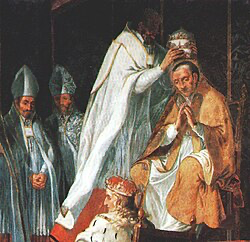
- Sic transit gloria mundi means "thus passes the glory of the world". The phrase was used in papal coronation ceremonies between 1409 and 1963. As the newly chosen Pope proceeded from the sacristy of St. Peter's Basilica, the procession stopped three times. On each occasion, a papal master of ceremonies would fall to his knees before the Pope, holding a silver or brass reed, bearing a tow of smoldering flax. For three times in succession, as the cloth burned away, he would say in a loud and mournful voice, "Pater Sancte, sic transit gloria mundi!". These cautionary words served as a reminder of the transitory nature of life and earthly honors.
2 comments
rbgayle ·
I found the Harvard Business Review article "How Apple Is Organized for Innovation" enlightening wrt how Apple is run. I worked at a biotech company called Immunex whose research group was organized similarly in many ways. 15 years ago, I wrote about 5 lessons I learned at Immunex that I suspect resonate still at Apple.
https://web.archive.org/web/20111201212804/http://www.xconomy.com/seattle/2011/11/28/five-lessons-immunex-taught-me/
By having management that is "of" the industry, we could make very rapid, often very smart, decisions. I think Jobs even gave an interview stating similar ideas -- that companies fail when they promote sales people, not engineers.
That is why I am so happy about this choice. If Apple moved a marketing or sales drone into the CEO spot, I would sell all my stock ;-)
farshad ·
@rbgayle curious: what if it had been Jeff Williams, i.e., someone from operation (don't mind his age)?
Who in the executive team would you consider a 'drone'? Can't see Cook giving the sugar water pitch to some external exec.
A sales or marketing CEO is a rarity at Apple. Only two come to mind: Sculley and Markkula. Think what you will of John Sculley but Mike Markkula's influence was quite significant. See his 3-point "Marketing Philosophy" which I'd consider as seminal as the Cook Doctrine. → https://stevejobsarchive.com/artifact/the-apple-marketing-philosophy ) He was a marketing manager at National Semi. Granted he was BS/MS EE.