Google to sell TPU chips as Gemini shows returns
by Horace Dediu
Why give all your cash to Nvidia? Why not make your own chips? Then why not sell them?
Google said that it plans to sell its custom Tensor Processing Units (TPUs) to select customers who will install the chips in their own data centers.
The move is a change from Google’s prior strategy, which saw it rent out TPU capacity to customers from its own data centers — and is yet another strike at AI chip king Nvidia.
The announcement, during the company’s Q1 earnings call, comes a week after Alphabet announced two new TPUs: its TPU 8t for AI training and TPU 8i for inferencing.
Alphabet didn’t disclose potential customers, but it signed a multiple-gigawatt agreement for next-generation TPUs with Anthropic earlier this month, with chips expected to begin coming online in 2027.
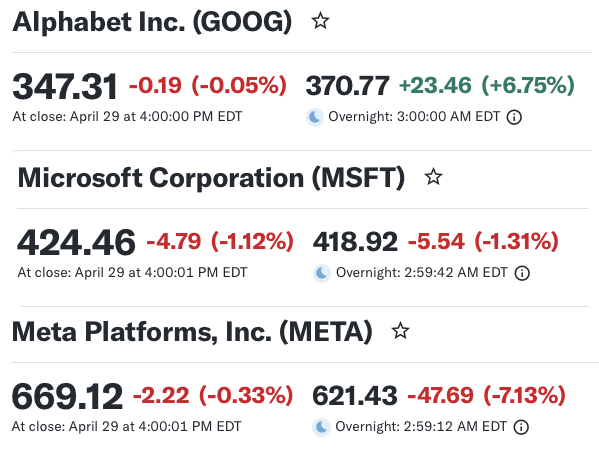
And according to The Information, Alphabet has also entered into a multibillion-dollar chip deal with Meta (META).
Source: Yahoo Finance
NB: Alphabet Q1 sales grew 22% to $110 billion, with Cloud up 63% to $20 billion. Operating margins grew by 220 basis points, with services and cloud operating margins both increasing y/y.
The search business continues to benefit from AI. AI overviews and AI mode are sustaining as search sales grew 19%.
A year ago, Google was trading as if it had lost the artificial intelligence race. Shares are up 6.8% after-hours to all-time high even after growing 114% from a year ago.
Though Google is considered an Apple competitor, the reality is that the two companies are very much in a partnership with Google's payments to Apple being treated as "advertising" revenues (part of Services). The relationship is being expanded with the Gemini deal.
In many ways Apple has effective equity in Google and Google is demonstrating how sustaining AI is to its core business. That sustenance is transitive to Apple.
Moreover, as Google's TPU strategy puts them in direct competition with Nvidia, it exposes the age-old adage that "there is no shortage that is not followed by a glut".
Amazon is also offering up its own chips to customers and Apple is developing its own AI chips.
In his annual shareholder letter, Amazon CEO Andy Jassy said that the company’s chip business, which includes its Graviton, Trainium, and Nitro processors, has an annual revenue run rate of greater than $20 billion.
When Apple ships the inevitable edge AI silicon in a billion devices, the democratization of AI compute will dawn. Remarkably, some can see the dawn already at sunset.
2 comments
FredHS ·
I'd love to know how Google's chips impact CAPEX and OPEX of current Nvidia-based hyper scale data centers. That sets up the question of depreciation of that CAPEX.
And a follow up, how much AI revenue comes from startups funded with VC money rather than with their own revenue.
deemery ·
This is inevitable. Where there's demand, suppliers will step up. Where competition is possible, others will compete.
The NVIDIA moat is pretty strong, but its primary AI customers, hyperscalers, have the wherewithal to produce alternatives. It is, after all, in their own best interests to reduce the price of AI hardware. Selling their internal chips to other customers recoups R&D investments, and one presumes companies like Google will do it in a way doesn't compromise their advantages (i.e. selling 'last year's chips')