Google’s free cash flow will hit zero next year
by Horace Dediu
The commodities strike back
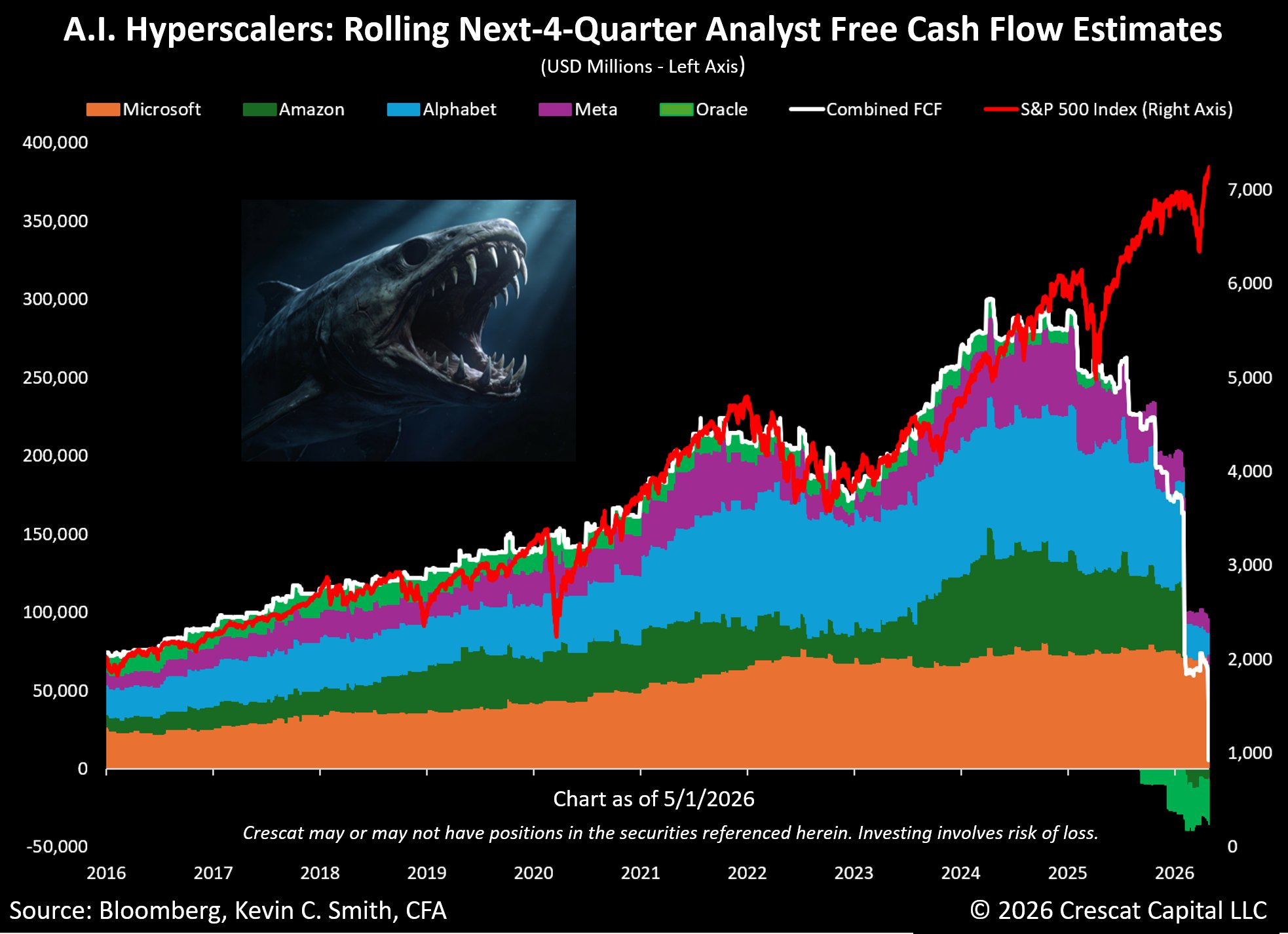
Alphabet generated $73.266 billion in free cash flow in FY2025, which sounds enormous until you look at what's coming. CEO Sundar Pichai has guided for 2026 capital expenditures in the range of $175 to $185 billion. For context, Alphabet's FY2025 operating cash flow was $164.713 billion. If capex hits the midpoint of that guidance range, it consumes essentially all operating cash the business generates.
The trajectory has been accelerating hard. In 2023, Alphabet spent $32.3 billion on capex. In 2024, that rose to $52.5 billion. In 2025, it hit $91.4 billion, a 74% year-over-year increase. The proposed jump to $175-185 billion in 2026 would be another near-doubling. Q4 2025 alone saw capex grow 95% year-over-year to $27.9 billion.
This dynamic is playing out across the peer group. Amazon already lived this story in 2025: FY2025 free cash flow collapsed 65.95% year-over-year to $11.194 billion as capex hit $131.8 billion. CEO Andy Jassy has guided for approximately $200 billion in capital expenditures across Amazon in 2026.
Meta and Microsoft are spending aggressively too. Meta's FY2025 free cash flow declined 19.39% year-over-year to $43.6 billion against 2026 capex guidance of $115 to $135 billion. Microsoft's Q2 FY2026 capex alone was $29.9 billion, up 89% year-over-year.
Patel's broader point is that tech insiders understand the technology better than financial markets, and that returns on AI infrastructure will ultimately justify the spend. The businesses backing these bets are not struggling — Alphabet posted Google Cloud revenue of $17.7 billion in Q4 2025, up 48% year-over-year, with a 31.6% operating margin at the Alphabet level. Full detail is in Alphabet's SEC filing.
Whether it's applied enough is exactly what Patel is questioning. If you believe AI infrastructure is a winner-take-most game and Alphabet and Amazon are positioned to win it, the FCF compression looks like the price of admission. If you think the returns won't materialize at the scale management expects, zero free cash flow at a $1.7 trillion market cap is a very different conversation.
Source: Yahoo Finance
NB: Even before these future investments are considered, for the trailing twelve months Alphabet's EV/FCF has his 73 vs. a P/E ratio of 29. If FCF goes to zero…
…EV/FCF goes to infinity. I've seen estimates that on a forward basis EV/FCF is already over 155. This order of magnitude will impact all the hyperscalers into the next year.
At this valuation, the payback needs to pretty swift but it seems to me that not all will see the benefit. Indeed, the narrative seen above is that it's a winner take most market. If Patel thinks Alphabet and Amazon are positioned to win it then what happens to Microsoft, Meta, OpenAI, Anthropic and XAI/SpaceX?
It could well be pyrrhic victory for the winners anyway as the battle is one of muscle (capital) rather than sustainable competitive advantage. Capital after all is a commodity, especially in today's global economy.
It's remarkable that the greatest business stories al about raw resources (compute or components fueled by capital.) Along with energy, the zeitgeist seems to be "the commodities strike back."
8 comments
FredHS ·
One wonders how much of the work being done in these data centers moves to the client, the edge, the PC/Mac/SmartPhones?
Or is the edge agentic work accretive? Does work at the edge drive demand for hyper scale compute?
Looking at only the hyperscalers, will efficiency, currently measured by cost per token, determine the winners and losers? Right now demand exceeds supply, obviating concerns about cost, CAPEX or OPEX.
deemery ·
All this expenditure, and it's not clear how Hyperscalers will recoup the investment. Even if LLM AI becomes as ubiquitous as some predict, what will be the mechanism for each hyperscaler to charge for it? And if supply exceeds demand, that will do Bad Things (tm) to whatever monetization approach they do use.
So this really seems to me an expectation that supply will exceed demand, and "bet the farm" on that expectation.
rbgayle ·
This seems like the mainframe vs. PC battle all over again. Centralized compute vs. edge. Much of what most companies will want with AI could well be done by in-house computers (likely Macs) with only a little need for LLMs at a datacenter. Much like how Apple envisions Siri AI. And keeping the costs internal.
So the actual money flowing to the hyperscalers could be much reduced from their expectation that ALL business needs will go through them. They will not be able to charge an arm and a leg because companies will just do the work in-house.
FredHS ·
Agree. We just saw the Mac Mini grab a chunk of that work.
Sacto Joe ·
Some folks seem to be defining Enterprise Value as synonymous with Market Cap, which to me muddies the water.
That said, GuruFocus says this about Apple’s EV/FCF:
“What is Apple EV-to-FCF?
Apple AAPL +2.02% 98 EV-to-FCF is 33.48 as of May. 09, 2026, which is 34% above its 10-year median of 24.93. GuruFocus rates AAPL with a GF Score™ of 98/100 and a GF Value™ of $260.16 (Modestly Overvalued). The stock has 4 warning signs investors should review. Among 1,356 Hardware companies, Apple ranks worse than 60.69% on this metric.
EV-to-FCF is calculated as enterprise value divided by its free cash flow. As of today, Apple's Enterprise Value is $4,324,299 Mil. Apple's Free Cash Flow for the trailing twelve months (TTM) ended in Mar. 2026 was $129,174 Mil. Therefore, Apple's EV-to-FCF for today is 33.48.”
I’d note that, like Price (per share)/(yearly average) EPS, this is absent any real data on potential future value. In essence, it assigns a “grade” which is itself an average of the EV/FCF of many companies, and not responsive to Apple as both an agent of change and being in the process of changing.
Jointdoc ·
Think "Thin client"(cloud) vs "Thick client" (Edge)
farshad ·
In between the mainframe vs PC…and cloud vs on premise was the Internet hosting boom.
I recall in the very late late 1990s there were so many hosting companies (eg Exodus.net) building up, a couple of hops to the Internet backbone with fiber interconnects. Renting even a quarter of a rack for cheap gave one such high privileges in terms of access to the Internet, when broadband access was still rare.
It was not unlike getting a Pro plan today on one of the LLMs.
And whoosh, they disappeared pretty quickly after the dot bomb, all eventually consolidated or out of business.
farshad ·
There is the idea of the leader will takes the market. What they assume is perfect is execution, and that a fully sustaining path will be enough. Likely one or both assumptions are false.
The buildup required to meet the projection of everyone’s imagination of what AI will be doing is not sustainable with today’s tech.