What's wrong with Chromebooks? Market down 11% in Q1, outlook even worse for the year as Neo steps in.
by Horace Dediu
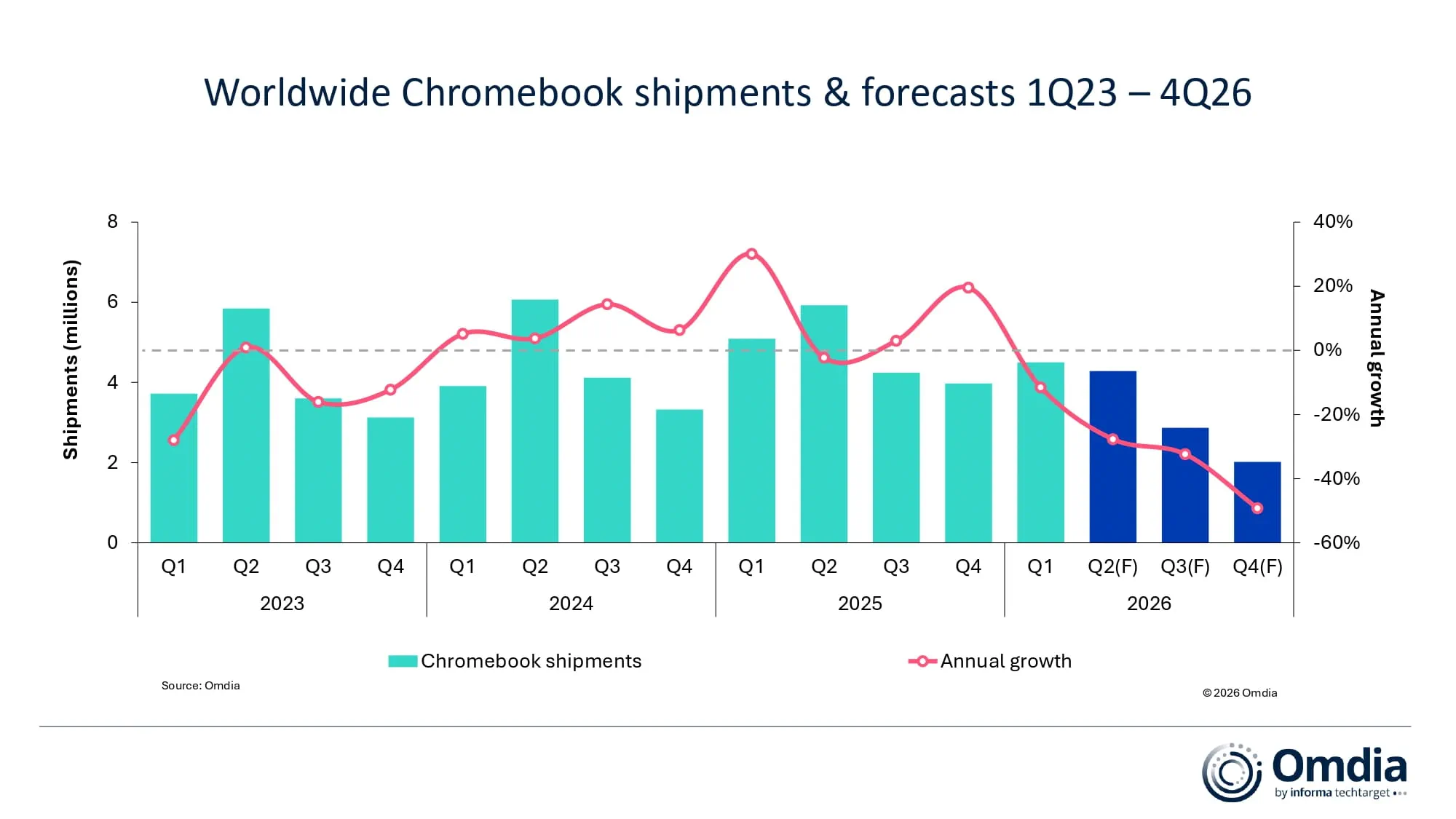
Q4 expectation: down 50% y/y
“Within the PC segment, Chromebooks are currently the most impacted category, with volumes declining significantly,” said Kieren Jessop, Principal Analyst at Omdia. “Production indicators point to a weak near-term outlook, and education-related deployments are increasingly being deferred until market conditions stabilize. Ongoing supply constraints are also expected to delay the second phase of Japan’s GIGA School Program 2.0. While the first phase - extended from end-2024 through end-2025 - was completed without major disruption, the current supply environment is likely to introduce delays in the next phase.”
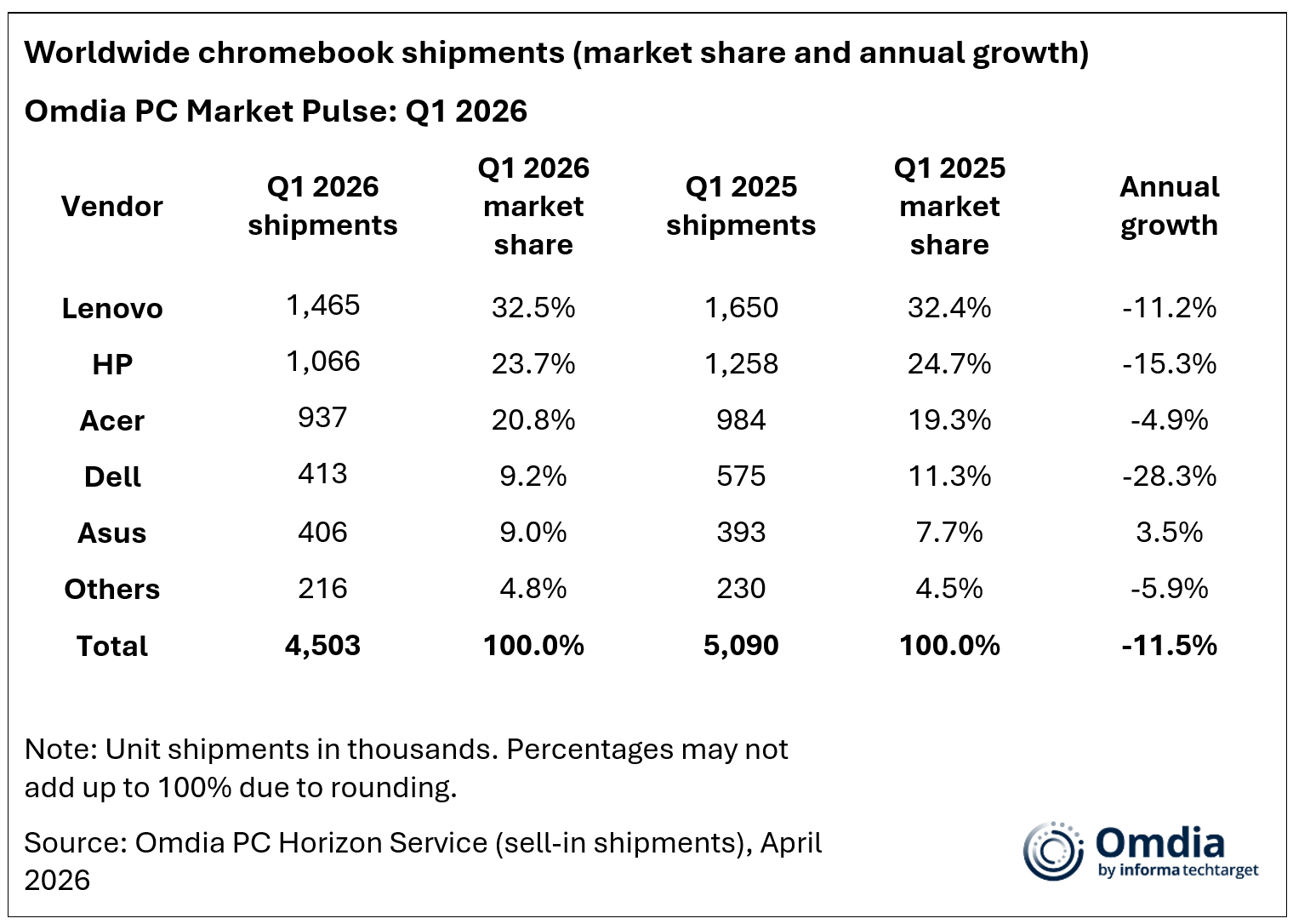
All major Chromebook vendors faced challenges in Q1. Lenovo, which ranked first and was a key participant in Japan’s GIGA School Program alongside its subsidiary NEC, saw shipments decline 11.2% year on year to 1.5 million units as the first phase of deployments concluded. HP ranked second, shipping 1.0 million units, down 15.3% year on year. Acer placed third with 937K units, managing a relatively smaller decline supported by stable shipments in North America and increased shipments into APAC. Dell experienced the steepest decline among the top five vendors, with shipments falling 28.3% year-on-year to 413K units. ASUS, another key participant in Japan’s GIGA School Program 2.0, was the only vendor to record growth in Q1, with shipments rising 3.5% year on year to 406K units, accounting for a 9% market share.
Source: Omdia
NB: When the only type of buyer is a government agency and there's only a handful of them, things can turn scary bad very quickly.
The Chromebook market is undergoing a significant transition in 2026, transitioning from a budget-focused, education-dominant sector to a premium, AI-integrated landscape. While ChromeOS remains dominant in education, Google is introducing "Googlebooks" to compete in the premium, AI-powered laptop market, aiming to unify ChromeOS and Android experiences.
While traditional, affordable Chromebooks for schools continue, the new Chromebook Plus and incoming "Googlebooks" are shifting the market toward higher-end, Gemini AI-powered devices with premium processors.
ChromeOS holds over 60% of the education market, with 93% of US school districts planning to buy Chromebooks in 2025. The Omdia report cites prevalence in the Japanese market as well. However Omdia project dramatic slowing in the next three quarters.
Traditional Chromebooks will continue to exist for the budget sector, while "Googlebooks" are the pivot that Google is hoping to engage. The question is why is this necessary? It seems that the low-end market is contracting dramatically this year.
In this context the MacBook Neo steps in providing a no compromise personal computer vis-a-vis a network "cloud-connected" device. The Neo alone might ship 11 million this year. Projections are that in the same time frame about 10 million Chromebooks might ship.
Googlebooks are an unknown at this time but it seems they are necessary to try to shift a negative momentum for Google branded hardware.
2 comments
FredHS ·
The A-series chip is only 15% of the cost. (Of the $250 to $300 BOM cost of the Neo, only about $40 to $50 is for the A-series chip.)
But that little chip does so much. It gives users sovereignty, freedom, and seamless interworking with the rest of the Apple ecosystem.
BTW. It seems Kindle e-readers are still a thing. You can buy mp3 players too on-line - really cheap.
deemery ·
At some point (probably take 3-4 years), we'll get meaningful data on the comparative service life for Neo vs Chromebooks. I know the Mac community where I used to work had substantial anecdotal experience on how much longer our Macs lasted than company issued Windows laptops. Also, there's my anecdotal observation about comparative laptop lifetimes for people on my project. I'm the only person who had a laptop (my Ti Powerbook) that lasted more than 24 months. The scheduled lifetime for the government issued laptops was 30 months. Mine lasted 34 months before I had to get the motherboard replaced (under Applecare), and that laptop lasted another 3 years. (Motherboard failed while I was on travel at Huntington Beach, CA. I handed it to the Apple store in Newport Beach late Thursday, and picked up the repaired laptop at my local Tyson's Corner VA Apple Store the following Tuesday.)