iPhone Share of US Big 3 Carriers reaches 75%, 77% with Verizon
by Horace Dediu
Android down 14.4%. Small players getting crushed.
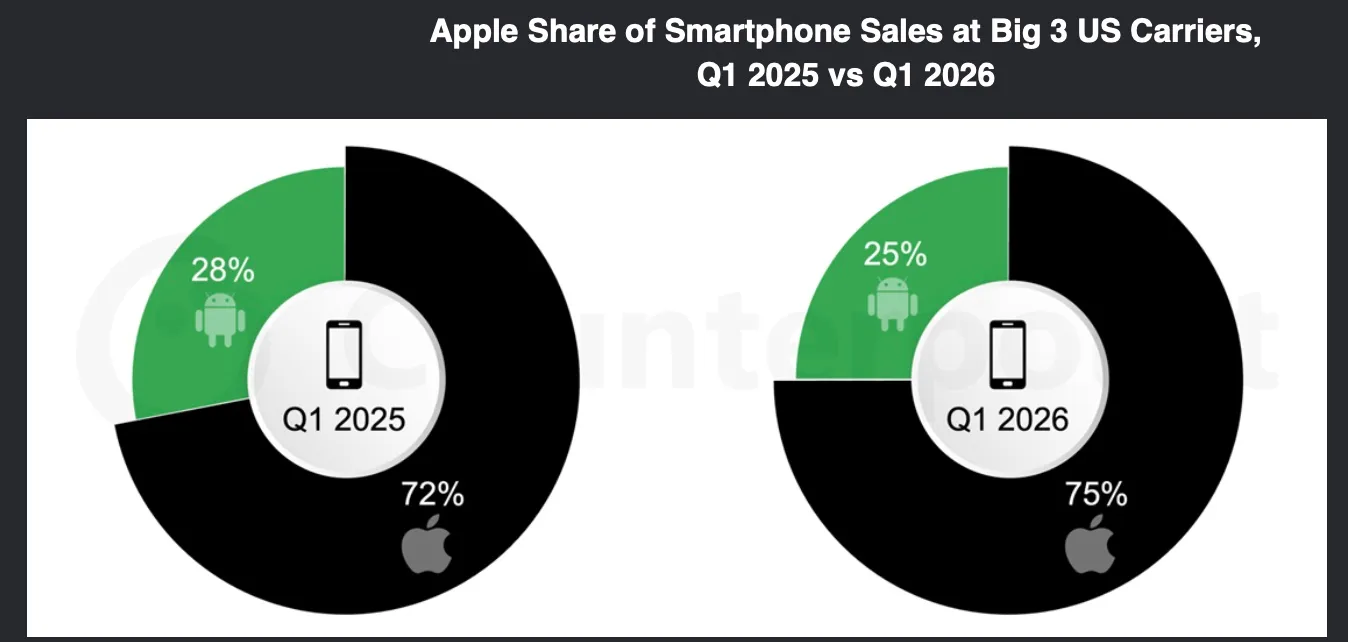
Apple’s quarter one (Q1) 2026 iPhone sales volume in the US was up 1.3% year-over-year (YoY), outperforming the country’s overall smartphone market.
That market declined 5.7% YoY, according to Counterpoint’s US Monthly Smartphone Channel Share Tracker. Apple’s share of volume grew by 4% YoY, as Android device sales declined 14.4% YoY.
On the impact of the delayed launch,Graham said, “The premium smartphone space in the US is highly consolidated compared to some other markets, with Apple, Google, Samsung and, to some extent, Motorola comprising the vast majority of sales here. When one brand delays a flagship launch, it opens a window of opportunity to fill that vacuum. Apple did just that.”
Apple grew its market share in each of the Big 3 US carriers. Its share grew the most at Verizon to 77% in Q1 2026.
“If Apple can avoid significant price increases and continue to outpace its peers in promotional dollars, it will be tough for Android manufacturers to keep up in the year ahead, said Klaehne.
Source: Counterpoint Research
NB: What are the dynamics of the US market? The split between Apple and the rest of the market seems to be starker than ever. It's ask if there is a K shaped market emerging…
Low-end weakness was mainly due to macroeconomic challenges. Lower-income households saw tax return increases year-over-year, but not as much as high-income households. These increases were offset by rising gas prices, and many consumers used the extra money to pay credit card bills. Consequently, more money transfers to lower-income households didn’t lead to the expected increase in smartphone sales in the prepaid segment, according to Counterpoint.
Amid lower overall sales, especially in the sub-$100 price range, prepaid channel marketing spend is concentrated on Motorola and Samsung. Other players like TCL and HMD have delayed model refreshes, exited the market, or struggle to compete with Motorola and Samsung’s marketing power. As a result, Motorola and Samsung increased their market share in most prepaid and national retail channels in Q1. Cricket (Samsung +6% points; Motorola +6% points) and Metro (Samsung +2% points; Motorola +7% points) saw significant YoY shifts.
Rising memory costs are expected to continue consolidating the low-end market in the US, impacting smaller players like Maxwest, Orbic, Blu, and white-label devices. This may lead to reduced portfolio diversity in lower price bands and further push lower-income consumers towards Samsung and Motorola options.
Meanwhile, Apple has maintained its pricing strategy, keeping the iPhone 17e pricing consistent YoY while increasing the entry-level storage to 256GB, even as competitors introduce price hikes. With this strategy, Apple draws more users into its iOS ecosystem, while placing service revenue growth over hardware profitability.
Counterpoint thinks this will lead to faster revenue growth through 2027. For manufacturers with smaller hardware margins, it will be tough. Perhaps impossible.
2 comments
deemery ·
I wonder if the amount a telco makes selling a handset varies by brand. I'd guess it would, but that's purely a guess. If so, then the telcos would have a clear interest in pushing the handset with the best return. So if Android phones bring more money, but customers want iPhones despite the telco marketing imperative, that says -a lot- about the relative demand between iPhones and Androids.
AAPL ·
Samsung used to rely a lot on sales 'incentives' to sales staff at the telco stores and kiosks you see in Costco and Sam's Club, ect. Hard to stop those programs without creating ill will. I would assume sales staff are rewarded for selling the highest cost unlimited plans vs. the $25/month per plan my family has been on since I retired 7 years ago.