Omdia: Apple grows 9% as European Smartphone Market Grows 2%
by Horace Dediu
Market contraction expected for second half of year.
Omdia reports that Europe (ex. Russia) smartphone market grew 2% to 33 million units in 1Q26.
Key vendor highlights from 1Q26 include
Samsung was Europe’s largest vendor as it grew 3% to 12.6 million units. Effective discounting of the Galaxy A16 4G helped Samsung boost volume, offsetting declines related to the delayed launch of the Galaxy S26, A57 and A37.
Apple grew 9% to 8.8 million iPhones, driven by robust iPhone 17 series demand in addition to benefiting from a wider mid-range coverage from the iPhone 15 and iPhone 16e. Noticeably, Apple’s strong results came despite lower and fewer discounts than in previous years.
Xiaomi retained third place despite declining 15% to 4.5 million units, as it was more immediately impacted by supply-side difficulties. However, Xiaomi’s ASP grew 21% compared with 1Q25, boosted by a record-strong Xiaomi 17 and 15T series performance, which drove year-on-year value growth despite the shipment decline. Premium sales were particularly strong in France, Germany, and Spain.
Motorola grew 17% to 1.9 million units, driven by rapid expansion in Spain and Portugal, alongside continued progress in France and Italy.
OPPO grew 9% to 1.3 million units, largely driven by its comeback in France alongside growth in Romania and Poland. With both realme and OnePlus now under its umbrella, OPPO is restructuring to optimize its portfolio and strategy with ambitions to strengthen its European position.
HONOR, ranking sixth, was the fastest-growing vendor among the largest players, with shipments increasing more than 60% compared to 1Q25. HONOR’s growth is underpinned by its portfolio being expanded further down the price-tiers.
Source: Yahoo Finance
"The average-selling-price (ASP) of smartphones in Europe surged to a record-high level of €580 in 1Q26," added Bjorhovde. "This was largely caused by lower availability of devices costing less than €200, which made up an all-time low of just 25% of shipments. Additionally, the high-end remained resilient thanks to Apple’s growth. The focus from both vendors and channel partners has shifted from volume to value to deliver results and operational sustainability. Many vendors who normally focus on the mass market segments are increasingly concentrating on the mid-to-high-end, hoping to benefit from less price-sensitive and upgrade-willing buyers."
[My emphasis]
"The first quarter of 2026 delivered beyond expectations, but the outlook remains bearish as the rapidly escalating memory bottleneck worsens," commented Bjorhovde. "Omdia forecasts shipments into Europe to decline 12% in 2026, but the majority of this will come in the second half of the year.
Applying average pricing per vendor and average gross margins gives the following picture of the market:
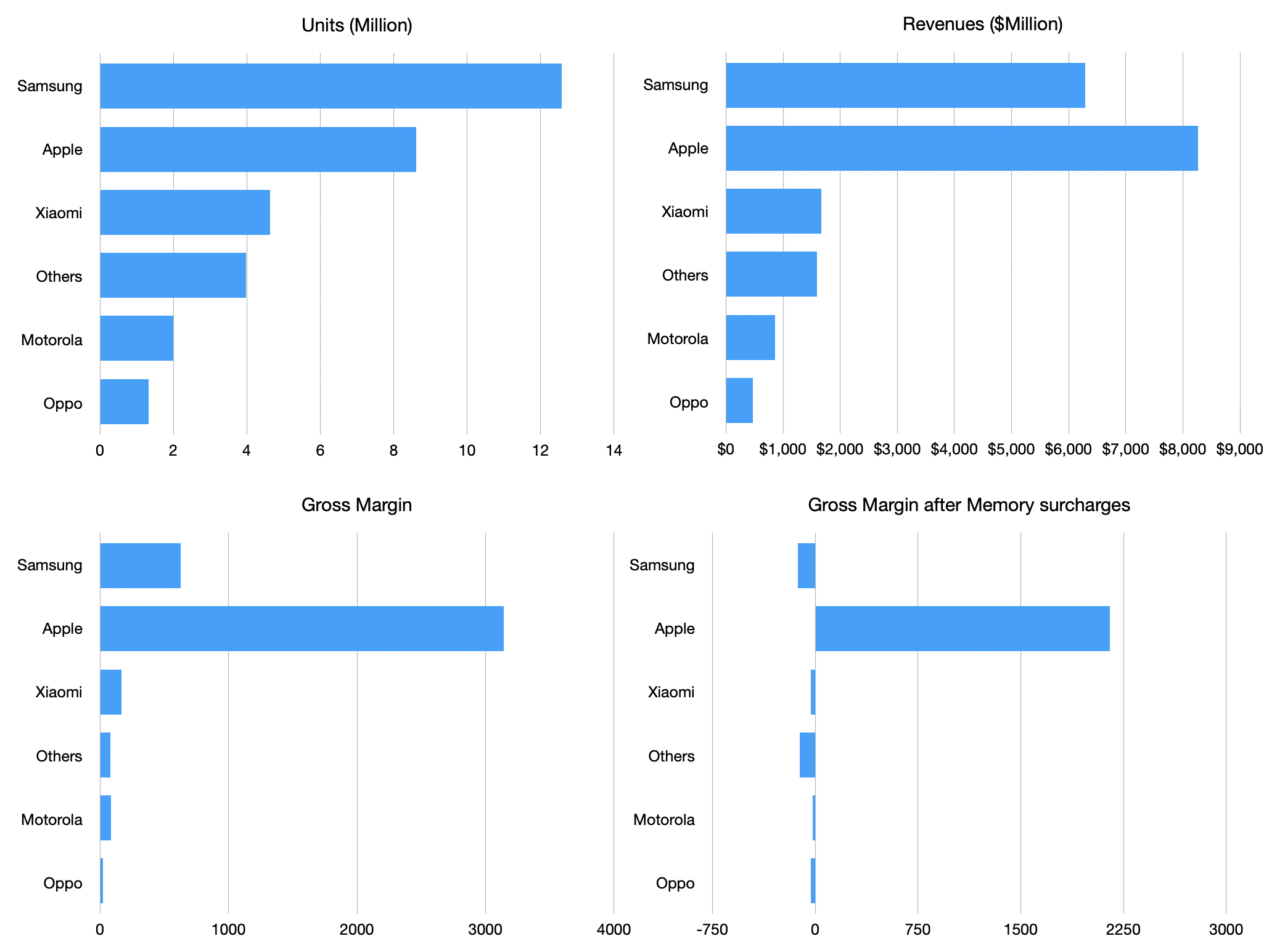
Apple currently captures 26% of unit volume, 43% of ...
… revenues and about 75% of the gross margin:
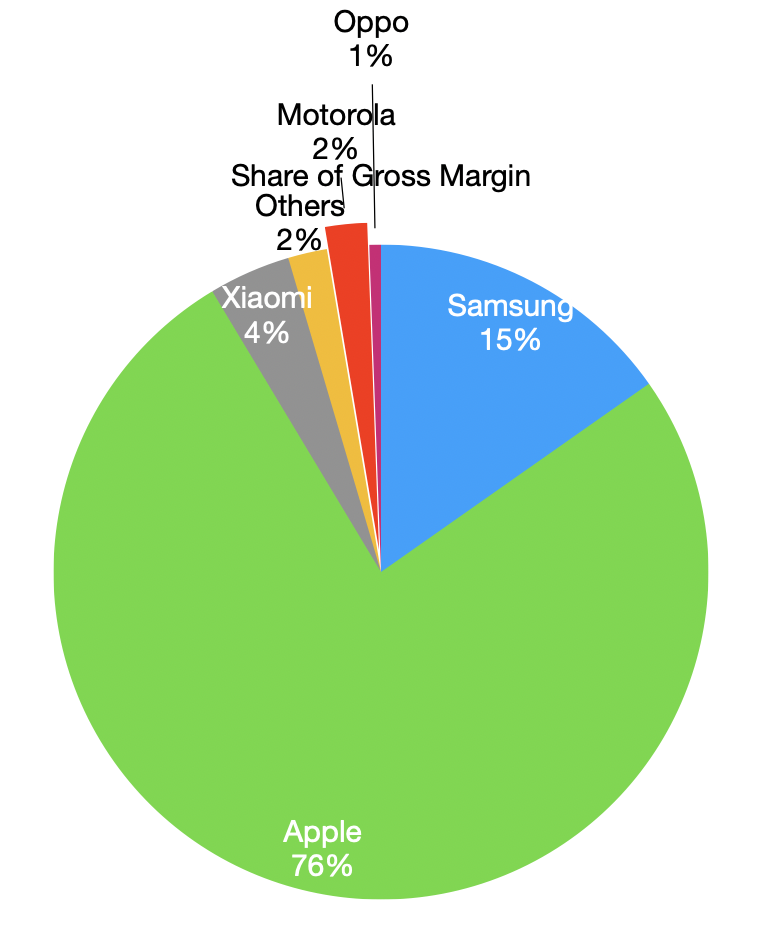
In a contracting market with memory costs increasing, I expect Apple to capture 100% of available margins and to gain share.
4 comments
deemery ·
Any idea about -installed base- as opposed to -sales-?
Sacto Joe ·
Good question, Fred!
Horace Dediu ·
I have a big data set on this. Global installed base for all devices by country over a 10 to 15 year period. However it's complicated because I have to calibrate vs. Apple's own reporting segments. Apple reports 5 geographic segments: Greater China, Rest of APAC, Americas, Europe and Japan. Europe I assume includes Middle East and Africa. My current count is that there are 356 million iPhones in use in Europe + MEA (out of population of 2.6 billion). Stay tuned as this is a work in progress. There are 117 countries in this segment. Once calibrated, I can break out the "Europe" as defined by other segmentation (EU vs. geographic Europe, etc.) To build this requires a starting point. I used the ITU data set which tracks "cell phone" populations by the following countries/states/polities. Russia Nigeria Iran Germany Egypt South Africa Turkey United Kingdom Italy France Ethiopia Kenya Tanzania Spain Morocco Poland DR Congo Ukraine Algeria Ivory Coast Saudi Arabia Iraq Ghana Sudan Uganda Mali Burkina Faso Angola Romania Cameroon Senegal Madagascar Netherlands United Arab Emirates Zambia Syria Tunisia Yemen Benin Zimbabwe Niger Libya Mozambique Israel Czechia Sweden Portugal Malawi Chad Belgium Belarus Greece Austria Rwanda Switzerland Hungary Somalia Serbia Sierra Leone Bulgaria Kuwait Jordan Burundi Slovakia Denmark Finland Oman Togo Norway Georgia Ireland Republic of the Congo Mauritania Qatar Croatia Palestine Botswana Lebanon Moldova Lithuania Bosnia and Herzegovina Armenia South Sudan Gabon Namibia Albania Gambia Slovenia Guinea-Bissau Latvia Bahrain Mauritius Estonia North Macedonia Central African Republic Eritrea Liberia Lesotho Eswatini Cyprus Montenegro Equatorial Guinea Luxembourg Comoros Malta Cape Verde Djibouti Iceland Seychelles Sao Tome and Principe Jersey Guernsey Faroe Islands Liechtenstein San Marino Monaco Gibraltar
deemery ·
For me, at least, the interesting thing is not in the raw numbers, but rather the changes and rate of change in those numbers. My thought is that concentrating on changes rather than the raw data would remove some of the potential sampling error in the data sets.
A related interest would be whether Europeans hold onto their Androids as long as iPhones, and how that retention changes over time. Of course, everyone wants all the data instantaneously available, with real-time analysis of same :-)