Melius’ Ben Reitzes raises price target on Apple to $385
by Horace Dediu
The company “may be on the brink of some real AI sizzle.”
Reitzes said people are becoming more comfortable using voice commands, and Apple could benefit from this shift as technology becomes more voice-driven.
Reitzes also said the upgraded Siri could become a standalone tool that many Apple users rely on, even instead of apps like OpenAI’s ChatGPT. He described it as an “agent-style interface” that could make the Apple ecosystem more unique and spark fresh excitement among developers.
Additionally, he highlighted that no other consumer tech company has both parts of that system under one trusted setup. He added that this advantage will become even clearer—and more valuable—as AI systems get more complex and start acting more independently.
Overall, he expects Apple to post about $613 billion in revenue by fiscal 2028.
Source: TipRanks Financial
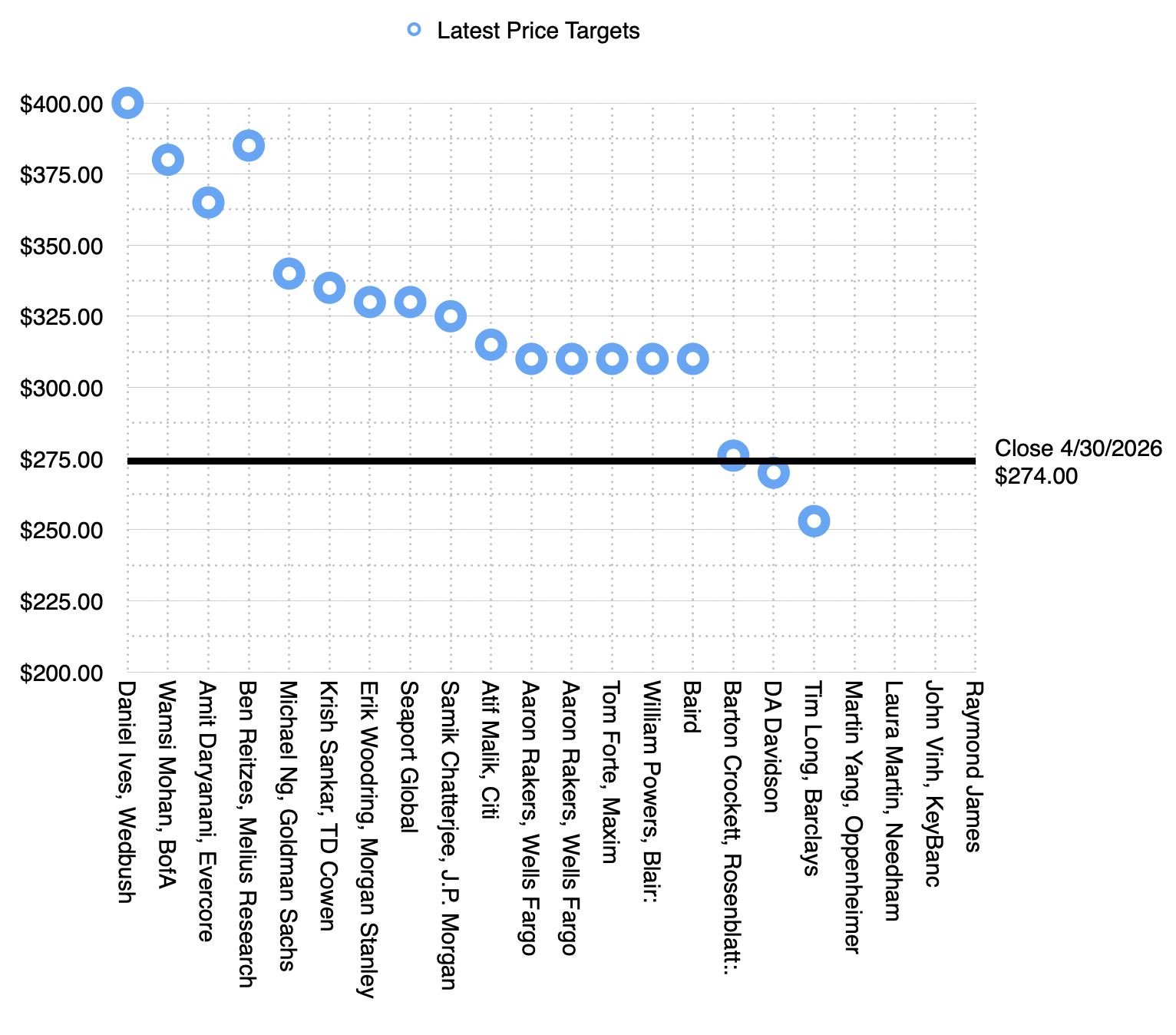
NB: Latest analyst targets are shown with Melius' stepping up. Analysts are coming round.
This upgrade follows Bank of America boosting its price target to $380 a share.
“In an agentic world, value accrues to the platform that controls user intent, personal context, app access, permissions, identity, authentication, payments, and trust,” said BofA’s senior equity research analyst Wamsi Mohan.
“Smartphone is the scaled consumer device where these factors already converge,” he added. “If AI assistants become the new front door…we think Apple should have meaningful leverage over model providers, app developers, merchants, advertisers, and payment networks.”
An agentic version of Siri could boost 2030 revenue by as much as $65 billion, Wamsi and his team estimated, adding up to $2 billion in incremental earnings over the next four years.
Reitzes sees the new Apple Siri as a stand-alone app that has the potential to replace ChatGPT for Apple's 2.5 billion installed devices, while proving to be “an agentic interface that can further differentiate the Apple ecosystem and ignite a level of excitement with developers not seen since the early days of the App store.”
But it’s also likely to establish Apple as the leader in consumer-use AI.
“If agentic AI shifts the market from answering questions to taking actions, the critical control point becomes centered around owning the endpoint,” Wamsi said. “Apple does not need to own the best frontier model if it owns the trusted interface that routes intent across local models, Apple-controlled cloud models, external models, and app actions.”
Reitzes at Melius sees that shift, which he describes as a “shot in the arm” for Apple’s app store, driving “a massive new product cycle that keeps iPhone growth going.”
He’s also observing that Apple’s architecture, with on-device models handling lighter workloads and its private cloud taking on the larger ones, makes it unique.
“No other consumer technology company has both legs of that architecture under a single trust model, and we think that gap becomes more visible, and more valuable, as agentic complexity scales,” he said.
“Agentic AI is a structural tailwind that will force consumers to get the latest and greatest Apple device because it will work better than other brands.”
I still struggle to understand why none of this was evident three years ago to anyone following Apple and the business of technology.
There is always the allure of a new technology somehow "changing everything" including human nature, economics, management behaviors, business theory, innovation theory and centuries of patters thereof.
See also Tesla and SpaceX for more magical thinking.
6 comments
AAPL ·
Summary of Reitzes‘s thoughts: DISTRIBUTION!
FredHS ·
Yes foreseeable, Deja Vu all over again.
The 'land grab' trope leads to over-investing the now-scare asset, LLMs and frontier models.
Apple follows its financial strategy of investing in durable, low CAPEX, parts, the parts that 'enrich people's lives' as Tim oft repeats. They never invested in financial rails, semi manufacturing*, communication pipelines, etc. Perhaps that's why they cancelled the rumored TV and Titan. That's also why Apple has not made big dilutive acquisitions urged by many Apple commentators who know little about Apple.
*Apple has provided guarantees to TSMC and other suppliers who invest the CAPEX in true win/win.
FredHS ·
Hats off to Wamsi for highlighting Apple's unique advantage for on-device AI work loads.
While this is just getting started in terms of usable on-device Apps, Srouji has been building the chips needed for a decade.
Horace Dediu ·
No kidding.
Horace Dediu ·
TV and Titan made no sense because commoditization was foreseeable. As pointed out in the "Cook Doctrine" Apple needs to be able to have "a significant contribution" and "control all the technologies" involved. There was not enough of either in TVs and cars. As evidenced now, cars are heading in a very dark way into over-serving with Chinese low-end pressure which is trapped by politics. It won't end well. Fewer people can buy new (<10% of US population) and repos and financialization are rampant.
Horace Dediu ·
When you look at the revenues/earnings of the semi companies (Nvidia included) they all look like they won the lottery. I need to perhaps recall what Christensen reminded us of: The point of a great business isn't to win the lottery. It's to win a competition against luck itself.