Q4 PC shipments are expected to fall 20% year-over-year, 11.3% for the full year
by Horace Dediu
If it wasn't for the MacBook Neo the fall would have been much worse.
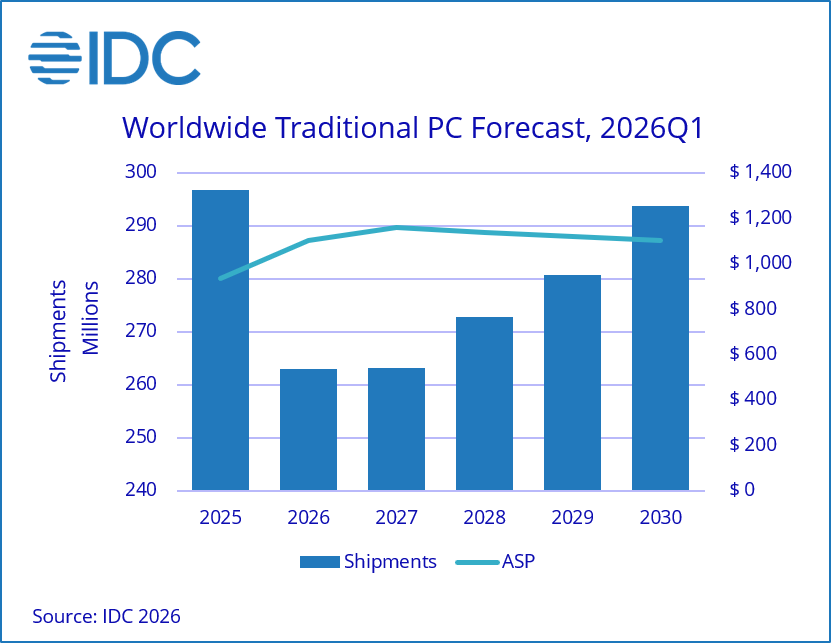
IDC now forecasts global PC shipments will decline 11.3% for the full year, with conditions worsening progressively through Q4, when shipments are expected to fall 20% year-over-year.
Pull-forward demand masked the problem, temporarily
The first quarter of 2026 offered a deceptively encouraging signal, with shipments growing 3% versus the same period last year. But that strength was largely borrowed from the future. Buyers, both consumer and commercial, accelerated purchases ahead of anticipated price hikes and product availability constraints.
Pull-forward demand masked the problem, temporarily
“The anticipation of rising prices and of limited availability of some system configurations due to memory and other component shortages has led some end-users to make purchases earlier than anticipated,” said Jean Philippe Bouchard, Vice President of Devices and Consumers at IDC. “We’re not seeing any relief to the memory shortage situation before the end of 2027, which means prices will continue to rise and PC manufacturers will struggle to maintain full product portfolios for the foreseeable future.”
One notable wildcard is Apple’s MacBook Neo, which has driven stronger-than-expected notebook demand and prompted IDC to revise its notebook forecast upward.
Source: IDC
NB: The problem is a memory shortage: PC manufacturers are struggling to maintain product portfolios.
“The introduction of the MacBook Neo is putting real pressure on the entire PC ecosystem,” said Jitesh Ubrani, research manager for IDC’s Consumer Devices Trackers. “We expect vendors to respond with a combination of new silicon, a more efficient OS from Microsoft, and aggressive promotional pricing.”
“The competitive pressure from the Neo is providing a partial offset to broader price increases, keeping some low-cost notebook options alive. But the overall trajectory for average selling prices (ASPs) is firmly upward. IDC forecasts ASP growth of 17% in 2026, and even as memory capacity expands over the next two years, pricing is unlikely to return to 2025 levels,” Ubrani added.
As the graph shows, IDC forecasts no recovery in volumes until after 2030. This is a multi-year opportunity for Apple and may reset market share dynamics permanently.
As the graph shows, IDC forecasts no recovery in volumes until after 2030. This is a multi-year opportunity for Apple and may reset market share dynamics permanently.
Recall that just a few days ago IDC forecast that smartphone shipments are headed for a 13.9% decline in 2026. This is even worse than the 11%+ for the PC market. The production planning in Cupertino must be feverish, more so perhaps than during the Covid supply chain disruptions.
The question is whether the Windows PC market will experience permanent demand destruction. One could imagine that, apart from Apple, PC users might consider cloud-based services sufficient without hardware upgrades. In this case, the AI "disruption" will not only cause a surge in pricing and a transient shift to Macs but it might decrease appetite for PC hardware altogether.
7 comments
deemery ·
vendors to respond with ... a more efficient OS from Microsoft,
Could be a LONG wait... Under the most optimistic scenarios, it would take Microsoft years to catch up to Apple MacOS/iOS in terms of software/hardware efficiency for power/energy aware computing. And that assumes tight coupling between Microsoft and NVIDIA, or Microsoft and Qualcomm. The fact that there are -2 competing hardware vendors- that Microsoft would have to satisfy, is one reason why I'm highly pessimistic about Microsoft pulling this off. The other, of course, is Microsoft's unbroken record of poor quality operating systems that are burdened with massive technical debt in their codebase. (At least they won't have Ballmer to throw chairs around when there's a threat to that codebase...)
FredHS ·
The Windows market has long-term headwinds: 1) Permanent loss to MacOS; 2) Fragmentation with RTX in the mix; 3) More work being done in the cloud; 4) Younger workers refusing to use Windows.
deemery ·
It is interesting to think about a pure cloud terminal as a replacement for netbooks or even PCs.
AAPL ·
I have never used one but isn't a Chromebook a 'cloud computer'?
deemery ·
isn't a Chromebook a 'cloud computer'? Well, from what I understand, there's still local processing and apps on a Chromebook. I'm thinking here a pure 'cloud terminal', with a minimal operating system and minimal RAM.
AAPL ·
Back before I retired, I’d vnc into my iMac and way too many windows computers and VMware servers at work. Definitely faster than driving in to sort out problems at night and weekends. But I’m not sure I’d want to something similar full time into a virtual machine. Well, maybe to avoid a daily commute!
Sacto Joe ·
The phenomenon being experienced with the Neo is a direct result of Apple’s laser focus on quality, which directly impacts longevity, which directly impacts resale value. Apple products last longer and are supported longer than its competitors’ products. That includes security upgrades, which is of increasing importance. Finally, Inflation continually drives hardware cost upwards, but Apple’s sheer parts ordering volume gives it a pricing advantage.
Ai is, of course, yet another paradigm shift, but it is just beginning to impact, and Apple is yet again showing it’s capacity to absorb these shifts. It’s low end high quality products have always existed, as has its ability to be useful for longer. Apple only requires enough time to build the supply chains capable of matching demand for its low end products, and growing it’s high quality production capacity has literally been the underlying reason for its continued growth.
Other high quality competition exists, of course, but they started late in the game and simply cannot match Apple’s ability to massively grow high quality production. Therefore, as long as Apple can continually stay at the cutting edge of paradigm shifts in computing and stay true to their commitment to quality production and customer support, Apple will inevitably grow it’s share of installed base compared to the installed base of its competitors.
Which is why outfits like IDC, with their anti-Apple focus on market share, have failed to adequately predict the path of computers, especially as it concerns the inevitable ascendancy of Apple Inc.