Apple confirms not using Google models, apps or search in Apple Intelligence
by Horace Dediu
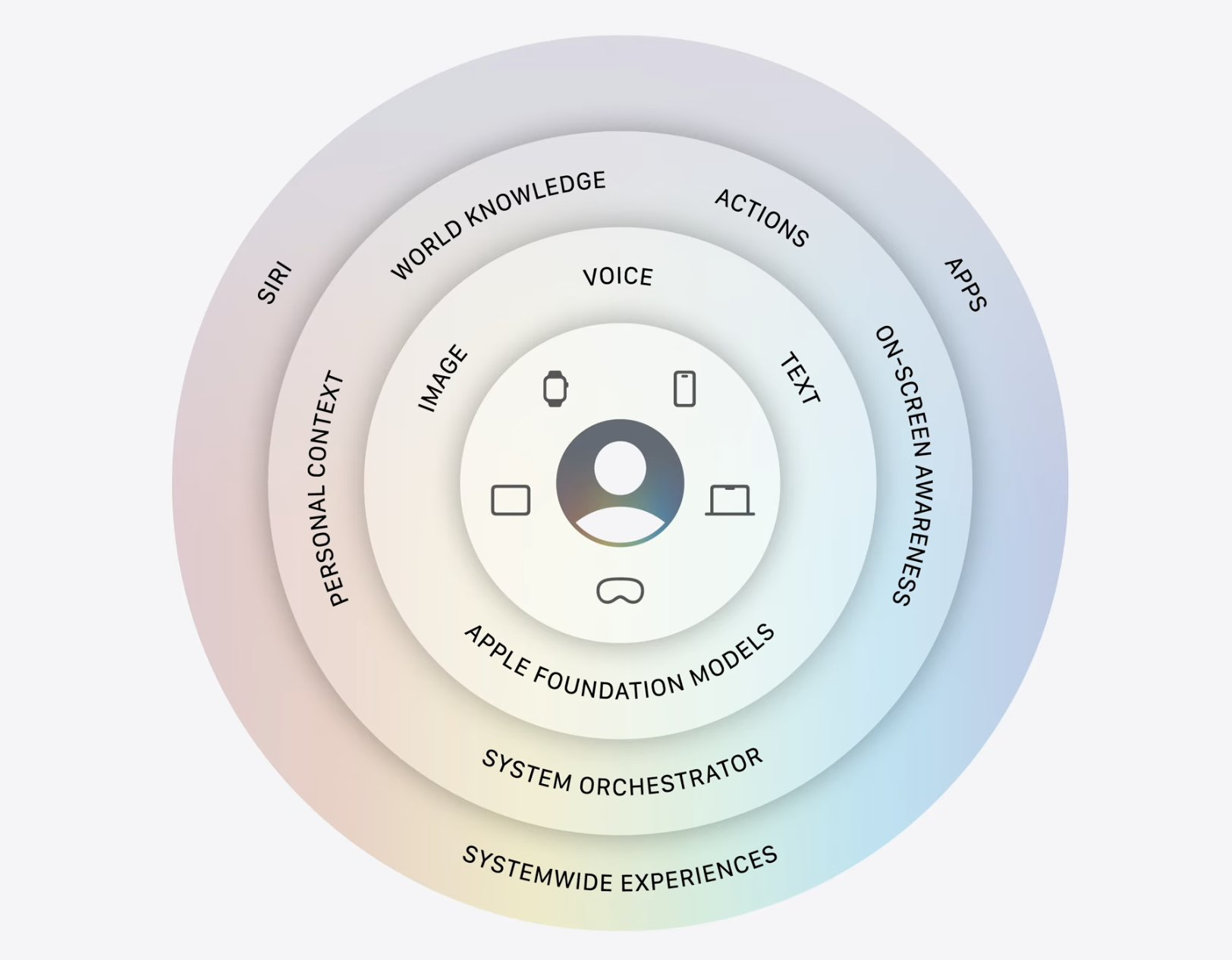
One Foundation Model runs on Nvidia GPUs hosted in Google’s cloud and some Google proprietary model data used to refine Apple's Models.
Apple has shared new details about the technology behind its latest Apple Intelligence platform, explaining how its new Apple Foundation Models (AFM) work and clarifying the company's relationship with Google. During a post-WWDC technical discussion, Apple executives said the company does not use Google’s Gemini models, Google Search, or Google Assistant infrastructure to power Siri or Apple Intelligence
Craig Federighi, Apple’s Senior Vice President of Software Engineering:
“Of course, we don’t have the Gemini app as our app. In fact, none of that client code is part of how we run on iOS. For these models, we use none of the models that Google deploy to their customers, nor do we use the infrastructure and means by which they deploy models to their customers. And then, when it comes to the knowledge base, we of course don’t use Google Search or anything like that as the foundation of our system. So I hope that’s clear. The amount of the Google Assistant we use is none.”
Source: The Mac Observer
NB: Apple introduced five foundation models.
- AFM Core (used for expressive voices and invitation capabilities on device)
- AFM Core Advanced (on device)
- AFM Cloud
- AFM Cloud Image image generation and editing tools, including spatial reframing
- AFM Cloud Pro complex reasoning and agentic actions; Nvidia GPUs hosted in Google’s cloud
These models are custom-built for Apple Silicon, trained using proprietary data, and refined using outputs from Gemini frontier models. The company emphasized that there is no direct use of Gemini itself.
Note that at the heart of the system is a decision by System Orchestrator, which routes requests to run on-device or through Private Cloud Compute. This "Neo Operating System" funnels multiple contexts for input: app actions, personal content, a semantic index, on-screen context while maintaining privacy.
Traditionally routing inputs and outputs, managing resources and protecting user data was the domain of the Operating System. The Orchestrator sounds to me like an OS for AI. Slipping in a new OS layer to accommodate AI properly on any device is demonstrably sustaining to Apple's core value proposition. Integration, safety, abstraction. All leading to comfortable adoption and engagement with the new technologies. Always has been.
5 comments
deemery ·
The Orchestrator sounds to me like an OS for AI.
Yeah, that does sound like an appropriate characterization. The Orchestrator would need to work with iOS on resource contention, memory management and data migration. iOS would still control user interactions, launching/managing apps, security, local storage, networking, and the non-AI interactions with iCloud.
Sacto Joe ·
Talked with my stepson Martin last night. He’s deep into security and AI, presently speaking at seminars on same. I pointed out this:
From Barron’s a couple of days ago:
““We are collaborating with Google and NVIDIA to run new Apple Intelligence workloads on Google Cloud, extending our industry-leading PCC [private cloud compute] privacy commitments to third-party data centers for the first time,” Apple said in a statement on Monday.”
He said that there's an element of trust in this transaction (said transaction being, IMO, an integral part of the Alphabet/ Apple Gemini deal), because the real estate and the server hardware/Nvidia connection are under Alphabet’s control, and “man in the middle” data transfers are susceptible to being intercepted. I pointed out that this is Apple’s proprietary PCC (Private Cloud Compute) data, but he remained skeptical that it couldn’t be tapped into.
Still, it seems to me that this is head and shoulders above everyone else’s approach to personal data. And while it might be possible to intercept such data and even “open” it, I can’t see that happening on anything but a very rare instance, and certainly not as a matter of course, to the degree that Apple is held totally unaware of the vulnerability.
So, from my POV, it’s probably not a concern. And I will probably start tiptoeing into AI as a result, when the beta goes to a deliverable.
hmlong ·
AFM Core (used for expressive voices and invitation capabilities on device) AFM Core Advanced (on device)
Pretty sure that's backwards.
"AFM 3 Core Advanced, our most powerful on-device model. It’s natively multimodal, enabling helpful features like expressive voices and higher-accuracy dictation. Built on cutting-edge Apple research, this 20-billion-parameter model uses a sparse architecture, activating just 1 to 4 billion parameters at a time depending on the request. AFM 3 Core Advanced is unlocked by and optimized for our most capable Apple silicon systems."
https://machinelearning.apple.com/research/introducing-third-generation-of-apple-foundation-models
FredHS ·
What about pricing? Maybe too early as these are developer releases.
AFP Cloud Pro costs for the Google Invidia-inside cloud must be recouped.
Just curious and patiently waiting to see.
deemery ·
Techniques to eliminate man-in-the-middle attacks are pretty well known, I think. (Of course, if you don't actually trust Google in that regard, all bets are off.) That's not a threat I would worry about.