The range of options has run out. When will Apple raise prices?
by Horace Dediu
Tim Cook warns memory costs to be passed-on to customers
Apple will not absorb all costs of memory and storage chips, Tom Cook confirms.
“Unfortunately, price increases are unavoidable,” he said. “We’re doing our best to mitigate the huge increases that are being passed to us, and we’ve been trying to shield our customers from the increases, but the situation has become unsustainable.”
No further details were provided.
Tim Cook decided to issue this warning about the price increases in advance through the Wall Street Journal. This communication preempts by at least 2 months of the Fall launch event. Due to this, it's likely that price increases on current products might arrive well before then.
Recall that guidance for the current quarter (ending June) was issued in April which indicated growth and markings consistent with the last quarter (ending March). The current quarter ends in 12 days and I would assume price increases are likely right after that. The current quarter likely saw increased inventory builds as components in the supply chain purchased at prices set a few months ago were used up.
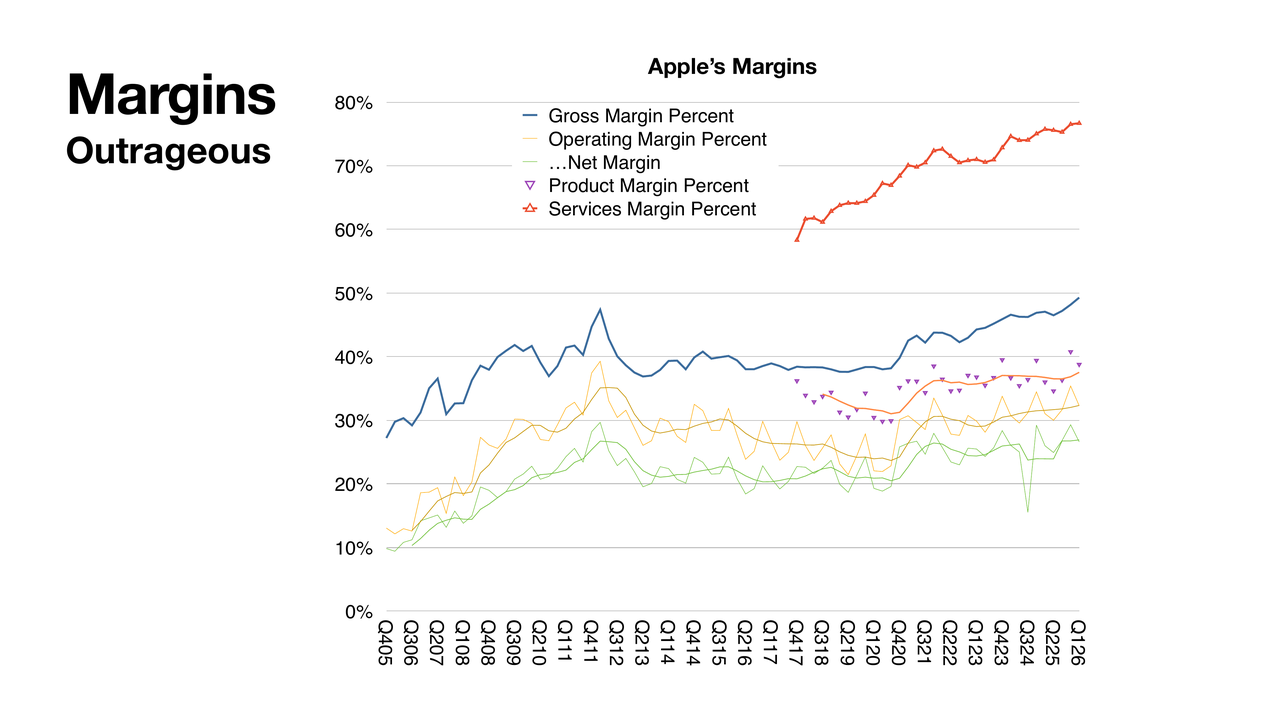
This has kept pricing and margins constant but at the last earnings call, Tim Cook warned that cost increases in memory were likely to impact "beyond the June quarter". Here is the exact quote:
...let me talk about memory specifically, which I think is the root of the question. And I'll go back to December for a moment and just walk you through the chronology. In the December quarter, we really had a minimal impact due to memory, and you can kinda see that in the gross margin results. We said it would be a bit more in the March quarter, and we did see higher memory costs in the March quarter, and they were partially offset by benefits from carry-in inventory that we had. For the June quarter, and what's embedded in the guidance that [CFO] Kevan went through earlier, we expect significantly higher memory costs. They are also partly offset by the benefit of carry-in inventory.
Then where we don't give color beyond June, I can tell you that beyond the June quarter, we believe memory costs will drive an increasing impact on our business. We'll continue to evaluate this, and as we've said before, we'll look at a range of options.
It seems the range options have run out. Tim did say that the situation was unprecedented and not seen in the 40 years he's been in the business. Analysts are busy trying to predict the trajectory of memory pricing.
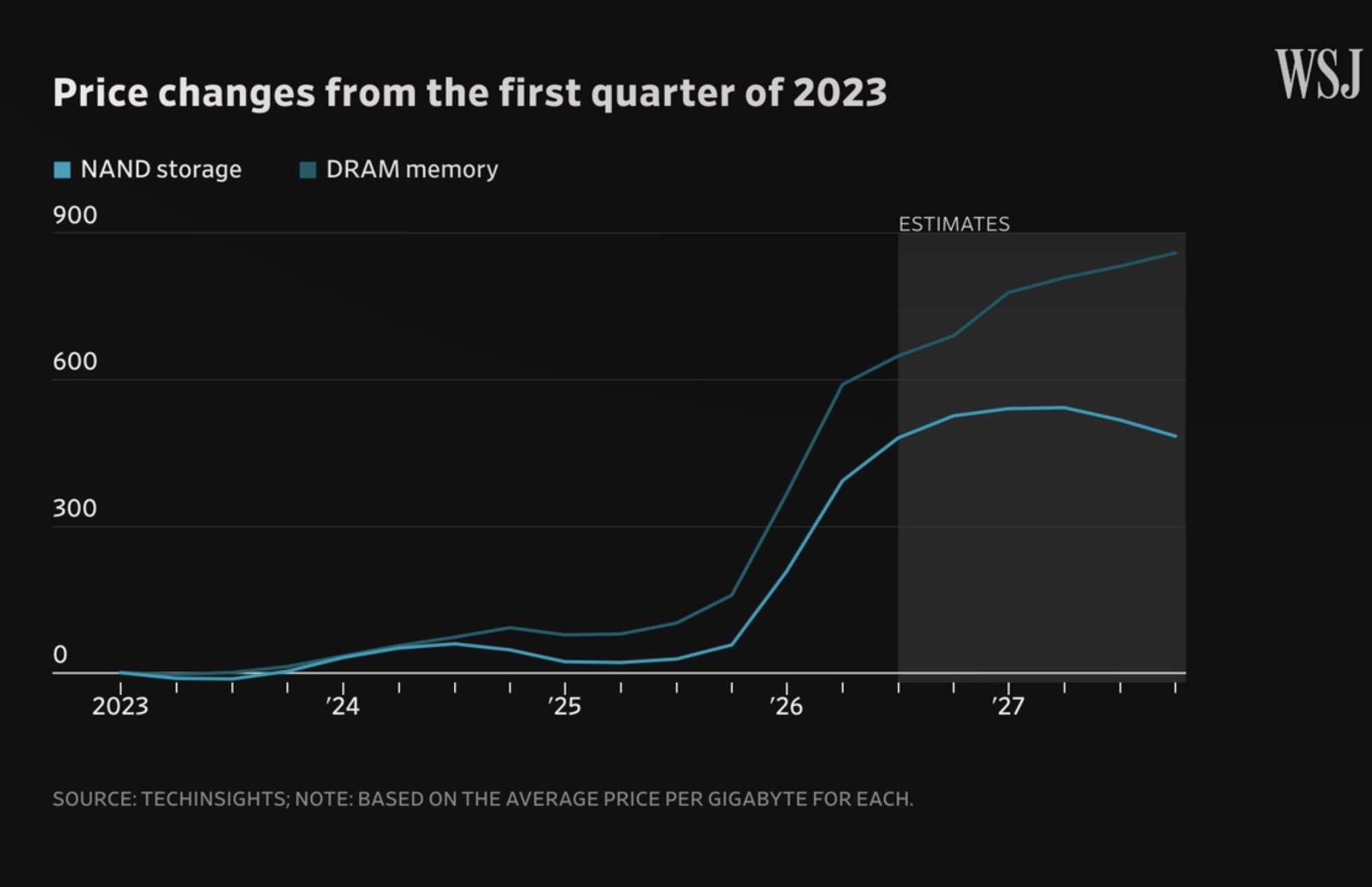
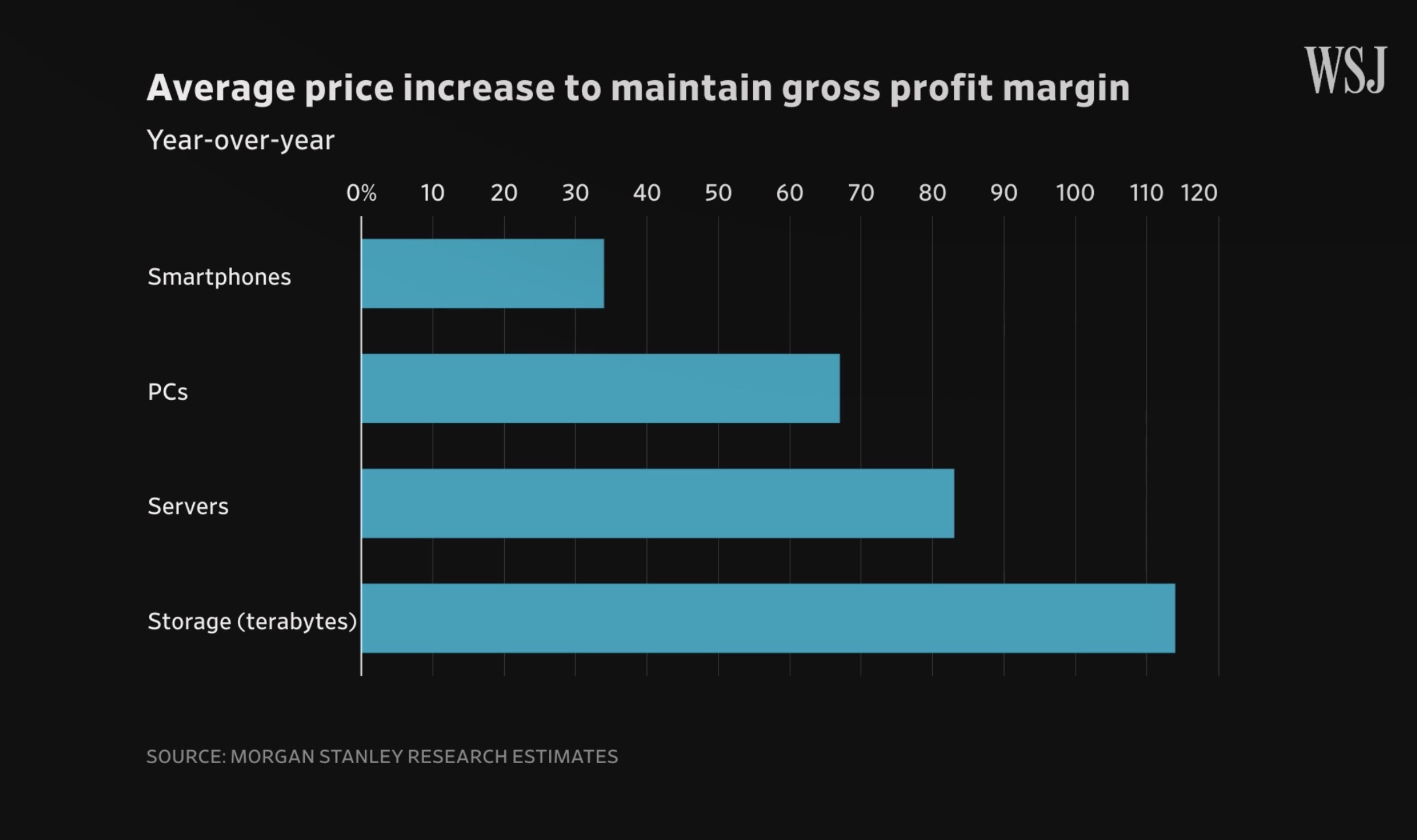
The Wall Street Journal states "Passing the higher cost on to consumers while maintaining its profit margin would add about $270 to the price of the next iPhone Pro model, estimates research firm TechInsights."
This is debatable.
Another estimate suggested that the increase in cost is about $140 per average iPhone. Passing that on without marking it up would obviously be less onerous. Margins would fall as a result but the cash flow would be largely unaffected.
But what isn't mentioned that these increases would also be worse for other vendors. A $140 or $270 increase on a $300 phone would be more dramatic, even impossible, as memory becomes unobtainable for smaller vendors.
This is a "100 year flood" and worse than tariffs and Covid. The cause is of course AI hardware demand which may ultimately be beneficial but the near term issue is that supply cannot be built quickly enough to meet demand.
How could the supply question be addressed? Apple has said they won't build memory as it's not something they are good at. But they might deploy cash, presumably to accelerate supply, as they have with other components. It's still a tenet of semiconductor business that all shortage is followed by a glut since supply reacts to demand with a delay. The problem is that the glut might not come until at least 2028.
4 comments
rbgayle ·
Great point about Apple accelerating supply lines, something few other companies can do (likely using some of that free cash flow ;-). For example, Apple has put money into GlobalWafer's plant in Texas, currently working its way up to 600,000 wafers a month. The 2nd phase will be online next year, so the entire facility will be producing over 1 million wafers a month. Apple gets those wafers if it wants because it invested in the plant.
And those wafers will be going to Apple suppliers like TSMC, TI, and maybe Intel now(maybe even some memory chip producers). To make the chips Apple needs. For years in the future.
Sacto Joe ·
What's really driving these prices up is demand, which is ultimately driven by the amount folks are willing to pay.
But Apple doesn't perfectly work that way. It could charge more for its devices, especially when they're in demand. In the past, it hasn't; it's tended to keep prices level and let increasing efficiencies drive up its profit.
But we are now seeing a big change in across-the-board inflation. A chunk of this is about that.
We just went through hell because of the last inflationary spiral, and once again we're getting reamed.
When will the stupid consumer wake up and realize that being hooked on hydrocarbon combustion is fleecing him, time and time again?!! When will they kick the hydrocarbon combustion drug peddlers like our present President to the curb?
How many lives have to be lost, shortened, or made miserable before the Sheep Look Up?
AAPL ·
@rbgayle, Global Foundries has a bedrock issue in Texas that's putting their plant and future plants in jeopardy. Chip making equipment needs to be secured into bedrock in the ground and there's a cement making factory being put in that's going to be an issue - crushing equipment makes a lot of vibrations that aren't good for GF.. Remains to be seen which factory will win out.
rbgayle ·
Looks like there is state legislation requiring seismic testing of the bedrock to see just how bad the vibrations will be. The kiln can't move forward until the legislature reviews the data. So the kiln is going to take a while before it gets going, if at all.