Only one in eight smartphone users uses a smartwatch. What's the problem?
by Horace Dediu
Apple grew at 21%. Global market grew 4% with forecast is 3% growth through 2030
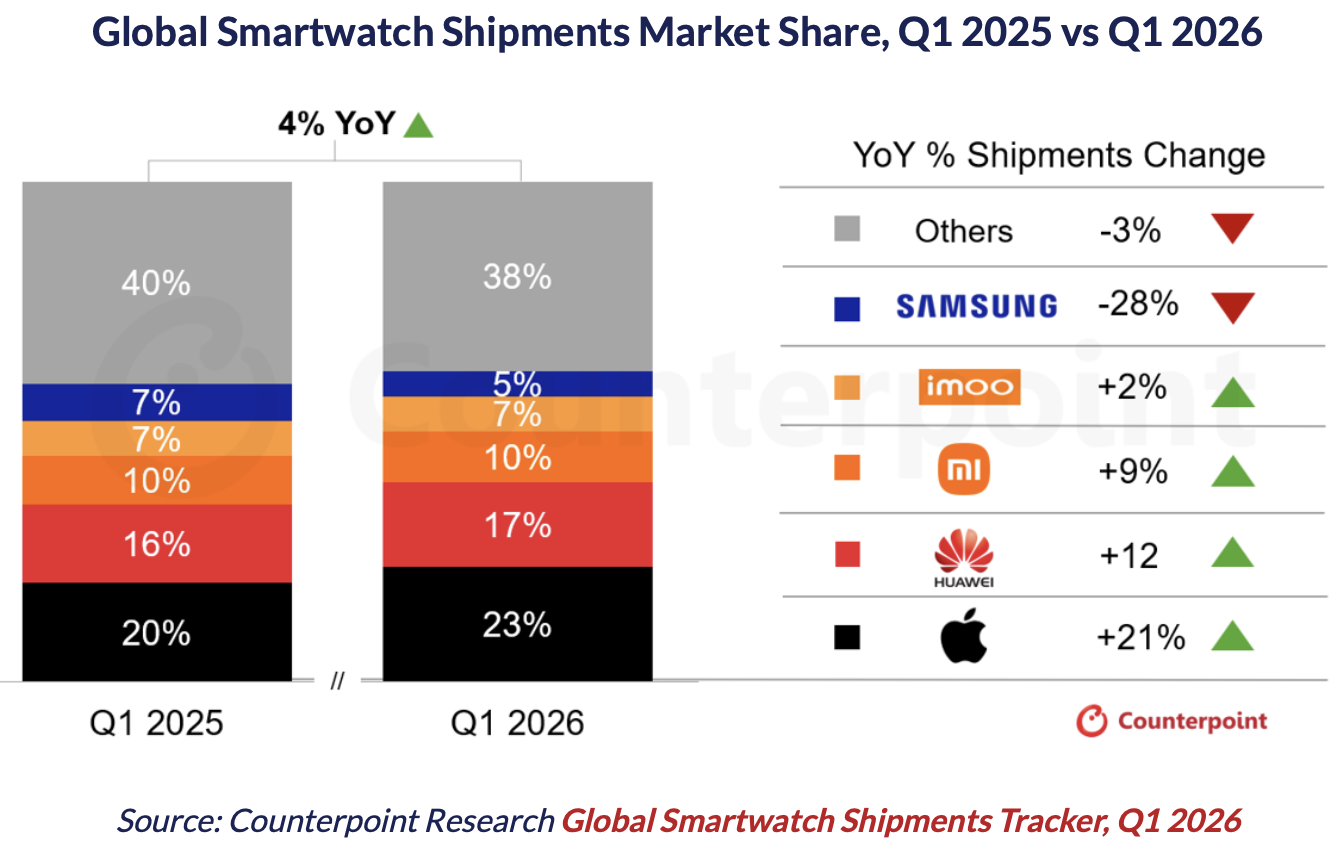
Global smartwatch shipments grew 4% YoY in Q1 2026, driven by continued Apple adoption and the China market’s recovery.
Apple shipments rose 21% YoY, the fastest growth among the Top 10 brands.
Following the extension of the Chinese Government’s electronics subsidy and the rise of local demand, Huawei and other Chinese brands regained momentum.
Rising memory prices are expected to have a more limited impact on smartwatches given their lower BoM costs.
Commenting on Apple’s performance, Counterpoint Research’s Principal Analyst Anshika Jain said, “Apple has captured the highest shipment share of 23% and emerged as the strongest performer in Q1 2026, driven by the continued success of its refreshed lineup. While North America contributed over half of the total shipments of Apple, China and Europe recorded the fastest growth for the brand. The addition of meaningful health upgrades and the affordable SE 3 attracted new buyers.”
Emphasizing the rising ASP, Jain added, “Smartwatches’ ASP rose by 6% YoY in Q1 2026. The major drivers were the integration of improved sensors and advanced technologies to support health monitoring and AI capabilities. In addition, consumers’ transition from basic smartwatches to advanced smartwatches in emerging markets like India is also driving the overall ASP growth.”
The smartwatch market regained momentum in 2025 after a slowdown in 2024. This recovery was driven by brands introducing a variety of new features, such as satellite connectivity, 5G RedCap, AI capabilities, and more advanced health tracking for conditions like sleep apnea and hypertension. This has helped build strong growth momentum in the market. However, recent memory shortages and macro-economic factors are expected to slightly impact the overall growth rate for 2026. Even so, the effect is likely to be less severe than in other consumer electronics segments, supported by comparatively higher margins in premium smartwatches. As a result, the smartwatch market is projected to grow at a CAGR of 3% through 2030.
Source: Counterpoint Research
NB: 3% growth through 2030 is no growth at all. Non-consumption is catastrophically high and yet Counterpoint projects zero growth over four year. Apple's share at 23% roughly matches smartphone share and that may be plausible however the market for watches is still modest relative to the phone market. Something does not add up. Here are the numbers…
…There are an estimated 650 million smartwatch users worldwide. That is super low relative to phones and even estimates that the user base is projected to surpass 740 million by 2029 seem weak. There are approximately 5.78 to 5.83 billion smartphone users making watch penetration by 2030 barely 12%.
Only one in eight smartphone users uses a smart watch. How can 3% growth be acceptable?
There is enormous headroom for Apple Watch and I believe penetration is proceeding at a measured pace (20% growth is above iPhone over longer periods). The opportunity, like that for the Mac, is to address non-users with a compelling new value proposition. Is AI such a proposition? Perhaps, though it will take years.
A more likely catalyst is still a "killer app" for health and wellness. It's cheaper than GLP-1 drugs and has more of a chance to change habits.
1 comment
deemery ·
For me at least, continuous blood sugar monitoring would be the Killer App. I don't like wearing a watch, but an Apple watch that does sugar monitoring would pay for itself in a year!