Counterpoint: Apple to Hit Record Market Shares in Smartphones, Laptops, Tablets; Watch Share Also Set to Grow
by Horace Dediu
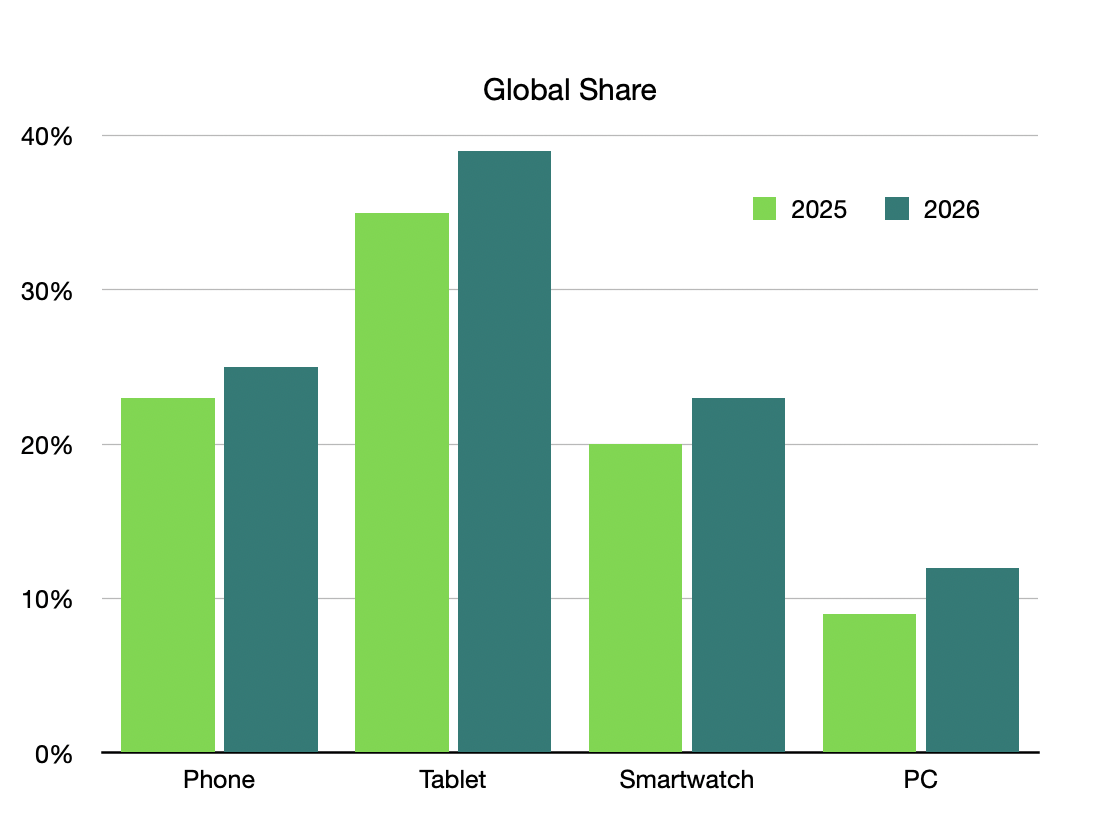
While most of the other OEMs are struggling, Apple, with its stable pricing, high margins and strong supply chain control, is in the best position to weather the memory crisis and win market share…
While most of the other OEMs are struggling, Apple, with its stable pricing, high margins and strong supply chain control, is in the best position to weather the memory crisis and win market share across key segments.Apple’s share increases in multiple categories also reflect the increasing strength of its ecosystem, with more premium users skewing towards Apple.
“This year defines Apple’s unique resilience within the industry. The multi-segment market share gains also mean a compounding impact on the company’s ecosystem strength. Apple is still gaining new users across categories, and it will become increasingly difficult for competitors to make an Apple user switch to their operating system.”
Apple’s iPhone shipments are likely to remain flat in 2026, while most of the other key OEMs will see double-digit declines. OEMs have to resort to price increases to sustain margins, but Apple has not raised iPhone prices yet. Premium segments have higher margins and can absorb more price shocks. At the same time, affluent consumers are less affected by price increases. Moreover, the iPhone 18 Pro series is expected to perform better than the iPhone 17 Pro series, and the iPhone 17 model is likely to continue its strong run in the absence of the iPhone 18 in 2026. As a result, Apple will reach its highest-ever share in the smartphone market in 2026 at around 25%.
The overall tablet market will also decline in 2026 due to inventory correction and memory shortages, but Apple is expected to grow, driven by an ongoing refresh cycle across its iPad portfolio and continued demand from emerging markets. Following the launch of the M5-powered iPad Pro in late 2025 and the iPad Air refresh earlier this year, Apple is expected to further strengthen its lineup with new base iPad and iPad mini models during the remainder of 2026. This broad refresh cycle should help Apple maintain consumer interest across multiple price tiers and better withstand the demand pressures affecting the wider tablet market, supporting further market-share gains.
Within the laptop segment, the MacBook Neo’s release will drive growth momentum in favor of Apple in 2026. Apple’s Mac shipments in 2026 will grow 23% YoY, while the overall laptop market will decline 11%. Compared to other OEMs, Apple will gain the highest percentage points of market share in the laptop segment in 2026. Within iPad and Mac as well, Apple’s share will reach its highest ever in 2026.
Smartwatches are less impacted by the memory crisis. The segment is expected to show 1% growth in 2026, with Apple growing faster than the overall segment, driven by full-year availability of the SE 3 and Watch Ultra 3 models. 2025 saw Apple’s first comprehensive portfolio refresh after 2022.
Another factor is the lowering of entry points in Apple’s ecosystem. Apple has already introduced affordable iPhone (e), watch (SE 3) and now Mac with the MacBook Neo. The company clearly wants to make its products accessible to the larger consumer base, and this is working more in its favor now as other OEMs increase prices in some segments driven by the surge in memory prices.
Apple’s share increases in multiple categories also reflect the increasing strength of its ecosystem, with more premium users skewing towards Apple. This will also mean a strong upgrade cycle for all these product categories in the future. Added to this is Apple Intelligence. At WWDC 2026, Apple showcased some strong use cases, especially for Apple Intelligence-backed Siri AI. If Apple delivers and evolves its AI landscape, it will act as a strong stickiness factor for the entire ecosystem.
Commenting on the role of Apple Intelligence, Principal Analyst Varun Mishra noted, “Apple holds the most important key, the user touchpoint across the most used devices on the planet. If delivered, a personalized Apple Intelligence will act as a strong ecosystem differentiator and unlock a new multi-device upgrade cycle for Apple.”
Source: Counterpoint Research
NB: This article was written before the price increase announced on the 25th of June. So pricing is not as "stable" as the article implies. Nevertheless, the conclusions are likely correct.
Share will grow as the effect of memory constraints will be far greater on competitors. To wit:
GoPro warned this month that it might go out of business after memory costs shot up between 80% and 115% at the end of the first quarter. And shares of speaker maker Sonos are down 23% this year as memory prices pressure margins."
Footnote: I remember when GoPro and Sonos were paraded as fantastic innovations that Apple could not hope to achieve.
More notable is that even with these high unit market shares, the share of users is significantly higher. Increasing the unit share will gradually translate in a more resilient user share in the long term. Users lead to increasing ecosystem, services and loyalty.
4 comments
deemery ·
Reading this, I realized the M5 iPad Pro would be a heluva great platform for handheld AI in an industrial setting. iPads are already pretty common. Imagine a mechanic (auto, aircraft, factory, etc) with an AI enabled diagnostic app. Or nurses using medical applications for diagnostics.... Even better when the iPad is networked with sensors and monitoring machines. We could see a rush of iPads built into devices for its exceptional AI performance.
Sacto Joe ·
Good point, David! Wouldn’t it be ironic if Apple ended up “saving” AI?
farshad ·
The problem here is that the Mechanic app supply chain seems to still be using DOS, at least per my personal observation.
I wonder if there is a market for bundling everything including the M5 iPad into an integrated offering.
deemery ·
I'm inclined to believe the current dependence on DOS across a lot of industry is because DOS/Windows systems are cheaper. But no one will execute AI on DOS, or on existing Windows hardware without significant upgrades.
What would it take to get the AI performance of an M5 iMac Pro on Windows hardware? And then how much would you have to worry about environmental - particularly cooling- characteristics in an industrial environment?
Thinking about my recent out-patient clinic experience (cataract surgery), the one advantage the Windows laptops had on carts with vital sign sensors, etc, was USB. iPad Pro has USB-C, of course, but I'm not sure if it's as easy to connect stuff to iPadOS as it is to Windows.