Capturing Eyespace: Plotting Apple's disruption of eyewear
by asymco-admin
Getting to 20% CAGR on Wearables
When Essilor merged with Luxottica in 2018 the eyewear market was $100 billion. In 2021 it was $150 billion. Last year it was $220 billion, this year it's estimated at $245 billion and in six years $463 billion.
Much of this growth is due to increases in Asia Pacific with 11.5% CAGR. The growth factors are improving competitiveness with non-consumption through expanding distribution mainly through retail and e-commerce. Technologies such as virtual try-on are enhancing accessibility, personalization, and purchasing experiences. Aging populations are also boosting demand for prescription eyewear.
EssilorLuxottica (EL) is an interesting case study as it represents a significant share of this total market. It’s also a useful proxy because it has a large overlap with segments Apple might target. EL operates in 150 countries, offers 150 brands, introduces 3500 eyewear models new every year, and has over 600 production facilities & optical labs. It sells 113 million prescription frames, 97 million non-prescription frames and 755 million solid and 79 million contact lenses per year. It distributes through 300k optical partners, 20k stores, 89 eye clinics and serves 500 million customers.
Through this, in 2025 it generated 28.5B€ revenues, at 16% gross margin, 11% net margin. Geographic segment revenues are shown below.
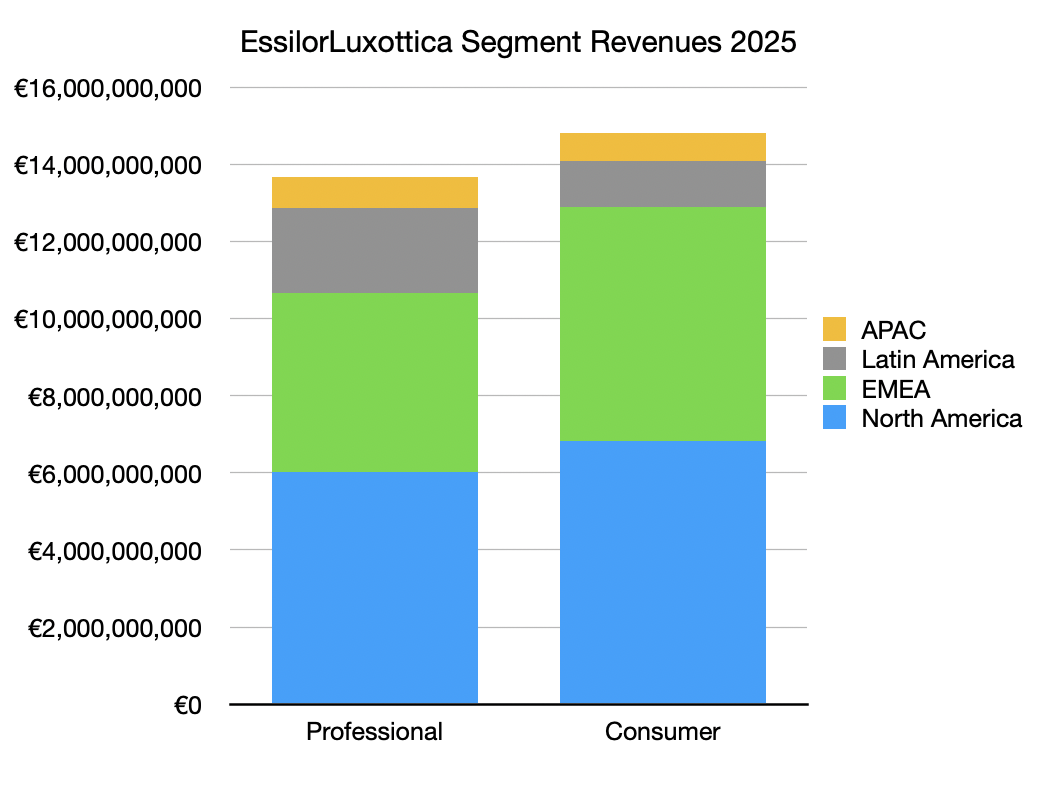
Additional consumer categories: 70% Prescription, 21% sunglasses, 6% AI glasses, 3% Apparel. In terms of consumer 77% is sold through Brick and Mortar retail.
There is a demographic overlap with Apple though they are far weaker in Asia (6% consumer sales). Distribution is also very fragmented as are its brands. Consumer sales are about $17B which I estimate is about the same as Apple Watch revenues.
On a unit basis i estimate that the wholesale average revenue per frame is $100, average revenue per lens pair is $50 and retail margins at 50% put average selling price per glasses of $300. Price ranges vary widely from $50 to $5000. The $300-$500 segment is expected to record the fastest growth from 2025 to 2030. This price structure allows the entry of a software-enabled frame+lens that is priced at what consumers are willing to pay but adding significant functionality—as long as style, aesthetic and social standards are met.
This suggests a similar opportunity for Apple to the watch market: approach the mid market and push incumbents into either low end or very high end while iterating rapidly on function and design.
Unlike the watch market, however the eyewear market is far bigger and growing much faster.
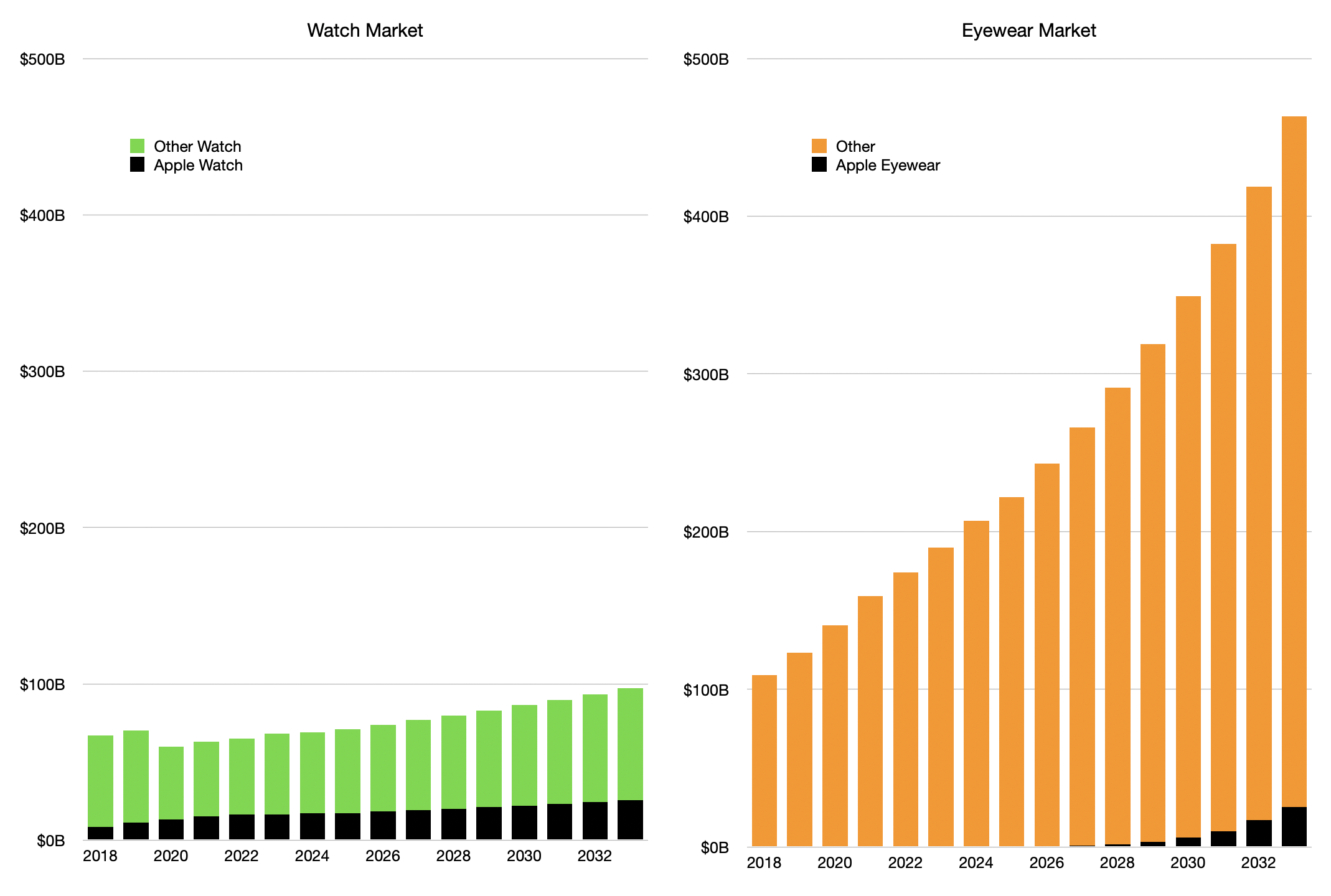
My estimates for both the watch market and the eyewear market (2018 to 2033) including Apple's share is shown below.
This scale suggests Apple eyewear could reach to be the same size as the Apple Watch by 2033 and each would be worth about $25 billion/yr.
By then Apple's share in the watch market would be about 25% but only 5% of the eyewear market. A substantial headroom exists where Apple eyewear could reach as much as $100 billion/yr.
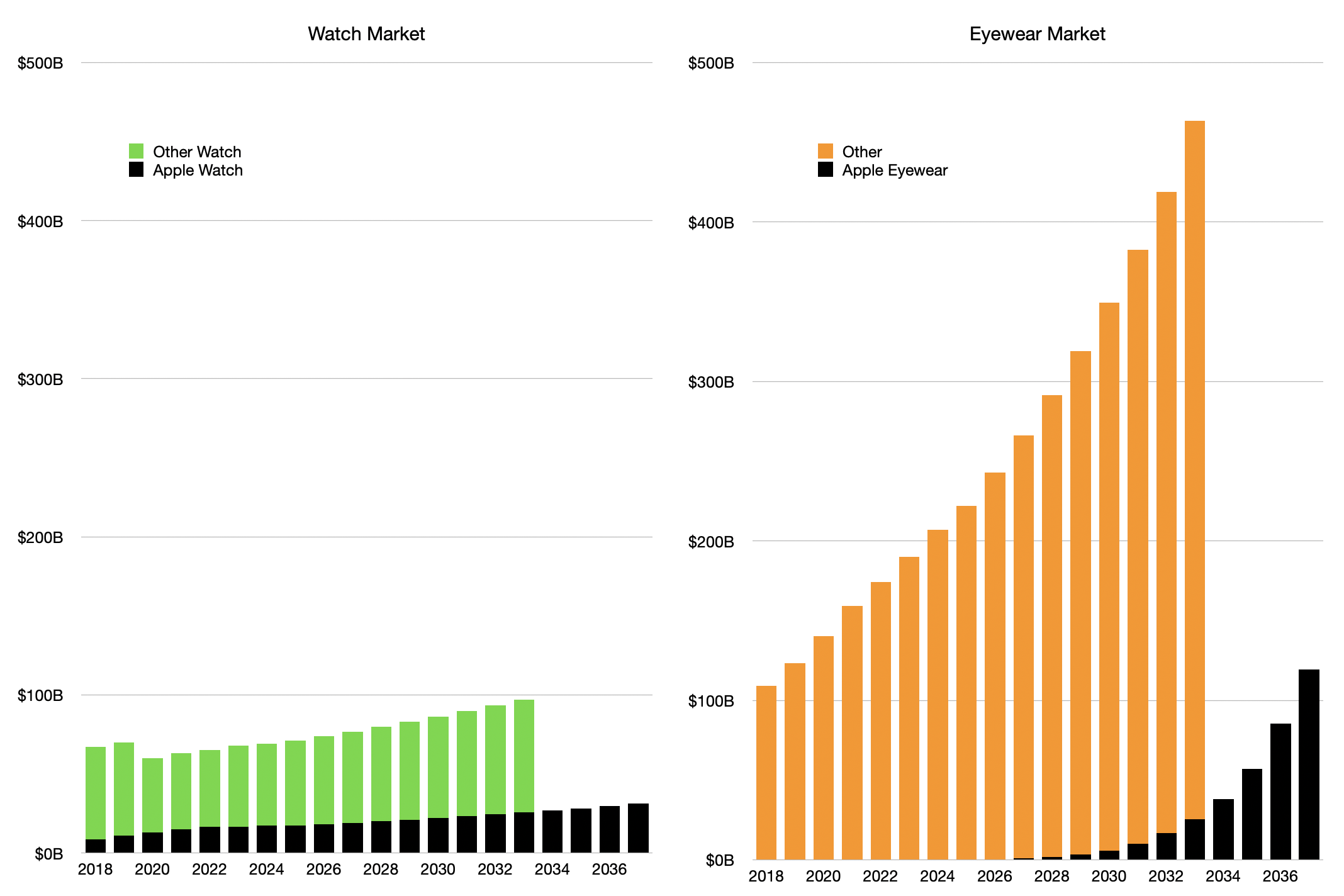
This is one of the reasons Spatial Computing is so strategic. By the time this opportunity arrives, vision computing technologies will allow the injection of software into eyeglasses that would solve incremental problems for many users on a continuous basis. We call this jobs-to-be-done and as display, input, and capture/sensing data will flood into the eyewear product, consumers will find new jobs to hire the products to do.
Overall Wearables should growth from $18billion/yr. today to $115 billion by 2035 sustaining a 20% compounding growth rate.
One important aspect here is not just competition with new features but with new customer experiences: virtual try-on, personalization, and purchasing options. The fact that 80% of the market is still brick-and-mortar and requires typically multiple visits is archaic. In addition there are many non-consumers. There is non-consumption for people who do not have an eye refractive condition (myopia, hyperopia, presbyopia), i.e. children and there are the underserved who may be unwilling to obtain glasses.
The conversion of 2.2 billion un-served is also worth considering1. When Apple watch arrived, many people had stopped wearing watches since timekeeping was always on their phones. The watch became an accessory to the phone and adoption increased. The same might happen with Apple eyewear. "Eyespace" is perhaps the most interesting and important wearable space after all.
- In 2018, an estimated 2.5 billion people, mostly in India, Africa, and China, lack access to eye tests and spectacles. This “visual divide,” as NGOs call it, is a significant global issue. Myopia and presbyopia, common in developing countries, are linked to high road deaths, low educational achievement, and poor factory productivity. Eye-health campaigners refer to it as the world’s largest untreated disability.
Comments