Why all-in and why all are in
by Horace Dediu
Take all my money, please.
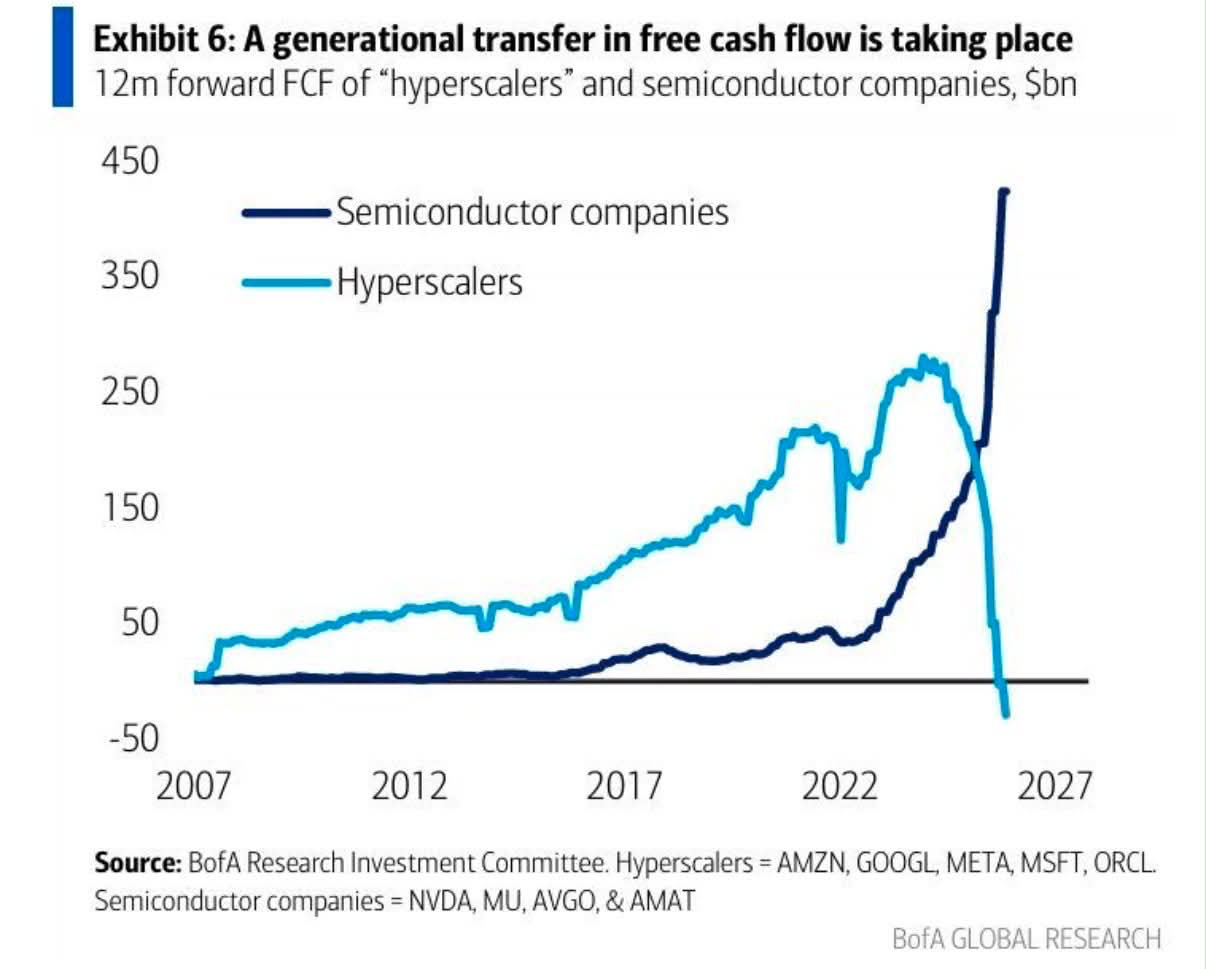
The graph above shows that Amazon, Alphabet, Meta, Microsoft and Oracle decided to transfer their shareholders' wealth to the shareholders of Nvidia, Micron, Broadcom and Applied materials1. This is not an exaggeration. Free cash flow is wealth and it belongs to shareholders. The transfer is real since the capital expenditures undertaken with this cash flow by these "hyperscalers" have gone directly to create unprecedented windfall profits for semiconductor companies. So much so that the companies receiving these windfalls are scrambling to give it to their shareholders (and employees.) And the scale is astonishing! These companies alone are moving hundreds of billion, more than the profits gained in the semiconductor businesses in decades.
Prof. Clayton Christensen had a theory he called "the dumb manager theory" to describe what most people use to explain why companies fail. According to this theory when a company is successful it's because its managers are smart. Conversely, when a company is failing it's because its managers are dumb. The problem with the theory is that it's usually the same managers who are there when a company succeeds as when it fails. Believing in the theory implies that you also believe that smart people can turn dumb. But you can't tell when and why this happens so determining success depends on your skill at psychoanalyzing managers.
The second problem with the theory is that when one company fails, many other companies in the same industry fail as well. Yes, Kodak failed to grasp digital photography and its management has been skewered for it. But so did Fujifilm in Japan and Agfa in Germany. Did all these managers get together at a dumb management conference and agree to do the same dumb things at the same time? Clay Christensen asked if it's possible that they colluded to fail. He noted that he's often heard of collusion in order to succeed but never of collusion to fail.
So the dumb manager theory of success and failure of businesses is problematic. When successful companies fail, it's not likely due to managers losing their competencies. Indeed, it may be because they are too competent.
Disruption theory holds that companies fail precisely because managers pay too close attention to targets that are no longer relevant. And the "collusion" aspect is that all managers become fixated on the same target at the same time because they are all trained in the same way. There is group-think but also group-obsession on metrics and best practices and theories of the market that no longer apply.
In the current wealth-transfer spectacle, managers at companies which are at the "top of the stack" offering complex, multi-faceted, multi-sided marketplaces of services to billions of consumers and businesses and advertiser customers through multiple channels of global distribution chose to give all they have2 to the "bottom of the stack" commodity semiconductor designers and manufacturers. The very businesses that they chose not to participate in and which a multitude of advisors, analysts and academics told them for decades are worthless metal benders.
This new logic is that by directing all their capital to the bottom of the stack they will ensure continuing success of their complex top-of-the-stack business.
The irony should not be lost on the reader.
It's not just a question of "what if they're wrong?" The paradox is why is the plunge so headlong, so reckless. I.e. why is it not calibrated to an abundance of evidence of returns on the risk taken and, moreover, why is the belief so universally held.
In other words, why all-in and why all are in.
Of course, there is one anomaly: Not "all" are in. Apple is not all-in and it's the only one of the Magnificent 7 that is conspicuously hedging on this wealth transfer.
Apple may be the anomaly that answers the paradox. The reason Apple stayed out will not be found in the "wise manager theory" of avoiding failure.
Apple preserved its shareholders' wealth because they focused on their customers. (Yes, quite an anticlimax.)
They did not have data centers to serve ads and sell capacity to businesses. They did not assume that customers' data is a commodity to be traded. They worried about privacy and quality of experience. They had to convince each buyer to decide to buy individually. In other words, they had a very simple business model: sell things to people who decide to buy because it works for them.
But it required a complex execution. They had an integrated business: from retail to distribution to manufacturing and all the way to silicon. They did not sit only at the top of the stack. They sat at the bottom of the stack too. And in the middle. They were aware of the power of silicon and of hardware and of operating systems, APIs, design and everything in between.
Having this perspective on their own business and customers, making all-in bets on a single technology that may be vulnerable to rapid commoditization3 seemed unwise. When everyone was throwing everything at "infrastructure" they looked at their own infrastructure and asked what the big deal was. When all the "compute" spending went to Nvidia, Apple asked why can't we just build our own, 1000x more processors? When projections of infinite revenues were made Apple asked where it would come from and how will it be segmented and justified and how exactly will consumers benefit and pay for it.
The head scratching was seen as foolishness or foot dragging or fatal delays but it was genuine prudence. The more alone Apple was the more it was accused of stupidity. Au contraire! The suspicion should have been on the "group" making wild bets not on the skeptic sitting on his hands. Always be suspicious of beliefs in miracles and especially of any consensus in them. But that is how markets work. Overreaction is axiomatic; disillusionment guaranteed.
- Not included are the capital flows from investors in OpenAI, Anthropic and SpaceX and recipients such as Samsung and LG and a multitude of data center suppliers.
- All the current cash flow is gone, next comes the process of going into debt and thus giving up what they might get in the form of future cash flows.
- Open source/Chinese models will clearly be good enough.
5 comments
deemery ·
The obvious question is "What happens when the big guys run out of (borrowed) money?" That's not just a question for OpenAI, et.al., but also a question for NVIDIA.
FredHS ·
Brilliant.
Apple wins Inference with high-volume chips following some derivative of Moore's law. In sharp contrast hyper scalars race to an illusory 'winner take all' training "top".
Sisyphus?
More: Both training and inference enjoy bullish forecasts. Back in March 26, WSJ shows inference CAGR is higher, surpassing training this year and soon to be 2 x training revenue. Apple with the best device sovereign inference wins the consumer piece with improved cash flow.
Baltra may open a pro/enterprise inference market segment. Duly noted - enterprise sales does not fit Apple so well.
FredHS ·
The market seems to 'get it'.
Hence AAPL up vs hyper scalars and their suppliers with 75%+ margins getting hit.
asymco-admin ·
The other big news is the release of Kimi, an open AI alternative from Moonshot, a Chinese company. The quality seems to be more than good enough and the cost is a few zeros less. The pressure from good enough AI continues to be relentless.
asymco-admin ·
The market is swinging all over the place. Quite unsettling.