One in three phones sold in Europe is now an iPhone
by Horace Dediu
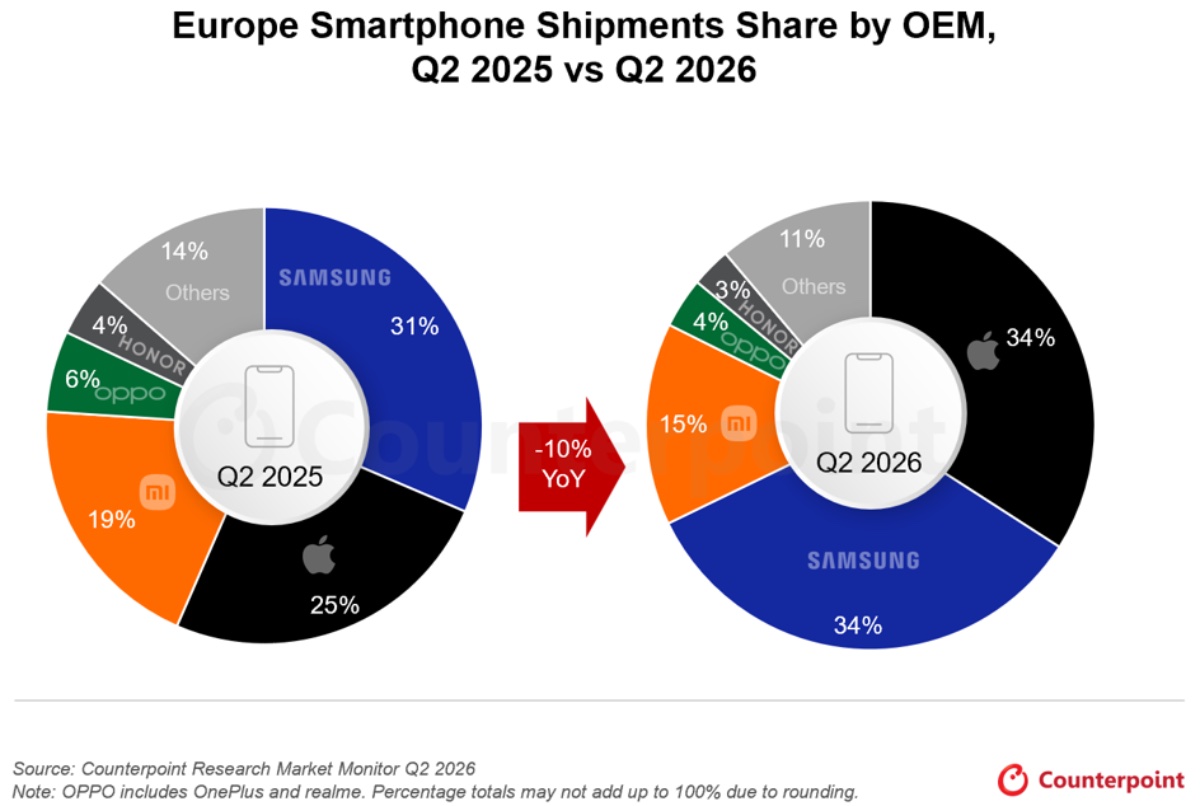
As the market shrinks, Apple now has 34% of Europe’s smartphone market
Europe’s smartphone market took a further tumble in quarter two (Q2) of 2026 with shipments falling 10% year-over-year (YoY) to 35 million units, the region’s weakest second-quarter tally in three years, according to Counterpoint Research’s Q2 2026 Smartphone Market Monitor.
However, it was good news for the iPhone. Apple increased its smartphone market share in Europe to 34% as of the second quarter of 2026. That compares to 31% in the second quarter of 2025.
Apple is tied with Samsung, which also has 34% of Europe’s smartphone market.
“It continues to be a very challenging time for the Europen smartphone market,” Counterpoint Associate Director Jan Stryjak. “An uncertain financial outlook across much of the region means consumers remain hesitant to make discretionary purchases, which is not being helped by the widespread lack of promotions as manufacturers looked to protect margins. In Q2 2026, things were relatively better in Western Europe where a very impressive quarter by Apple and marginal growth by Samsung softened the drop, although Eastern Europe suffered a significant decline as budget segments were squeezed and most Chinese manufacturers struggled.”
Source: Apple World Today
NB: This phenomenon is more than one quarter in duration. Counterpoint expect further declines over the next few quarters, especially for lower-end players. Indeed, they expect Apple to outperform the market "for the foreseeable future".
It's still hard to say if the market is permanently affected by this component shortage. Unlike previous perturbations, the effect today might be that it will make the phone industry unattractive to many current incumbents to the point of causing an exit. This would not be the first time.
It seems that Apple and Samsung are the only ones thriving in the market. Samsung benefiting more from the components business than from the complete phone product. As I mentioned in previous dispatches, the market is cracking. Whether is breaks altogether remains uncertain.
One possibility is that 2/3 of the incumbents call it quits and exit but at the same time a new set of entrants wade in. The entrants may see an opportunity with new form factors such as AI-based wearables, though they would be not-quite-a-phone.
Historically we might look back on 2026 as the year that the phone market cracked and the transition to wearable computing took off.
Of course, Apple is energized by this transition because it was never a phone company to begin with.
6 comments
deemery ·
It will be interesting to see if iPhone growth has any impact on Eurocrat attacks on Apple... I could argue it both ways: (+) Apple's ability to differentiate its product line increases. (-) Apple's limitations driven by the EU rules, along with the price differential, holds Apple back. :-) :-)
FredHS ·
iPhone actually takes more share when counting used iPhones.
No doubt the increase in share of new iPhones stems from price increases due to memory cost for Android, which causes Android owners to either defer purchases or switch to new or used iPhones.
Sacto Joe ·
Hi, David,
Please see https://apple.news/A37SuA3tjPRm9tPtSUEx6LA
Per this Daring Fireball story, it’s the EU citizens that are losing, thanks to the self-interest of the EU buteaucracy.
Sacto Joe ·
Hi, Fred. Good point about market share vs installed base!
The EU bureaucratic pirates are in danger of facing the wrath of EU Apple users. Maybe they’re finally beginning to feel the heat….
deemery ·
It's the EU citizens who -will lose-, but it's not clear how current owners and potential buyers of iPhones will react. Gruber does a good job laying down the impacts, but not the consequences from those impacts.
ianandbike ·
Is there an error in the article commentary? It says “Apple increased its smartphone market share in Europe to 34% as of the second quarter of 2026. That compares to 31% in the second quarter of 2025.” But the graphic showed Apple at 25% in 2025 and Samsung at 31%. Both are now at 34% (so they say). 31->34% in a market dropping 10% is about flatlining. 25->34% in the same market IS significant growth. So it matters a lot. Or maybe I misread something?