The Freshman Register
by Horace Dediu
Social media is no longer social. What now?
In 2004, a frenzy spread across Harvard Yard in days. Four billion users later, we are only just catching up.
Harvard itself had planned to publish a college-wide digital version of a student registry along the lines of The Freshman Register, the physical book handed out to all first-year students, who traditionally used it to scour each other’s high school photos for the purposes of icebreaking and dating potential. (“The Face Book” was the informal name for that book on campus.)
[…]on the first day, 650 users logged on; two weeks later, it was 4,300, including a few alumni and even fewer faculty members. A month later, Thefacebook had spread to other, carefully chosen, colleges—Columbia, Stanford, and Yale—and had signed up 10,000 people. Harvard’s users alone had viewed individual profiles 1.5 million times in less than a month, at a time when profile viewing was still the main activity.
Source: Harvard Magazine
NB:
Social Media has grown to be one of the primary activities consuming the most time on all devices, Apple's included. A majority of news, entertainment and communications has moved to these products and therefore their impact on how advertising and content are created has been permanently altered. Social Media takes up the largest share of total screen time. Instagram, TikTok, Facebook: 3+ hours. WhatsApp, Messages, Telegram: 2+ hours. YouTube, Netflix, Amazon Prime: 2 hours. Thus, if we include short video and messaging, social media could take more than 4 hours per day for the average user.
However, after a mere 22 years it seems that the thesis of Social Media has all but disappeared. It's no longer "Social" but rather "Algorithmic" Media. As conceived, the content seen by social media users was generated by other users--it was peer-to-peer. Driven by curiosity about social cohorts, initially classmates, later friends and family and, later still, semi-professional creators.
Today what one sees on social media rarely includes content from friends, family, classmates, or even the people you chose to follow. This transition been hard to notice mainly because the changed come gradually and subtly, but considering how people use the products, it began to change already more than seven years ago, with TikTok.
At first glance, social media seems stronger than ever. There are 22 billion active accounts across the top 20 "platforms"1. The ranking is shown below.
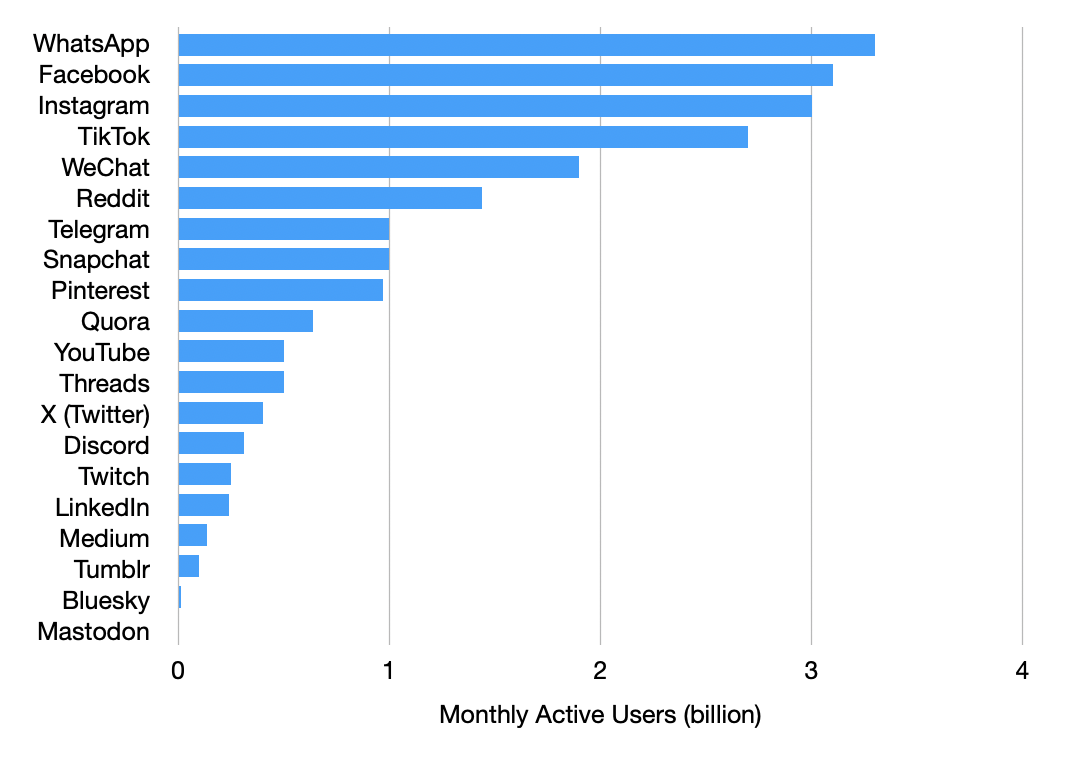
Ownership of these platforms is not self-evident so I also combined them into this chart.
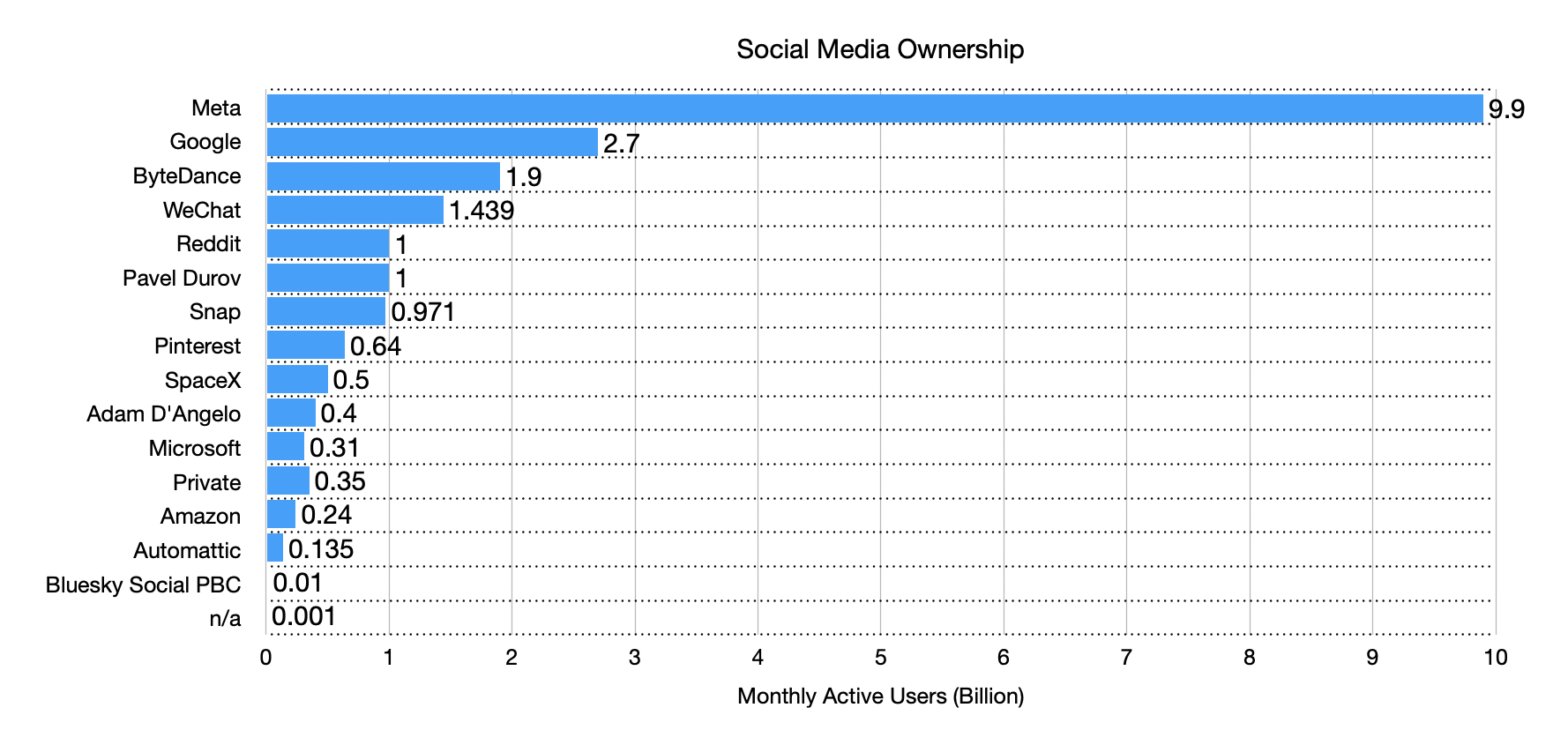
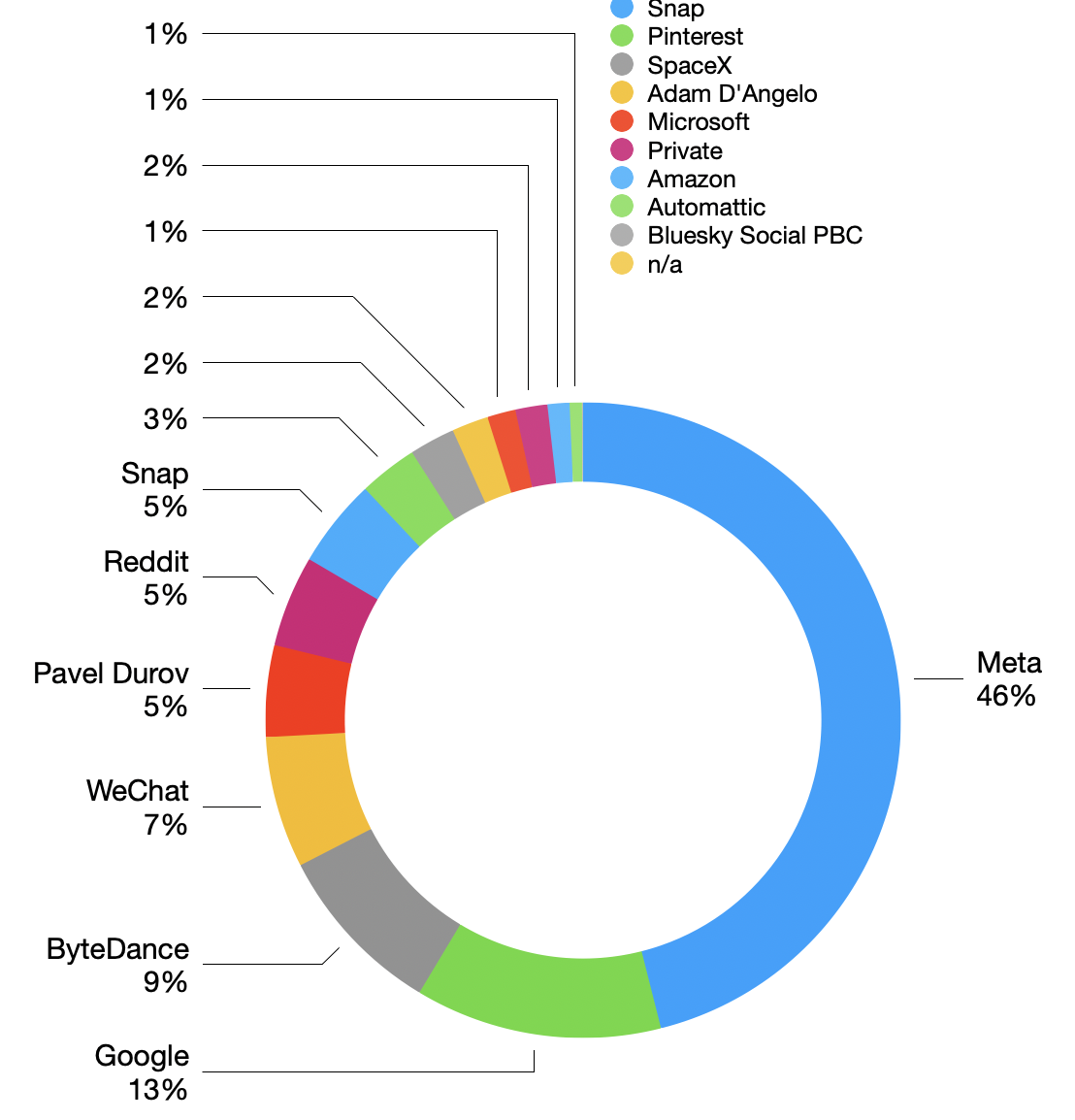
Meta holds about half of the monthly active user account (MAUs). The other interests are, roughly, Google, China (ByteDance and WeChat), modest-sized public companies, private companies and even individuals. Some non-profit or decentralized organizations also bring up the rear.
If taking a market value point of view (market capitalization per MAU) the clusters show up as follows:
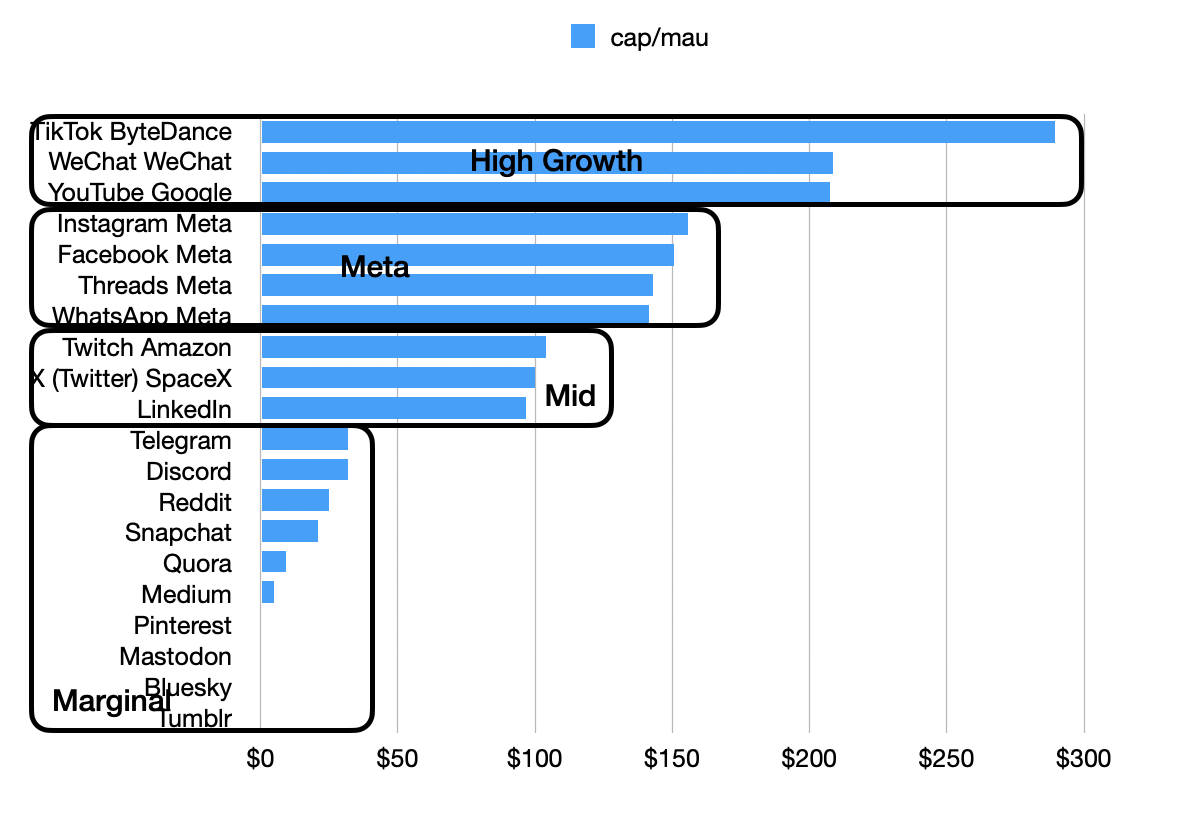
A MAU is worth between $100 and $250 in net present value. Notable outliers are TikTok at $300/MAU on the upper end and the marginal players shown at below $50/MAU. The main difference in value seems to be the rate of growth.
Meta however is a good proxy for the entire space. Not just because it was the "OG" or first mainstream success with Facebook but also because it has morphed itself through acquisitions and replication to get onto the trends that resonate. Messaging (buying WhatsApp), photos (copying Snap with Instagram), short video (replicating TikTok), and Threads (replicating short text Twitter) are all invented elsewhere.
Thus observing Meta, one can't help but see how the "media" usage has shifted. It's anecdotal but one hears that Facebook demographics aged in North America and Europe, but still young in much of South Asia and Africa. FB is seen as "best for B2C with mature audiences, local businesses, and ad spend (Facebook Ads remain one of the most sophisticated targeting platforms anywhere). Organic reach for pages is low, but the platform's reach for paid distribution is unmatched."
Meanwhile, Instagram demographics center on millennials and Gen Z with Reels now the primary growth engine. E-commerce integration via Shopping makes it best for "B2C, lifestyle brands, and personal brands with a visual aesthetic."
Threads has grown faster than expected (equaling the usage of Twitter/X after only three years, by leveraging Instagram's social graph.) Its algorithm is still being tuned — chronological-leaning feeds with discovery boosts.
And this is the clue: "the algorithm" determines what people see. It's what creators live and die on. It's what determines virality. This algorithmic distribution has spread to YouTube and back to X, both of which offered, by default, followed content first and "suggestions" only as an option.
Today followers don't matter because users are no longer given what they follow by default. The odds of a follower seeing what a creator posts are insignificant.
This is all in pursuit of "engagement" or screen time. It works. Usage is up, addiction is up and dopamine is up.
However it's also corrosive. For all the new type of scrolling induced, the sense of satisfaction with the medium is dropping. It results in a sense of loss at the end and regret. It exhausts and irritates and preys on what we used to call vices.
More than a decade ago I posited that each social media is positioned on one of the seven deadly sins. In the standard list, the seven deadly sins according to the Catholic Church are pride, envy, wrath, gluttony, lust, sloth, and greed. Which media went with which sin is left as a fun exercise.
It was a tongue-in-cheek post but over time it became reality. The media seemed to be designed to "trigger" rather than inform or relax the user. Even if not intentional, an algorithm "learns" that negative emotions are more valuable than positive. This is a biological necessity: threats are more important than comforts and we evolved to pay more attention to them.
I believe that as the rush to maximally trigger users, the corrosion will ultimately undermine the businesses.
For this reason Meta is finding itself is a difficult business proposition. The ads are working but the audience is exhausted and the regulators and lawsuits keep pouncing. Meta today trades at a P/E of 20 and a 50% return over five years (compare with e.g. Google at 144% or Apple at 110%).
What comes next?
The algorithm is likely to move beyond heuristics. If we look at the methods uses so far, starting with TikTok, it seems that the rules were very basic: dwell time, categorization, engagement triggers such as like, comment and subscribe indicate what the user likes. Provide more and more of the signals that resonate. These were the result of trials and errors with a simple optimization in mind.
This is a slippery slope to a glut of stimulus.
The way this overshoots is with AI. More and more study of what people respond to leads to a perfect picture of the person's psyche. But there lies the problem. This is the formulation of narcotics and how they create undesirable dependencies.
It may be all right to addict billions of people but it does not last. Addiction with no lasting benefit will ultimately be regulated. This happened with alcohol and tobacco and other narcotics. Society realizes that these are to be managed if not banned. People recognize that they are being manipulated and turn to some form of authority to help them from themselves.
The future of the misnamed social media may be that it becomes treated as a controlled substance. The tobacco of the current century. It has so far evolved too rapidly to be controlled but attempts to do so will continue.
Turbocharging it with AI will not convince us that it is becoming more beneficial but rather the opposite.
The evidence of this aversion to the model is shown in the valuation of the companies involved. They are starting to reek of malfeasance and are not particularly desirable by capital.
- I use the term loosely since, as Bill Gates once pointed out, a platform isn't valid unless the participants "on top" of it make more profits than the platform itself. A social media platform should benefit its content creators more than it benefits itself, perhaps in a 5:1 ratio. That certainly does not seem to be the case for the typical creator platforms. This is in contrast to software platforms such as Windows and iOS where there is more economic activity that is created and not even touched by the platform.
1 comment
Sacto Joe ·
Morning, Horace. I posted this on Apple 3.0 in its entirety (without the charts, of course).
This is one of your most important works, and it deserves much larger readership.
Also, I hope it plugs your Asymco One service. Just in general, you truly need to be read much farther and wider.
Joseph Bland, aka Sacto Joe