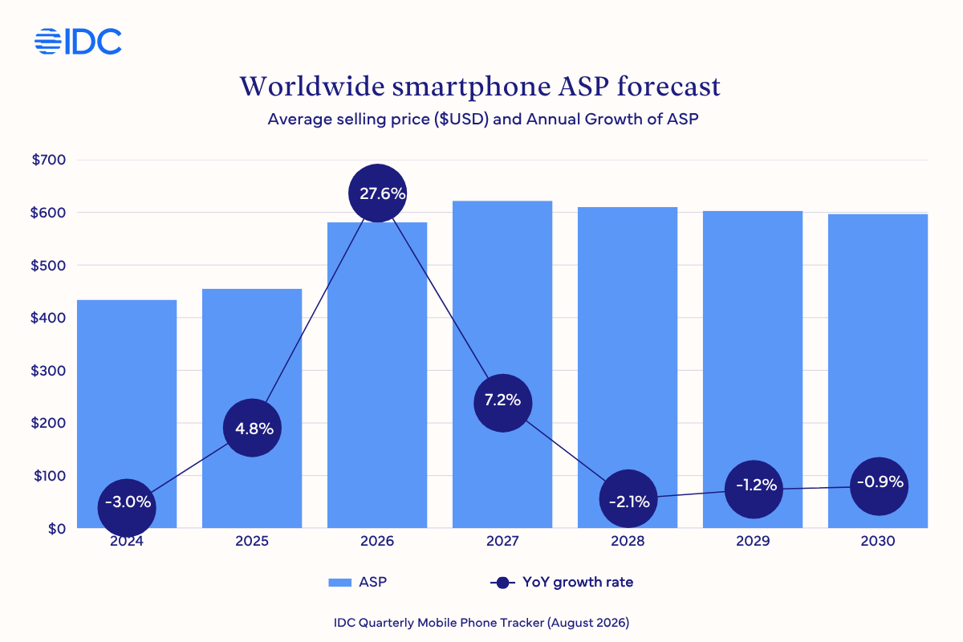
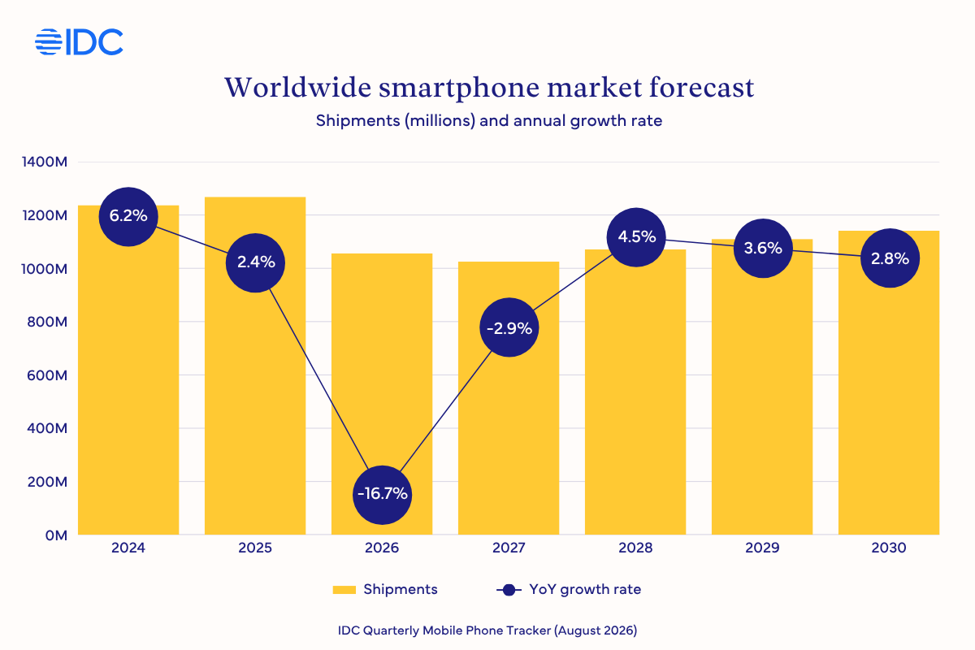
IDC lowers smartphone market volume estimates again: Now down 16.7%, lowered from previous estimate of down 13.9%. ASPs to rise 27%.
by Horace Dediu
The era of the cheap smartphone has ended
Highly anticipated foldable launches from Apple and Huawei Technologies next week are expected to offer a much-needed lifeline to a subdued global smartphone market, which is bracing for an estimated 17 per cent decline in 2026.
Analysts are counting on Apple’s foldable debut to lift a sluggish smartphone sector reeling from soaring component costs.
“Apple’s entry into the foldable market has done more than reignite growth in a category that was losing momentum,” Nabila Popal, senior research director at research firm IDC, said on Wednesday. “It has fundamentally altered the market’s trajectory.”
Popal projected that Apple would ship more than 17 million foldable iPhones by 2027, capturing about 40 per cent of the global foldable market.
“Apple is positioned to challenge Huawei and Samsung for leadership in markets where they have long dominated – an extraordinary outcome for a product expected to be less than two years into its life cycle,” Popal said.
Global smartphone shipments are expected to fall 16.7 per cent this year, which would mark their steepest annual contraction on record, according to IDC’s latest report. The forecast is down from the research firm’s previous estimate of a 13.9 per cent decline, issued last quarter.
“The memory tsunami that we warned about is now hitting the market in full, and consumers are starting to pay the AI bill,” said Francisco Jeronimo, vice-president for worldwide client devices at IDC. “The era of the cheap smartphone has ended."
“From here, the winners will be the vendors with the scale and supply leverage to hold demand at prices consumers have never had to pay before.”
Source: https://stocks.apple.com/ACvhd8-EKTWW8B7IQLPHQHg
NB: Second half of 2026 shipments are expected to fall by more than 27%. ASP is forecast to rise 27% to $581 this year (revised from $550). The IDC view that Apple will shake up the foldable market is a mistaken understanding of how markets are created.
There is no "foldable market" since the market is not defined by form factor or particular mechanism of operation. There is no "thin phone" market or "touch ID" market. The market is delineated by iOS vs. Android with significant fragmentation within Android between OS variants but also between vendors and their distribution partnerships. It is then sub-divided by price and jobs to be done.
The possibility that Apple will launch a foldable means that Apple will create the market for iOS folding phones. That market currently has a size of zero. Its potential size remains to be determined but it probably has been estimated by Apple on the basis of their knowledge of their customer base.
The second aspect of this article is on the change in IDC's estimate for the year. This is not a change in thesis but on the scale of the decline in volumes and increase in pricing.
"Smaller Android brands anchored in the entry tiers face the hardest stretch in the industry’s history, and some will not clear it. The market that emerges on the other side of the crisis, when the memory supply finally stabilizes in 2028, will be smaller in units, larger in value, and far more concentrated at the top. The cheap smartphone era is not pausing. It is over."
The idea that a mature market enters a "post low-end phase" or the end of the cheap smartphone is a development that needs far deeper consideration.
I will address this in a research note separately.
1 comment
Sacto Joe ·
"The idea that a mature market enters a “post low-end phase” or the end of the cheap smartphone is a development that needs far deeper consideration."
Deep consideration of anything Apple-related is uncommon, present company excepted.
The bottom line is that folks are going to be "stranded" with lower quality and unsupported "smartphones" just as AI's ability to pirate individual's personal information comes online.
But what would one expect when everyone but Apple has a business plan based on stealing? Heck, those developing these massive data centers are expecting to get paid back on the backs of that pirated personal information - very much including the pirated data that has given these AI creations all their "power" in the first place!