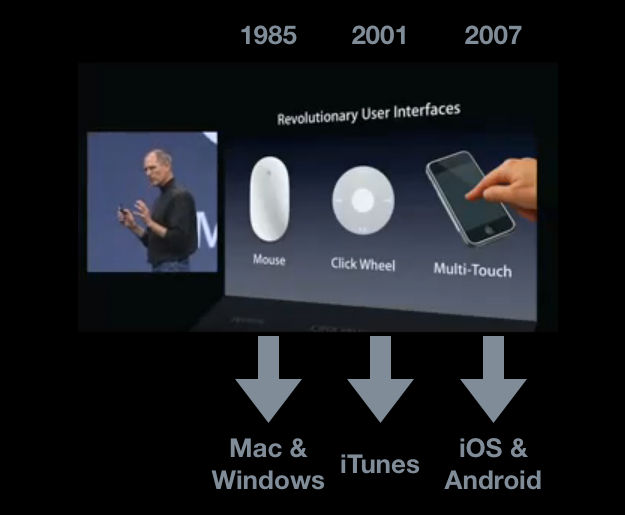
My hypothesis is that The Primary Cause for the shift of profits from Incumbents to Entrants has been the disruptive impact of a new input method.
It was a description of what I considered to be the "disruptive technology" which caused incumbents which had a "front-row seat" to the future of their industry to be completely displaced and marginalized by an entrant ((later more than one)) with no discernible right to do what they did.
I illustrated what underpinned the sea change in the phone business via the slide that Steve Jobs used in the iPhone launch event:
I added the years when each input method was introduced and the platform/ecosystems created as a result. These new ecosystems were the primary cause for dramatic industry-sized shifts in profits.
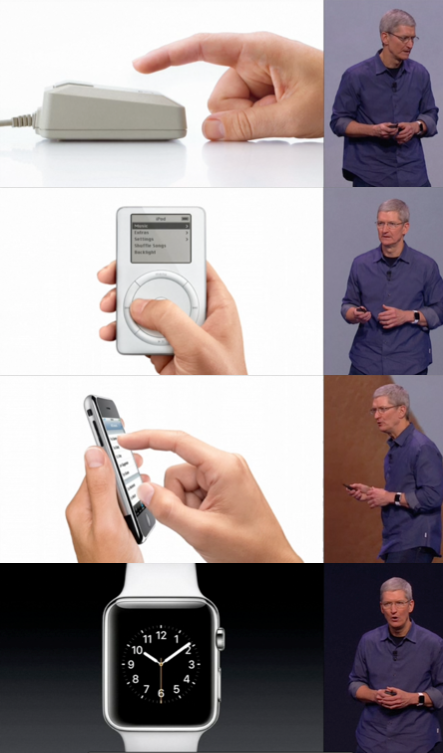
Not coincidentally, during the 2014 Apple Watch launch, the presentation began ((Begins one hour into the 2 hour downloadable video)) with a re-telling of the "mouse, click wheel and Multi-Touch" story.
Seven years later, the difference is that there is a new object added to the story. It answers the question that has been on my mind since that first post on revolutionary user interfaces was written: what will come next.
Now that we have an answer, the next step is to understand the new platform, its ecosystem; which industry will be affected and which incumbents will be displaced and to what degree will value be created beyond that which will be displaced.
Anders Brownworth and Horace Preview of Apples September 2014 special event. We focus on how Apparel gets disrupted. We also wrap the Creativity, Inc. book review.
The bank robber Willie Sutton did not say, when asked why he robbed banks, "because that's where the money is." He did agree with the idea however saying "Go where the money is...and go there often".
Regardless of it being apocryphal, this idea came to be called Sutton's Law and is often taught to medical students. It's similar to the notion of Occam's Razor: when an obvious or simple answer competes with an obscure or complicated answer, pick the obvious one first.
These are sound analytical rules of thumb. When thinking about what products and services could arise in the immediate future, those most obvious and with fewest assumptions should be put forward first. The what part is relatively easy. The tough question is more about when will they emerge?
We now know that Apple will announce new products on September 9th ((I'll be there and will report via Twitter and a special session of The Critical Path podcast)). This gives us an idea of when something will happen, answering the tougher question. It leaves the simpler question of what will emerge.
I put forward my predictions as follows:
Regarding iPhone, a tweet on product mix and pricing.
Regarding an "iWatch", an answer to a question from Eric Jackson.
Regarding the potential for wearables, a post on the subject.
One more item has surfaced on the potential of payments processing which I want to address now.
Handling payments, to me, is a perfectly plausible activity for Apple mostly because the company has made quite a few comments on the value of their "customers with credit cards" and the effort that went into Touch ID (which seems to be extravagant relative to the value of rapid unlocking).
But one word of caution: if Apple does enable payments it's important to realize that being a (payment) bit pipe is not a particularly profitable business. It will undoubtedly bind value to the iOS devices which make it possible, but I don't think there will be a direct capture of profit from the transactions themselves.
Profit needs to be in proportion to the value delivered. When that value is marginal convenience it is worth something but it's not a huge something. It is a marginal something.
You might disagree pointing out that payments are big business and banking bigger still. But those businesses are not hired to simply funnel low friction payments around. They are proxies for trust and complex risk management. ((Nota bene: this trust could be commoditized with crypto currencies and blockchain technology making these giant businesses perilously smaller.))
So for a company that facilitates the payment clearing system, the margins are likely to be very thin and with costs being non-zero it may be nearly a wash. The real impact of the decision to support payments will be in the aura surrounding the iOS ecosystem. An aura which will glow intensely.
The idea of untold riches coming from "being in the payments business" is rather like the bank robber's dream of being where the money is. It is tempting to think that handling lots of money must result in wealth. However consider the value of Brink's. Net income of $57 million on $4 billion revenues and $1.3 billion market cap.
Reality is that wealth comes from the creation of value not from its transport.
One of the paradoxes of the "post-industrial" era is the aversion to application of capital to growth opportunities. Generally speaking, capital has become trapped in bank accounts as opposed to equipment which could be used to produce value. This aversion is rooted in many dysfunctions, chief among them being the misunderstanding of the purpose of the firm.
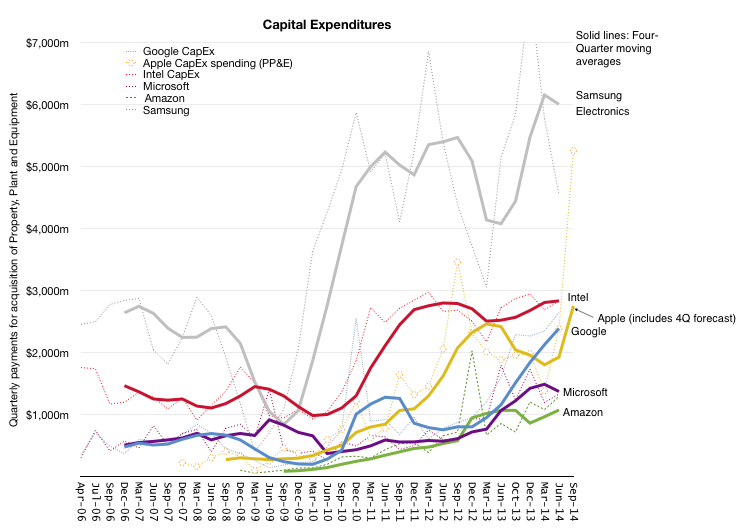
But there are exceptions. Illustrated below are the patterns of spending in property plant and equipment (capital expenditures) by companies that still recognize that there are opportunities to be obtained by investment in the means of production.
The highest spenders in this cohort are Samsung and Intel, both of whom spend mainly on semiconductor production equipment. Apple has been a big spender on production equipment and, to a lesser degree, on data center infrastructure. As the graph shows, Apple's spending has been nearly at the same level of Intel but with recent volatility, suggesting shifts in production processes ((I'm assuming that the 5S/5 required a surge in spending followed by a throttling back for the 5C with the iPad processes wild cards)).
Companies such as Microsoft and Amazon have been increasing their spending but since their assets are mostly data centers ((Amazon also accounts for its distribution warehouses and web site development costs as capex)) they have been considerably below the "manufacturing" investment level.
The interesting story emerging is Google. Its spending must include data centers primarily but the level is now reaching that of Intel and Apple. It actually spent more than Apple for the last four quarters. There might be a lot more need for infrastructure to support its users, but the revenues have not risen as rapidly as this line item
The question of what Google spends on is interesting. There are many projects which require capital including announced fiber networks but nearly $10 billion/yr. in capex is a staggering amount and I'm curious if its explainable as sustaining their current strategy or something emergent.
In October 2013, at the end of its last fiscal quarter, Apple stated:
The Company’s capital expenditures were $7.0 billion during 2013, consisting of $499 million for retail store facilities and $6.5 billion for other capital expenditures, including product tooling and manufacturing process equipment, and other corporate facilities and infrastructure. The Company’s actual cash payments for capital expenditures during 2013 were $8.2 billion.
The Company anticipates utilizing approximately $11.0 billion for capital expenditures during 2014, including approximately $550 million for retail store facilities and approximately $10.5 billion for other capital expenditures, including product tooling and manufacturing process equipment, and corporate facilities and infrastructure, including information systems hardware, software and enhancements.
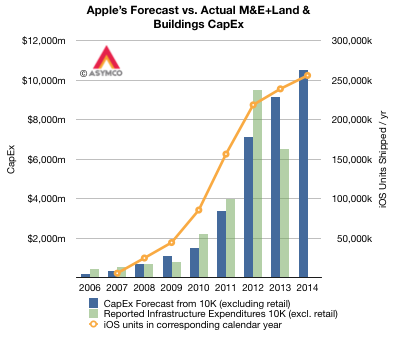
These 10K (fiscal year annual) forecast figures for capital expenditures are shown in the following graph. Note that they also include the fiscal years from 2006 to 2012. Note also that the graph includes the actual expenditures (in green).
From 2006 through 2013 the sum of the forecasts was $23.445 billion while the sum of the expenditures were $24.662 billion. With the exception of a carry-forward in 2012, the forecasts are broadly in-line with expenditures, with about 5% more spent than forecast.
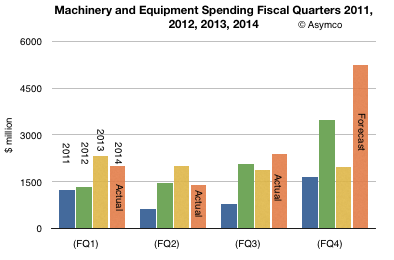
This pattern of accuracy in spending makes a $10.5 billion expenditure during the current fiscal year believable. In other words, taking the forecast at face value, and given that three quarters of the fiscal year have already passed, what does it imply for the current and last quarter? The following graph shows what Q3 spending should be relative to previous quarters (and 2011, 2012 and 2013).
The FQ4 (CQ3) "budget" for PP&E should therefore be $5.255 billion. This would be the most Apple has ever spent on PP&E in a single quarter.
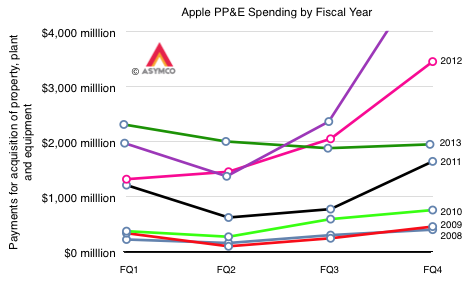
Shown another way, each fiscal year's spending from 2008 to present looks like this:
2014 is shaping up to be a bigger "ramp" in spending than any previous year. We have also noted how iOS device shipments correspond to these CapEx figure.
The relationship is shown in the first graph. I super-imposed iOS unit shipments for the calendar years because capital expenditures tend to result in production in the following quarter and Apple's fiscal year is shifted one quarter earlier than the calendar year. The iOS units shown for 2014 is based on shipments to date and a forecast of shipments for Q3 that is in-line with company guidance ((37.2 million iPhones, 14 million iPads, 1.9 million iPods touch which result in net sales of $40.18 billion and corresponds to the top of the guidance range of $37 to $40 billion)) and a modest forecast for Q4.
The metric of Capital Expenditures (excluding retail) is a good "rule-of-thumb" for predicting iOS growth, but it's not perfect. Obviously we've seen issues between forecasts and actual spending on a quarterly basis, but there is an overall relationship which makes sense: Apple spends on tooling and infrastructure in terms of data centers to support iOS growth. So far, a growth in CapEx has resulted in a growth in iOS.
It's therefore reasonable to assume that calendar 2014 will see at least 250 million iOS devices sold. How much that figure will vary will depend to some degree on the confluence and substance of product announcements this fall. ((My best guess is now 255.8 million.))
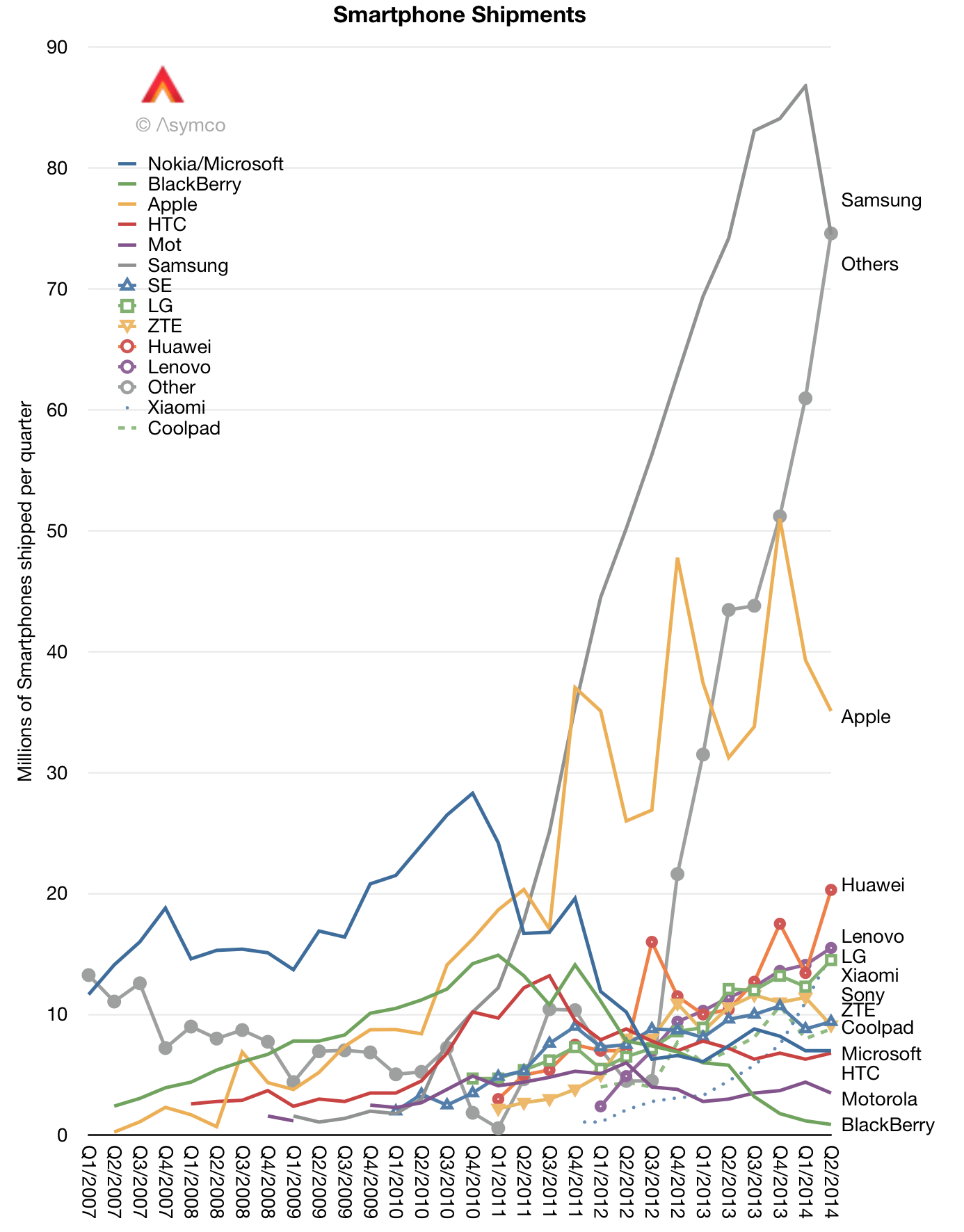
ABI Research estimates that AOSP (or forked Android) is the fastest growing mobile operating system with a total share of units shipped of about 20%. This is not surprising considering that most Chinese vendors don't include standard Android into their products. Indeed the current leader in China, Xiaomi has its own take on Android and includes a unique UI and set of services. This is also not a new pattern, Amazon's fork of Android has been in development for many years and powers the second most used tablet in the US.
If one looks at the volumes of smartphones shipped by vendor, the most rapidly growing (Huawei, Lenovo, Xiaomi, ZTE, Coolpad and "others") are likely to be using forked versions of Android.
The reasons for this are many: a reluctance to deal with Google's obligations, Microsoft's IP licensing costs ((which even Samsung seems to be eschewing)) , potential litigation, politics (including bans on Google services in certain markets), etc. But the most likely reason is flexibility. Vendors competing on price and localization are looking to move quickly against each other and can't wait for blessings from above. Belonging to some "Alliance" and all that it entails is just too much to ask for companies that are, so to say, delicate.
The result is that the "more open" version of Android is beginning to threaten the "less open" version of Android. China is already lost to OHA but India where penetration is still very low is up for grabs. Into this fray Google launched "One" a more low-end friendly version of sanctioned Android, hoping to retain opportunity.
The value of a singular Android version is not just being Google-friendly but also being better managed and more BOM-friendly. Google is trying to solve the control issue with ease of use, but still retaining control There will be alternatives however which are both easy and "open" ((or Free as in speech)). It seems that there is an opportunity for a hardware-independent vendor to take AOSP and provide a complete solution to local phone brands so they don't need to expend efforts on integration. A non-Google One, so to speak.
Why it's likely is that openness in software makes sense when parts of the stack become commoditized. Google took advantage of the commoditization of operating systems (i.e. Linux) to deliver non-open services on top. However, it's inevitable that some of those very services will also be commoditized and therefore that the portions of the stack which sustain Google will be forked as well.
iTunes/Software/Services revenues grew at 12%. This was the second fastest segment growth last quarter, with the Mac growing at a slightly faster 13% rate. Apple mentioned in the quarterly earnings conference call the for the first nine months of its fiscal year (i.e. since September) the line item iTunes/Software/Services has been the fastest growing part of the business. The following graph shows the growth scorecard for Apple's line items and it shows how the iTunes store is the only line that has been consistently green (growing above 10% for at least seven years.
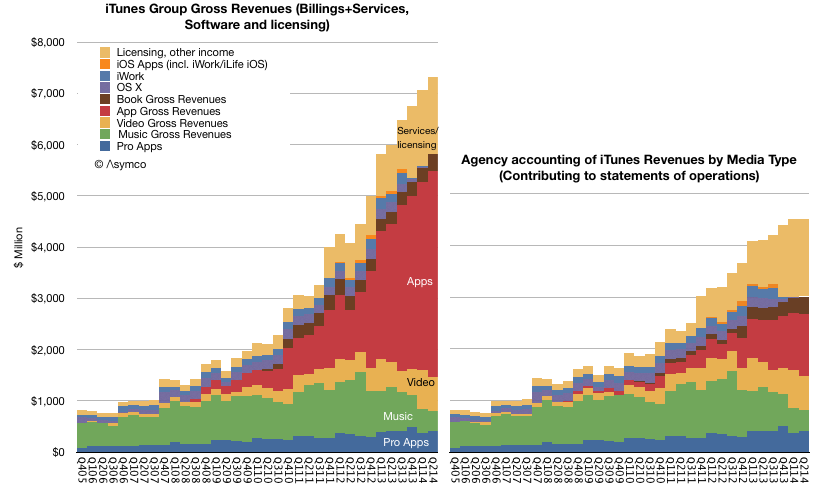
In addition to its revenues, iTunes can also be measured in terms of billings (or gross revenues). The billings growth rate is even higher at more than 25%. This is mostly to the more rapid growth of apps relative to a decline in music. As Apple only records the 30% it keeps as "revenue" for apps the overall growth in apps is less visible in its accounts.
The relative performance of billings vs. reported revenues is shown in the following graphs:
Note the estimated split between media types and software and services. The software and services portion of the business had sales of $1.9 billion while the revenues from third party content/apps sales reached $2.6 billion.
The value of this data is that it encompasses an almost complete view of the Apple ecosystem. As almost all content and transactions are tracked and reported and one can get a very precise view of the economic value of the ecosystem. ((In addition to iTunes/Software/Services Accessories could also be considered as part of the ecosystem. The value of Accessories and licensing as Apple reports it adds another $6 billion to iTunes/S/S)) (( What is missing are ad revenues through apps which don't use iAd )) (( What is also worth asking is what is the size of alternate ecosystems such as those of Microsoft, Google etc. ))
From the launch of the iPhone the value of Apple's ecosystem has grown more than 600% which is faster than overall sales growth (approximately 400%). If ecosystem value grows more rapidly than underlying hardware sales the question that emerges is when would the ecosystem transaction value exceed that of the business is supposedly supports.
Today the iTunes/S/S ecosystem is about $20 billion/yr. iPod, iPhone, iPad and Mac sales are about $150 billion/yr. It does not seem likely that the former will overtake the latter. If that were the case then one wonders why build a business entirely predicated on retailing and services without the support of hardware revenues. Something along the lines of Amazon.
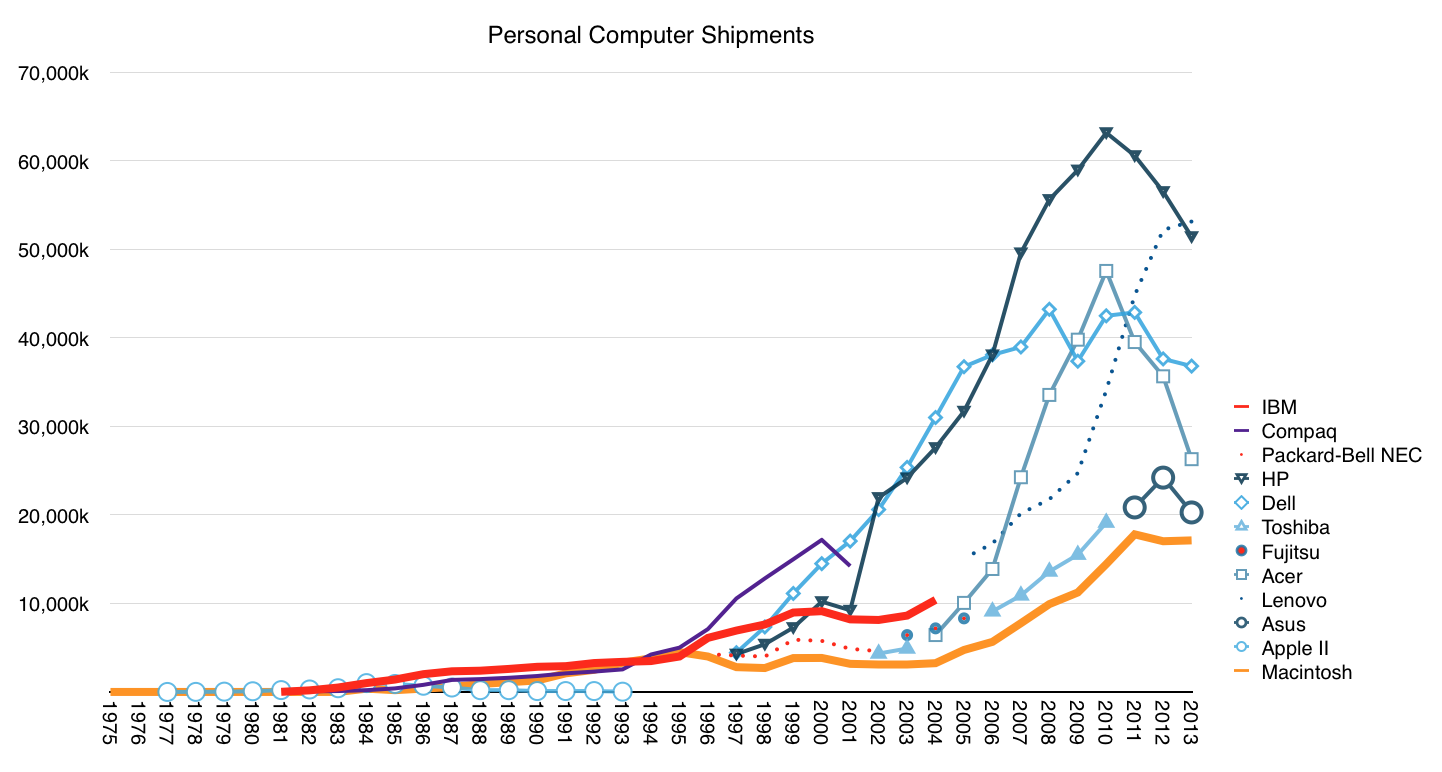
IBM did not invent personal computing but their "PC" became synonymous with the category. Having entered the market in 1981, the IBM PC quickly became the top selling brand. From 1984 to 1993 IBM sold more PCs than any other vendor, conceding the spot to Compaq which remained on top only until 2000. No PC vendor remained at the top of the sales leagues longer than IBM. HP had the second longest run but that run was broken last year as Lenovo (who acquired IBM's PC business) surged.
As the graph above shows, the period of time when IBM was dominant was characterized by far lower volumes. In 2004, the year IBM exited, they sold about 10 million units. ((as the graph shows, if we consider Lenovo as taking over from there, they did a very good job extending the legacy.)) It was a decent performance but one that did not keep up with the Dell and HP/Compaq race to the bottom in pricing and subsequent rise in volumes.
However, throughout its position of strength, IBM was a reluctant PC maker. IBM never controlled the PC platform the way they had controlled their mainframe and mini-computer businesses. Their falling out with Microsoft over OS/2 and their attempts at differentiating with the PS/2 architecture show how uncomfortable the situation was. Their exit in 2004 must have come as a relief and, in retrospect, they should be congratulated for having exited the market well before it began deteriorating. First came pricing and margin collapse and later total volumes began to decline. Most of the remaining vendors are today in various states of distress. Lenovo is growing but incumbents like Dell, HP and entrants have come and gone (Fujitsu, Sony, NEC, Toshiba). Potential disruptors like Asus and Acer have found no long-term success with PCs.
This is because without control over the platform, PC hardware is nothing more than a commodity, with negligible margins, intense competition and an inability to control one's destiny.
One company making computers did manage to control its destiny. By continuous refinement, the Macintosh survived and even thrived as the market pivoted toward mobility (and hence requiring integration that values design). Indeed, Apple now ships over 17 million Macs a year. More than either IBM or Compaq did at their peaks. It's not in the top five globally but has a very profitable niche. ((It's very likely that it captures more operating profit than the top five vendors combined.))
As a matter of fact, through 2013 Apple shipped a total of 156.5 million Macs, 50% more than all IBM PCs ever shipped. Apple also shipped more than twice as many iPads and five times more iPhones. And it's not just popular with consumers. With iOS Apple manages to reach 98% of Fortune 500 companies and 92% of Global 500.
At the same time, even though IBM exited the hardware business, it remained a powerful force in computing. IBM pivoted to primarily being a service company with a vast client base and increasing global reach. It essentially moved up the value chain to become an integrated services provider to business customers. IBM's reach in breadth and depth of services is extraordinary.
This dramatic turnaround–Apple moving to a device leadership position and IBM moving to a service leadership position–created the conditions for today's announcement of a strategic partnership--an event which is astounding to those who witnessed the 1980s and 1990s. Were it not for the tenacious independence of Apple and the business model agility of IBM, neither company would be around today to leverage one another.
There is drama in this industry and this latest chapter has a plot twist which any poet would envy.
Horace Dediu joins us for the 22nd episode of “The Innovation Engine” podcast to discuss innovation and the future of mobile - what the post-mobile world will look like; how Apple, Google, and others are shaping the mobile experience of the future; and the next frontiers of mobile after health and fitness.
In this episode of the podcast, Horace talks about why mobile and smartphones will no longer be thought of as synonymous in the very near future. He discusses how soon-to-be released products like Apple's HealthKit and Google Fit, combined with the revolution in wearables, will continue to drive change in industries like health care and will put more power than ever in consumers' hands.
Horace also shares his thoughts on "The Disruption Machine," Jill Lepore's New Yorker article that criticizes Clayton Christensen's theory of disruptive innovation. While he believes there is some merit to the notion that disruption is overused, Horace says the article overlooks years of research and writing since that has helped refine Chrinstensen's theories. He wrote a post for the Asymco site titled The Disruption FAQ in response to the article if you are interested in reading more of his thoughts on the matter.
Other highlights from the conversation include:
What we learned about the Apple New Product Process, or ANPP, from Leander Kahney's book Jony Ive: The Genius Behind Apple's Greatest Products
Some of the reasons why health care technology lags behind consumer technology, and why that means we are just beginning to scratch the surface of what will be possible in personal health care
Other "white spaces" in the marketplace that Horace sees as ripe for disruptive innovation, including education and transportation
Why Horace says software, not technology, is the thing with the power to truly transform industries
My thanks to Richard Gutjahr for taking time to talk about self-disruption. I met Richard as the Master of Ceremonies at the Censhare FutureDays event in Munich. He interviewed me for his blog and posted the results as a video and sound file. Richard is a journalist (Berliner Tagesspiegel, Frankfurter Allgemeine Zeitung) and TV personality (news presenter for Rundschau night).
Horace and I have met at a conference in Germany a few weeks ago. During a break, we were talking about the future of Apple. Horace made a statement, which I found quite intriguing: In order to remain innovative, it is not enough to reinvent yourself again and again. Apple must be the one to destroy its own business.