In November of last year I wrote a series of posts regarding the relationship between Google and Apple in light of the antitrust trial that Google was facing. The expected verdict was issued (Google was declared a Monopolist and found to be abusing that position). Many more appeals will follow and a remedy will need to be agreed upon--a process which will take many years. The implementation of any remedies will take yet more years.
Nevertheless, commentary on this trial has continued to center of the harm the verdict will do to Apple. Since Apple receives a substantial amount of highly profitable revenue from Google for search defaults, the conventional wisdom is that, due to this verdict, Apple is at a very high risk of losing that revenue. Very little has been said about what harm the verdict will do to Google. The paradox to me is why there is no connection being made between the implied loss to Apple being necessarily a gain to Google.
Since almost all people will continue to use Google on Apple devices, regardless of default, not paying for distribution (through defaults) will lead to a huge boost for Google's bottom line. In other words, most comments currently imply that a verdict declaring Google an abusive monopolist will result in a huge benefit to Google. So I ask again: why would Google management fight against such a verdict? Surely it would have been far more beneficial to argue to lose rather than to win this case! The court will force Google to make more money.
But my conclusion last November was that "a declaration that this [default placement] deal is invalid simply means that Apple and Google would craft another deal that would work around the restrictions. And that new deal would probably turn out to be more beneficial to Apple. [and less beneficial to Google.]"
The reason would be that Apple would increase its bargaining power because Google has, necessarily, decreased its own by losing the case.
Recently, I met Farshad Nayeri and Dave Sundahl—formerly of Christensen Institute, now at Disruptive MBA (dx.MBA)—when the topic of M1 Macs came up. The result was a multifaceted conversation where we took a long-lens look at Apple & Disruption around three core questions:
1. Is Apple Disruptive? 2. Is Apple Overserving with M1 Macs? 3. How does Apple defy Disruption?
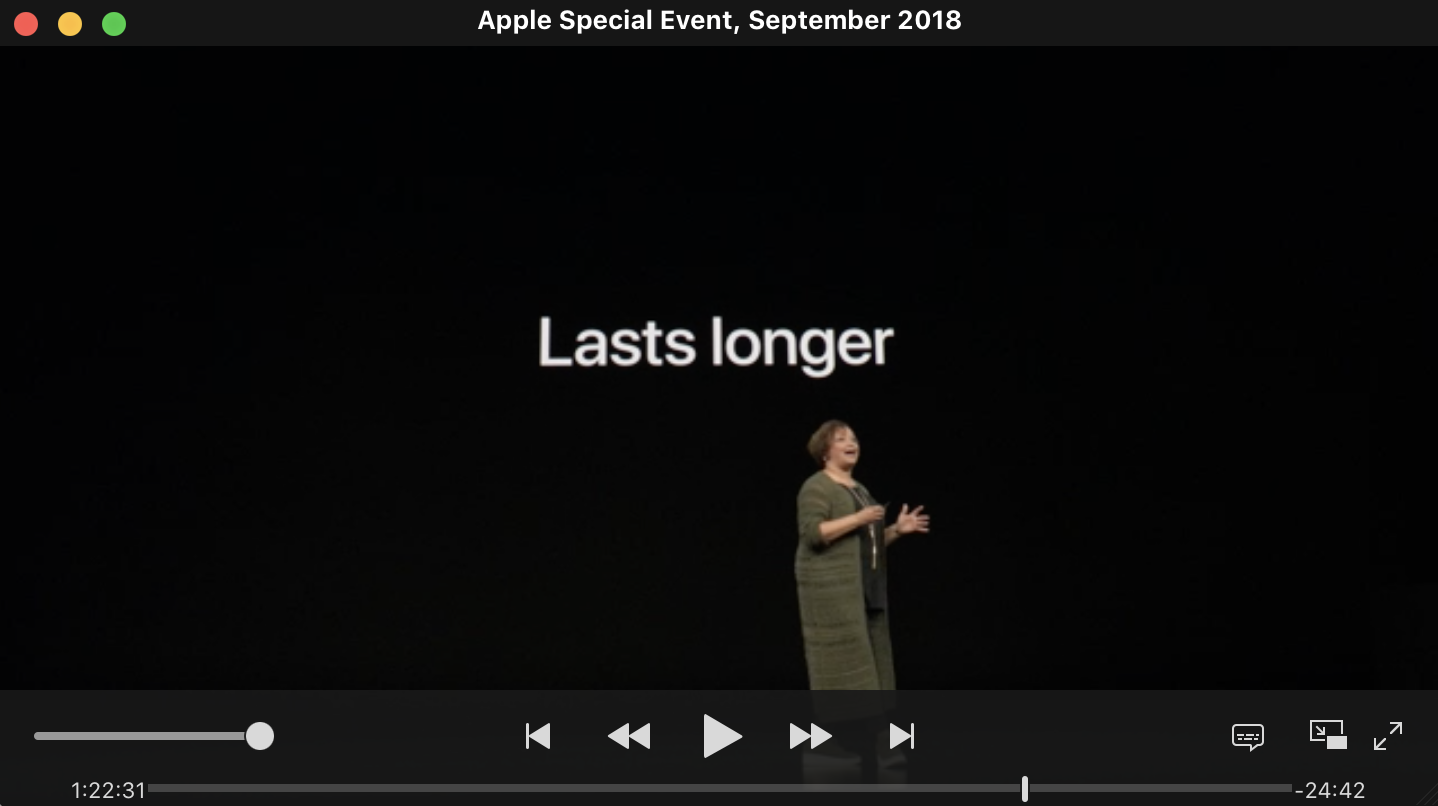
I think Lisa Jackson's presentation at the September 2018 iPhone launch event was perhaps the most interesting and most profound.
Lisa Jackson is Apple’s vice president of Environment, Policy and Social Initiatives. Previously, Ms. Jackson served as Administrator of the U.S. Environmental Protection Agency (EPA). In her role at Apple she has been responsible for the transition to 100% renewable energy use by Apple across all its facilities.
This goal has been achieved and it's a remarkable achievement deserving congratulations. But her presentation was noteworthy for setting a new goal.
She laid out a goal for Apple to eliminate the need to mine new materials from the Earth.
She said that to reach that goal Apple will have to do three things:
Sourcing recycled or renewable materials for all products.
Ensure that Apple products last as long as possible.
After a long life of use, ensure that they are recycled properly.
It's this second point that I thought would bring the house down.
To emphasize the second point she said Apple now strives to design and build durable products that last as long as possible. That means long-lasting hardware coupled with long-lasting software. She pointed out that iOS 12 runs even on iPhone 5S, now five years old. Because iPhones last longer, you can keep using them or pass them on to someone who will continue to use them after you upgrade.
She said that "keeping iPhones in use" is the best thing for the planet.
At this point in the presentation I wondered if everyone would rush out of the room and call their broker to sell Apple shares. One premise of investing in durable goods hardware companies is that value depends on frequency of upgrades. If products are not replaced frequently they do not generate revenues and the company selling them ends up growing very slowly if at all after markets saturate. The smartphone business is certainly approaching saturation and the implication of making Apple products more durable would imply lower revenues from replacements. This anxiety around replacement rates and extended lives is used by analysts to discount future cash flows and if those lifespans are extended price targets come down.
So why would Apple want to do this? What is the logic of this durability focus as a business model? It may be good for the environment but is it good for the bottom line?
Of course, there would be not much business without an environment and we should all strive for sustainability. But this is an existential observation, and it's defensive. The important call to make is that Apple is making a bet that sustainability is a growth business.
Fundamentally, Apple is betting on having customers not selling them products.
The purpose of Apple as a firm is to create and preserve customers and to create and preserve products. This is fundamental and not fully recognized.
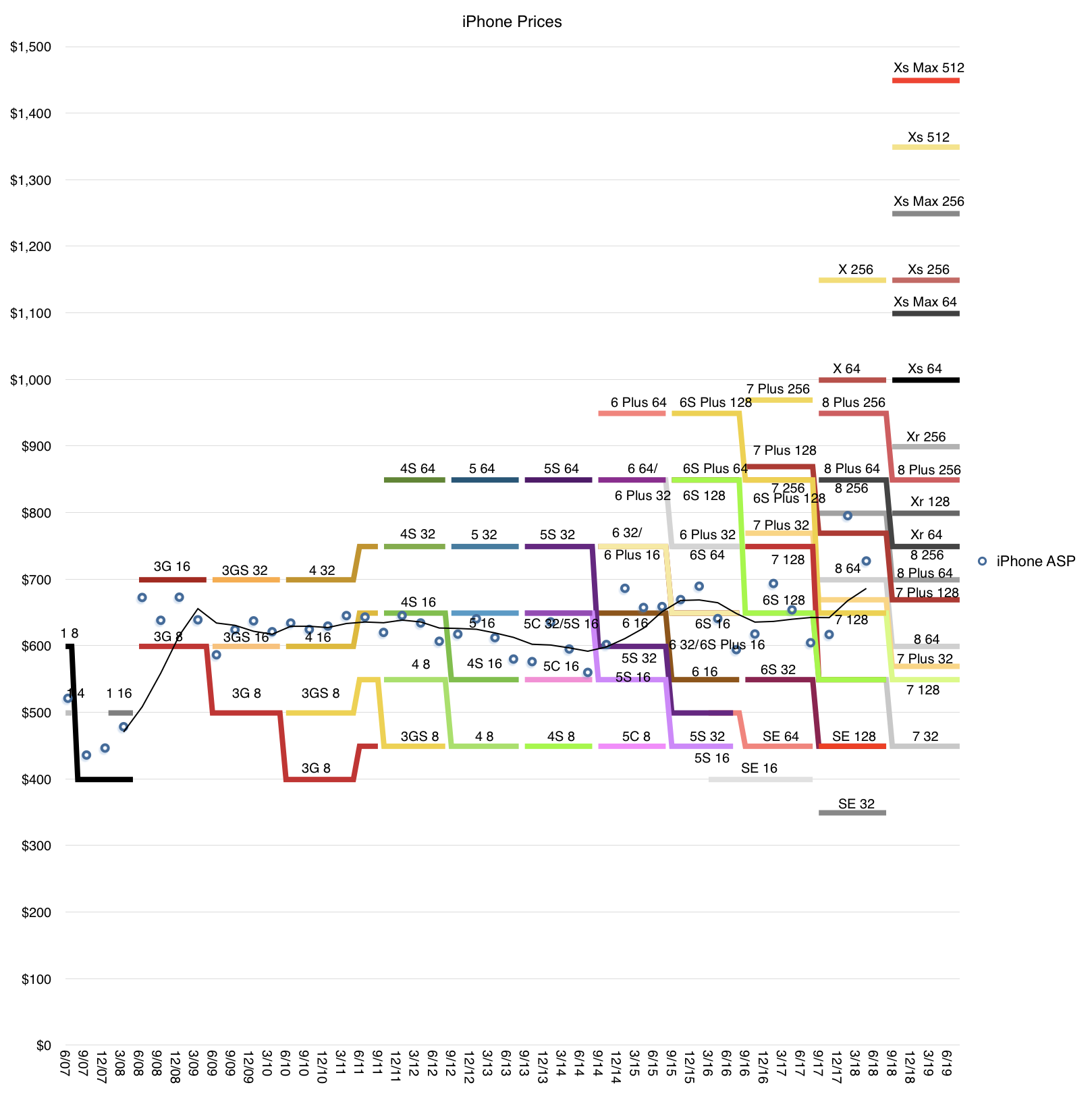
To understand how this works, if you look at the pricing graph below, you can read it as a story of increasing prices for a decreasing market share. But if you understand that each advance in products increases absorbable ((Insoluble utility is very dangerous and it's important to qualify e.g. higher storage capacity that people hunger for or better cameras that increase picture taking from features that are neat but don't get utilized)) utility then the cost per use remains steady or declines.
An iPhone at $1200 may be less expensive than an iPhone at $600 if the $1200 version lasts twice as long as is used twice as much each day. The $1200 phone delivers 4x the utility at twice the price, making it half the price. By making more durable products, both in terms of hardware and software, the customer base is satisfied and preserved.
Practically, the initial buyer may resell the iPhone and that 2nd hand devices may be sold yet again. This means an iPhone could have three users over its life and thus it could end up expanding the audience for Apple by a factor of 2 or even 3.
The expanded audience is offered accessories, additional products such as wearables and, of course, services. These residual business models are certainly profitable, perhaps even more so than the iPhone.
Overall Apple has 1.3 billion devices in use and perhaps as many as 1 billion users. This base is certain to expand and it will expand more rapidly with durable devices and software.
This is a hardware-as-platform and hardware-as-subscription model that no other hardware company can match. It is not only highly responsible but it's highly defensible and therefore a great business. Planned obsolescence is a bad business and is not defensible.
Therefore the statement that Apple now prioritizes device and software longevity is very important and I consider it one of the most important statements made during the 2018 iPhone launch event.
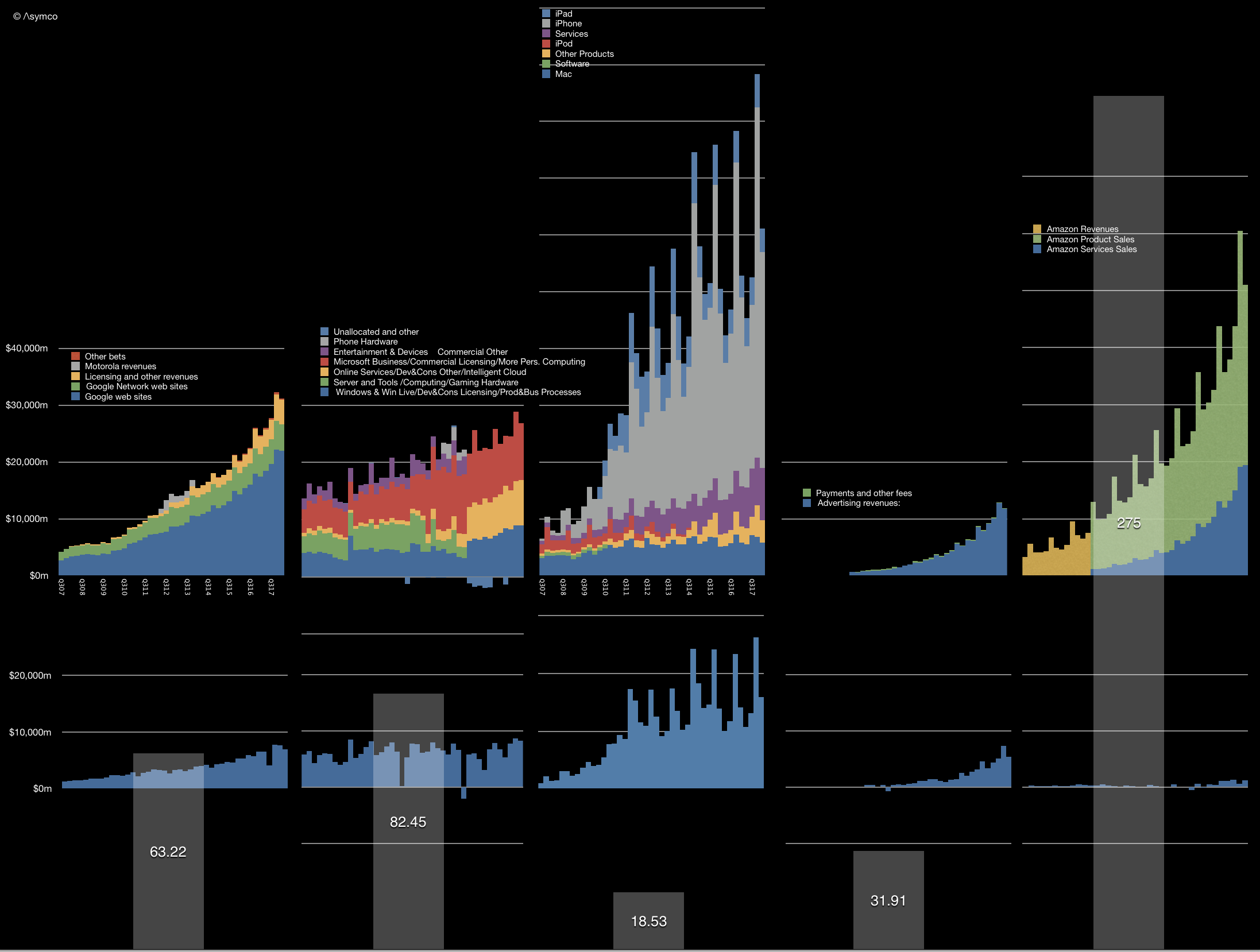
At the latest Apple Summit in Los Angeles the question of Apple's valuation was foremost on many minds. The illustration I used there to discuss valuation is shown below.
It shows the history of revenues (by reported segments) and gross margin for the five largest companies in the world by market capitalization. I have been publishing this illustration for five years ((initially with Samsung rather than Facebook because it was originally a set of "challengers" to Apple. The fact that with only one substitution the illustration turned into a view of the five largest companies in the world was a welcome surprise.)) in order to contrast the growth and perception of value between companies that might be considered comparable with Apple. Thus the graphs show the top and (near) bottom lines of the companies over an epoch of about a decade. ((This being the iPhone epoch))
In contrast with the histories above, there is a price set on the equities today. These prices are captured by the market capitalizations as follows:
Current market cap (billion)
Peak market capitalization (Billion)
Apple
$918
$955
Amazon
$844
$856
Alphabet
$810
$825
Microsoft
$780
$789
Facebook
$584
$589
Market capitalizations are interesting because they show perceptions of value. The traders in the equity are negotiating with each other on what the shares are worth and, as a voting system in a liquid public asset, share pricing is very representative of the perceptions about that asset. Representative because there are literally millions of decisions being made on a daily basis which determine this price.
The sales and profit data in the illustration above is about the past. In contrast the market engine is voting about the future. Any student of finance knows: the value of a company is the net present value of all future discounted cash flows (plus any current assets.)
So what would history have to do with it? What use is the trajectory?
This goes to a deeper question: How does history inform the future? What is the value in knowing previous performance when thinking about future performance? The common caveat in mutual fund prospectuses is "Past performance is no guarantee of future results". We are repeatedly warned of this because it is within our nature to look at history and recognize patterns. But beware! At least beware those whom you might entrust with your fortune.
But consider that it's conventional wisdom to also say that culture and preparation are the best ways to ensure a prosperous future. Ask athletes or coaches and they will say that practice and dedication lead to success. Sports fans know that a team or player with a record of success is more likely to succeed in the future. In this way sport is, in many ways, a simulation of reality. Which is why it's so popular: a metaphor of life teaches as well as entertains.
Knowing how to read ability as well as conscientiousness are keys to scouting talent. Again, it's not a guarantee, but in various fields of human endeavor the past does predict, with high accuracy, the future.
This relationship between past and future is what education is based on. We spend our lives preparing and training ourselves and our children and their children with the implicit hope that this leads to better outcomes for everyone. We establish a pattern of success because it is the best predictor of future success. Practice, learn, commit, defer satisfaction, trade time for knowledge, fight, lose and try again. These are the qualities we look for in the past of individuals when assessing their potential for the future. Culture is everything, we are told. Build a track record, we tell the young.
So what does this have to do with valuation?
We can't easily measure the cultures of persistence and perseverance in companies. Grit, guts, stoicism, fortitude, courage, the Finnish "sisu". These are not measurable in financial reports. Yet our language is as filled with words to describe character and our financial reports are empty of them.
It's left to investors to work it out. The exercise of relating the future to the past is the calculation of the ratio between Price (future) and Earnings (past). A high P/E ratio suggests repeated success from past success. A low P/E is a disbelief in a future repeating the past.
The P/E ratio thus allows us to say to what degree recent past performance is repeatable. I.e. how many `last years' can we expect in the future. A P/E of 1 means a company is worth what it earned last year. A P/E of 10 means it is worth ten years' proceeds. ((We could easily calculate P/E for more than one year but the default is one year.))
This P/E ratio is shown for the five companies above as the overlaid bars in the graph above.
Sure, you say, but it depends on the industry and circumstances. A future divorced of the past is more likely in an environment where there is rapid, chaotic change. The more volatility in fundamentals, the more uncertainty. Technology is changing rapidly and therefore it's quite possible that Apple's low P/E reflects this disconnect.
If so then what about its peers? Why would Apple be subject to different technological risk than other technology companies? All of the top five companies are considered "tech". Indeed, Apple is perhaps the least technologically oriented as it has a brand and consumer orientation. It operates hundreds of stores, and sells design as much as it sells algorithms. It fundamentally tries to deconstruct human needs and package those needs in products.
Alphabet, Microsoft and Facebook primarily don't "sell" to end-users. The revenues come from businesses in the form of advertising or licensing. They don't have support staff, interacting with people who buy what they use. They need to understand needs but they trade other things. And Amazon offers AWS to enterprises as its own unique product. Other than AWS it operates a marketplace, acting as an intermediary.
Apple is a consumer company depending on consumer tastes as a brand. This is more typical of a non-tech company in a boring business of consumer brands.
But it's not valued as either a tech company or a consumer company. Both have typically higher P/E ratios. In fact, Apple's P/E ratio is lower than the S&P 500 and has been below that level for almost the entire history of the iPhone, regardless of growth rate.
A track record of hit products and the stability of a brand seem to be of no value. Perseverance, consistency and stability are not valued. If it were an athlete with a track record of world-record performance and a spectacular reputation with the public, it would not be granted an above-average pay for its performance.
In the past I've argued anti-fragility as a cause. In the context of the other companies, Apple is at the center of perceived vulnerabilities and is thus perceived as vulnerable . The other four are at the center of no competition and perceived as invulnerable. And yet Apple, so far, has survived. So have the others, but apart from Microsoft, they are much younger. I argued that Apple exhibits anti-fragility and has unrecognized robustness. Perhaps Warren Buffet now agrees and this is encouraging to the thesis.
Yet, at an even deeper level, in Apple's valuation we see how culture is not valued. How the idea of character assessment is not applied to businesses. How ethos is unquantifiable and thus discounted. How markets, accustomed to weighing things, reflective of collective human judgement, demonstrate that we are woefully incapable of valuing that which matters most.
Oscar Wilde famously said that the cynic knows the price of everything and the value of nothing. Here's to the sentimentalist, because at the end of the day those who change the world know the value of everything and the price of nothing.
The iMac launched May 6 1998, exactly 20 years ago. It is not the most significant computer to ever exist. It was a clear descendant of the original Mac which established the "all-in-one" desktop computer category. That category, to which it still belongs, is a modest segment. The last time Apple reported portable sales separately was in late 2012 when the desktops/servers and pro systems combined made up only 20% of all Mac sales by units. If iMac were 10% of Mac sales, it would represent about 2 million units in 2017.
Desktops evolved into laptops and personal computing evolved into pocket computing. Becoming more personal means more intimacy and this is leading to wearable computing. There is more beyond that to be sure.
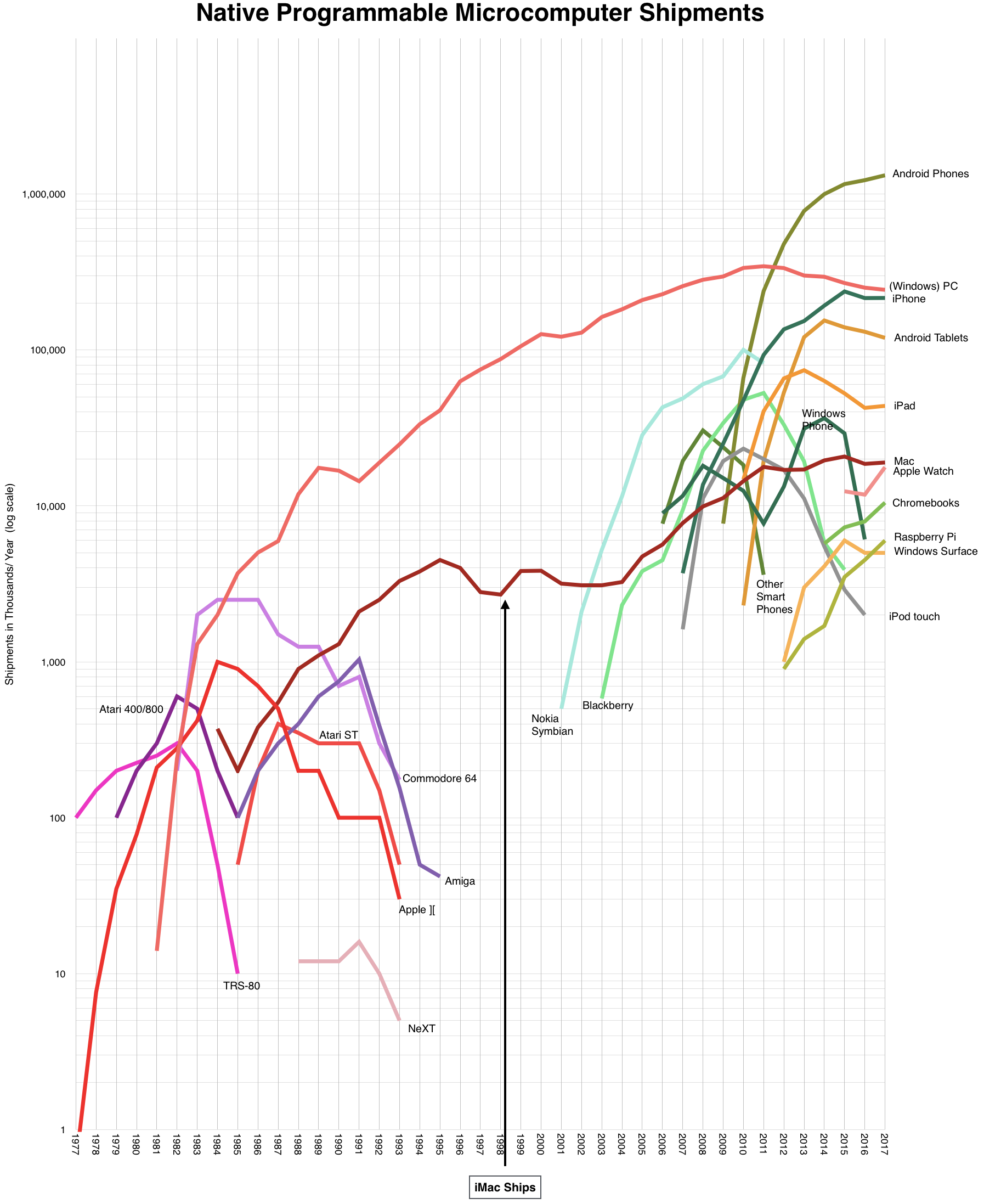
But the iMac is a historically significant machine. It allowed Apple to start on a new trajectory. It did this by first offering a financial lifeline. Sales of Macs, which were at the time the only source of revenues for Apple, increased from 2.7 million to 3.8 million a year. This at a time when Windows PCs were shipping about 100 million units. That was enough to ensure survival. Today Mac units are five times higher while Windows PCs are about 2.5 times higher. The following graph shows the impact of iMac on the Mac's trajectory.
Second, the iMac was the first host of OS X, an operating system built on Unix which made it extremely flexible. iMac gave Apple the space for OS X to be developed and to be optimized for various hardware. The experience with OS X and its inherent scaleability (down as well as up) meant that it could be considered for the post-PC devices of the future.
Lastly, iMac's design screamed "consumer product" which went from signaling inferiority to superiority. It set a standard for novelty, creativity and dynamism in the category that was considered second-rate. In the early 2000s consumers began to lead in the adoption of new technologies. DVD drives, internet connectivity, wifi, instant messaging, media consumption exploded. All the while institutions, hung up on legacy, began to block technologies. At this pivotal moment, the iMac spoke with its looks. It didn't just imply a new order, it stated it.
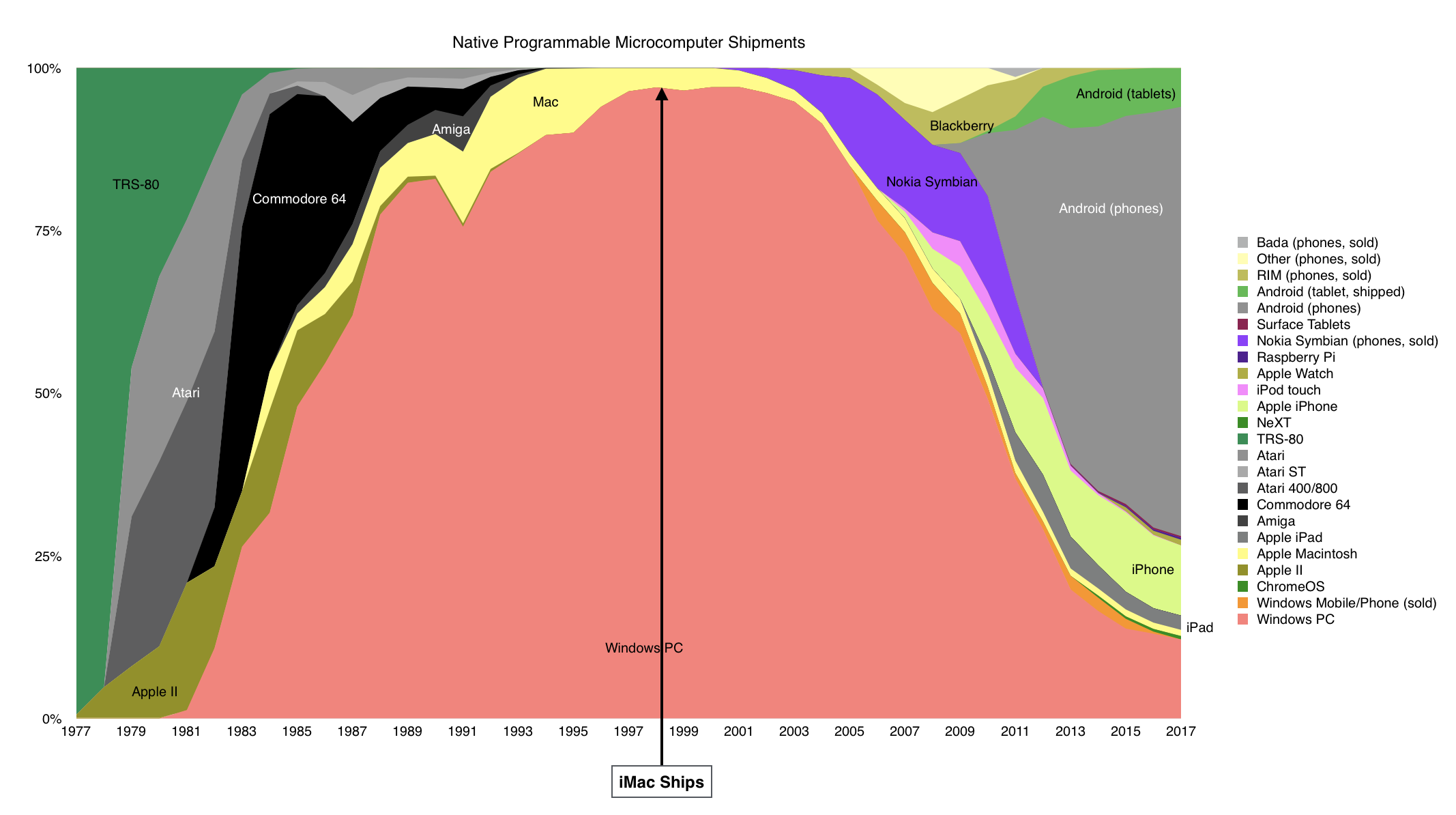
To me the incredible aspect of the iMac's entry is its uncanny timing. It came not only just in time to save Apple but exactly half-way between the first two ages of computing. In the following graph showing "share of computing" you can see it as launching precisely at "peak Windows".
In retrospect you have to wonder if Apple, with the iMac, was lucky to survive into this next era or if that era would have ever happened without the iMac. It's a question of causality which quickly devolves into an un-winnable argument about stochastic vs. deterministic existence.
Regardless, the result was felt more than seen. The computing industry was pivoting. The results are seen also in the graphs above. The iMac came right in the middle of the "desert" of platform choice of the late 1990s. By the 2000s mobile platforms detonated on the scene. The iPod was Apple's first entry, in 2001, but it was not a computer. It was an appliance. A stepping stone at a time when the early platform contenders Nokia, Palm, Microsoft and BlackBerry surged before realizing that they did not have sound foundations upon which to build ecosystems. Their advances could not be consolidated.
The spoils went to the later entries of iOS and Android. The resulting disruption was shocking and disorienting. Not only did the old order get up-ended but the magnitude of the new was 100x the old. The iMac enabled at least a trillion dollars of value to be created and made Apple the biggest company in the world.
As you would expect, at the time, 20 years ago, none of this change was anticipated. iMac was a 'cute' computer. Toy-like and obviously unprofessional. It attracted and relished contempt.
So now we are at a point where the second era of computing is at its apex. With markets near saturation, the device business is inflecting from growth to possible stagnation if not decline. There are two platforms--though unlike Windows, Android is fragmented and iOS is not just on one form factor. Nevertheless there is stasis. The touch UI which begat nine billion devices is normative. The next interaction metaphor has not emerged as an obvious successor.
The question for today is what is the new iMac? What is the enabler for change? It's not easy to spot. It is not the thing of the future but it points to the future.
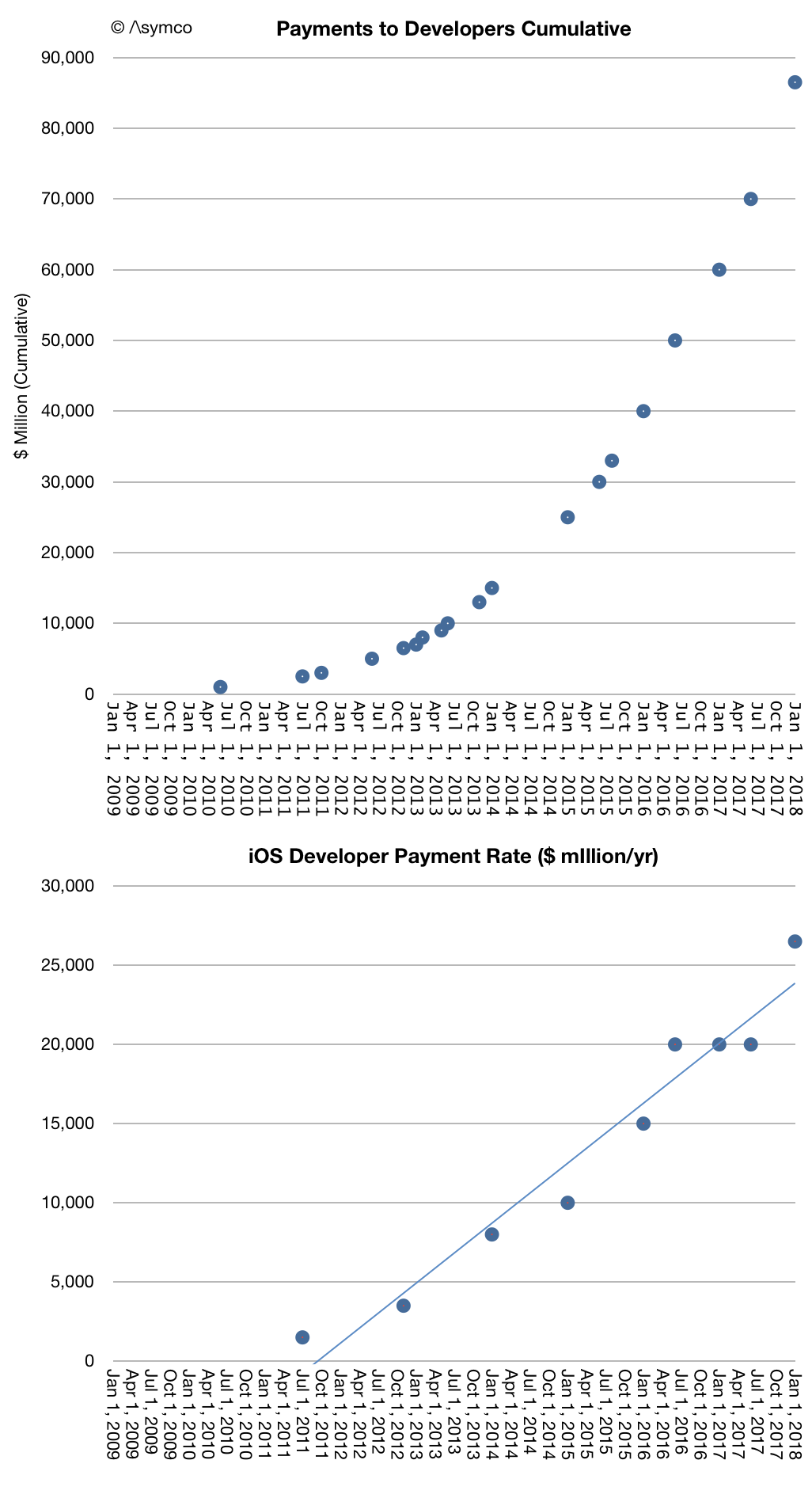
In its latest update on the App Store Apple reported that iOS developers earned $26.5 billion in 2017. A year ago the figure was $20 billion. The growth rate is then about 33%. The cumulative payments to developers can be calculated as $86.5 billion. This amount was generated in a span of less than 10 years, with the first billion paid by June 2010.
The following graph shows the history of cumulative payments and the corresponding payment rate (in $/yr.)
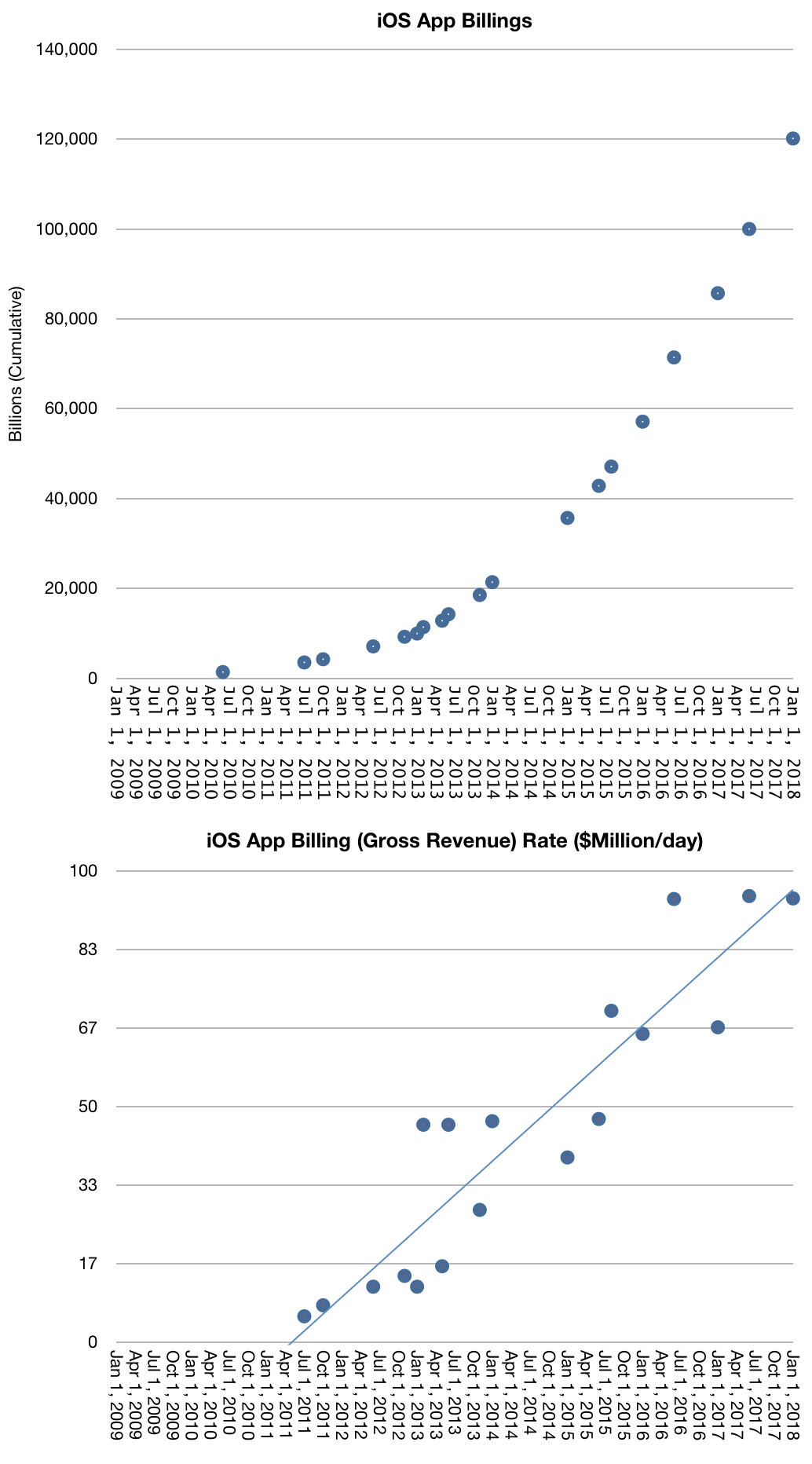
Note that this represents the payment to developers, not the spending by the customer. Apple keeps about 30% of the revenue. The total spending on the App Store is then about 43% higher. ((During the last year some types of app subscriptions have been priced by Apple at 15% of gross so I adjusted the payment rate to 72% for 2017)). The equivalent figures for spending on the App Store are shown below.
A few observations:
Developer payment rate is now above $25 billion/yr. I've been notified via Twitter that this is higher than the revenue of McDonald's Corporation in 2016.
During this year iOS users will be spending about $100 million per day for Apps. This was Google's AdWords revenue rate in 2012.
The spending on App Store has been rising steadily, adding about $5 billion/yr since mid 2011.
Apps are the biggest component of Apple services and helped that segment gross over $57 billion in 2017, passing Fortune 100 level (net of developer payments).
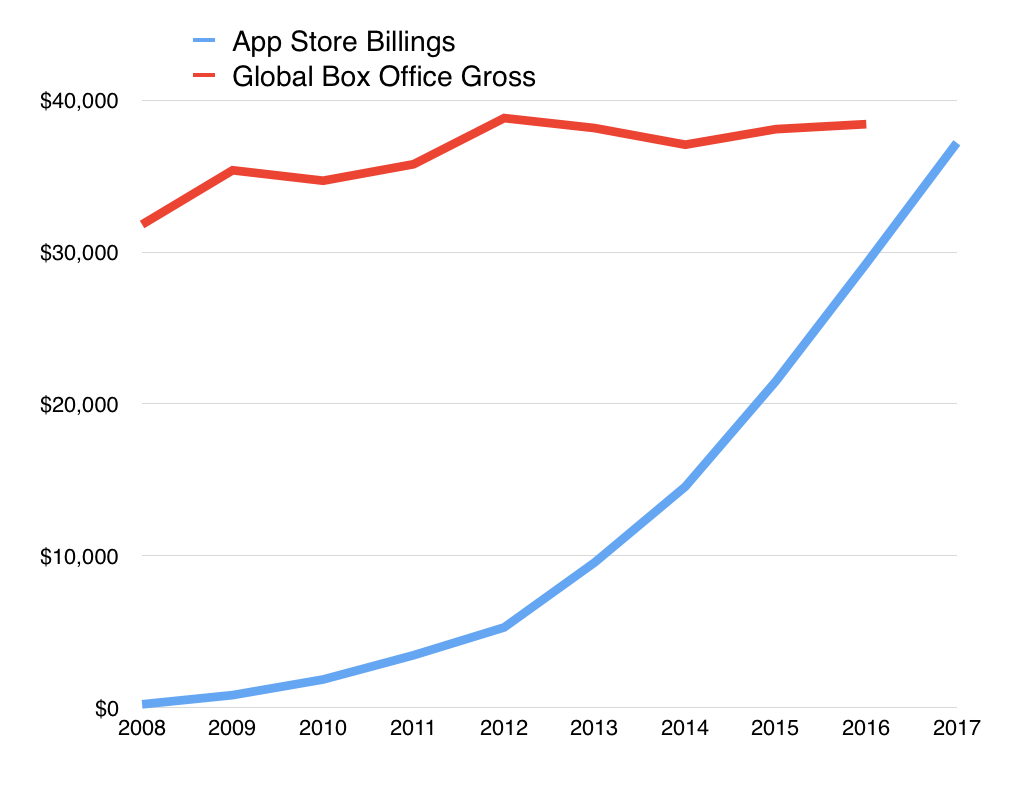
I've made comparisons before with the app business being bigger than the film industry (and much bigger than the music industry.) This was considering Android revenues and iOS combined as "app revenues".
As of this year the App Store alone will overtake Global Box Office revenues.
Of course this is only an observation of the scale of App Store rather than a judgement of the benefit obtained from either medium or the substitutability of one for the other. ((The substitutability of apps for movies is not to be discounted either. The analysis should be based on understanding the jobs the media are hired to do.)) The reason scale should be noted is that the App Store, and Apple services overall, is becoming one of the largest enterprises in the world. Even more importantly, it should be noted for its rate of growth.
Even when considering this, one should keep in mind that the figures of revenue and payments to developers are only a small fraction of the overall app economy. Apps sold to end users are a subset of all apps on the App Store. There are not only free apps but also many apps which are front-ends to complex services which are monetized in various indirect ways.
Facebook, Twitter, Linkedin, Tencent, YouTube, Pandora, Netflix, Google, Baidu, Instagram, Amazon, eBay, JD.com, Alibaba, Expedia, Tripadvisor, Salesforce, Uber, AirBnB and hundreds of others are all "free" apps enabling hundreds of billions of dollars of interaction none of which are captured in the App Store revenue data. The vast majority of activity for the top commerce, communications and media properties are now coming through mobile devices.
By weight of users and their propensity to engage, iOS enables about 50% to 60% of mobile economic activity.
Based on assumptions of revenue rates for mobile services and iOS share of engagement, my estimate of the economic activity on iOS for 2017 is about $180 billion. Including hardware sales, the iOS economy cleared about $380 billion in revenues 2017.
Additional assumptions around growth rates suggest that iOS economy will achieve the half trillion revenue rate in 2019. Valuing this, especially as a part of Apple's intrinsic value, is a challenge but it's probably worth doing. There are implications in the robustness or sustainability of the underlying business.
Microsoft has announced that by the end of the year the Groove music service will be phased out. Users are being offered the option to move their music libraries into Spotify.
This brings to an end a long story of Microsoft in the music distribution business. It started nearly 15 years ago with technologies in Windows that allowed for purchase and playback of various media formats. Microsoft sought to enable a large number of music retailers to market music through its formats and DRM and transaction clearing.
Services such as AOL MusicNow, Yahoo! Music Unlimited, Spiralfrog, MTV URGE, MSN Music, Musicmatch Jukebox, Wal-Mart Music Downloads, Ruckus, PassAlong, Rhapsody, iMesh and BearShare and dozens of hardware players licensed Windows formats. Almost all of these services have shut down and the devices disappeared.
The next stage was to offer an integrated experience through the Microsoft Zune player and Zune Marketplace music service. This too failed and was replaced by the Xbox Music brand in 2012. On July 6, 2015, Microsoft announced the re-branding of Xbox Music as Groove to tie in with the release of Windows 10.
There was a time when Microsoft was thought of as the certain winner in media distribution. Inserting media into the Windows hegemony was classic "control point" strategy: owning the access points was a sure way to collect a tax on what transacted through the network.
Instead we are facing a market where media is consumed through new access points: phones, tablets and TV boxes. Netflix, Spotify, Roku, Google, Amazon and Apple are all offering distribution and some are investing in original programming.
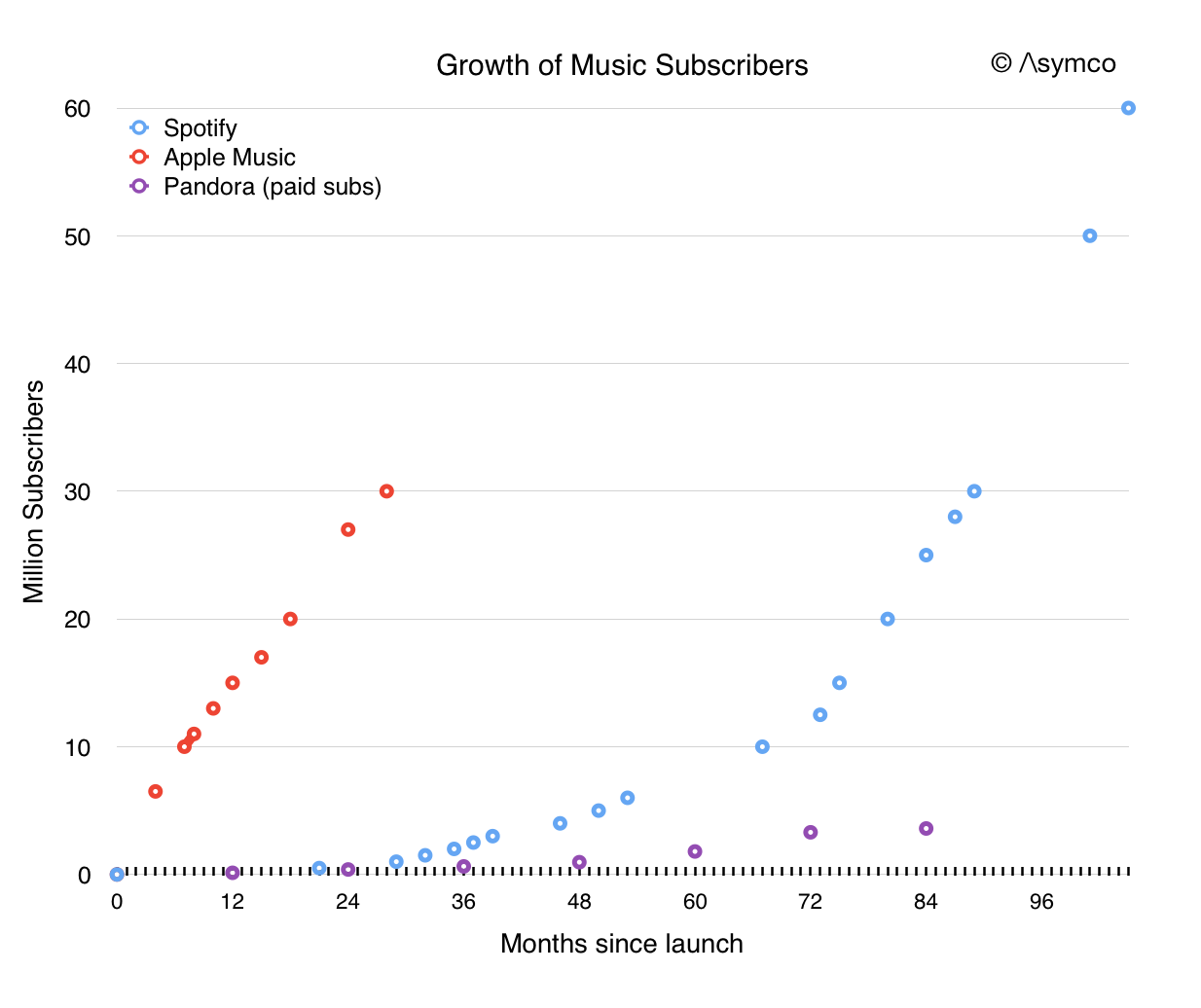
It's perhaps worthwhile to recall that Microsoft and Apple both started their media efforts around the same time. Apple's iTunes is 16 years old and the iTunes Music Store opened in 2003, almost 15 years ago. Today Apple is transitioning to streaming with 30 million subscribers. The graph below shows the history of subscription growth to Apple Music and Spotify.
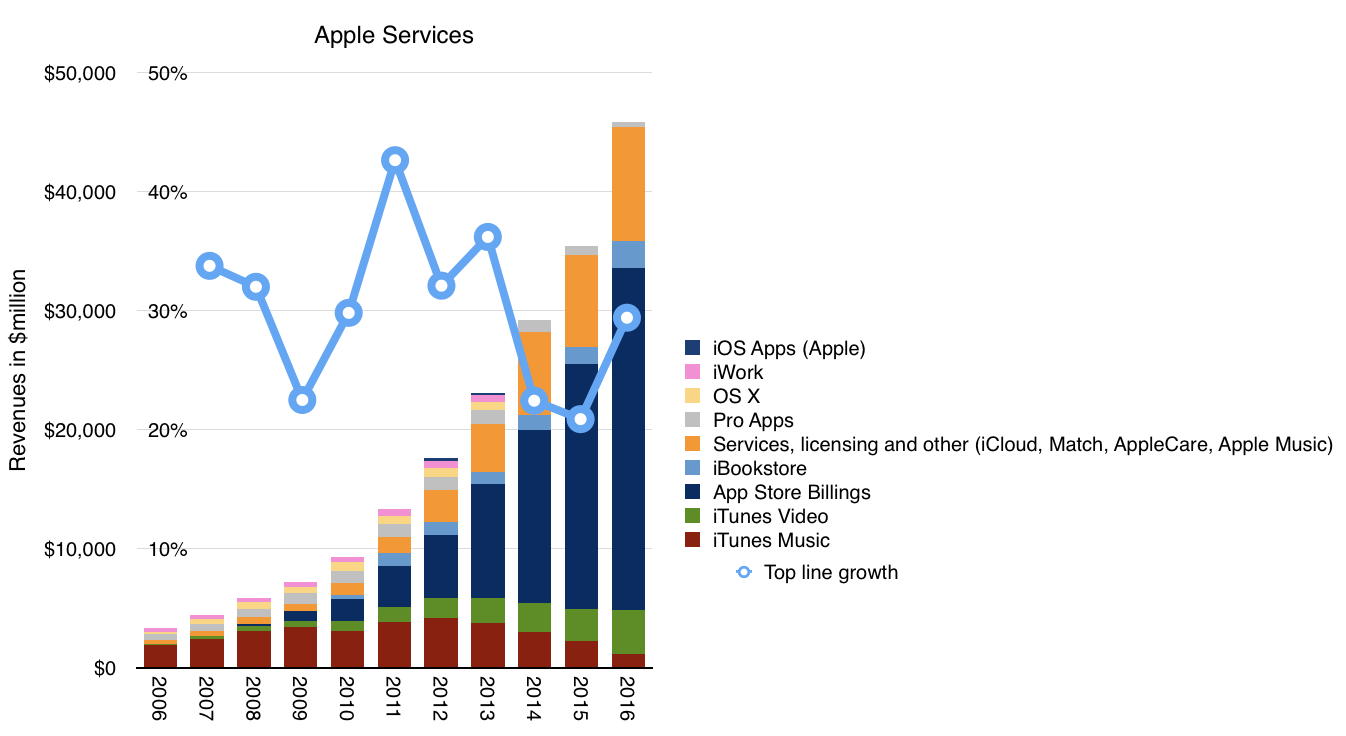
Apple Music is a small part of Apple Services (part of the orange area below).
On a yearly basis Apple Services are this year crossing the $50 billion gross revenue run rate. This year Apple released a new Apple TV 4K and is releasing a new smart speaker called HomePod.
The contrast between Microsoft and Apple is most visibly between the Mac and PC. But the story of how media paralleled mobility and how Microsoft struggled with both is perhaps a cautionary tale.
Microsoft saw the limits of modularity when new product categories emerged and when new user behaviors were created. They attempted to pivot into being more integrated but those efforts also failed. The efforts continue today with Surface devices; looking forward they will continue with AR/VR and perhaps a pivot of Xbox..
But the long arc of history shows how hard it is to succeed in vertical integration after you build on horizontal foundations. Generations of managers graduated from the modular school of thought, specializing rather than generalizing. Now they are facing an integrated experiential world where progress depends on wrapping the mind around very broad systems problems.
Entire industries are facing this orthogonal pivot: media, computing and transportation come to mind. Huge blind spots exist as we see only what we've been trained to see.
I will be presenting my latest analysis of Apple at the Sustain event in San Francisco on Thursday Sept 8th, the day after Apple's keynote, along with Ben Bajarin, Carolina Milanesi who will alsob equipped with their latest market insights.
There is a time to disrupt and there is a time to sustain.
Sustain event is about understanding Apple's levers of control to sustain the iPhone as it moves into direct competition with Android. We will also examine positions of top five technology brands: Apple, Amazon, Facebook, Google, and Microsoft.
Berkshire Hathaway, led by Warren Buffett, now owns about $1.4 billion of Apple. Occasionally we hear about various "celebrity investors" taking positions in the company or exiting those positions. The last one I remember was Carl Icahn. He seems to have exited Apple before Berkshire entered. There are some who will act because of these decisions. You should not be one of them.
Nor should the management of the firm act in response to investor decisions or concerns. Management is specifically distinct from ownership in the corporate construct precisely in order to bring professionalism to the role. The manager must set priorities as they see fit, irrespective of what the transient owner might prioritize. The separation of ownership and management is one of the greatest innovations in commerce.
There are many opinions on what priorities should be. Delivering a specific financial ratio, achieving a certain market position, changing the world for the better. These have all been cited as top priorities. I happen to believe that what matters most is the creation and preservation of customers. That is because I see customer creation as causal to the other desirable outcomes and it is therefore the more important priority.
And this is why, whenever possible, I try to deduce how well a company is performing on this metric. The greatest companies (by market capitalization) today are certainly examples of achievement in customer creation. Facebook, Microsoft and Google are members of the "billion user club" or companies that crossed a billion active users.
But do they really have a billion customers? Microsoft has over 1.2 billion users but many (most?) of those users are using computers that their employers provide on which Microsoft software was installed. They may not have made the choice to purchase the tools they are using. Microsoft certainly has millions of customers in the form of "accounts" purchasing its products and services, but It's not likely that there are a billion people who have directly chosen to buy a Microsoft product.
Facebook has over a billion daily users. Facebook users are certainly using the service of their own accord but they are not paying for the service. Quite the contrary, the actual customers of Facebook are companies buying an advertising service offered in the form of exposure to those billion users. The Facebook users are the product being sold, not the buyers. Thus Facebook's total number of paying customers is probably only in the tens or hundreds of thousands. ((Orr Sella @orrsella pointed out that Facebook has stated that they have 3 million businesses actively advertising on their networks.))
Same with Google. We don't know how many accounts Google send invoices to but the number is very likely not even in the 100 million range. Its billions of users are beneficiaries of services but they are not paying Google/Alphabet.
Amazon has many millions of customers, if not billions. Prime membership is above 50 million but not above 100 million. Amazon may some day have a billion customers but there are limits to how quickly that can happen. The growth potential is governed by logistics and that's as much an issue with atoms as it is with electrons.
Which brings us to Apple. Apple does not offer a figure on its specific user count, but we have some viable proxies:
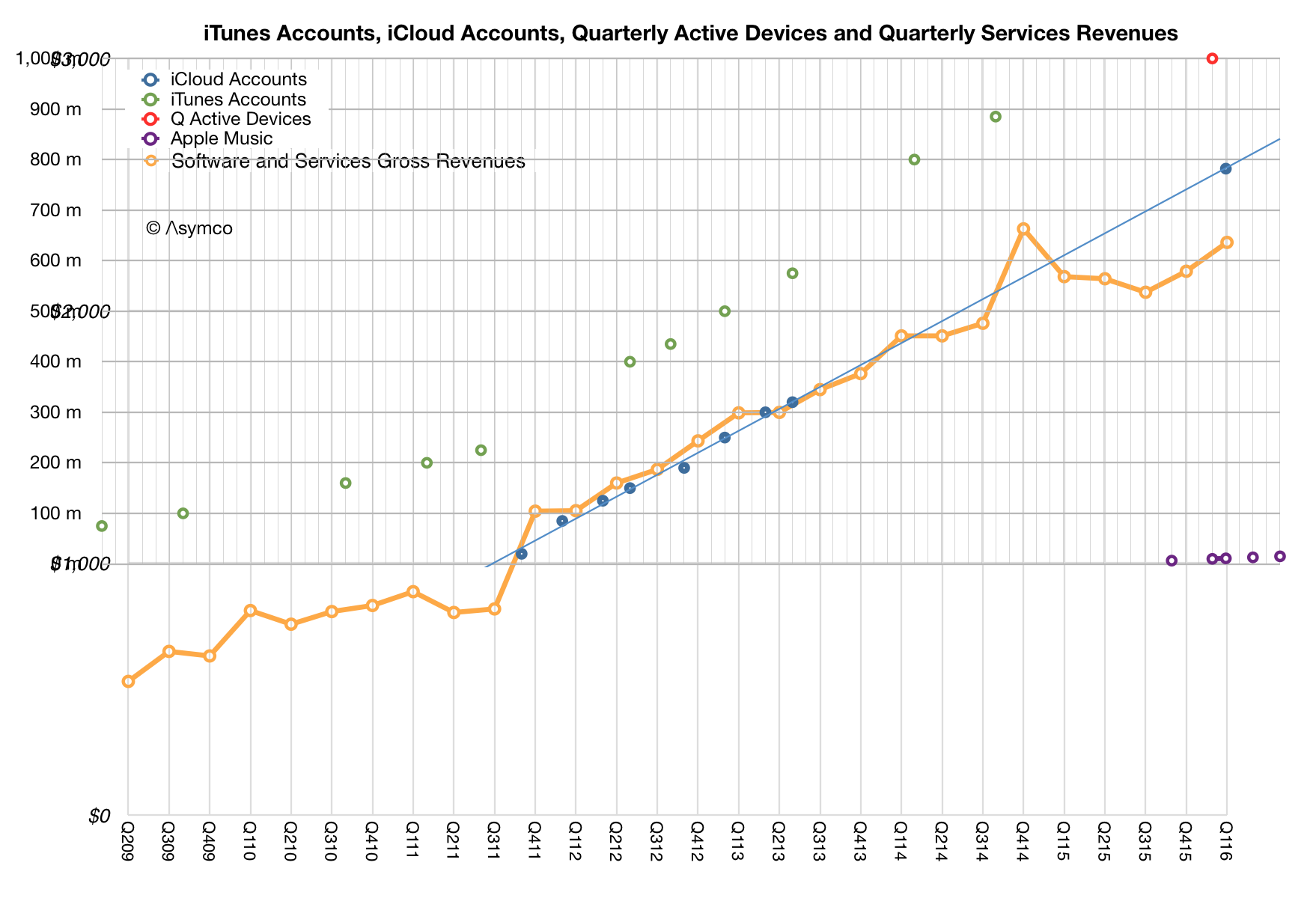
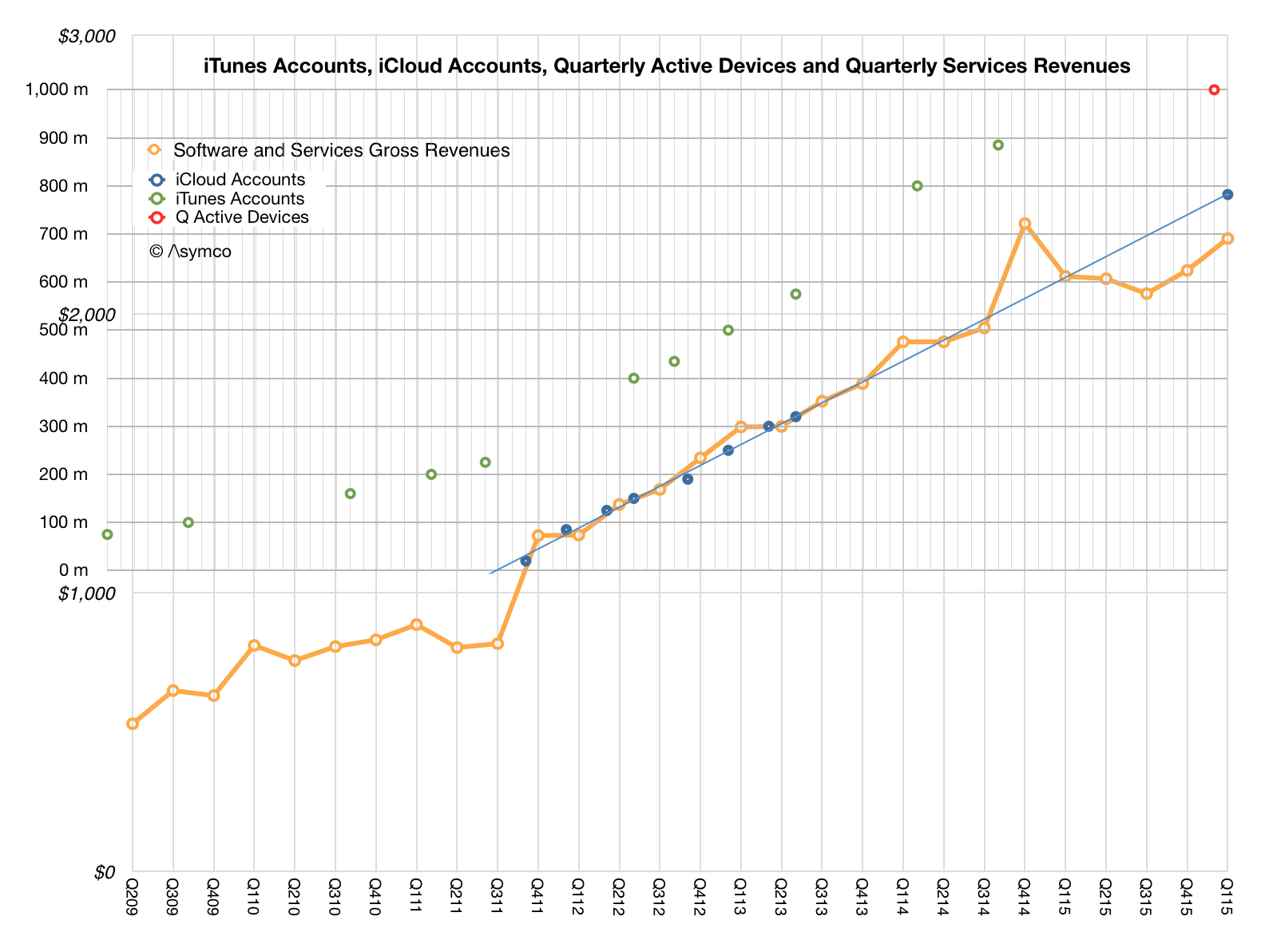
iCloud accounts reached 782 million in February 2016.
iTunes accounts reached 885 million in September 2014
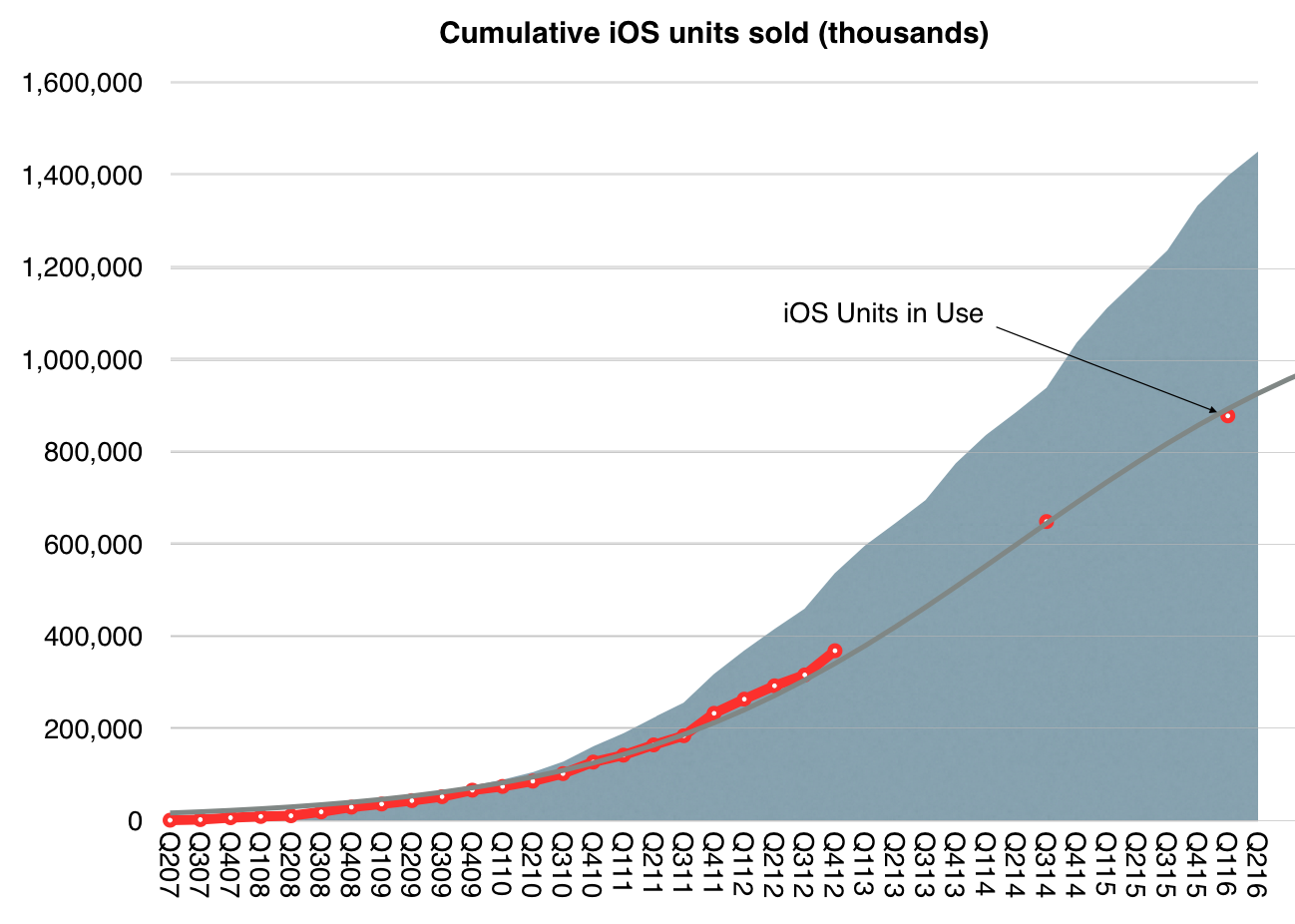
Active devices reached one billion in January 2016. That number is likely above 1.1 billion now. (Includes all devices, hence Macs and Apple TVs).
These figures are also parts of patterns (shown below) which offer an indication of predictable growth.
In addition to the absolute figures and their growth there is also the question of loyalty (frequently cited by the company), switching from other platforms (also frequently cited) and revenues. The company publishes specific figures on service revenues for consumer attached devices showing a run rate of $41 billion/yr in services for their device base.
In combination, a picture emerges which shows that Apple has nearly a billion customers. I can't say how many with any precision but it's certainly above 500 million (on the basis of iCloud and iTunes accounts). It's below one billion because some users have more than one device.
Even though it has not happened yet, the trend is pretty clear. Apple will at some point in time have a billion paying customers.
What is more significant than the specific count is that these customers mostly chose to be customers individually. Some may have been given the products as gifts, but the vast majority bought the items for themselves. Apple benefitted from hundreds of million of individual purchase decisions.
Furthermore, having made the decision to purchase, chances are that they will do so again. Apple customers are a recurring revenue stream. In fact, it's fairly easy to calculate that being an Apple customer is equivalent to spending about $1/day on its products and services, indefinitely.
Apple is not there yet, but a billion dollars a day from a billion customers is not inconceivable. That would be quite an achievement.
A merger is the result of two entities in the same business joining forces. It is usually justified through "synergy", a euphemism for removing redundancies from their unity. Arithmetically, the desired outcome is that the resulting organization should be smaller than the individual parts (which is desired if the available market is shrinking.)
An Integration is the answer to the question of "Why two companies in different businesses are better off together." Arithmetically, it suggests that the proposed sum is greater than the individual parts.
The spin-off is the response to a situation where one company houses two unrelated businesses.
For completeness, we can define an acquisition as the purchase of an unequal entity in order to improve the value of the acquirer.
The logic of any of these is that there is a disequilibrium which offers an opportunity to those who can exploit it. What the analysis fundamentally assumes is that the status quo of firm boundaries is not optimal.
Much of the measurement of the balance in the equations assumes that the overall industry is stable and that the problems (technical or market) are largely understood and that there is no learning that needs to happen. Boundaries need to be re-drawn because they are imperfect. Boundaries may have grown imperfect for many reasons: founders/owners were separate, markets and technologies evolve at different rates, resources are inflexible, processes are entrenched and values are outdated.
However, all this arithmetic can be safely thrown out of the window if there is a new industry in the making. If there is no balance to begin with because there is an entirely new problem being posited. That is, not only do we not know the answers to technical or market questions, we don't even know what the right questions are.
When looking at the history of industry creation, the breakthroughs were always about the discovery of the right questions to ask. The early automobile industry was a scramble for solutions to a huge number of technical and market questions: technology, business model, infrastructure, usability, customer segmentation. From 1886 until 1915 there were many grand experiments with thousands of automobile firms springing up. ((Estimated 3000 world-wide))
Early computing, internet, mobile and consumer durables industries went through similar periods of grand experimentation. But the breakthroughs occurred when someone was able to ask (and subsequently answer) a question that nobody had asked before.
Henry Ford asked, "What would enable everyone to have a car". The result was not a better car but a better production system.
Steve Jobs asked, "What would enable everyone to have a computer". The result was not a faster computer, but a more approachable computer.
Akio Morita asked, "What would enable young people to have their own music". The result was not a better audio quality but a smaller audio player.
Kiichiro Toyoda asked, "How can a car be built without faults". The result was not a bigger factory but many smaller ones.
Jeff Bezos asked, "What would cause people to do their shopping online". The result was not a lot of unique sites but one infinite one coupled to a logistics and computing service.
Having great taste in questions turns out to be the principal quality of the successful industrialist: The creation of economic value and power well beyond the boundary of the firm itself.
When the correct question is asked, resources can be efficiently marshaled to answer it. The wrong or incomplete question leads to inefficient resource allocation. And so the architecture of the solution can be built. If the new problem statement is a technical one then an integrated implementation is required. If the new question identifies non-consumption then a modular implementation is required. Each of these approaches suggests different customer sequencing strategies and different application of resources and processes.
There is no right architecture for industry creation. What matters is asking the right question.
So is Elon Musk, today, asking the right question?
The presumptive question seems to be "What would enable everyone to have an electric car?" This is not a great question if it is seen as a continuation of other such questions: "What would enable everyone to have a safe car" or "an efficient car" or "a reliable car" or "a fast car" or "a second car" or "a fashionable car" or "a bigger car", etc.
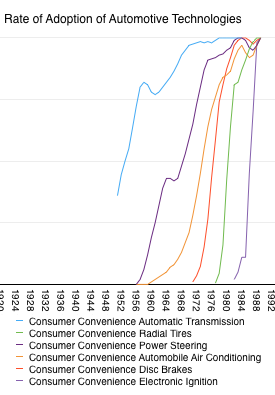
These previous questions were answered by introducing sustaining improvements or modules to the existing production systems. The following graph shows the speed of adoption of various automobile technologies. Hundreds more were introduced and all could be shown to have roughly parallel adoption curves. None of these introductions changed the structure of the industry. ((The industry changed through revolutions in production systems)).
To make electric cars therefore all one has to do is to reduce the cost of electric components for carmakers. They certainly make lots of cars and can make lots more. So why not give them the economic incentives in the form of components to build electric ones? ((Incidentally, hybrid cars are slow to be adopted because the modules are not available as such. Each manufacturer is struggling to match Toyota's solution through internal development—a decade-long process.))
Tesla seems to be an attempt to incentivize carmakers to build electric cars by setting an example. Maybe it will succeed but this is not a reliable or even viable way to build a defensible business. Envy generates the wrong competitive response, usually. If that business cannot be defended then it will perish and so perhaps will the acceleration.
And so we come to the question of whether the defensibility of Tesla relies more on integration. By adding ancillary businesses, can it sustain itself and perhaps eventually pivot away from a commoditizing business (car making)?
Through the addition of a business building batteries and then a business selling home power storage and now adding a business selling home solar power provisioning, the car business becomes a module in a larger system.
So is Musk effectively asking "How to accelerate a global transition away from hydrocarbon energy?"
This gets more interesting as a question. The production, storage and use of energy have been modularized over a century and a half from the wood era through the hydrocarbon era. Perhaps the renewable era will be characterized by integration and de-networking or edge-enabled production. If so the energy problem needs to be solved through a re-integration and a new set of business models. Production and consumption can be coupled and thus production can be decentralized.
But is the answer Tesla+SolarCity? An integrated approach is appropriate if the technical problems are very difficult and cannot be solved through collaboration across firm boundaries and if buyers are eager for great leaps in performance. Join forces if introducing a new measure of performance, solving an unmet job to be done.
A modular approach is appropriate if the problem is one of scale and reach. That is, remain separate if the problems are with finding and building new markets (competing against non-consumption) and if customers are eager for convenience or conformance while being largely satisfied with performance.
This is the crucial dichotomy: The business architecture needs to match the point of time in the evolution of the prevailing measure of performance. Consider this proposed integration an experiment to determine what performance we should measure and thus where we really are.
At WWDC 2016 Apple offered a set of new data points to illustrate its ecosystem's robustness.
First, the number of registered developers increased by 2 million in the last year to a total of 13 million. That is a growth rate of 18%. To compare this total consider that Oracle claimed in 2014 9 million Java developers and IDC claimed in 2014 there were 18.5 million software developers in the world, of which 11 million were professional software developers and 7.5 million were hobbyist developers. It's therefore possible that Apple's "market share" among developers is close to 70%.
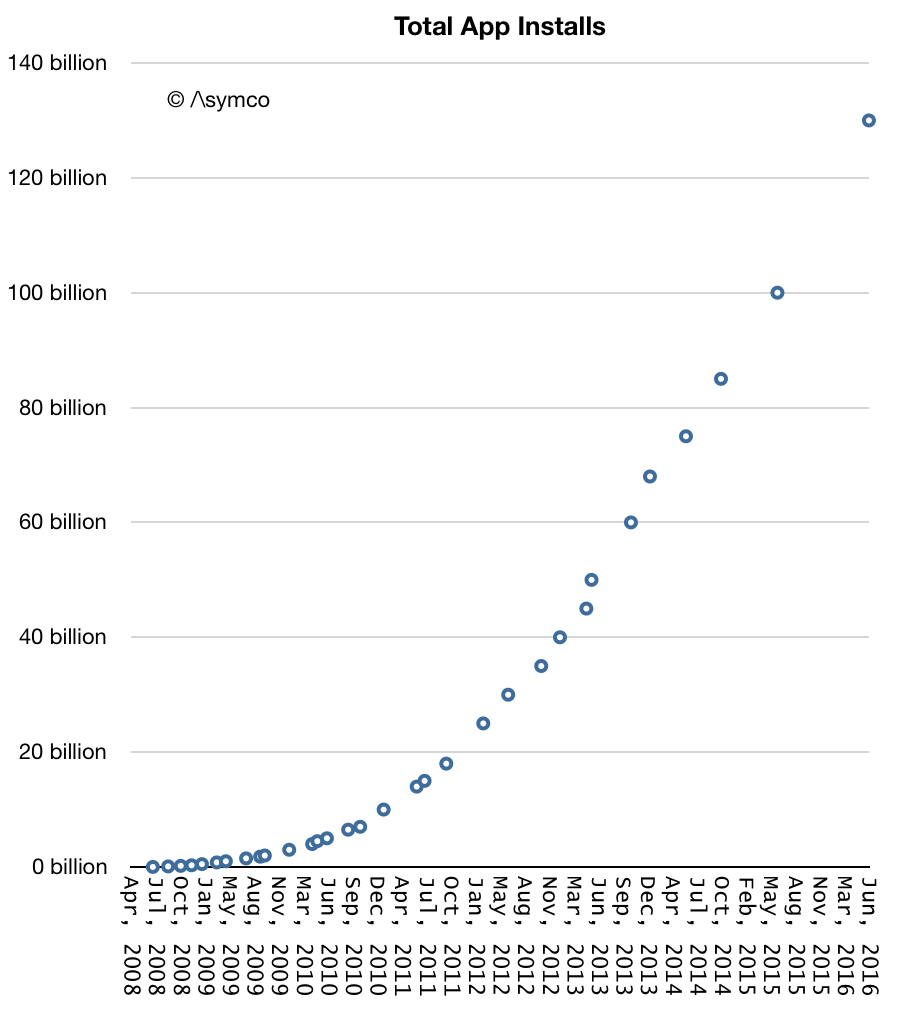
Second, App installs have now reached 130 billion. The cumulative growth is shown in the graph below:
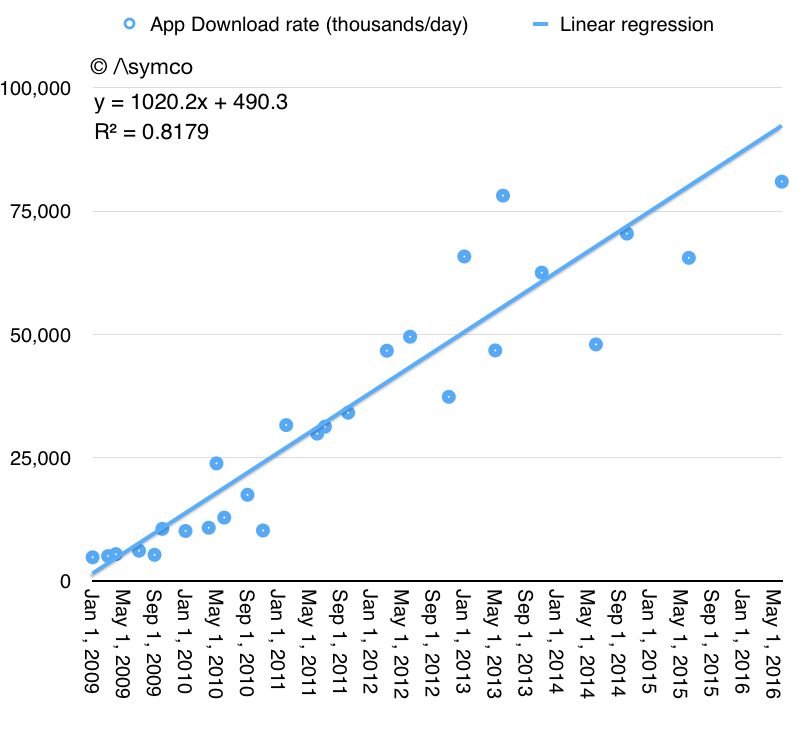
The rate of growth is also shown in the following graph:
Note that the rate of growth continues to increase and is now above 30 billion/yr. It turns out that apps continue to be a popular download item. The size of the audience continues to grow (see graph below) and it's therefore understandable that activity in the store continues to grow.
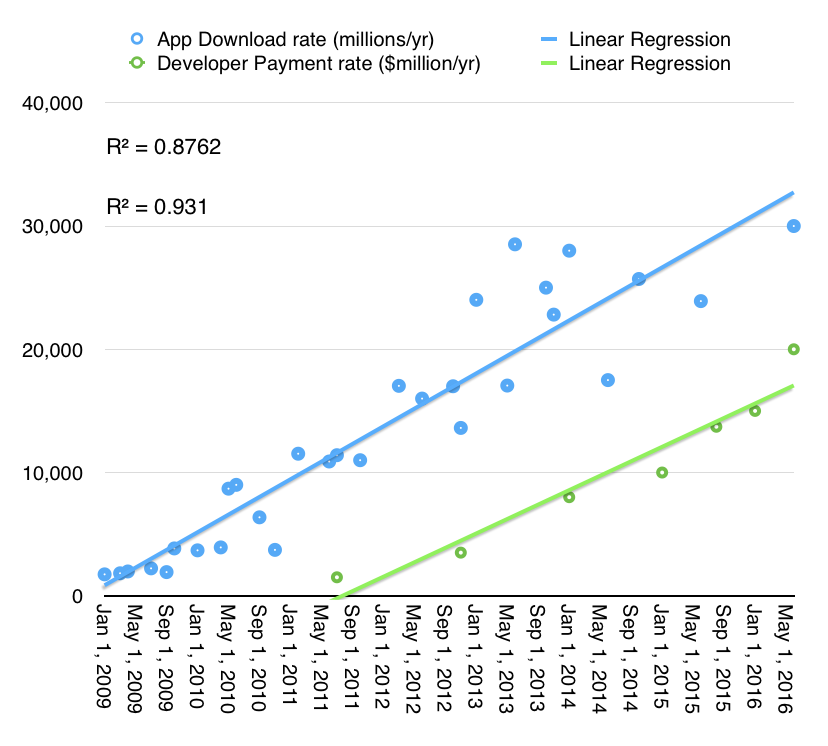
Third, the rate of payment to developers has also increased to over $20 billion/yr., with the total payments having reached $50 billion.
The graph above shows the derived payment rate (in green) relative to the download rate (blue). Although not completely parallel, the overall correlation is plain to see.
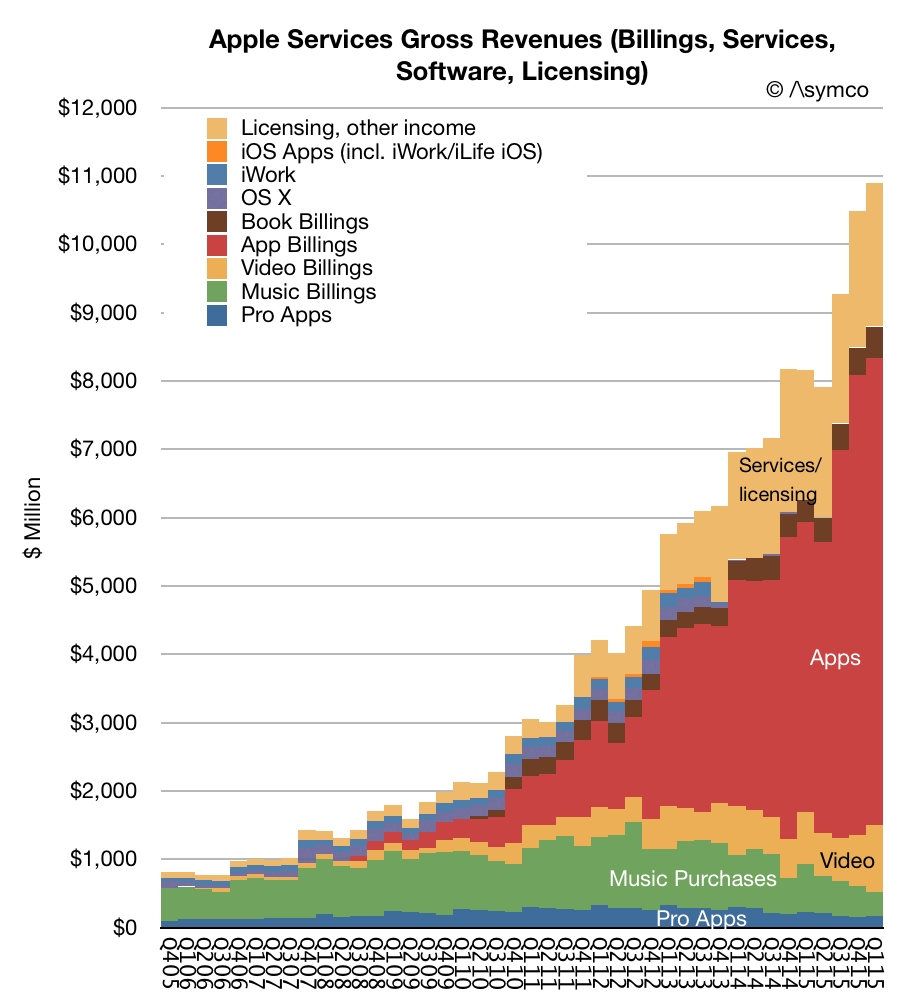
Fourth, there are more platforms than ever (four device and three services). As a result, Apps and services continue to outgrow traditional content revenues. Gross revenues for iTunes/Apps/Software/Services/Licensing is shown below:
Overall, economic activity transacted directly through Apple's platforms is approaching the run rate of $40 billion/yr. It continues to grow at about 20%, so it's foreseeable that it will reach at least $50 billion/yr.
It's hard to compare to other ecosystems as metrics vary but this rate alone places Services as one of the larges businesses in the world (service or otherwise).
There are other ecosystems "on top" of iOS which transact outside the Apple systems (and hence are not reported in the total above). These include Facebook, Google, Uber, Amazon and other economies which use iOS devices to enable engagement. These add up to hundreds of billions of dollars in transactional value. My estimate is that all mobile services are at least $250 billion/yr today and will reach $800 billion/yr in 2020. Apple is and will continue to be the home or enabler to the majority of this revenue.
But the more profound point to be made is that this ecosystem relies mainly on direct payments by the beneficiaries of the service or content. Apple contents itself with the $35 billion it can transact through its own storefronts because it feels that the business models are compatible with its brand.
When it comes to all the ways of "monetizing" platforms, this may be a very conservative strategy but it's one that also avoids the potential pitfalls of social scandal.