Asymco

Asymmetric Intelligence

Horace Dediu

  1. The parable of the telegraph

    Research · 22 comments

    As previously described in an earlier piece on the transistor, there is a theory that underlies much of what this web diary is about. Telecommunications is undergoing wrenching change. And not for the first time. The history of the industry is filled with disruption and thus with drama that leads to fine storytelling.

    One such great story is that of Western Union and the telegraph.

    Western Union was formed as a company in 1851 and ten years later had completed the first transcontinental telegraph line. Following on that breakthrough, it introduced the first digital real-time data service, the stock ticker, in 1866. Business boomed and by 1870 it was the world's most powerful telecommunications company.

    By any standards it was innovative: it offered remarkable and revolutionary telecom data services, a century before the Internet. But in the century that followed why didn't Western Union become the leader in voice communications, ceding that position to the Bell companies?

    Alexader Graham Bell did not invent the voice telephone with the intention of toppling Western Union. In the language of today's technology entrepreneurship he hoped Western Union would be his "exit". He pitched the phone to them as an improvement to their core telegraphy business. Bell offered the patents for the telephone to Western Union for a mere $100,000, roughly $2 million in today's dollars. In other words, today the deal would be: two million dollars to own all voice IP.

    Western Union passed

    Now why would they do that? Imagine you are an analyst at Western Union advising management on technology acquisition and M&A. What process would you use to evaluate it? First, most obviously, you would try to get feedback from marketing and sales. They should go out and survey their customer base to find out who would be interested and how much they would be willing to pay.

    The sales force would naturally seek out their best customers and ask them first. Those customers were the stock ticker users. They were extremely voracious users of the ticker tape system. It should be no surprise why we have "ticker tape parades"--there was enough of the stuff lying around offices in New York to shower down and flood Broadway end-to-end". Ticker tape was a boon to merchants and traders. Chicago would know what's happening in the New York stock exchange instantaneously. Price data was traveling at the speed of light.  The sender and receiver were in lock-step sync. To suggest to these customers a voice product would sound like a step backward. Why would they want to talk to the other party? The data was coming on tape and it was also recorded for posterity. Speaking with the other person meant confusion and delay and a mess of record keeping.

    The word from the customers would be a resounding negative.

    Second would be the business model.  How would you charge for voice? Data was subscription based, and the fees were huge. Voice would be metered and the price low. If targeting consumers, telegrams were priced by the word, but you couldn't price voice by the word. Marketing would stare back at you as if you had committed a judgement error.

    Thirdly you would look at the cost side. Operations would give you more bad news. Voice technology was different enough that it needed new infrastructure. Switchboards, operators, handsets and new power and insulator requirements were all expensive and had no clear return. Voice was a loser all around.

    So the decision was perfectly reasonable, smart even.

    This is not to suggest that Western Union did not accept any new technology or invest in it. For decades after the phone, Western Union continued to invest in innovation: It introduced an electronic payment system (called money transfer) in 1871. In 1914 it offered the first charge card and in 1923 it introduced teletypewriters. Singing telegrams followed in 1933 and fax service in 1935. Intercity wireless microwave communications were introduced in 1943. Telex came in 1958 and the product of marketing genius, the 'Candygram' in the 1960s. By 1964 its network was all wireless using a transcontinental microwave system. Western Union became the first American telecommunications corporation to maintain its own fleet of geosynchronous communication satellites, starting in 1974. The fleet of satellites, called Westar, carried communications within the Western Union company for telegram and mailgram message data to Western Union bureaus nationwide.

    And it wasn't lacking in talent either. Western Union had the best telecom managers in the business and was raking in profits to fund expansion. It attracted the best and brightest engineers for generations. Western Union probably passed on hundreds of other inventions and ideas, and rightly so.

    So what happened to WU?

    It's still around. However, due to declining profits and mounting debts, Western Union slowly began to divest itself of telecommunications-based assets starting in the early 1980s. Due to deregulation in the US, Western Union began sending money outside the country, re-inventing itself as "The fastest way to send money worldwide". In 1987, an individual investor acquired control of Western Union through an outside of chapter 11 process that was a complex leveraged recapitalization. After several other changes in ownerships and moves through bankruptcy, WU is now a public company with an enterprise value of about $12 billion based entirely on international money transfer business.

    3G as a disruptive technology

    Today we've come around full circle. Whereas voice was disruptive to a data network provider in the 20th century, data is disruptive to a voice network provider in the 21st. The mis-application of 3G network technology to sustain voice-oriented business models gives one a strong sense of déjà vu.

    The telecom world moved swiftly to 1G and 2G cellular voice. Each new generation of mobile telecom was sustaining the core business model of subscriptions feeding centrally managed networks and symbiotic device vendors benefiting from handset and switching system upgrades. Standardization, international expansion, lower price points and network effects made this industry the most ubiquitous technology distributor the world had ever seen.

    3G however was different. It was effectively mobile broadband data. It enabled data services to be de-coupled from the network operators. IP protocols did not require the servers to be located on operator premises or even to be managed or monitored by them. Devices could be general purpose computers not specific purpose communicators. Incumbents did not adapt to this well.  They continued to build business plans according to a central-switch blueprint.

    So although incumbents did not reject the smartphone as a technology, they tried to make it sustaining when plainly it isn't. They essentially tried to cram it into their business models.

    The struggle to keep the service structure of telecom centered around the network operator will continue, but short of pulling the plug on 3G and LTE, there is little that the incumbents can do to stop it.

    So what's the lesson?

    Some technologies are embraced and some are rejected. You can't fault every rejection and you can't praise every acceptance. The most likely reason for embracing something is that it helps grow your existing business. The most likely reason for rejection is that it may harm your business. Even acceptance sometimes leads to mis-application in sustaining the core rather than planning for its demise.

    The decision on how to handle something new and potentially disruptive requires a different sense of what's right and wrong about it.

    --

    Photo: Former headquarters of WU, located at 60 Hudson, New York.
  2. BusinessWeek: Nokia failed because it's in Finland

    Research · 12 comments

    How Nokia Fell from Grace - BusinessWeek.

    The author asserts that company success and failure are determined by the location of its headquarters. He also adds a bit of stupid manager theory to flesh out his thesis for Nokia's failure.

    I've already debunked the stupid manager theory here. So let's look at what's left.

    The bad geography thesis is a far less common theory than the stupid manager theory but maybe it's worth analyzing.

    Here are the basic questions anyone can ask:

    1. When did Finland become a bad location, exactly? It was clearly a good location for Nokia when it was winning and growing. It seems to have become a bad location for Nokia around the same time its business began to slow down. That puts Finland at a geographic disadvantage around 2005 or so. As far as anyone can tell nothing changed with the population or intellectual capital of the country around then (if anything all the surveys seem to show it's gotten better). So whereas Nokia was successful in Finland and unsuccessful in Finland and Finland did not change, Finland cannot be causal to the failure.
    2. If Finland had something to do with it, did companies in Finland succeed at the same time as Nokia and fail at the same time? I don't have any evidence to confirm or deny this but I will say that the iPhone's most popular application is written in Finland (Angry Birds by Rovio). So there are still creative and clever people around.
    3. If location in "hub" locations like Detroit for automobiles or New York for finance, ensures success... oh, never mind.
    4. Since Sony was successful in Japan in the 70's and 80's then should they also have moved in the last decade when their business turned? Is Japan also an isolated place for innovation?
    5. What about Microsoft? Seattle was the technology boonies when Microsoft moved there.
    6. Finally, when Hewlett and Packard started in the agricultural plains south of San Francisco, I'm sure the residents of electronics hubs of New Jersey and upstate New York pointed and laughed.

    The hypothesis that location matters in success or failure of business models is so easy to disprove that it's hardly sporting.

  3. Windows Phone Thoughts: AT&T set to release multiple Windows Phones

    Research · 6 comments

    That makes a total of six devices for [AT&T] who is looking more and more like the premier Windows Phone 7 partner.

    via Windows Phone Thoughts: AT&T Set to Release Multiple WP7 Devices.

    With Verizon shaping Android into its image, you can read AT&T's embrace of Microsoft as the deeply-held belief by operators that they need multi-platform balance in their portfolio.

    The idea that operators will tolerate "dominance" of a platform is looking less and less tenable.

  4. IBM CEO: the PC era ended three years ago

    Research · 23 comments

    But one area where IBM won't compete with HP is personal computers. In 2005, IBM sold its PC business to China's Lenovo Group for $1.75 billion. The PC era, Mr. Palmisano said Tuesday, ended three or four years ago.

    "We wanted to get out before it was obvious to everyone," said Mr. Palmisano. "I couldn't give it away today," said Mr. Palmisano of the PC business. HP is the world's biggest PC maker.

    via IBM's Chief Thumps H-P - WSJ.com.

    Is this obvious to everyone yet?

  5. What Apple and Android owe to Symbian and RIM

    Research · 6 comments

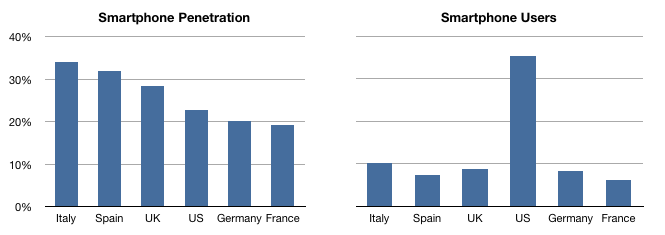
    Following up on survey data showing that up to 25 percent of Americans have moved to smartphones, here is another survey (Comscore) which shows that US smartphone users are at about 23 percent.

    Comscore also surveyed European countries, and we can compare the popularity of smartphones vs. the US.

    I also indexed the share to population to show the relative populations of smartphone users across these countries.

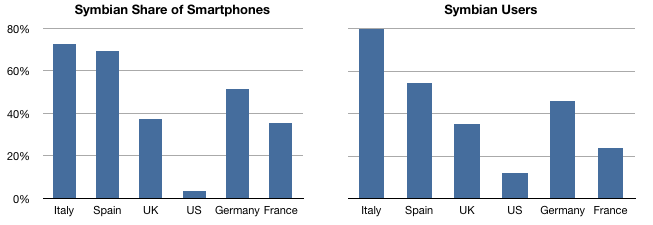
    It may come as a surprise to some that smartphones are more popular in the UK, Spain and Italy than in the US. Considering that these are countries with lower levels of disposable income, and that in Italy and Spain pre-paid plans are overwhelmingly more popular. Buyers in those countries are much more likely to pay full, unsubsidized prices plus 20% or more VAT. Overall the price differential for an Italian buying a smartphone vs. an American is likely to be a factor of 5. It gets even more peculiar when you consider that many Italians have more than one phone, with overall phone line penetration above 100%.

    The explanation for this remarkable appetite for smartphone goodness is the early lead that Symbian had in Europe. Buyers who entered the phone market ten years ago became accustomed to upgrading their Nokia phones. Symbian phones were aspirationally positioned as feature-rich camera and messaging devices. Many were also purchased without data plans and were thus used as high-end feature phones. In other words, consumers in those countries were comfortable paying full price for unlocked Nokia devices and using them with multiple SIM cards.

    This can be seen in the share of Symbian in these charts:

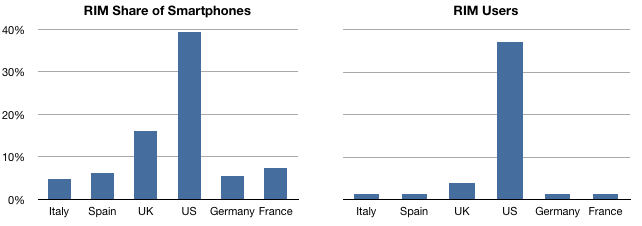
    The data points to how normative behavior evolved and how different that can be even among culturally aligned Western nations. When looking at Asia and South America, it gets even more interesting.

    Whereas in Europe it was Symbian, in the US RIM got the ball rolling.

    The contribution of these platforms in shaping expectations, not to mention pricing, for the iPhone and Android should be noted.

  6. Per Lindberg predicts things

    Research · 18 comments

    “The N8 is certainly a step in the right direction, it’s much more multimedia,” Per Lindberg, an independent technology analyst at MF Global in London, told Marayam Nemazee on Bloomberg Television’s “Countdown.” “But whether it will move Nokia’s market share upwards is more debatable,” he said adding that Android phones are becoming an “formidable force.”

    via Nokia Says Preorders for N8 Smartphone Are Strongest Ever Seen - Bloomberg.

    This is the same Per Lindberg who, in January of this year, reiterated his February 2009 Sell rating on Apple and the entire smartphone industry:

    "There is no doubt, in my mind, that the whole sector is hugely overstretched," says the London-based physics PhD and MBA graduate who joined MF Global Ltd. in 2008 after 10 years at investment bank Dresdner Kleinwort.

    "The whole sector is priced as if the average player would sustain 25 per cent margin in eternity," he adds.

    "It's bordering on absurdity. This will end in tears."

    He is willing to use the b-word: "Many stock bubbles are generated by sell-side analysts generating enthusiasm for the companies they cover."

    To date however, it's Mr. Lindberg's call that's been the costly one for investors. He has maintained his sell rating on Apple since early February of last year, causing investors who followed his advice to miss out on a more than 110-per-cent surge in the share price.

    Meet Apple's sole skeptic - The Globe and Mail

    In February 2009 Apple's stock price was $89. Yesterday it closed at $267.

  7. Nielsen: Nearly 25 percent of US adults use smartphones

    Research

    Nearly all U.S. adults have cell phones, and 1 in 4 uses a smart phone, compared with about 16 percent last year, Carson said.

    Nielsen, which surveyed 4,000 mobile-phone subscribers in August, predicts that the majority of mobile subscribers in the United States will have smart phones by the end of 2011.

    via AppNation opens to sound of cha-ching.

    Nielsen surveys are sound.

    The last survey in June showed 20 percent penetration for smartphones in the US.

    asymco | 20% of American subs have a smartphone with 1.2 million switching every month

  8. iPad in the enterprise: Once the head goes, the body follows

    Research · 28 comments

    In my talks with about 100 senior-level people at as many companies over the past six months, the feeling is that the tablet is here to stay and it's going to be bigger than everyone expected it to be. It's an always-on, always-with-you data experience. The other thing is that we spend about $1,500 for a laptop and another $300 per year over five years for the Microsoft Office suite. That same capability on an iPad is $600 to $800, and the software is $10 per application forever. It's about one-third or one-fourth the price. The cost of ownership is inexpensive--and that's just the first generation before they drop prices.

    via Rise Of The Tablet Computer Page 3 of 3 - Forbes.com.

    How fast is it catching on?

    In the C-suite and the executive suite there is mass adoption. In Bank of America it took 60 days to hit the corporate standards list, which is the fastest any technology has hit that list. We've already bought 1,000 of these and we hadn't bought anything from Apple in more than a decade. Executives everywhere are carrying iPads. And like we saw with the BlackBerry, once the head goes the body follows. The top executives get them and then they order them for the next 10 or 20 people.

    The iPad use in corporate settings is even more disruptive than the Blackberry. No contract to sign, no administration overhead for voice and data plans. Trivial setup and instant gratification.

    The way iPad is knocking down IT barriers to entry makes one wonder if Apple did not engineer it for this. But when you look at the product and positioning corporate use is that last thing you think of. This is often the case with disruptive products.

    Lost of other great quotes in the article. For example: the iPad can be passed around a table but a laptop can't.

  9. FaceTime and the elevation of emotion over function

    Research · 8 comments

    With 50 million clients installed likely this year, FaceTime is a service which may have potential.  By potential I mean, of course, its potential to make a dent in the universe, the universal goal Jobs has set for Apple so many years ago.

    It's entirely possible that FaceTime will be an inconsequential nice-to-have enhancement to the iPhone platform that sustains and improves the iOS (and OSX) franchise. But it's also entirely possible that FaceTime could become a disruptive challenger to the functional voice-oriented telecom network.

    What you choose to measure determines what you know

    The thing that jumps out at me is the service's under-performance along metrics that the industry defines as critical but over-performance on dimensions that the industry considers non-critical.

    It suffers from poor coverage (WiFi only), a limited network of possible users, high bandwidth requirements which are still hard to match and a steep price point for initial entry.

    But I would say data-oriented devices were similarly met with poor performance 4 to 5 years ago. No 3G, poor coverage, few services and high prices. Even today there are many telecom skeptics who think smartphones are toys for the well-to-do or IT types and not something for the mass market.  As can be easily seen however, all the shortcomings of the mobile-data-oriented-device (aka smartphone) turned out to get ironed out with time. You just need to plot a historic graph of network performance and device price points to see where they're going to go.

    On the other side of the equation FaceTime offers huge performance on the dimension of emotional attachment to a device and to a conversation. The FaceTime experience is qualitatively distinct from either desktop video chat or device-based VoIP. It's intimate, emotional and stirring, (just look at the commercial) not to mention accessible by just about anyone. These new measures of performance cannot yet be quantified with spreadsheets and measuring the effect will not be a priority for anyone in the industry for a long time to come. Therefore, the asymmetry is there implicitly.

    So here we have classic Apple: shifting of the basis of competition so subtly that it's almost imperceptible while under way yet glaringly obvious after the fact.

    So what does FaceTime have to do with FaceBook?

    When FaceBook launched, I don't recall observers predicting that a site allowing college students to keep track of their friends after graduation would grow into the stickiest site by time spent online ever seen. Nor that it would become a site that swallowed all online communications including IM and email. Nor a site that would possibly challenge search consumption. The performance attributes that FaceBook relied on were not in algorithms but in the emotional hooks that relationships have with people. FaceBook was personal, emotive and private, the exact opposite of what the Web offered a decade ago.

    So, like the names imply, both these services are about Faces, the first objects we as humans recognized after birth. That's a powerful image to have a handle on.

    The pattern that emerges is that Web 2.0, Telecom 2.0 and Personal Computing 2.0 will pivot on the elevation of emotion over function. That may be a banality but empires have been built on less.

  10. When will the smartphone become a commodity?

    Research · 21 comments

    I am taking a comment thread and promoting it to an article so as to expose it to a larger audience. There are two points of view:

    Ariel writes:

    I believe that next year and perhaps the year after that will see intense competition on the OS platform front, but eventually one will dominate the other(s) by a significant margin (and this also depends on the cloud and how it will be adopted across platforms). This happens as a result of a unified platform in which many can compete on lower margins instead of the development of the entire package and platform, which all goes hand in hand with commoditization.

    However, to predict that smartphones will not be commoditized within the next three years is bold to say the least. The desktop was settled very quickly, and in this industry of exponential growth, it can be assumed it will not take longer for a similar scenario to settle.

    I reply:

    I’ve been observing (professionally) the smartphone market from its inception and was holding my breath for the commoditization of handsets that Microsoft promised all the way from 2004 through 2009. Several generations of Windows Mobile were predicated on the imminent stabilization of hardware and user experiences years before the iPhone came along. Not only Microsoft but Palm via PalmSource, Symbian as a consortium of all incumbents, Sun & IBM via Java, DoCoMo with iMode and not least of all, Qualcomm with BREW all made the same bets and ran with horizontal strategies toward a smartphone future built on the lessons of the PC industry. The only holdout for the integrated approach was the one company that everybody marked for dead: RIM. It’s also the only one who raked in all the profits.

    All this happened before 2007.

    To suggest that this time, in 2010, it’s different: that the definition of the smartphone as it exists today is the product at its zenith; that user experiences and expectations and hardware specifications and platform dynamics will be henceforth frozen with minor sustaining tweaks to look forward to is, in my opinion, a far riskier bet.

    I don’t try to be a futurist or predictor of how the product will evolve, but I can see a dozen ways of how the very definition of a smartphone will change and how in 4 years we’ll have products that won’t be recognizable as such today.

    So much depends on when the smartphone (or more broadly mobile computing) reaches this point of good enough. It's at the root of all hypotheses of how the market will evolve.