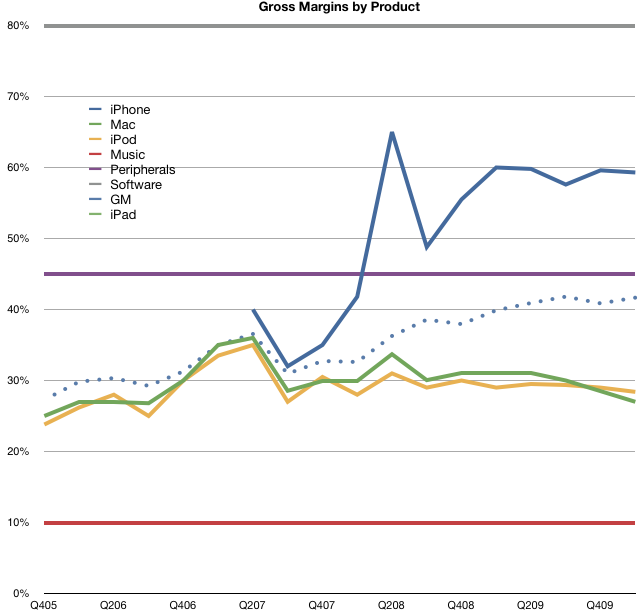
Apple's overall gross margin reached 41.67%, the second highest ever. The highest was 41.82% last Fall. This should not come as a surprise as the iPhone continues to make up an increasingly larger percent of Apple's total sales. The gross margin on the iPhone continues to be well above all its other product lines (except for software).
Although Apple does not provide product line GM break-out, some intelligent guessing can be made. Here are my estimates:
iPhone 59%
Mac 27%
iPod 28%
iTunes 10%
Periph 45%
Software 80%
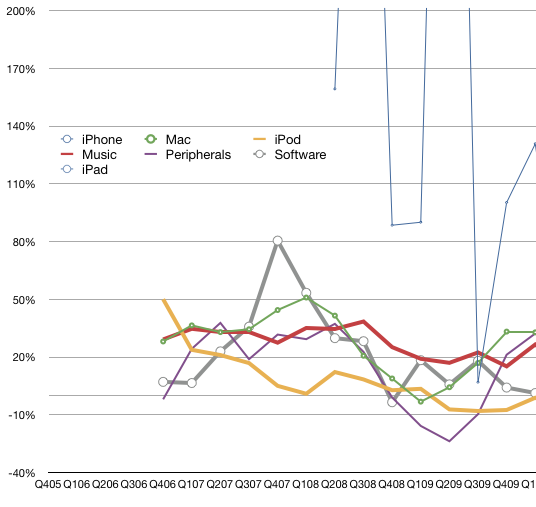
A historic perspective for gross growth (iTunes, Peripheral and Software sales growth) is shown in the graph below.
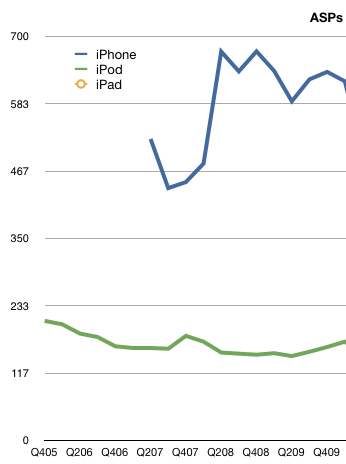
Each of Apple's individual business lines is profitable. Last quarter only the iPod experienced negative year-on-year unit growth but still generated a positive sales growth due to higher ASP.
Here is the list of each product line and its y/y sales growth:
Unit Growth, Sales Growth
iPhone 131%, 124%
Mac 33%, 27%
iPod -1%, 12%
iTunes n/a, 27%
Periph n/a, 32%
Software n/a, 1%
Overall sales grew 49%.
A historic perspective for unit growth (iTunes, Peripheral and Software sales growth) is shown in the graph below.
Nokia reported 21.5 million converged devices sold in Q1. The units, share, ASP, Revenues and Operating Profits are compared in the following table.
It's once again evident that Apple captured more profits from the iPhone than Nokia did from all its devices and services operations.
With respect to converged devices, Apple also generated more sales and had nearly triple the ASP. Unit shares remained almost the same sequentially. Nokia did suffer more from ASP erosion sequentially as the converged ASP dropped by 24% vs. a 2.5% drop for Apple.
What is interesting from a growth perspective is that Apple's #1 position in the share of profits from mobile phones was acquired with such a low market share. Analyst Brian Marshall said the most interesting part of Apple's story is the international growth of the iPhone. He believes that Apple has only acquired about 1.5 percent of its international carrier partners' total postpaid subscription base of 525 million. For comparison, its penetration in the U.S. peaked in Sept. 2009 on AT&T with 5 percent.
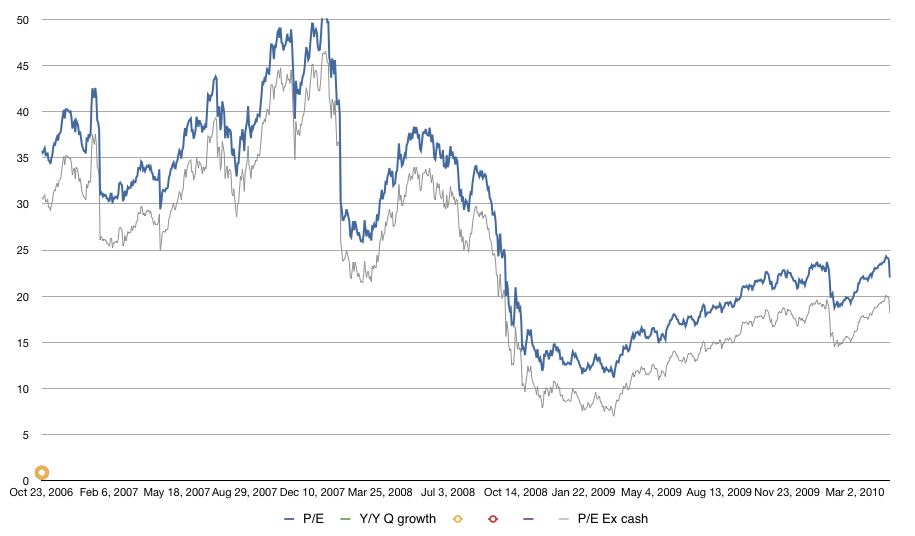
Apple's latest earnings showed growth of nearly 90% (following a nearly 50% growth the previous quarter.)
Normally, growth like this is rewarded with a significant P/E ratio of 30 to 40. Apple enjoyed P/E of 50 as recently as 2007. However Apple's P/E ratio dropped to about 22 after earnings.
Although higher than during the worst of the recession, this low P/E either reflects continuing pessimism in the overall sustainability of the economy or a continuing discounting of Apple's potential growth.
Excluding the nearly $45/share cash and looking at a forward twelve months earnings of 15, the forward P/E is an almost embarrassing 14.
It's possible that after a few quarters of above 50% growth Apple's P/E and hence its valuation will return to more normal (PEG ~1.0) levels. A P/E of 30 at today's trailing 12 months earnings would put the stock above $350/share.
About 31% of the units sold in Q1 were activated on the AT&T network. The iPhone is reaching a more balanced global distribution but still has a long way to go.
On the company's earnings call, Apple COO Tim Cook says the company is "shocked" by initial demand for the iPad. He also added, "I'm personally addicted to mine and couldn't live without it."
I argue that Apple now has not one but two monopolies:
I) A nearly-total monopoly on computer (and pocket computer) systems designed with good taste. II) A total monopoly on the Microsoft-free, hassle-free personal computer.
Imagine that every car maker save for Toyota insisted on using the infamous East German Trabant as a standard of quality – yet blindly imitated random elements of Toyota’s visual design. How long would it take for the whiners to appear on the scene and start making noises about monopolistic tyranny? How long would it take for Toyota to start living up to these accusations in earnest? And why should it not do so? What is to be gained from corporate sainthood? ...
Of course, Apple’s competitors cannot actually copy the secret of its greatness, because Apple is a fundamentally different type of organism. Rather than a brainless government-by-committee, it is an extension of one man’s will, projected with the aid of a small group of trusted lieutenants: no focus groups in sight. For the Apple-imitators to turn into genuine “Apples” would be as fantastic and unlikely as it would be for a slime mold to spontaneously become a true multicellular animal, equipped with a central nervous system. It is also unclear that, from their own perspective, they should want to grow brains – for a creature with that kind of centralized point of failure is decidedly no longer immortal.