Asymco

Asymmetric Intelligence

Horace Dediu

  1. Podcast: The New Industry Analysts, Who Are They? (Part One)

    Podcast

    Over the last couple of years we have been witness to the rise (and fall) of new research initiatives. What defines them, and what drives them to take on the market as they do?

    Hosts Thom and Derk Erbé are joined by Phil Fersht, Michael Coté, William Tincup and Horace Dediu. The panel drills down on new types of industry analysts and how they will change the IT research landscape.

    Source: Podcast: The New Industry Analysts, Who Are They? (Part One)

  2. The Alphabet of Google A and Google B

    Research · 86 comments

    For the last few years, I've been proposing that the way to conceptualize Google is as two separate entities: Google A and Google B.

    Roughly speaking Google A was the R&D ((Research and Development)) organization and Google B was SG&A ((Sales, General and Administrative)). You can find the operating expenses of running each of these organizations in the company's income statement.  In the last quarter R&D was about $2.8 billion and SG&A was about $3.5 billion ((Sales and marketing was $2.1 billion and General and Administrative was $1.5 billion)). The two entities are further distinguished as follows:

    • Google A was led by Eric Schmidt and Larry Page and Google B was led by persons unknown, but mostly represented by the "Chief Business Officer" Omid Kordestani.
    • Google A spends money. Google B collects money.
    • Google B sends a check to Google A while Google A sends data to Google B (which then sells it on to advertisers and collects money).
    • Google A communicates frequently with optimism and enthusiasm about the future. Google B remains quiet.
    • Google A solves problems of humanity, Google B solves problems for advertisers.
    • Google A has users, Google B has customers (to whom it sells users.)

    In summary, Google A is altruistic, Google B is pragmatic. Google A engages in research, Google B engages in commerce. Google A operates in a structure similar to a Bell Labs for the good of humanity ((Using a definition of Good as established by the founder)),  Google B operates in a structure similar to AT&T and collects monopoly rents but without any government oversight.

    This was an effective construct for analysis which explained to me much of how Google operated and how it made decisions. So what do we make of Google's new Alphabet? Is this a dissolution of the Google B/Google A dichotomy?

    My initial answer is no. We don't have a change in this core structure. What we have instead is a split of Google A into Google A and Google A+.

    A+ is the crème de la crème of the altruistic Google A. It's the stuff that really does not make money. It's the laboratory of Bell laboratories. It's the moonshot manufacturer. It's the incubator where hobbies are hatched. It's the funder of ventures.

    After A+ is carved out, Google A and Google B remain exactly as they were, now under a new CEO. The previous CEO no longer has any day-to-day input in the running of Google A and is no longer soiled by association with Google B.

    Alphabet is therefore the "holding company" of Google A+, Google A and Google B. I can only suppose that the separation of A+ from A (and the previous A from B) allows the founders to distance themselves even further from the purchase decisions which, through pricing signals, determine where value lies and how resources should be allocated. That must be a great relief.

  3. The new switchers

    Research · 66 comments

    During the last quarterly earnings call, Tim Cook said that Apple has seen the highest switching rate from Android ever. That there is switching isn't surprising. We've seen many surveys which show higher loyalty with iOS than with Android. But it's been very hard to spot the evidence in the data which is visible publicly. Both iOS and Android are adding users and sales for both platforms are still increasing.

    The switching effect is easier to discern when the market is not growing overall. In that situation one platform's growth has to be at the expense of another. However, some markets do show evidence of "churn" in users.

    Screen Shot 2015-08-10 at 8-10-12.52.52 PM

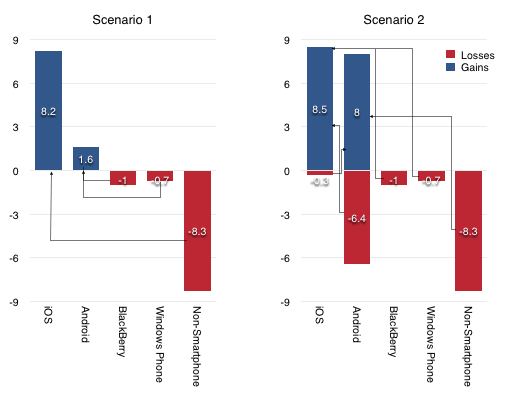
    Consider the ComScore data on US platform users (above). If we look at the last six months' data ((these data are actually three month averages)) we can count that there are about 8.2 million more Americans using iPhones than there were six months ago. At the same time, there are 1.6 million Android users. One million users left the BlackBerry platform and about 700,000 left Windows Mobile. The data also suggests that the total number of first-time smartphone users is about 8.3 million.

    Now, we could say that Android recruited all the Windows and BlackBerry users that switched (1.6 gained equivalent to 1.7 million lost) and Apple recruited all the new-to-smartphone users (8.2 million gained by Apple vs. 8.3 million non-consumers).

    Screen Shot 2015-08-10 at 8-10-12.44.31 PM

    But this is not very plausible. It's much more likely that Apple converts existing smartphone users while Android converts first-time users.

    In this scenario, 8 million non-users first started using Android while 1.7 million BlackBerry and Windows users switched to iPhone. But that leaves the question of what happened to the missing 6.3 million that Apple should have gained.

    That's where the switching number comes into the picture. This Scenario 2 is shown in the figure above and suggests that although Android gained 8 million new users, it lost 6.4 million to iPhone for a net gain of 1.6.

    Apple may have also lost a few users to Android but overall gained switchers from other platforms, mainly Android. This is what would support Tim Cook's comments.

    Thinking further ahead, as the markets mature globally, they may well evolve into the way the US market evolves today. Apple's brand promise ensures loyalty while competing platforms slowly "leak" users. If this sounds eerily familiar then you'd be right. This is exactly how the PC market behaves today.

  4. Samsung's profit center

    Research · 41 comments

    Will there come a time when Samsung will earn more profits from the iPhone franchise than from its own Galaxy product line?

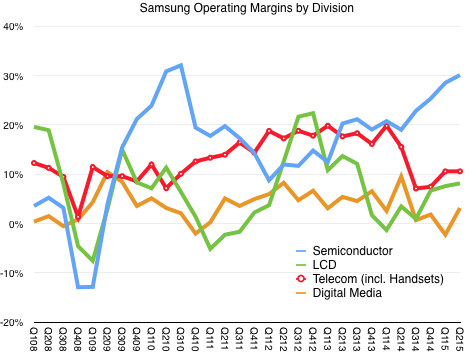
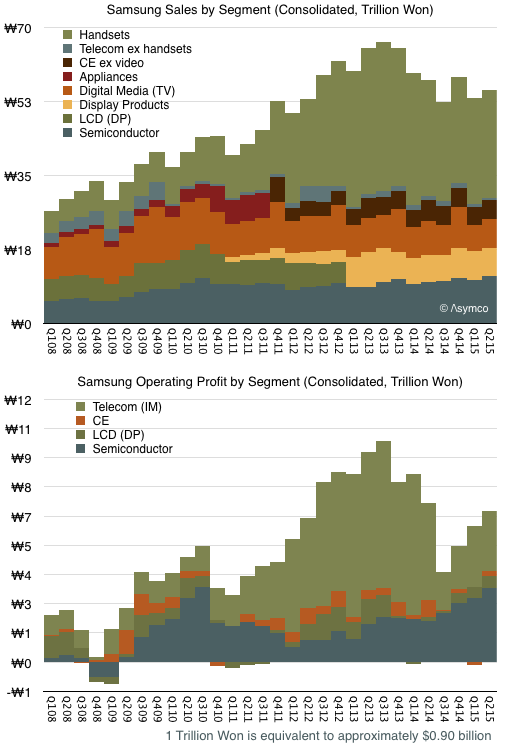
    The problem for Samsung is that although it still sells the most phones ((over 80 million but we don't have a precise figure)), and the most smartphones, the price and margins for these products are collapsing. The pattern is shown in the graphs below:

    Screen Shot 2015-07-30 at 7-30-8.20.29 PM
    Screen Shot 2015-07-30 at 7-30-8.20.22 PM

    Phone operating margins peaked in Q1 2014 at 20% but are half that level today. These margins have dropped to levels Samsung had in 2009, before the Galaxy launched and before they had any substantial revenues from smartphones.

    In contrast, the semiconductor group is growing both revenues and margins. Margins and operating profits are both 50% higher than those of devices.

    We also know that Apple is Samsung Semiconductor's single biggest customer. We can't be sure how much of the total revenue/profit comes from Apple but if the pattern continues then Apple could be the greatest contributor to Samsung's profitability in the near future.

    How could this be? Wasn't Samsung supposed to "disrupt" Apple?

    The reality is that Samsung's own smartphones are being disrupted by good-enough Android devices, typically made by Chinese brands. This low-end disruption is also affecting LG, another phone maker and Apple supplier.

    Unlike Samsung and LG, Apple is less susceptible to low-end disruption. What Apple offers is a brand promise, an ecosystem, associated products and services and what amounts to a new market. It's this parallel value network that competes with Android/Google, rather than with Samsung.

    Samsung is a supplier in the Apple network and a licensee in the Google network. As a result, it has a near monopoly position with a platform controller (Apple) and a commodity position with a platform licensor.

    Neither position is one of control, but the current market stage benefits Samsung within the Apple ecosystem more than  in Google's ecosystem. It's a situation analogous to one where Intel made both x86 chips and PCs that ran Windows. Long term it's likely that the sole-source chip business does a lot better than the multi-source systems business.

    That should be a warning to others who hoped to survive as Android OEMs. They don't have semiconductors to sell to Apple.


  5. The one where I offer stock tips

    Research · 50 comments

    Let's say I offered you the option to invest in a monopoly or in a hit-driven company whose survival depends on always finding the next big thing? Which would you invest in?

    Before you answer, let's say I offered you the option to invest in a person who has a large inheritance or a person who is poor but is hustling for any opportunity. Whom would you invest in?

    Before you answer, let's say I offered you the option to invest in real estate of a city which depends on a stable, capital-intensive manufacturing base or one where they make nothing but movies. Where would you buy land?

    Each of these reflect the same choice: stability vs. instability, the known vs. the unknown.

    Historically, capital has always gone toward the stable and away from the unstable. Wealth has gone the other way.

    Onward.


  6. How iPad Educates

    Research · 20 comments

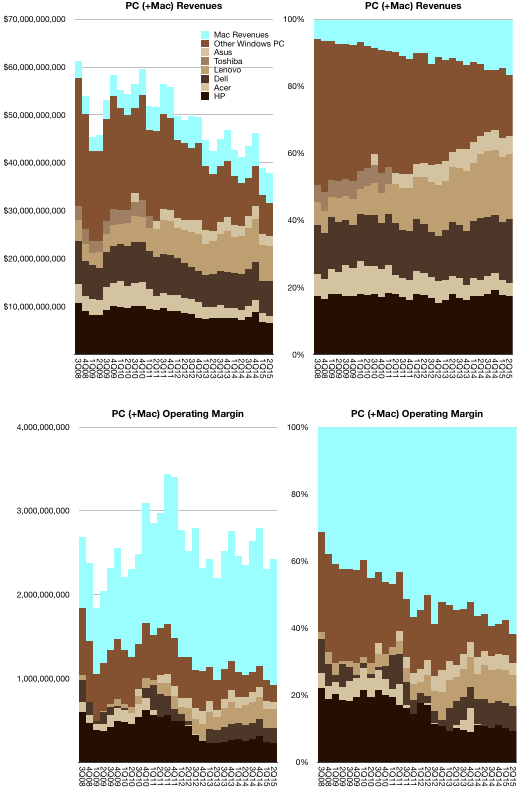
    The fact that the iPhone is contributing over 90% of the operating profits in mobile phone sales has penetrated even as far as the Wall Street Journal. However, it's not yet commonly known that the Mac captures a majority of personal computer operating profits, at least when considering the sale of hardware.

    My calculations suggest at least 60% of operating margin in personal computing hardware is captured by Apple. This is mainly due to the fact that the average Mac sells for more than $1200 while the average PC sells for less than $450.That is equivalent to $1.5 billion per quarter for Apple vs. $930 million for all the other PC makers combined.

    Screen Shot 2015-07-17 at 12.16.27 PM

    If we are to consider the iPad as a "PC equivalent" computer ((for a substantial minority of tasks)) then another $billion/quarter is contributed to the profit pool. It increases Apple's share of profits to 73%. As a result, Apple absolutely dominates computing profits.

    But, as we know, computing, even on handheld devices, is enabled by a multitude of business models. Selling hardware is one thing, but Microsoft showed that one could sweep up profits in the industry by selling enabling software. It's much harder to assign a share of profits if we try to consider all the business models associated with computing and all the form factors that computing has taken shape in.

    The problem can be acutely observed with the iPad alone. It's sold with a decent margin ((my estimate is a gross margin of around 27%)), though not one which approaches that of the iPhone ((my estimate of the iPhone gross margin is near to 48%)). It also enables an ecosystem with thousands of collaborating firms and users.

    Consider the uses of the iPad in education. 15 million iPads were sold to educational institutions. An unknown number of millions have been hired for education uses by end-users or teachers. The result is over 100,000 education apps are available in the App Store.

    The education sector's "jobs-to-be-done" has led to the product being associated with entire new processes for education. Education is not a product but a process and therefore any technologies must be hired as part of the process. In the App Store you can see the “Apps in the Classroom” guides along with impressively powerful apps being used in education. These are educator-created guides designed for other educators.

    There is no way to measure the "profit" in this endeavor.

    Nor is there a way to capture the "profit" in people engaging in exercise because they wear an Apple Watch.

    Nor is there a way to track the operating profit of HealthKit which has enabled 1000 apps to help people manage their health.

    These education and health efforts are not designed to be profitable. And yet Apple is very profitable. That is because creating valuable things generally leads to value being accrued by their creator. How that happens is not very important. Indeed, focusing of the how is actually often self-defeating. What matters is the why and the what is done.

    Understanding this leads us to understand the foundation of any great organization, not just Apple.


  7. Apple management answers questions on the market performance of Apple Watch

    Research · 10 comments

    Katy Huberty (Analyst - Morgan Stanley): You've said in the past that the watch may take longer to ramp given the new category and new interface to customers. Is that, in fact, playing out? Is the watch ramping slower than past product categories?

    Tim Cook (CEO): Katy, when you use the word ramp, do you mean from a -- I assume you're talking about supply?

    Katy Huberty (Analyst - Morgan Stanley): Yes. Pre-orders and first week in sales and any other data points that you track in terms of interest versus, say, when the iPad launched in 2010?

    Tim Cook (CEO): Let me talk about supply and demand and sort of separate those two. Right now demand is greater than supply. And so we are working hard to remedy that. ((This is still true today, three months later))

    We've made progress over the last week or so and we're able to deliver more customers an Apple Watch over the weekend than we had initially anticipated. We're going to keep doing that. […] So I'm generally happy that the -- that we're moving on with the ramp.

    It is a new product for us, and with any kind of new product, you wind up taking some time to fully ramp.

    Having said that, I think we're in a good position. And by some time in late June, we currently anticipate being in a position that we could begin to sell the Apple Watch in additional countries. And so that's our current plan. ((This has been achieved according to plan.))

    From a demand point of view, it's hard to gauge when you don't have product in stores and so forth. And so we're filling orders completely online at the moment.

    The customer response from people that have gotten theirs over the weekend have been overwhelmingly positive. And we're far ahead of where we expected to be from an application point of view.

    To give you a comparison, when we launched the iPhone we had about 500 apps that were ready. When we launched iPad, we had about 1,000. And so our internal goal was to be able to beat the 1,000 level and we felt -- we thought it would be great if we were able to do that by a little bit.

    And as I've mentioned before, we now have over 3,500 apps in the App Store for the Watch. And so we couldn't be happier about how things are going from that point of view.

    We are learning quickly about customer preferences between the different configurations. There's a much larger breadth of possibilities here for customers than in our other products. And in some cases, we called that well and some cases we're making adjustments to get in line with demand.

    But I'm really confident that this is something we really understand how to do and will do. And so I'm really happy where we are currently and happy enough that we're looking forward to expanding into more countries in late June.

    […]

    Gene Munster (Analyst - Piper Jaffray and Co.):  …question for Luca, in terms of any thoughts on what the margin impact from the Watch as that ramps over the next couple of years?

    Luca Maestri (CFO): Apple Watch is, not only a new product, but it's a brand new category with a lot of new features, a lot of new innovative technologies. And Apple Watch margins will be lower than the Company average.

    […]

    Toni Sacconaghi (Analyst - Bernstein): I just wanted to revisit the watch.

    Tim, I think you said when you were talking about your new products, you said we're, quote, very happy with the reception. And in response to a previous answer you said, relative to demand, it's hard to gauge with no product in the stores.

    I would say relative to other product launches where your commentary around demand was characterized by superlative after superlative, that assessment feels very modest. And part of the reason that I ask is, A, are we reading you right in terms of that? But if we look at consensus, consensus is expecting that Apple will ship more watches in its first two quarters than it did iPads, despite, as you said, very limited distribution in terms of only selling through your stores.

    So I'm wondering if you can talk a little bit about putting those demand comments in context, given that they do seem different from how you've characterized product demand for other products. And how, if at all, we should think about the modeling demand in the context perhaps of the iPad, which was your most recent significant new category? And then I have a follow-up, please.

    Tim Cook (CEO): I'm thrilled with it, Toni. So I don't want you to read anything I'm saying any way other than that. So I'm not sure how to say that any clearer than that.

    And in any situation, whether it's the watch or in the past on iPad or on iPhone, when demand is much greater than supply, it's difficult to gauge exactly what it is. And so, as you know, we don't make long term forecasts on here. We maybe forecasts for the current quarter. And so I don't want to make any comment about the consensus numbers.

    Honestly, I haven't even studied those. We've got enough to think about here.

    I feel really great about it. The customer response, literally from what I've seen, is close to 100% positive. And so it's hard to imagine it being better.

    -------

    Excerpts from Apple Earnings Report: Q2 2015 Conference Call Transcript, April 27, 2015.
  8. iOS v. Windows and Immunity to Disruption

    Research · 30 comments

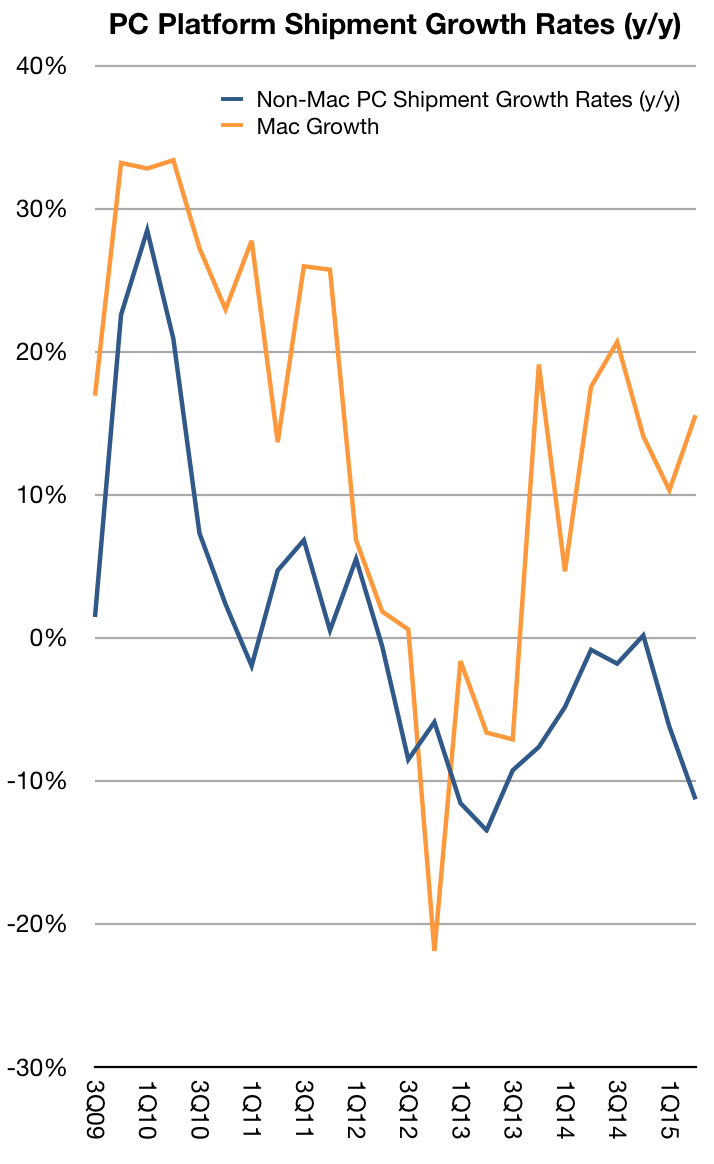
    The pattern of Mac growth exceeding Windows PC growth (and overall PC growth which includes the Mac) is old news. It has been observed for at least 40 of the last 42 quarters.

    Screen Shot 2015-07-10 at 12.47.04 PM

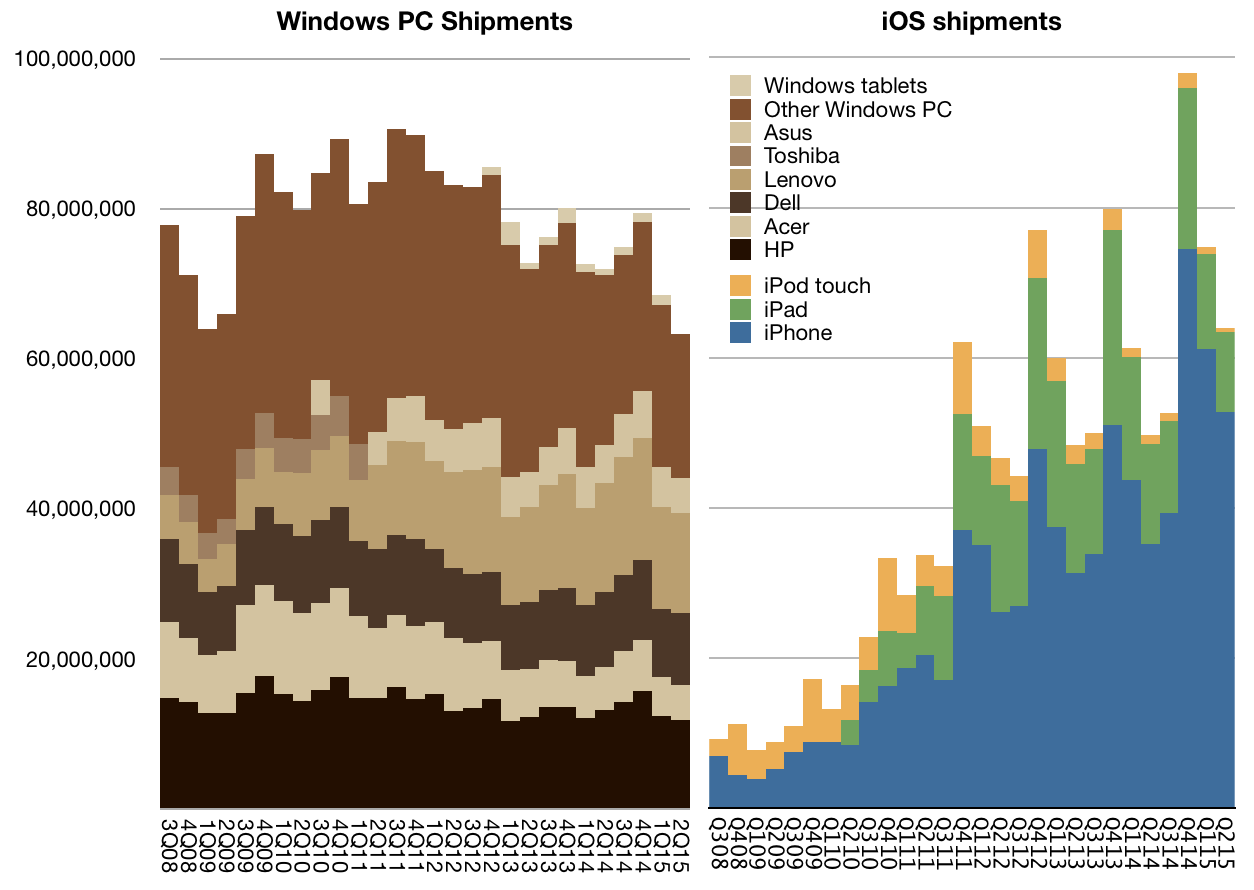
    It's a historically interesting contest, but the story of computing has moved on.  Starting with building computing, via floor computing, office computing and then to desktop computing and portable computing we are now in the era of mobile computing. ((And as sure as the sun will rise tomorrow we will move beyond mobile computing)). The problem with observing mobility in general is that there are too many mobile computing options. Phones have a wide range of capabilities, tablets and various other form factors are positioned on differing jobs-to-be-done. Platforms and services are also scattered around jobs which have been carved from fixed computing or have been established with no fixed precedent.

    So can we pinpoint with any accuracy the moment when the tipping point has been reached? We could point to all mobile phone shipments, or even the vaguely-defined smartphone shipments compared to all PC shipments. We could look at tablets alone. If we could get accurate measurements.

    One measurement could be to look at operating systems alone. When comparing iOS shipments (iPhone, iPad and iPod touch) to Windows we can see that combined iOS shipments exceed all Windows PC shipments for all three previous quarters.

    Screen Shot 2015-07-10 at 12.54.25 PM


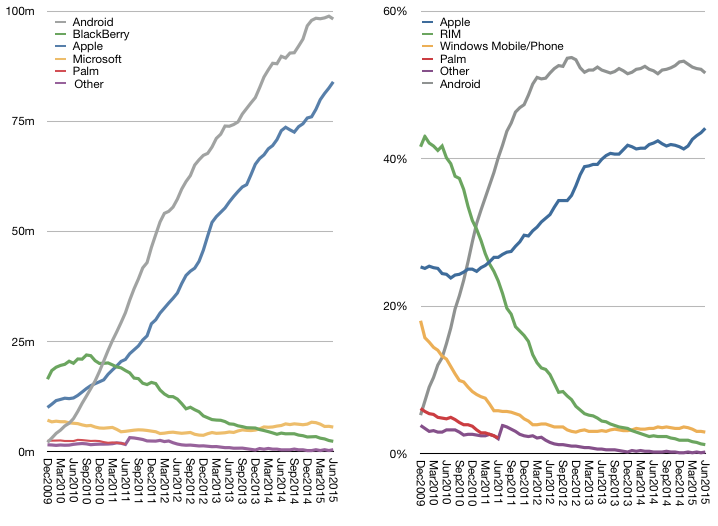
    Which reminds me. This week Microsoft wrote off the acquisition of Nokia's mobile phone business. The growth of mobile as an alternative to desktop/laptop computing was foreseen by Microsoft a decade before the the data in the graphs above. It began in 1994 with Windows CE development, proceeded with a PDA operating system by 1998 and the Pocket PC brand in 2001 and Windows Mobile in 2004 and Windows Phone in 2009.

    After anticipating, predicting and dedicating decades of work why didn't Microsoft  participate in its own vision?

    The curious thing about disruption is that predictability does not result in immunity. If the new trajectory threatens the current profit formula, the trajectory is not joined with enthusiasm. There is an uncanny unwillingness to self-disrupt.

    The exceptions to this rule are so rare that they are seen as magical, enabled only by accident or catastrophe.