Asymetric Podcast: Episode 139 — No Free Lunch
Horace not having long arms, shares his thoughts the un/bundling of LLMs, and opines on Korean stock market turmoil.
Available to Asymco One subscribers at asymco.com/podcasts/.
Audio Recording
https://asymco.com/wp-content/uploads/2026/08/asy-139.mp3
Transcript
Judd
Several microphones, several local hard drives, several cloud drives, and yet sometimes. Nothing gets recorded. This is asymmetric.
Apple announced Apple upgrade. Some people are very upset. Other people are loving it.
You've talked about how this was This idea of basically a hardware subscription had kind of been inevitable. Yeah. But it's taken us a little while to get here.
So You you are I've never seen you happier. Tell us tell us why you're overjoyed and why we should all be overjoyed.
Horace
think about Apple products as a some something you pay on a month on a daily basis. Not pay as I should say you should consider what it costs you on a daily basis. And that's a un that's called unit economics.
It's like, what does it cost for a cup of coffee? But what does it cost to own a car? What does it cost to rent a house or whatnot.
So years and years ago I have to give a little credit to to who gave me this inspiration. It was actually Jean-Louis Gasset. And like could like twenty JLG twenty 12 or earlier even.
We had a lunch in Palo Alto, I remember. And you know he's he's Who paid? I think I think he did, yeah.
Yeah, he's a good guy. he said, you know, you should look at Macs and phones and everything as a what does it cost per day? The problem back then and for until last week, was that, you know, you paid a thousand bucks for a computer or a phone or whatever it was.
And the way to calculate what it's costing you a day is knowing how long you're gonna use it. then subtracting how much you're gonna get for it as a secondary, you know, or as a as a used product. So you're gonna trade it in or you're going to sell it to your friendly you know f Facebook marketplace or you're gonna find the you know a a mall guy or something.
I don't know how people even do that. Or you give it to your children or you give it to your family. And so they use it for another year or two, and then you calculate, okay, I've this has been in use for five years now, so I'd have to take my initial purchase price divided by the number of months in five years and th and then and then do all the math.
Well, if you did that on average My point was, based on this suggestion, that Apple products were about a dollar a day. Now that assumed that, for example, you would keep an iPhone that cost you let's say eight hundred dollars, you'd keep it for three years and then get back. m whatever it was like two hundred dollars at the end, right?
So that would be like roughly six hundred dollars divided over two years. You know, give or take, you it comes out to about a dollar a day. But now it's a lot easier because now when you go through Apple upgrade, you'll get that price on a monthly basis.
All you have to do is divide by thirty or m you know the equivalent average month. which is 365 divided by 12. So that is b that becomes your daily cost to own the product.
And at the end, yeah, you could extend its life or your ownership of it. through buying out the lease and the value is whatever it is left over from the original purchase price having you know paid into it with with lease So there's no there's no interest, by the way. That's the amazing thing.
It's like you you get a an interest-free loan, at the end you can choose to pay the remainder. That you owe, or you can just turn it in and get another one and continue. And all of that works out so the the w most expensive option is to have the one-year lease.
and you're paying a little bit higher, I think, for depending again, so depending on on the configuration. Now this is where it gets gets a little bit tricky. So you have to go And what I did is actually to calculate on average, you have to go out there and and pull every configuration.
Get those those revenue or those cost numbers and then decide okay what is the average from all of these price points because some are more popular than others. Now the good thing is that these tend to d what I did is I picked the median, which is the midpoint of all these prices and said, okay, let's call that the most common and call that the average. And if you do that with the iPhone, it comes up to about a dollar 13 to $1.
15 per per per day. So the old rule of thumb of the dollar per day holds even though this was initially determined In 2012, and it hasn't changed since. So I was very surprised.
By the way, this is on the longer lease. Shorter lease is a little bit more money, like a dollar thirty or something like that So anyway, it's but but most people think of it as like, oh my god, it's a thousand dollars or it's twelve hundred dollars or it's uh whatever the Mac might be, you know. And Macs, by the way, are surprisingly also in fairly cheap, like a buck fifty a day because you hold on to them a little bit longer.
By the way the lease terms on the Mac are two years or three years. On the phone it's one year or two years. And the iPad is also two to three years.
Judd
So a couple of things. So right now it's only available in the US. And they've had programs like this before, at least for the phone.
I don't think they've done it before for um for the Mac itself. But for Apple, what's the real advantage? Like what's the they they have the Apple card, so if you you know, you wanted to get basically interest-free loan, you get an Apple card and then Buy it with an Apple card.
Horace
And you get your three percent cash back, all that. You So what's the advantage for Apple for Well a couple of things economically it might be a little bit advantageous because you get the product back with a reliability of like most people are gonna turn them in and and they get to probably resell it at a little bit higher than would have been the residual value. because people have been yeah, so they you know if it's residual 200 then maybe it's worth a little bit more, it's maybe 400, depend again, a lot of variables.
We're talking hundreds of different configuration here so that's one thing is is that the majority of people are probably leaving a little bit of money on the table, whereas they if they paid for it off they could maybe even get a better price on their own if they went and shopped around or or or marketed their product. That's one thing. The other thing though that's more interesting to me as an analyst is that you get a lot more predictability in terms of having access to large inventory of used products, which means for Apple, now the some might be in poor shape and they're gonna get refurbished or disposed of, but there might be quite a few that allow them to market more effectively into emerging markets.
So the problem has been that they've always offloaded that job, you know, like dealing with second hand and third gen. I mean there's refer, but but this is gonna drive that volume a lot higher and then it might allow them to kind of maybe create a secondary market that's a little bit more upscaled than what they have. what people have to rely on today in these markets.
So there's there's something interesting in that secondary market control. And and there's also the data overall. Like you have you know having people on lease paying you every month.
You have that same relationship with with the mobile operators who kind of know the financial activities if you if you will a little bit. And and so inf it's funny actually how they might steal, quote unquote, steal a little bit of that knowledge away from operators, because operators may end up not having as f as many sales through that channel 'Cause you'll get through Apple and it's monthly. But that's why they bundled the operator with the phone.
You'll notice if you try to buy a phone, you have to buy it with an operator contract now. even though it's unlocked. So the assumption is that in the US you're going to still need to go through a major operator to get the phone.
So there's there's something of a of a glitch there but but there's something knowledge this on so number one it's it's gonna be secondary markets are more more reliable for apples and s and and and in addition there's There's probably more information they're gonna be able to mine.
Judd
So just to clarify, so when you say secondary market, do you mean Apple will sell in a used you know pre a Apple will sell a lease return phone in Bangladesh, as opposed to a local retailer or an Apple store doing it. And does that mean that they're not going to expand the program outside of the city?
Horace
No, I think they will. And I think what's going to happen is they'll have They'll have Apple Store Referb for lack of better term, because I think it's used now, but Apple Store Refurb inventory will be much higher. And maybe they'll market them a bit better And then they'll have the the Refurb refurb Apple certified products in those secondary markets or used markets. Um under Apple branding, there'll be a lot more inventory there and it'll be much easier for Apple to then get that customer in the front door in these markets.
Judd
Well, I'm glad you're excited.
Horace
I Well I would I'm so excited I w I would do it this way. If I had probably the next phone I'll buy. I'm gonna do it this way.
And I'm a little bit concerned about that operator deal but but but maybe I'll do it for other products. The watch is available, the iPad, the I the Mac And and I would recommend this over it's it's essentially an interest-free loan and you you still get three percent if you pay with their your Apple card. 3% back, cash back.
Judd
Yeah. This was also the last last week Apple reported earnings. I hear they did quite well.
So congratulations to all involved. This is the last earnings call that Tim Cook was on as CEO. He will very quickly become executive chairman and there will be a new CEO, mister Suns out, guns out himself, John Turnus.
what is the one thing he absolutely cannot do. And I don't mean like a major strategic decision. I mean a very small tactical decision.
Like what is one tiny little thing that he absolutely cannot do as CEO of this company we refer to as Apple.
Horace
first of all let me just say I the the the word is that the way he's referred to internally is JT. So Justin Timberlake?
Judd
No, just John Turn is his JT and Justin Timberlake is JT.
Horace
Oh no.
Judd
I had If Justin Timberlake became CEO of Apple I would be I think that would be just very impressive.
Horace
Maybe maybe I'm wrong about this, but I heard him referred to as JT. So but because I don't know what to say. You know, there's Tim, Tim Apple Cook, I don't know if we're gonna call him John, you know.
John is so generic. Um Yeah. Turnus.
Turnus is also a little too formal. Anyway, um, yeah, maybe it'll be John Apple. Could be.
So what was your question? What is it something that he cannot do
Judd
Yeah, absolutely like if he does this one little thing, I don't mean like a big thing, I don't mean like he decides to put out the Apple car I mean a small thing. What's a small thing he cannot do or Apple will truly be doomed?
Horace
Well, I probably I'm gonna it's a little a little weird question, but I think He cannot go to the Apple Mac Cafe and expect not to pay for his lunch If he walks out the door without paying, I think his reputation will be demolished. I think he'll be ostracized Famously, you know the story of how Steve Jobs did this. He he he somehow always paid you know, if you were if you were a guest.
And and the thing was though that the way it works is you swipe your your ID and then it will deduct from your paycheck the uh the amount and this was very convenient. And the thing was though that at that time Steve Jobs had a paycheck of one dollar. He he was insisting to pay for other people And in so doing I was stealing from the company lunch once in a while.
So nobody nobody bothered to catch him on that. But I think if he Steve could get away with that, but I think John He's not gonna be able to get away with that. He's he's he's gonna have to pay for lunch.
Judd
Has he offered to work for speaking of a dollar, was it a dollar a day or was it a dollar a day?
Horace
A dollar a year actually, I think For a while at least, he pr he you know he came on with that deal.
Judd
I've never seen him eat. Steve or John? John. Well.
Horace
You know, he's a fit guy. He probably eats a lot. He seems to be a swimmer.
I think he was a swimmer, right? He's got the physique. Gotta have those long arms.
Yeah. Long legs. I used to be a swimmer, but I'm not a very good one.
I swam in high school and
Judd
I wasn't very good because I don't have the the long arms. It took a while for Tim Cook to have his his own product that was not just considered the latest version of something that had had been introduced under Steve Jobs. I think it was the watch. Yep Is there we're running out of of things to introduce. does JT need to have his own No I think he will.
Horace
In fact, and I know what it is. it's gonna be the glass the Spectacles, the Apple Vision, not Vision Pro. I don't know what they're gonna call it, but it'll be it'll be the equivalent of of um whatever Meta's name is, but yeah, it will be eyewear.
And I think the eyewear market is very exciting and I think There's been rumors and rumors about what they'll do next. the vi the Vision Pro was sort of looked like a bit early. and maybe the next first the next version will actually not even have any display in the in the lenses but it'll be just it'll just be passive lenses But eventually the lenses will be displays and that category of product, um, although under development But you don't consider that the same category as the Vision Provision Pro I mean Vision Pro if anything was a prototype and yes it is it is effectively the beginning of that category, but it's like saying You know, because the iPad was developed before the iPhone, and and yet the iPhone is reco regarded as the sort of the defining product for multi touch and all of that thing, all that followed with the iOS.
and you don't you interface. But spatial computing is what we're talking about at a software level and as an interface level. And spatial computing is gonna carry on and be embedded in other things.
But but I think the the whatever they're gonna be called, the Apple Vision it will be the product that most people remember. Remember also the Model T was not the first car that existed and certainly not even the m first car that Henry Ford built. I mean the you know so we tend to remember version three of something usually as the the sort of the the actual s genesis even though it is it is it is really built on generations of other work.
Judd
But it was the first one that people could afford. That could be mass produced.
Horace
Well, if even the models that Henry Ford always developed were a little bit the probably they didn't work so well, they weren't marketed, they weren't There wasn't a production system for them. And so he he had something called a quadricycle as one of his earliest cars. And that was like I forget what year it was, 1905 or something.
Yeah, anyway, I digress. But but the the the the the work on Vision Pro started seven, eight years before it launched. So we're probably you know already a decade into it now.
Judd
Okay. So you would consider those to be this d distinct products though, the vision and the vision product.
Horace
Well, I think John will be remembered as the guy who introduced the vision. That's how old it'll be. It won't be that Tim oh wait a minute.
Wasn't there a Vision Pro before that and Tim introduced that? No, I think John will be I'm gonna bring it up. Well John I think John will be remembered for this.
This is the thing.
Judd
I wish him luck. Um You posted a YouTube video to your X account. Maybe you maybe you post it elsewhere.
as well. But it was it was a a gentleman, I forget his name, some sort of he is a doctor, I believe in Aussie, and he works at a place called Kira And they are making software in order for people to make their own local AI, most likely using upcoming Mac Studio that'll have all the RAM in the world. And your your only comment was a data center never Oh oh I see.
Horace
Yeah I okay I remember now it finally clicks. That the I thought you meant a video that I made, but it was a video someone else made, yes And that was Yeah, so this guy who I don't really follow, but I have seen a couple of his videos and he's he's a I think he's British or Australian, like you said. And he he he he writes or speaks a lot about AI and you know he s he got excited about the fact that There's a generation of Macs that will come soon that will have unified memory in the dozens of gigabytes.
Okay? Now That means, as he put it, as a data center on your desk, you have multiple processors, you have multiple cores, and then you have multi-this giant addressable memory and so yeah the you know I don't know what that really means but in practice the and also by the way Apple in invested in a company that shrinks the size of models by like a factor of ten or more. So there's there's so the models are shrinking in size and there might it might be soon possible to fit everything.
in a in a desktop. That's why it's interesting. And I think I you know, the the lI sound a little bit old fashioned here, but I do remember when we went through this before with mainframes and other big computers becoming small.
And then the Apple would just rode that wave of my miniaturization, the so-called microcomputer Then it rode the wave of getting even smaller to the pocket sized computer. And now many people are saying, yeah, but these models are so big they can only be be delivered by the cloud cloud data centers that are the size of I don't know buildings big buildings and yeah I just keep thinking the old days you know we we The tendency is to get things to be smaller and s get things to be personal, get things to be cheaper, and uh That's that's where we're going. I do believe, I've said this before, but I do believe Apple is even going to make their own servers.
And their own server processors as well. So even though that future of a data center on your desk will be possible, maybe they'll also have Apple Silicon data centers as well because they you know they'll they'll they'll be doing some heavy lifting in the cloud for Apple's own LLMs. and their own services.
So the the the chances are they they are developing their own alternatives to nvidia's processors So Apple's doing its own data centers for a long time, not always with its own Macs in the data centers, but We'll see more and more of Apple's data center strategy coming forward.
Judd
Maybe clarify that a little bit for me. What if there you know if more and more of this stuff is gonna be if it's gonna be easier for more of this stuff to be local Yeah, what does the data sit?
Horace
Well there's a local model and there's a global model. So Apple's already kind of hinted at this in dubbed up DC. So what they what they've done there is They're using Google on the world models that are in the cloud, and then they're using their own, there's like four, I think, four different um models that are available to to developers and users.
And the stuff in the cloud is is also used to train some of the local models But the global stuff is, let's say, knowledge, general knowledge, world knowledge, world understanding, okay? And it's also up to date, constantly being refreshed. And the problem with the local is that that's where the private knowledge is.
So to the extent that you need, hey, can you index my emails? Or rather index this like the kind of questions you're going to ask your computer to do would be organize my calendar. you know connect to my friends and contacts, do things with my personal data that that I need done and so that gets processed locally.
But but but then you ask When's the next flight or how do I connect to databases? Those are gonna be in the cloud. And so the the the the the Google models are better at that world stuff and then Apple's models are better at the private stuff.
and private cloud compute is what Apple's bridging these with. So to the extent that they send information to Google to say, can you fit this data into the global data that will be protected against Google's indexing of it. And so this is why a lot of people were like suspicious that there handing over the keys to Google.
There's a lot of suspicion about Google being the brains behind everything Apple does on AI. That's not the case at all. There's a lot of heavy lifting on on Apple's side as well.
In fact, some suppose you know suppose you are to launch in China, for example, as as Apple will and has been actually authorized to do. They're not going to be using Gemini in China. Or the or in India they're probably not going to use Gemini in in many parts of the world.
So the question is, th there's a plug-and-play architecture where they can they can substitute the world models that fit the markets, right? And so the they've they've architected this whole thing so that there is there is a lot of modularity, I believe. so th that's why I think it you know and also the access to these things will be through through possibly through agents and apps, which are third parties.
that you know will will be yet another level of integration.
Judd
Are these large language models in the process of being bundled or being unbundled?
Horace
Well, they're bundling the global knowledge, and then the the commoditization is happening simultaneously where other open source models are unbundling them So that the this is all happening simultaneously. And this is one of the things that's perplexing is that a lot of Chinese open source models are essentially scraping or copying the the the pr the so-called frontier models and they seemingly are good enough because they're just one one step behind and as as the the As the best models move forward, the open source models are like like right behind. And you're dealing with like a one maybe a one-year lag, maybe less.
And w in which case, I mean last year's AIs were pretty damn good. So if you can get that for free, a lot of people are saying, why am I paying, you know, so much for the latest version of Anthropic or or whatnot. So I think that's the commodization angle is a modularization, somewhat.
And then Apple's gonna just say, well we treat all of these as modules because we think of these as as as modules that we plug into our operating system. And and for that reason I think there's there's this is why there's the whole economics of AI is is cracking or there's a lot of confidence the being uh lost by by by the s by the hyperscalers and and if their economics don't work then they stop spending on data centers. Then then the whole semiconductor bubble bursts And and the data center bubble bursts.
By the way, I don't know how much you've been paying attention. There's a lot of chaos going on in in Korea with with that market. The stock market there went through Girations up up over 100% in a couple of months, now crashing like 30-40% in a couple of days and then up again fifteen percent the next day.
It's tripping all of these circuit breakers almost every other day. And there was a the th this was done the this is ha the tr the circuit breakers were being tripped once every ten years and now it's like every ten days.
Judd
Circuit breakers in terms of the market being shut down.
Horace
So the you you know the market opens. The market opens and these were circuit breakers were established precisely to protect let's say I don't know, the small investor or or whomever. But it was if it drops I think it was there's a threshold, I forget what it is, maybe five percent.
So if it drops be beyond that, then suddenly the the market stops. You know the biggest thing, but trading ends for for a while until the O starts again. And and this is causing not just pain, but the problem is that a lot of the people who are investing in the Korean stock market are small investors, retail investors, mom and pop investors And they've been getting in the game while the m market is booming, and then they've been leveraging themselves with so-called single what is it single equity ETFs, exchange traded funds that are trading just one thing so that they can get leverage.
So people are, you know, four times exposed to to something. But you're four times up and four times down. So you're you're They they get margin called.
And so what happened is millions, literally millions of Korean small investors have gotten wiped out in like the last week and and various estimates out there, how many people are were affected and it it's it's it's scary and it's all because semiconductors, as I said which is including Samsung are being bit up to crazy trillion dollar valuations and then the rug is pulled. and and I think it's it it's one of the aspects of the mania that is driving also Apple's component pricing up, but it's actually causing complete societal level disturbance in in the in a major economy right now. So we're we're we're you you know we're talking about potential for trauma and maybe even a a recession, maybe even a a a real estate crisis.
One of the funny things. Yeah, in Korea. So far so far it hasn't spread yet, but you know, it could spread to Japan.
Japan's having its own issues with the currency there. The yen is being is is being bailed out and under pressure and there's all kinds of things. We could be looking at m at at bank runs, we could be looking at a lot of things.
Russia is another case in point. the oil market is in chaos. But the what I want to point out about Korea that's particular is why so many mom and pop investors exist is because As I understand it in Korea, if you had a landlord, you're not allowed to to own you're not allowed to charge rent.
What you do is you collect a deposit. from the renter and then you're s you're supposed to give it back to them on the lease end fully. And so people who rent in quote unquote rent in in uh in Korea really don't have enough money to buy, but they may have like twenty or thirty percent of the value of the house, so they'll hand over hundreds of thousands of dollars equivalent as a deposit and the only way that the landlord makes money is by investing that money to try to maximize their return and that it should be higher than what you get in rent.
Now think about that Because then that that encourages speculation and encourages precisely these sort of investments in crazy in crazy leverages. And and so these landlords who might be doing this and they get margin called, then they lose their house because the bank says, you know, um This is only only collateral or the only capital you have. So I don't know exactly.
I'm just saying that this this is scary. AI is not just An interesting odd technology, the way it's being and one of the big lessons here is if it's a bad business generally speaking, right, and we are not sure it is what it is right now. It's it could be good for some, bad for others.
But the ide the problem with misallocating capital is that it's not as it's not a victimless crime. It's like saying, well, the investor lost. But when y when society does it on such a grand scale, when with capital is so badly allocated, markets are supposed to be really good and efficient and really smart about allocating capital, right?
They make mistakes, but the the damage is contained. and and the the investor learns pro supposedly. But here we have something.
And I wrote this piece, Why is everyone all in on AI? and m my problem with this is that they're all in even though we're not sure it's a great business And if it isn't, then then it it it's maybe the first equity led financial crisis we've ever seen, because everything else has been debt driven. I mean ever, not ever, you know, the initial investments in by you know in peop the famous Dutch pul bulbs that were tulip tulips, yeah That that would that was effectively also like an equity an equity.
Judd
I'm a little rusty on the Dutch tulip crisis. Um in the from the sixteen hundreds. tie those together for me.
Horace
How how make What I'm trying to point out is that there's typically when you get to s what we call typically a um Not just a market crash, but it's contagious enough so that an entire economy, globally possibly, ends up in a recession. So do you have a global crisis? So we have the last was 2008.
And that was driven by bets on on i e derivatives, but ultimately real estate exactly. And a lot of those were mortgage backed securities and and a lot of those were fundamentally tied into the bond market. It wasn't that it was any stock market bubble.
It was it was it was something in a whole different type of equity. I mean that that the stock market got dragged down by a crisis in debt, let's put it this way simply. And if you go back and look at other crises It's been usually behind the real estate like Japan has problems I mentioned Korea, but also China.
China has huge real estate problems. And because the amount of debt out there is far bigger than the amount of equity, the debt market is far, far, far bigger. Than the equity market.
So the equity market, if you were to sit all up, is you imagine all the businesses that are traded on all the stock exchanges in the world. Take all that market capitalization, add it all up, it wouldn't be one percent of the debt market. Because everything in real estate is debt.
Everything in commercial real estate, private real estate, then you have commercial loans to to you know businesses that are f you know underwriting things like factories and other things though that may be capital in capital expenses. But it there's real estate is by far the biggest asset class, even in amongst let's say all the wealth in the world. More than I'd I you know, I'd guess equities make up probably fifteen percent of the wealth in the world.
And and and so everything else is debt or or cash. And and and so then or other things. I don't know, the art market is tiny, but but the y you know, I can't overstate the importance of a stable debt market.
And this is why when even when Trump was messing around with tariffs, he had to pull back from some statement or p policy because he quote quote unquote, you know the the the bond market was getting jittery. I used the different phrase, but it was essentially the bond market was and if bonds by the way, the bond market crashes then you know, treasuries are in trouble. The m the US can't borrow anymore you know, there's there's issue issues with with the federal federal government liquidity.
So so there's there's it's profound and what what I'm saying is that when you talk about contagion There's a famous phrase or s word. It says that the the the bad debt is contagious. Well, what means is a the bank fails And because other banks have pieces of that bank or the assets in that bank, they're all going down start to you know domino effect.
So the the thing about AI so far is that it seems like it's not apart from the hyperscalers. It's not likely that it's going to be contagious to other parts of the economy if things go bad. But it looks more and more, and it's always surprising because you don't know where it's coming from, where the threat is Sometimes these things are hidden from view and they're deliberately hidden because they're nasty.
So here the problem we have with AI is is a circular is circularity in terms of relationship that Nvidia is paid by the hyperscalers but then it turns around and finances the hyperscalers. Right. Finances and owns equity in OpenAI and Anthropic in in this or that whatever project is involved, startups and so on.
And and so you get this process of knocking over one another. So you know I'm just warning. I'm not an expert any of this, but I'm just warning that The bigger it is, the more likely that there's stuff that you cannot see as far as the the dirty laundry.
Judd
Well I'm worried about I'm worried about these Korean landlords. What are they gonna do?
Horace
Yeah, and I I've I have one friend from who from from Korea and I'm sometimes pinging him and asking him are you alright? Are you on a ledge somewhere? Um But I try to I try to to get some inside info because I'm I'm just reading reading the headlines is not the You know, there's a there's there's a lot going on on the street level.
So Korea is a weird place, you know. You also have North Korea, but you also have you have politics. Yeah, but the the the whole c I've been there a couple of times.
The whole it's very different than uh Then what you might expect. I mean in many ways.
Judd
Rent thing is I don't think I've ever heard of that before.
Horace
Yeah, but plus there's other things like like the government interferes a lot in the Chables.
Judd
The Chables are the large organizations, like conglomerates.
Horace
Conglomerates. So what happens is like they're not allowed to participate in certain businesses there, you know, because they don't want the small businesses to be crushed. So one example is I was there visiting and I was talking about micromobility and I said hey why don't you let's say Samsung or LG I'm not gonna name who it is but it was one of the Chables And I said, why don't you guys build e-bikes or or scooters?
And they're like, we're not allowed to because bikes are considered a small business. that local people are running and if and Samsung is has a gentleman's agreement with the government that they're not gonna go make bicycles. I mean that's a that's a sort of like informality but also like there's there's this this and there's a bit of socialism if I may say because I think there's a lot of a lot of Koreans are kind of Quite, although it's a very capitalistic country, there's a lot of social justice d demanding.
You know, people are very kind of w the workers' rights and this and that and there's I suppose there's a there's a left and a right in politics and the left is swinging sometimes w you know, one you know, in power and others there's a reaction. And so when when they had this gr constitutional crisis it was exactly because like the right was was one fomenting for for, you know, a coup and stuff like that. So it's a very is is I don't know what to say, but I would say that in it sounds to me like Korea is a little bit A little bit of a canary in the coal mine here.
So maybe maybe you should keep an eye on it as as this AI story develops.
Judd
Yeah, no, for sure. Can you briefly I think I have a decent understanding of what a che ball is, but maybe you could explain it more succinctly than I could.
Horace
So the Che Balls are similar to the Keiretsu in Japan. And Kiretsu in Japan were informal or formal relationships between so it's not quite as you said a conglomerate but it's let's say a big company is in a partnership with another big company and they form together Not a cartel because they're in different businesses. So Toyota will be in a relationship with Denso.
Denso makes parts, Toyota makes cars, but somehow Denso is nearly exclusive to Toyota. And then Denso then gets into a relationship with a chemicals company and another relationship with a steel company and so on. And then therefore Toyota is linked to all these other companies and they all kind of are happy together and doing business together but not really a classic cartel.
And so Che Ball is similar, but in this case, maybe Samsung has divisions doing all kinds of things, and that that is a conglomerate. But also is a relationship with, I don't know, they're big vacucleaners, but they're also like, you know, have a relationship with a rental company or something. It's funny Samsung when I looked it up started as a rice trading company or noodles or something.
It was it was food and it was a it was a it was a it was like a wholesale or intermediary. and trading and doing random random things and and over the decades it just became um it just became a a a m a ma mass of business.
Judd
and and I think they were tolerated but isn't there something isn't there like a there's a family component to this. There's something And most of them are family do the there was a original
Horace
Because these are all old post war. They're not that old. We're talking since the fifties probably.
so the the founder or his direct descendants are still alive. And it they tended to be majority but then maybe minority shareholders, but still a huge chunk of the of the equities held by by a family and it gets ugly because again you got this social y you know, resentment against the ultra rich and and and and then they have to they're sometimes accused of all kinds of uh economic white collar crimes and the msometimes they go to jail. The the the the their behavior is scrutinized for signs of insensitivity.
I remember there was a the the daughter of the f president or maybe part owner of the major airline in Korea had an incident where she was flying first class and she she complained to the steward that the service was inadequate, like but she s was so violent and angry about it that You know, he was almost like injured. And it it bubbled out of this, you know, this incident came out because of this. And then she ha Man, she was almost she w they almost lost everything because of that because everybody turned against this.
You know, they'd like canceled her in a sense. But i it's a strange strange thing where you have these well I suppose wasn't there a movie Crazy Crazy Rich Asians or something like that, but that was set in Singapore Mm-hmm. It was about very wealthy people.
Good movie.
Judd
That's a it's a it's a perfect airplane movie. That's a perfect airplane movie. Okay, so basically, uh, in order to keep track of how the the so-called AI business may bring us all down Download and listen to every single BTS alband we'll we'll have a clear understanding.
Horace
That is your expert advice. Correct. Fascinating also Korea becoming a a a an exporter of of soft power and cultural goods, which I always think is an interesting indicator.
Because Japan began that too with uh Comics with cartoons, with with films, famous famous movies in the fifties, Godzilla, all those things from Japan. manga or whatever the comics are. Manga anime.
Yeah anime. But the but I think w again Korea many ways replicates whatever happens in Japan because they they copy what's successful and they decided hey we should do that too so they said hey we can do pop music And then that we can do it with boy bands and we can do it with this. So they you know, K-pop came around and and that to me I would without disrespect, but it just seems a little bit manufactured, you know Like like it's a business business development.
Judd
Yeah, I can't I can't speak to the music part of it, but I will say there are some of the most interesting and exciting filmmakers are Korean.
Horace
Nowadays, yes. Nowadays.
Judd
Yeah. Yep. Yeah. And I ca when I was growing up that really wasn't the case. But I'd say you know fifteen, twenty years ago. For me, there's a movie called Old Boy, and that was the first one that really kind of broke over, and now it's
Horace
well didn't they get an Oscar for what was it Several Parasite in a one one
Judd
several Academy Awards. but it's not uncommon to see in Minnesota at the movie theater cor you know, movies from Korea in Korean
Horace
and Unheard of, unheard of, unbelievable.
Judd
It's it's wild. So kudos, kudos to the Koreans, but man, I hope they figure that out because we want more movies, we want better movies
Horace
So we don't want we don't want Korea to go down in flames and they won't make movies anymore. But I would say it's also by the way, they're living next to an existential threat of North Korea, nuclear nuclear armed f m the second third largest army in the world. And and and and yet they're like they're like super cr super productive, creative, and And apparently super willing to gamble on on on very very very precarious bets on the on the stock market
Judd
Well every day is precarious if you're living next to insane an insane person with nuclear weapons.
Horace
My my questions when I go there is like aren't you guys worried and like well not really but you know if you were in Taiwan and you look at China same thing it's like existential.
Judd
Well hopefully everybody in South Korea and Taiwan listening is feeling good about their prospects. And Horace, anything we're we're coming up on our our time. Anything you'd like to add before we before we bid adieu?
Horace
we're gonna post a b a few videos I believe from my office hours. So if you want to check in on on some of the some of the details of the quarter, but it was a it was a it was a surprisingly good quarter but also there was a surprisingly bad guidance and that had to do with with shortage of components and and so th there's a lot of m madness in the markets right now but uh But overall demand demand for Apple's products is is through the roof. It reminds me a lot of COVID when things were looked very, very crazy and yet people just couldn't get enough Apple product But this time there's there's there's a there's actually not enough supply. So anyway, interesting times. but stay tuned and we'll talk about it all.
Judd
Horace, thanks for the time. Thanks to everybody listening. We will see you again very soon on asymmetric.
Now in Beta for Asymco One Subscribers. You can now listen to Asymetric from your favorite Podcast app. Sign in to Asymco, then visit Podcasts page.
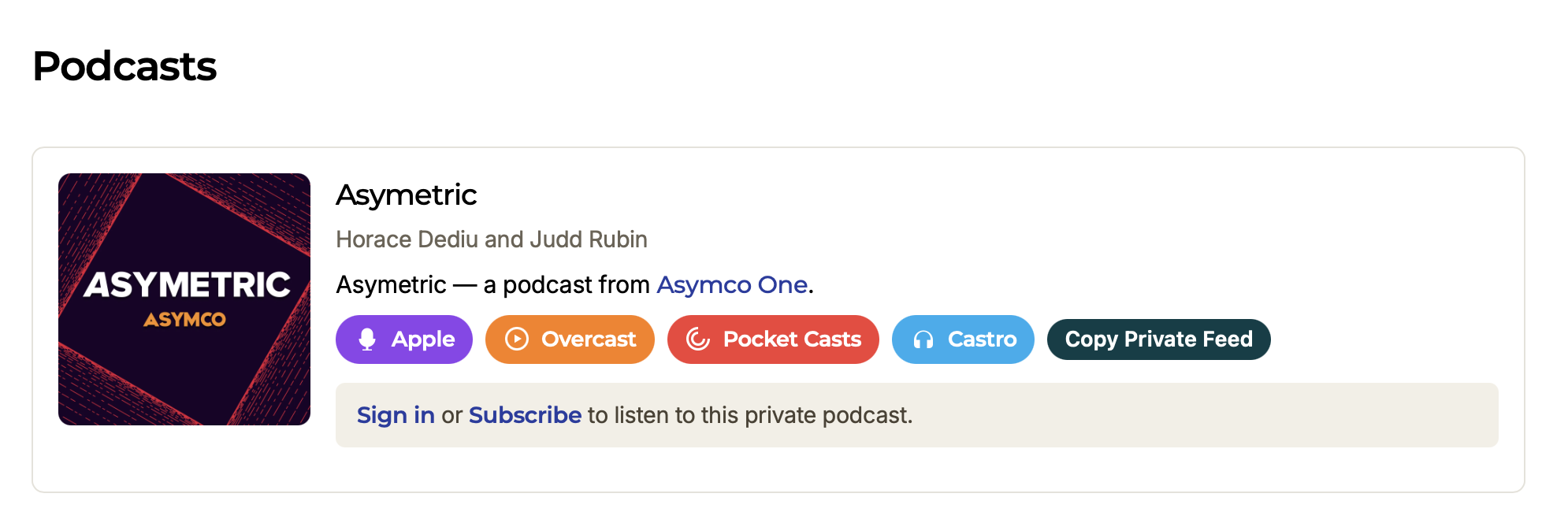
Tap or click on the button corresponding to your choice under Asymetric. This should open up your Podcast app with a private feed for Asymetric.
Should you have any issues, please send email to support@asymco.com.