Asymco

Asymmetric Intelligence

Nota Bene

News Commentary from Asymco's Horace Dediu.

  1. Rosenblatt Lifts Price Target on Apple by $1, Maintains Netural Rating

    Nota Bene · 3 comments

    From $267 to $268

    On March 5, TheFly reported that Barton Crockett of Rosenblatt Securities increased the price target on Apple Inc. from $267 to $268, maintaining the Neutral rating on the iPhone maker.

    Crockett remains positive on Apple following the company’s recent event, in which it launched its MacBook Neo, tapping into the lower end of the laptop market. Apart from that, a lower-end iPhone 17e also adds to the company’s lineup in the budget hardware category. The analyst also mentioned that Apple’s high-end products account for a modest percentage of build-to-order, which could lead to in-line performance with its March-quarter guidance.

    On January 30, Reuters reported that, according to the LSEG, Apple expects Q2 FY2026 revenue to increase by 13% to 16%, compared with analysts’ 10% growth rate. Despite strong performance, Crockett highlighted that Apple trades at a meaningful premium.

    A majority of 52 analysts out of 54 have rated AAPL a Buy, while only two analysts rate the stock as a Hold. The average price target of $302.5 highlights an upside of over 16%, while Rosenblatt’s price target implies a modest increase of almost 3% as of March 10.

    Source: Yahoo Finance

    NB: Apple expects revenue to increase by 13% to 16%, compared with analysts' 10%??

    Apple does trade at a premium, but not much. As the table of the largest market caps below shows, as of time of publication, Apple trades at 32 P/E vs. high 20s for the other tech giants (with TSMC at the same multiple). Arguably Apple gets the premium as a counter to getting the discount during the go-go days of AI hype inflation. Apple is now seen as a reliable growth story and a safe harbor during volatile times (read: not throwing cash flow into the bonfire of AI vanities.) I should also point out that the new "affordable" products are indicators of aggressive market share expansion.
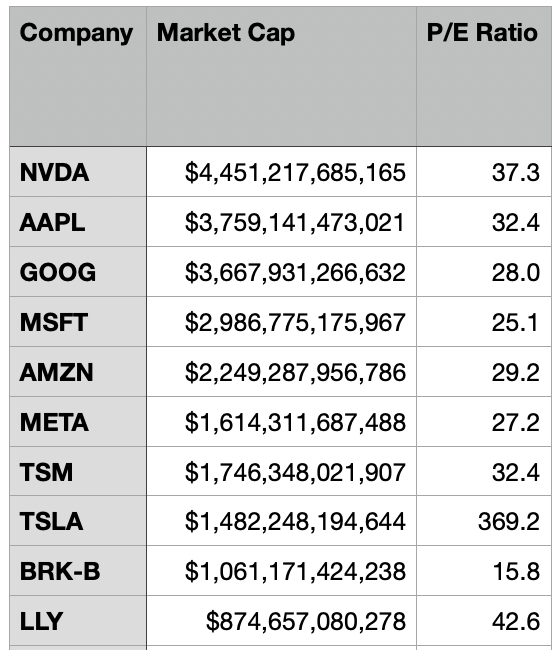
    Table displaying market capitalization and P/E ratios for various companies including NVDA, AAPL, GOOG, MSFT, AMZN, META, TSM, TSLA, BRK-B, and LLY.
    Market Caps and P/E ratios of the largest market capitalizations.


  2. How many employees does Apple have? What do they do?

    Nota Bene · 3 comments

    The biggest function is engineering, by far.

    Apple had about 166,000 full-time employees globally at its fiscal year ending September 27, 2025, according to business data aggregator Bullfincher. That’s more than double the number of people it employed (about 60,400) in fiscal year 2011, when founder Steve Jobs served his last full year as CEO.

    According to Apple's job creation page, 80,000 employees — a little less than half of the company's workforce — are in the U.S., with an additional 450,000 working for the company's suppliers.

    Apple posted $416 billion in revenue in 2025. Based on 166,000 full-time workers, the company brought in about $2.5 million per employee. By comparison, in 2011, a year before Tim Cook took over as CEO, per-employee revenue was lower, at $1.79 million (based on $108 billion in revenues and about 60,400 full-time employees).

    Source: TheStreet

    NB: Over half a million including suppliers. Employment by function is as follows:…

    Engineering is the largest group with 49,812 employees, about 41%

    Business Management (18,157; ~15%),

    Sales and Support (11,070; ~9%), and

    Marketing and Product (8,544; ~7%)

    Operations (7,895; ~7%)

    Finance and Administration (7,463; ~6%).

    Information Technology (4,343; ~4%),

    Consulting (4,199; ~3%), and

    Human Resources (2,951; ~2%)

    “Other” 6,051 employees (~5%).

    Over the years have said that Apple is a "marketing company" but in reality it's overwhelmingly an engineering company. (41% vs. 7% for Marketing and Product; with operations almost equal to Marketing). Culturally it's an engineering firm and that will affect the choice of the next CEO.

     Source: https://www.unifygtm.com/insights-headcount/apple…


  3. First footage of X-Plane 12 on Vision Pro

    Nota Bene

    Including an ARKit trick in action

    Yesterday we learned that the “world’s most advanced flight simulator” will soon work with Apple Vision Pro. Now we have a first look at how the experience will look, including how ARKit intelligently handles physical controls.

    X-Plane 12 is coming to Apple Vision Pro through a companion app this spring. Support will be enabled by visionOS 26.4, which supports Nvidia CloudXR 6.0 technology. The flight simulator will stream in mixed reality to Apple Vision Pro from X-Plane 12 on the Mac, Windows, or Linux.

    Now Spatial Insider creator Justin Ryan has shared a first look at how X-Plane 12 works on Apple Vision Pro.

    Source: 9to5Mac

    NB: A complicated product for a demanding audience.

    These are tools for professionals. Not your typical low end product but what they replace costs hundreds of thousands. I find it noteworthy that the apps we see are increasingly professional.


  4. iPhone production in India increases by 53% in 2025

    Nota Bene · 1 comment

    Years in the making

    According to Bloomberg, Apple increased iPhone production in India by about 53% last year and assembled around 55 million devices in 2025. That’s up from 36 million in 2024,

    The company now produces roughly one-quarter of its iPhones in India.

    Globally, Apple manufactures about 220-230 million iPhones each year; India's share is rising quickly.

    Apple currently assembles all models of its latest iPhone 17 lineup in India, including the Pro and Pro Max versions. At the same time, suppliers such as Foxconn Technology Group, Tata Electronics, and Pegatron Corp also manufacture earlier models, such as the iPhone 15 and iPhone 16, for domestic sales and exports.

    The company is also expanding local supplier partnerships in India to produce components such as lithium-ion cells, device enclosures, and accessories, including AirPods.

    Source: Bloomberg

    NB: The article suggests this is a some tariff-dodging effort. Obviously it's not.

    "Tim Cook Races To Dodge Trillion-Dollar China Tariffs" was the title. This is lazy and wrong. the article goes on to say "The goal is to reduce reliance on China and avoid U.S. tariffs tied to trade disputes between the two countries". No, the goal is to create the next billion customers. This requires a multi-year, even multi-decade effort as it required to crack the Chinese market.

    The notable and quotable is the growth rate of 53% and level of 55 million. It does not seem out of the question that half of iPhones will come from China in next few years. This is regardless of the latest tariff of the month.


  5. Qualcomm faces loss of Apple business, rated 'Underperform' by Bank of America

    Nota Bene · 3 comments

    Writing of the wall faded after years in the sun

    The analysts see Qualcomm as a leader in smartphone processors, but noted the handset chip market has matured and faces potential headwinds, including higher memory prices and a decline in business from Apple. They added that the company faces the well-known imminent ~$7 billion to $8 billion loss of Apple business.

    Apple has historically been one of Qualcomm’s largest modem customers, but the bank expects the relationship to wind down as the iPhone maker shifts to its own internally developed chips. “QCOM's modems will be completely phased out of iPhones by Fall 2027 as top customer Apple shifts to internal modems,” they wrote.

    The report also highlighted a broader trend of smartphone manufacturers investing in their own semiconductor capabilities. Samsung has reduced Qualcomm’s share of processors used in its Galaxy lineup, while Chinese smartphone maker Xiaomi has committed about $7 billion toward internal silicon research and development.

    Source: Yahoo Finance

    NB: It's not just Apple that is bailing…

    Apple sued Qualcomm in a bitter battle over the structure of its licensing. As did Nokia. The nature of the relationship was always suboptimal for OEMs as they had to pay a percent of device sales for component on the basis of IP licensing. An outrageous request with fed huge profits to Qualcomm but which compelled everyone to seek alternatives.

    Now, after years of development, Apple finally has a suitable alternative and they will run as fast as they can away from Qualcomm. So will everyone else.


  6. MacBook Neo May Boost Revenue By 0.5% While Expanding Into Student Market - Gene Munster

    Nota Bene · 2 comments

    Needle mover?

    In a video segment titled Pressure Points, Munster said the device could modestly increase Apple's overall revenue while expanding its reach in the education market.

    "The new $AAPL MacBook Neo should add 0.5% to overall revenue for the next year. I believe it won't impact margins."

    Munster estimated the device could add roughly $2 billion in annual revenue to Apple's Mac segment.

    Apple's Mac business generated about $34 billion in fiscal 2025, meaning the Neo could provide roughly a 6% boost to that segment if adoption plays out as expected.

    The analyst said Apple is targeting a large pool of potential buyers in the U.S. education market, where many students currently rely on Chromebooks.

    "This market, if we just take the U.S. alone, is about 25 million students," Munster said in the video, adding that investors may think of this as "new customers for Apple."

    "My take is that they're probably doing this at a similar margin profile as their existing products," he said.

    Munster added that Apple's gross margins could remain near 48% across the coming quarters, suggesting the lower-cost Mac should not pressure profitability even as it expands Apple's customer base.

    Source: Yahoo Finance via Analyst: Gene Munster

    NB: Customer base is everything…

    I think narrowing on students alone fails the job to be done test. There are many, many jobs this product is perfect for. It is the best "good enough" laptop out there and it competes with non-consumption as well as Chromebooks.

    Having said that, I can't offer a specific impact figure. I do believe the margins will be very solid and that the Mac revenue line will inflect upward, perhaps as much as it did during Covid (2020, 2021).


  7. Apple's AI Hardware Blitz Could Send The Stock 33% Higher, Says Wedbush's Dan Ives

    Nota Bene · 1 comment

    Missed the AI angle

    Wedbush analyst Dan Ives believes the launch lineup could help drive the next upgrade cycle for Apple, with the firm maintaining a $350 price target, implying roughly 33% upside from current levels.

    According to Ives, the chips deliver over four times the peak GPU compute for AI compared with M4, alongside roughly 35% stronger graphics performance.

    Apple paired the silicon with a refreshed Mac lineup, including new MacBook Air and MacBook Pro models, alongside a surprise entry: the MacBook Neo.

    Ives believes the lineup could broaden the Mac base further, noting nearly half of Mac buyers remain new to the platform, leaving room for incremental growth.

    Apple also introduced the iPhone 17e, powered by the A19 chip, designed to run generative AI models more efficiently.

    For Ives, the takeaway is simple: Apple's expanding lineup of AI-enabled devices could set the stage for the next major hardware cycle — and potentially push the stock toward its $350 target.

    Source: Sahm via Analyst: Dan Ives

    NB: AI Silicon at the core…

    AI does play a part but it was not the emphasis from Apple. The hardware emphasis product blitz suggests that Apple will keep the flywheel spinning even if it's not leaning heavily on AI. The consumer AI story is still unclear and it may well be that the path to that discovery goes through the Apple ecosystem but that will take time.

    Whether the $350 target is in sight, that depends on many things outside Apple's control. I do note however that many of the AI early movers (MSFT, GOOG, META) are trading at lower P/E ratios than Apple while chalking up faster growth. It seems the market is pricing in a hangover.

  8. China's Android shipments plunge as inventory builds in contrast to iPhones: Jefferies

    Nota Bene

    China smartphone shipments fell 16% in Jan as Android inventory swells; iPhone stays healthier.

    China's shipments of smartphones fell 16% in January, due in part to escalating inventory, which was in sharp contrast to Apple iPhones demonstrating a slight month-over-month decline in rolling six-month inventory days, according to data by Jefferies.

    "Since our checks indicate smartphone sell-through in Jan. fell 22% (partly due to Chinese New Year timing), we estimate Android's rolling 6-month inventory days have risen by 26 (down by 3 days in Dec.), while iPhone is down by 2," said Jefferies analysts, led by Edison Lee, in a Thursday investor report.

    The iPhone's healthier inventory reflects strong demand along with several months of shipment declines.

    Jefferies also noted an increase in promotional discounts for Android phones in China as opposed to iPhones.

    "Our tracking shows consistently limited promotional discounts on iPhones," Lee said. "PDD (PDD), being the most aggressive platform according to our tracking, has been offering only mid-single-digit discounts on the iPhone 17 series, while there has been no discount on Tmall. However, we saw double-digit % discounts across key eCommerce platforms on Android flagship models, including Huawei Mate 80, vivo X300, OPPO Find X9, and Xiaomi 17."

    The average discount on PDD for Android flagship models has increased to an average of 24%.

    "That shows the pressure for key brands to reduce inventories," Lee added. "However, as memory costs are skyrocketing, it would create more pressure for Chinese OEMs to cut shipments in order to rely on selling inventories and thus protect margin."

    Source: Seeking Alpha

    NB: Inventory is a fundamental evil.…

    There could be a perfect storm brewing for Android. Memory costs, rising inventory and a resurgence in iPhone. Personally, I don't have any insight why this cycle is different but there is resonance and an expanding base. There is a tipping point out there.


  9. Apple’s strategy is actually genius if you think about it

    Nota Bene · 4 comments

    I did think about it. Three years ago.

    the real bear case for this AI boom isn’t a bubble or a recession.

    It’s your iPhone.

    Baker says in 3 years, a bulked up iPhone will be able to run a pruned version of a frontier model.

    Think future Gemini, Grok, ChatGPT at 30–60 tokens per second, on device, no cloud is needed and it’s free.

    That’s exactly Apple’s strategy, don’t win the model war, become the distributor of AI.

    Make it private, local and safe.

    If that happens, most everyday AI use rewriting, summarizing, basic reasoning never touches a data center.

    The AI capex boom gets cut off at the source.

    Model builders become interchangeable and apple owns the gateway.

    That’s the bear case Gavin is warning about.

    The real threat to the AI boom isn’t that the models fail.

    It’s that Apple makes them run on your phone and keeps all the power for itself.
    The richest company on Earth just watched its rivals light $650 billion on fire.

    And did nothing.

    This might be the most brilliant move in corporate history.

    Source: X (formerly Twitter)

    NB: Apologies for linking to X. Edge computing is as old as the hills...

    ...It does not take a giant leap to conclude that what can be done centrally can be (eventually) done in your pocket. The other history lesson is that software and compute commoditize. What does not commoditize is access to customers, aka distribution. What factors are involved in the creation of customers and their satisfaction? Technology alone has never been sufficient.


  10. Say hello to MacBook Neo

    Nota Bene · 2 comments

    hello

    Apple today unveiled MacBook Neo, an all-new laptop that delivers the magic of the Mac at a breakthrough price. Apple’s all-new MacBook features a durable aluminum design, a stunning 13-inch Liquid Retina display, the power of Apple silicon, and all-day battery life — all for the breakthrough starting price of just $599.

    "While many Chromebooks start lower than the Neo's $599 starting price point, there have been reports that disappearing margins could drive the cheap Windows laptop market into extinction by 2028." -Tom's Hardware

    Source: Apple Newsroom

    NB: The choice of a neo generation. MacBook Neo is a watershed event. First Mac with a…

    …mobile processor and the end of the disruptive arc of mobile computing. From Motorola to Intel to Apple silicon M series, now personal computing is an accessory to mobile computing. A sharp punctuation to the transition. The grand is poetic but the mundane is prosaic. The way the reveal is presented is almost as if it's aimed at adolescents, which is probably where it is aimed. The youngest, educational buyers (price $499 to education) were born well after then iPhone was launched. This is the computer for the iPhone+ generation. For them the computer needs to explain itself. The explanation offered is that it is useful during those times when the phone is not enough. A shrinking demand but then you have a shrinking computer.

    Join us at Asymco Office Hours, for a Live Q&A about Apple with Horace Dediu & Ben Bajarin.

    Today, Wed March 4, 3pm ET / 12p PT.

  11. Apple unveils new Studio Display and all-new Studio Display XDR

    Nota Bene

    Don't ask me, my only monitor is an Apple Vision Pro

    Studio Display XDR is the world’s best pro display, featuring a 27-inch 5K Retina XDR display with a mini-LED backlight, 2000 nits of peak HDR brightness, and a 120Hz refresh rate

    Source: Apple Newsroom

    NB: These numbers are not for most people. They certainly are...

    ...above my pay grade. However, one footnote caught my attention: Apple introduces new DICOM medical imaging presets and the Medical Imaging Calibrator, allowing radiologists to view diagnostic images in apps like Visage 7 directly on Studio Display XDR. The emphasis on medical applications is not lost on me as I have seen how medical professionals have taken to the Apple Vision Pro. Perhaps both products are demonstrations of Apple's willingness to address "verticals" which have very demanding requirements and yet present itself as a consumer products company.


    Join us at Asymco Office Hours, for a Live Q&A about Apple with Horace Dediu & Ben Bajarin.

    Today, Wed March 4, 3pm ET / 12p PT.