With Horace criss-crossing the globe on various secret missions, Moisés Chiullan, host of Screen Time, fills in for Dan this week. In this episode, Horace follows up on last week's predictions now that the Apple v. Samsung verdict has been finalized ... or has it? Horace and Moisés also dig into the algebra needed to decode how many tablet units which manufacturers have sold, and what that means for Amazon's Kindle Fire in particular.
The crumbs of data falling off the Samsung v. Apple trial table get some scrutiny. Horace expands on some of the hints from the partial release of information and then continues with a discussion of how market data is collected and whether it should be trusted. That leads to a question of whether private (or paid) analysis is "better" than public (and unpaid). The benefits of having access to the vastness of collaborators online and the public sources of info might be tipping the balance. Finally, we talk about how big ideas go from sounding impossible to being inevitable and who gets rewarded for making them so.
Horace takes another look at the aviation industry and asks whatever happened to air taxis. Then we go back to the manufacturing miracle of WWII in order to ask what might be the limits to growth. That helps us describe the "top down" opportunity for iOS and mobile computing in general looking at the overall mobile phone market. Finally Dan asks what are the qualifications needed for an analyst to perform wide-ranging reviews of industries.
We turn our attention to the notion of competition. It's a concept that has many contradictory connotations. What we anticipate as sporting or fair is never the way business or war is conducted. How should you think about this and why does it matter in every decision you make professionally and personally?
In my last podcast (Impatient for Growth) I mentioned my frustration at Apple's slow entry into emerging markets outside of China. I cited Tim Cook's comments that he did not see an opportunity there in the short term. He mentioned the multi-level distribution challenge which I took to mean the difficulty in setting up Apple stores (in itself due to restrictions on foreign owned retail chains) and the absence of device/service bundling.
This requires more analysis and the best place to start is to look at the data available.
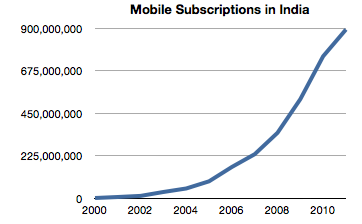
The market potential is enormous. Globally, there are 6 billion mobile cellular subscriptions (end of 2011, ITU) and 86% penetration, but only 1 billion have mobile broadband subscriptions (which make ownership of a smartphone worthwhile). In India there are 893 million subs (vs 986 million in China).
In 2011 142 million mobile cellular subscriptions were added in India, more than in the Arab States, CIS and Europe put together.
So the potential and growth are spectacular. But that is just 2G. Mobile broadband (i.e. 3G) is rare. Globally, developing countries have only 8% mobile broadband penetration vs. 51% in the developed world. Mobile broadband is a proxy for mass adoption of the iPhone (though perhaps not for Android inasmuch as it's employed as a feature phone).
The situation for 3G in India is even worse than the overall developing world. 3G licenses were only first awarded at the end of 2010 and the process was fraught with allegations of corruption. In the year and a half since, there came to be an estimated 10 million HSPA connections in the country.
The potential therefore is huge but the timing is difficult. Analysts are projecting 100 million mobile broadband connections by 2014 and over 350 million by 2016. Apple can affect this rate of growth as it's not only enabled by the network roll-out but can affect the take-up rate by consumers.
It's a chicken-and-egg problem. No network means no devices but no devices may mean the network cannot be paid for. In the initial phases, the economics of mobile broadband are still dominated by the incentives for operators to pay for the infrastructure rather than for consumers to pay for the service. The iPhone will have a role to play and the question is whether 2014 or 2016 are the dates when Apple will be able to claim that they've cracked the India code.
This episode is recorded on the day after Apple's second quarter earnings release. We go through all the income statement updates and discuss what went wrong (almost everything) and what went right (precious little). We use statements by management about India to answer the question of where the emerging market potential is for iPhone. Putting aside some of the missed opportunities or bad timings, the quarter is reviewed as less than the stellar performance we've become accustomed to but not bad all things considered.
We cover the valuation question regarding Apple and tech in general as seen through investors' eyes. This discussion ranges a bit on P/E compression and the psychology of investors--which might change with Apple TV.
We also look at who is most vulnerable in the ongoing mobile computing disruption and who are the up-and-coming challengers. Finally, I introduce the Perspective app which I used for all my live presentations.
I'll post more about Perspective in the future as it will be my platform for publishing complex or rich data.
We start with a discussion of RIM's latest quarterly performance and follow with a description of the inherent tension between managing and leading. To further illustrate this divergence we discuss the conflicting messages from Microsoft about the Surface.
Dan and Horace reflect on the Osbourne effect of Windows Phone 8 on Nokia and how to value a company in distress. In particular, we talk about the potential of a Microsoft acquisition and the conditions needed to make it happen. Horace takes two reader questions: How did Samsung succeed while other vendors failed with Android and what are the pitfalls that could cause Apple to stumble.
Today I was a guest on Jen Simmons' The Web Ahead. It was a chance to discuss some of the big questions facing the Web in general especially vis-à-vis apps and mobile in general.
How can we understand the business of the web? Horace Dediu joins Jen to talk about the web through the lens of disruption theory, discussing innovation and jobs to be done. Along the way we get into advertisement on the web, and the old website vs native app debate.