We take a look at Mountain Lion as evidence that Apple is cross-pollinating its product lines. We look at the Apple stores as a service brand and Horace tips his hand ever so slightly about Asymconf.
We talk about Apple’s fourth quarter, Horace’s trip to California and his visit to The Colbert Report. It’s all leading up to a fusion of entertainment and technology to create something never seen before. Something wonderful.
Horace talks to Prof. Bill Torgerson from St. John’s University about the writing process and how it survives and/or thrives as a commercial enterprise. We touch on writing for movies and compare the collaborative process of “content creation” vs. the “single voice” of an author.
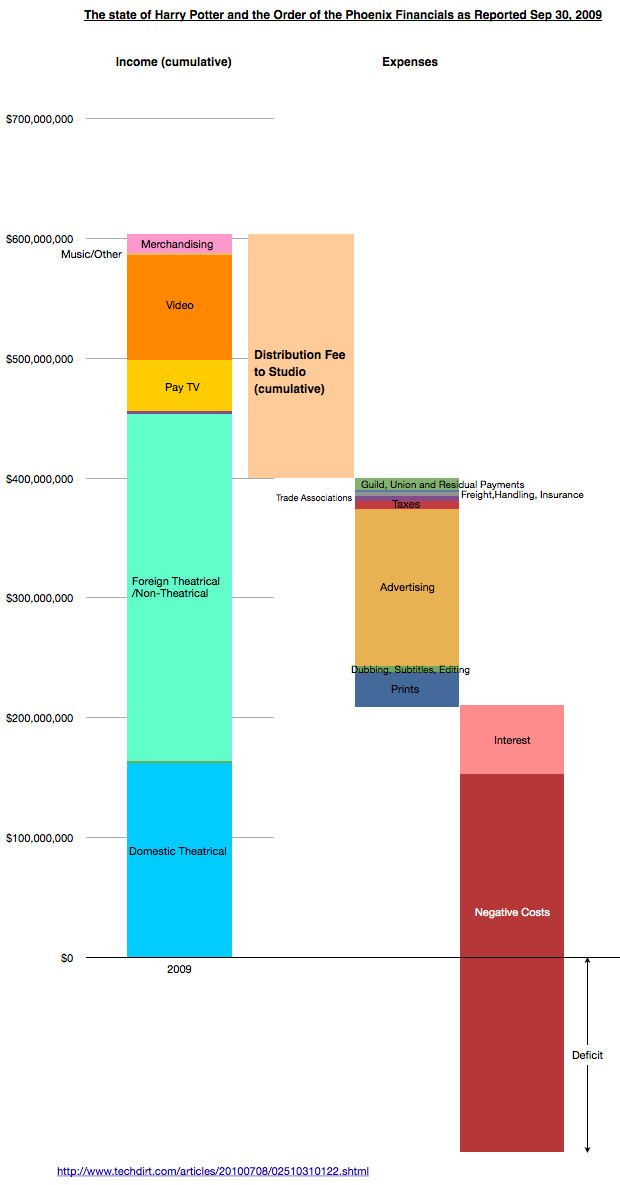
Continuing their discussion of the creative side of Hollywood accounting, Dan and Horace take a look at the way income from movies is distributed and why no movies ever make money. The observations sharpen focus on the over-arching influence distribution has on the creative process.
The following chart is a visualization designed to accompany the podcast:
Compensation based on "Net income" depends on there being a surplus rather than deficit. The problem is that the Fees and claims on income increase as they are defined as a percent of total income so the goal of break-even is a moving target.
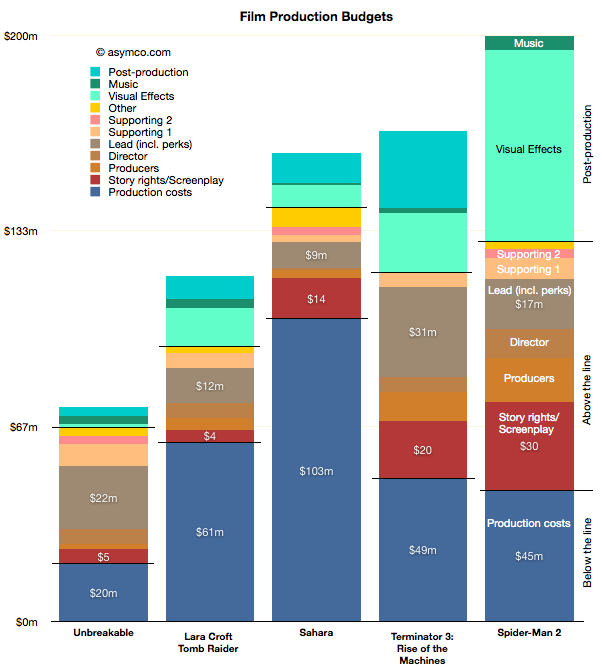
The Negative Costs are approximated by the production costs as discussed and visualized in the previous podcast here.
In this episode I talk with Bob Moesta, a pioneer of Job To be Done research. We go over the theory and process of understanding what products are really hired to do and ask why this understanding is so hard to come by.
In a discussion rich with examples from multiple industries Bob illustrates how marketing, design and engineering are all dancing around the question of how product should be developed.
Could the universally accepted compartmentalization of corporate functions be a root cause of product failure?
Dan and Horace ponder why some companies are more mysterious than others. We ask whether transparency and simplicity of business models is a sign of strength or weakness. We compare the measurement, creation and capture of value and why we should celebrate the mortality of businesses.
Horace interviews James Allworth, author, Fellow at the Forum for Growth and Innovation at Harvard Business School, and a former Apple employee. James describes what it’s like working with Clayton Christensen and takes us on a journey through the latest academic and applied research being conducted on the theories of disruptive innovation.
Horace interviews Dan Benjamin on the motivation, basis of competition and trajectory of the 5by5 network. By studying where podcasting came from and where it’s going we provide proof of existence of disruption in “big media”.