With this interview, we begin a journey into the world of entertainment and the forces that are re-shaping what most of the world hires daily for recreation. We will talk to actors, writers, producers, distributors, and media execs. We'll get perspective on what I expect will be a big year for television in 2012 and prepare for the new era to follow.
In this episode I talk to actor Hoon Lee[1] about the challenges of disruption in the creative arts, and theater in particular.
(Note this is not the Critical Path, but a guest appearance on the sister show Mac Power Users.)
Episode #65 • December 5, 2011
Katie and David are joined by Asymco publisher Horace Dediu, who talks about how he researches and publishes his analysis of the mobile marketspace and his thoughts on the future of presentation tools.
The idea is that rather than just telling stories and interpreting the world from my point of view, I should also ask others to teach from their experience.
In this case I discuss the disruptive potential of cloud computing with Randy Bias. Randy is the CTO of Cloudscaling, a designer of infrastructure cloud systems and a vast knowledge of the challenges and value of what we now call cloud systems. I've consulted for Randy in the past and I thought he could add a lot to the understanding of super-platforms. Super-platforms, you may recall, is a term I used to describe the coupling of Web Services and Devices in a mutually inter-dependent business model. I introduced the concept as a way to think about Siri and iCloud and potentially the Kindle and Amazon in general.
In this show I ask Randy to comment on the thesis that devices and cloud systems as a coupled system are a potential disruption to both the device-only model of computing and the cloud-only model of services. In other words, is the new ecosystem the coupling of devices with backend cloud APIs? We also touch on the scope of Apple's data centers and the way we can calibrate the investment.
I think this is a ripe area of research and thinking about the future of computing. It will require learning a new way of measuring "performance" of solutions and the businesses built around it. It will take a multi-disciplinary approach to ferret out the key value propositions.
Dan and Horace talk about innovations in emerging economies related to mobile service and how they might foreshadow changes in the developed world. We also discuss why some industries seem to be exempt from disruptive innovation and suggest that there are boundaries societies set to how value can be re-defined.
This show pushes beyond the boundaries of company and industry analysis and touches on the limits or "sound barrier" of innovation itself.
Dan and Horace talk about the tension between relying on data and using intuition to make strategy decisions. We also apply this dual approach to think through the next evolution of user interaction and the jobs we might hire mobile computers to do for us.
In his third “The Critical Path” podcast, Horace Dediu explained how Apple’s cash can be viewed as a strategic option, an opinion that resonated also with other analysts [1]. Cash is one of the most flexible resources as it can convert quickly into other resources such as brands, companies, technologies, people and even processes. More cash means more strategic flexibility. The large cash reserve Apple has accumulated provides high flexibility for future investments. These characteristics of cash already imply an intrinsic option value. But how big is this value?
Calculating Option Value
To help us determine, I will apply the Black-Scholes model. The model has two key characteristics that are applicable to valuing the option character of Apple’s cash. First, the simple form of the calculation excludes dividends and, as far as we have seen, there is no new information available that would suggest that Apple will pay dividends in the near term. Second, it implies that the option can be exercised at any given time until the end of the option exercise period - just like any buying or investment decision made by consumers. Lastly, we will assume that Apple’s cash (including short-term and long-term cash as well as financial investments) is instantly available. Although large amounts are held by foreign subsidiaries or are invested in maturities longer than one year, we can overcome these practical issues by borrowing against it. As we are interested in the value of the whole pile, we use the latest reported figure of $81.6 billion as the strike price (or exercise price).
What other inputs do we need to determine the option value of Apple’s cash [2]?
Volatility: A measure that determines financial risk of a certain asset. Apple’s share has shown a volatility of 26,1% over the last year.
The risk free rate determined by the 10 year US governmental bond interest rate: 1,96%.
A timeframe in which the option can be exercised. Let’s assume a 10 year timeframe in line with the risk-free rate and an imaginable horizon for mere mortals.
The value of the underlying (or what Apple is investing in):
The return of the investment exercised with the cash at hand should yield a higher Return on Capital Employed (RoCE) than previously achieved to increase shareholder value. On the other hand, such a high cash pile also provides the flexibility to invest into lower return ventures. Such an investment would be taken if a certain technology or trend has been missed by management or becomes suddenly more important in the priorities of the company. In defensive moves or moat creating ventures, the expected return would be significantly lower or can even be negative. For the last twelve months, Apple has returned 106% in terms of operating income over its capital employed [3]. I use the return to value the underlying. For example, investing $81.6 billion in assets that yield 106% return equals a underlying value of $168 billion.
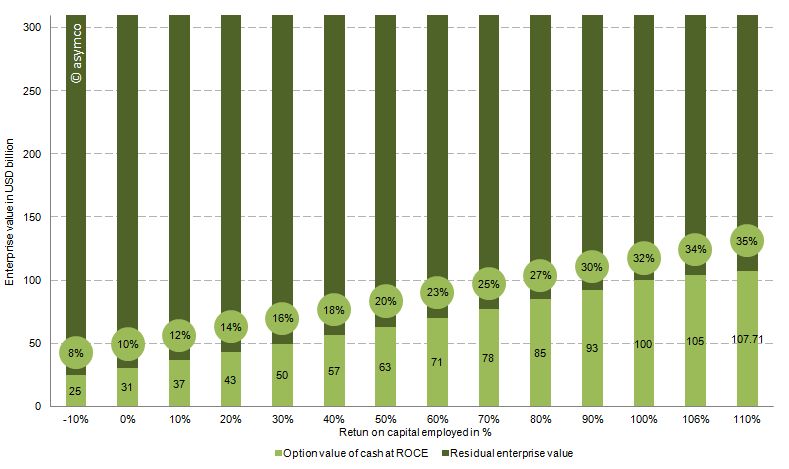
The chart below shows the option value of the cash as a percentage of enterprise value of Apple (at the time of writing $310 billion) based on the range of the expected return on capital employed. Or in other words, how much of Apple’s current value is explained by the option value in holding such a large cash reserve.
Conclusion
Therefore, with the assumptions above and a RoCE from -10% to 110%, between 8% and 35% of Apple’s current valuation is explained by the option value of cash. We can see that even with large variations of the key input variables, Apple’s enterprise value is partly explained by the option value of cash which, in turn, is attributable to the sheer amount of cash at hand.
If we look at the option value explaining 25% of Apple's enterprise value then 75% or $232 billion is the "Residual Enterprise Value" (REV) representing the value of Apple's cash flow generating operations. That puts Apple's valuation at 6.9x REV/EBIT 2011 or 6.5x REV/EBITDA 2011 -- fairly low relative to recent performance. EBITDA and EBIT have been growing at a rate of 70% for the last two years and at a rate of 84% over the last year alone.
It’s good to be king (http://5by5.tv/criticalpath/3) , Apple: Behold The ‘iEndowment,’ Says Wedgewood (http://blogs.barrons.com/techtraderdaily/2011/09/20/apple-behold-the-iendowment-says-wedgewood/)
Operating income of the last twelve month of 33.8 USD billion divided by capital employed of 31.8 USD billion defined as total assets minus cash (or sum of all asset excluding cash)
Dan and Horace talk about patents and litigation as a means of defending innovation. We go way back to the beginning of the last century and talk how patent wars have played out in the past and how they affected the fortunes and fates of innovators.
IMPORTANT: I made an error in claiming that Mauser litigated for royalties during WWI. The litigation with Mauser preceded the war, but the bullet design used in the rifle was the subject of litigation before, during and after the war. The story of that patent fight is described here: The Tale of the Spitzer Bullet Patent Lawsuit | asymco
Dan and Horace talk about Apple’s quarter with an eye toward the operational commitments being made. We cover the cost of store openings, data center purchases and machinery used in manufacturing iOS devices. By tracking capital expenses we can get a clue about where Apple wants to go.
Dan and Horace talk about some of the more profound implications of “intelligent assistance” in personal devices both in terms of business models and in terms of industry dynamics. Getting assistance is an implied bargain we all make as internet citizens but what do we pay for that assistance?
Thirty minutes after the end of the 'Let's talk iPhone' event, 5by5.tv will be hosting a set of commentators[1] giving initial impressions of announcements.
I'll update this post with a link for the download once available.
[UPDATE]
Dan Benjamin talks about Apple’s “Let’s Talk iPhone” event with Dan Moren, Marco Arment, John Siracusa, John Gruber, Horace Dediu, Arnold Kim, and Christina Warren. Topics include the iPhone 4S hardware and form factor, the iOS update, the “geek letdown”, Siri, iPods, pricing, release dates, AppleCare, carriers, serious stats, iCloud and iTunes Match, the non-geek response, and more.
Horace and Dan talk about why CEOs are paid so much and what analysis has come to mean in equities research and the value of cross-pollination between the camps that form around technology companies.