The Critical Path #146: Bob Moesta
Bob Moesta demonstrates Jobs to be Done interview technique by speaking with Horace about a car purchase.
via 5by5 | The Critical Path #146: Bob Moesta.
This is very important. You should listen.
Bob Moesta demonstrates Jobs to be Done interview technique by speaking with Horace about a car purchase.
via 5by5 | The Critical Path #146: Bob Moesta.
This is very important. You should listen.
Back from the Apple Watch event, Horace gives his trip report discussing watch pricing and what we now know of how Apple intends to sell them. What cognitive illusions might come into play as people consider the watch?
Horace and Anders discuss Apple's brand reorientation from the intellectual and analytical to the emotional and instinctual. Moore's Law is fundamentally incompatible with luxury so new measures are necessary. What should one call this new paradigm?
Horace and Anders discuss the design of Gordon Murray and what it might take to enter the automotive industry. Is an integrated strategy the only way? What job would an Apple car be hired to do?
Horace discusses his latest work at the Christensen Institute and considers why the educational system works the way it does. Can large scale education be modularized? In the second half of the show, Anders and Horace discuss the rumors about the possibility that Apple might be working on a car.
Podcast #Industry · 152 comments
Like a siren, it calls.
The Auto Industry is significant. With gross revenues of over $2 trillion, production of over 66 million vehicles and growing ((The industry continues to grow, registering a 30 percent increase over the past decade, mainly due to Asia and China in particular)) it seems to be a big, juicy target. It employs 9 million people directly and 50 million indirectly and politically it must rank among the top three industries worthy of government subsidy (or interference). Indeed, in many countries--the US included--government interference makes it practically impossible for a producer to go out of business, no matter how poorly it's managed or how untenable the market conditions.
But this might be the tell-tale sign that danger lurks. Theory suggests that incumbents going out of business is an essential indicator of industry health. Without their exit, entrants are never allowed to bring disruptive ideas to bear and innovation simply stops. Is this interference with mortality the only indication of entrant obstacles? Are things about to change? Is there pressure for innovation? Can we spot other indications of a crisis in this industry?
Taking the US as a proxy, here is a graph of the number of new car firm entries (and exits):
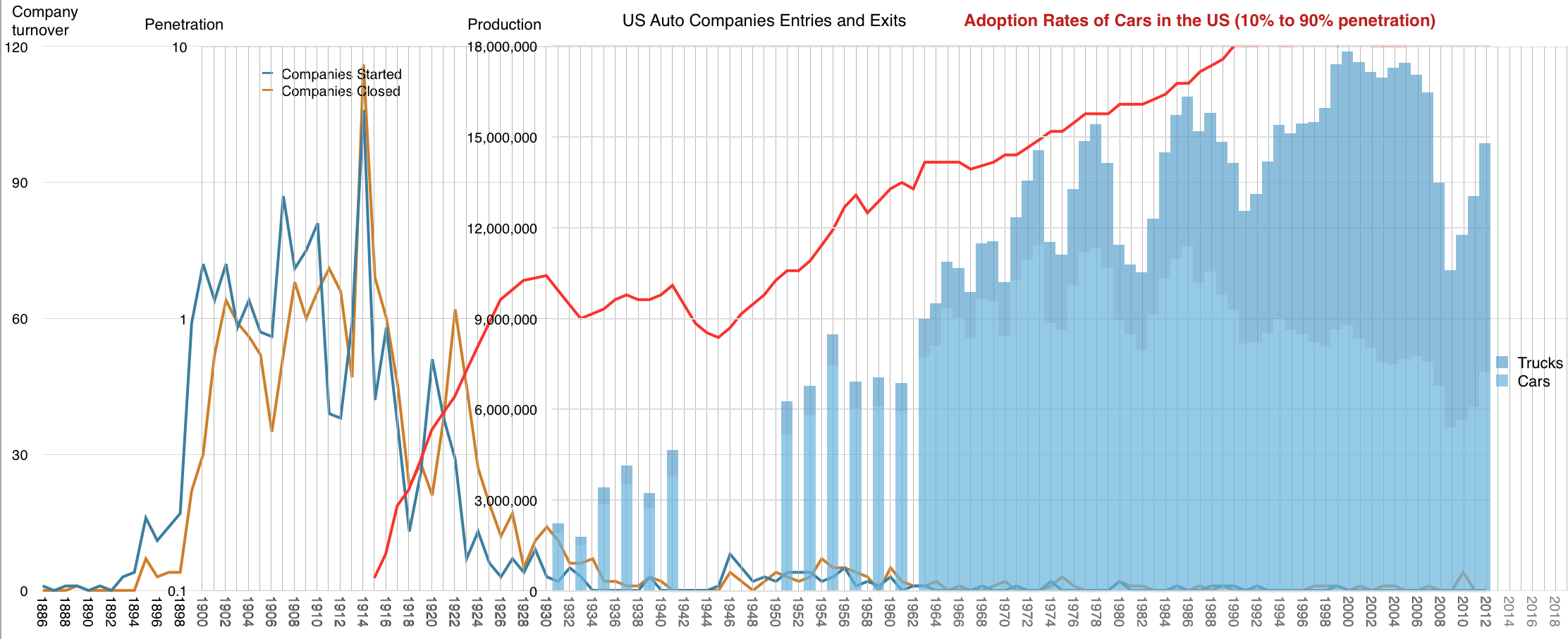
The total number of firms ((counted as brands)) that entered the US market is 1,556. The blue line graph shows the entries and the orange line shows the exits. This sounds impressive, but note that the year when the peak of entries took place was 1914, exactly 100 years ago.
1914 was also the year when penetration of the market first reached 10% and the rapid slope of adoption was joined. You can follow this adoption rate as the red line in the graph above ((The line is on a log graph and shows the P/(1-P) where P is the penetration of households)) ((Note that all line graphs have the same x-axis but have different y-axes.))
The first analytical task for the entrant today is therefore to ask why there have been so few others succeeding in the last century. In the last half-century 14 tried and all failed.
One clue is the third set of data plotted above: production figures. The blue area represents the production total for the industry on a yearly basis. ((The graph is split into cars and trucks. You can plainly see the recessions and the patterns of war and peace)). Note that all three data sets have some relationships to each other: Production growth is dependent on new demand growth and that on a household basis demand ceased growing in 1990. Production and penetration accelerated when entries ended. Given the economies of scale in manufacturing, a consolidation occurred and barriers to entry exploded when volumes became significant.
This leads the casual observer to conclude that production is the predominant consideration for participants and that the entire industry revolves around this measure.
Indeed, production is everything. Capacity utilization is the first priority for an auto manufacturer. Capacity is why firms are not allowed to die and entrants are not allowed to enter.
But you don't need the data to tell you this. There are other clues. I will summarize these observations in the following "ten commandments" for the industry:
All these topics and much more have been discussed in Asymcar, the podcast for those interested in entering the automobile industry.
As technology companies listen to the siren's song they should contemplate the basis of survival in the industry. Whether your approach and innovation sustains the hegemony or changes it will largely depend on your business model being asymmetric to the incumbent. Determining what is and isn't symmetric should be the first step in your analysis.
Podcast #Industry · 4 comments
Horace presents the next class in The Critical MBA. Having too much of a fundamental footing could be a disadvantage when evaluating what theory might apply to a given situation. Could this be why so many fail to understand Apple? In the second half of the show, Horace and Anders discuss Amazon as retail goes online.
In this special "live" version of The Critical Path, Horace gets the numbers just minutes before Apples January 27th, 2015 earnings call and dissects them live. The show picks up just after the call finishes with a quick recap and discussion of yet another record quarter.
Horace and Anders discuss the current uncertainty in the commodities markets and take a look at the logical segments of the adoption curve. Could the conventional wisdom between invention and product in the market be wrong?
Horace and Anders discuss this years CES, Apples record $25B in payments to developers as well as the initial installment of the Critical Path MBA. How is business taught in schools? What is a business school graduate optimized to do? Horace explains what one might need to know when considering a business degree.
Can we measure the time between inception of an idea and the disruption it later causes in the market? Startups are there to discover a job nobody sees yet but not all laboratory experiments make it to commercialization. Horace and Anders discuss the timing of disruption and look at Bitcoin as an example.