Horace and Anders on the irrelevance of shareholders. Anticipating an Apple October 2014 event they discuss how the iPad and tablet designs could evolve. Diving into how brands can manage disruption through a whirlwind tour of products from cameras to watches to cars.
Horace and Anders analyze the possible business models for Apple Watch, how it may be introduced, distributed, sold, and bought. What impact will the Watch have on Apple's top and bottom lines? They further look into possible introductions for the rest of 2014. Horace sounds about to give up hopes on Apple TV.
Horace and Anders discuss Opening Weekend Sales of iPhone 6, Accurate Timekeeping Device, the 3rd tentpole of Apple Watch, leading to a brief history of wristwatches, a study of Job-to-be-done for the watch and what it signals about Apple's future.
Horace also announces his new role at the Clay Christensen Institute, and the resumption of Airshow World Tour starting with Airshow Seattle on Nov 8.
Steve Jobs said death is the best thing in life. And yet we seek immortality, or at least life-extending technologies. What are the possibilities and implications of a salubrious app? Is life extension the next killer app ((No pun intended))
How and why does Apple get paid for Apple Pay? Anders and Horace dive into the payments value chain and break it all down for you: whats in it for users, merchants, issuing banks and payment networks. What are the risks and opportunities for Apple? Is there a disruption about to happen?
Anders Brownworth and Horace Preview of Apples September 2014 special event. We focus on how Apparel gets disrupted. We also wrap the Creativity, Inc. book review.
The bank robber Willie Sutton did not say, when asked why he robbed banks, "because that's where the money is." He did agree with the idea however saying "Go where the money is...and go there often".
Regardless of it being apocryphal, this idea came to be called Sutton's Law and is often taught to medical students. It's similar to the notion of Occam's Razor: when an obvious or simple answer competes with an obscure or complicated answer, pick the obvious one first.
These are sound analytical rules of thumb. When thinking about what products and services could arise in the immediate future, those most obvious and with fewest assumptions should be put forward first. The what part is relatively easy. The tough question is more about when will they emerge?
We now know that Apple will announce new products on September 9th ((I'll be there and will report via Twitter and a special session of The Critical Path podcast)). This gives us an idea of when something will happen, answering the tougher question. It leaves the simpler question of what will emerge.
I put forward my predictions as follows:
Regarding iPhone, a tweet on product mix and pricing.
Regarding an "iWatch", an answer to a question from Eric Jackson.
Regarding the potential for wearables, a post on the subject.
One more item has surfaced on the potential of payments processing which I want to address now.
Handling payments, to me, is a perfectly plausible activity for Apple mostly because the company has made quite a few comments on the value of their "customers with credit cards" and the effort that went into Touch ID (which seems to be extravagant relative to the value of rapid unlocking).
But one word of caution: if Apple does enable payments it's important to realize that being a (payment) bit pipe is not a particularly profitable business. It will undoubtedly bind value to the iOS devices which make it possible, but I don't think there will be a direct capture of profit from the transactions themselves.
Profit needs to be in proportion to the value delivered. When that value is marginal convenience it is worth something but it's not a huge something. It is a marginal something.
You might disagree pointing out that payments are big business and banking bigger still. But those businesses are not hired to simply funnel low friction payments around. They are proxies for trust and complex risk management. ((Nota bene: this trust could be commoditized with crypto currencies and blockchain technology making these giant businesses perilously smaller.))
So for a company that facilitates the payment clearing system, the margins are likely to be very thin and with costs being non-zero it may be nearly a wash. The real impact of the decision to support payments will be in the aura surrounding the iOS ecosystem. An aura which will glow intensely.
The idea of untold riches coming from "being in the payments business" is rather like the bank robber's dream of being where the money is. It is tempting to think that handling lots of money must result in wealth. However consider the value of Brink's. Net income of $57 million on $4 billion revenues and $1.3 billion market cap.
Reality is that wealth comes from the creation of value not from its transport.
If software can be injected into an industry's product it will bend to the will of the software writers.
This theory expands on Marc Andreessen's observation that "software is eating the world". The evidence is that software, coupled with microprocessors, sensors, batteries and networking becomes applicable to an increasingly larger set of problems to be solved ((Or, put another way, is eligible to be hired to perform an increasingly large set of jobs)). Software has "eaten" large portions of entertainment (e.g. Pixar, iTunes, video games), telecommunications (iPhone, Android, Messaging), various professions including journalism, management and law, and is entering transportation, energy and health care and poised over banking, finance and government.
As entry happens, asymmetries are enabled and disruption follows. This is the bending to the will of the writers--who tend not to be incumbents. The incumbents can't embrace the changes in business models enabled by software without destroying their core businesses and thus, invariably, they disappear.
The pattern is easily observed but the speed and timing of it is difficult to predict and hence investment success is not certain. ((Which, ironically, means that the jobs of venture capitalists are still safe. At least until the theory develops to the point where it can predict with more accuracy winners and losers.)) There are many entrants who try and few succeed and there are many incumbents who will survive longer than a prophet can stay hungry.
Nevertheless, this process of software-induced turnover in wealth--and, incidentally, vast, additional wealth creation--is inevitable.
But can we predict anything other than timing? For example, can we predict the next industry to succumb to this force?
There is hope because the last big disruption was predictable. When looking at what caused telecom to become a domino, the pattern of development of hardware pointed the way. It was clear in the late 1990s that computers would become small enough to fit in one hand. The first instances were PDAs (mid-1990s) and once they proved valuable in solving many jobs it was easy to plot their evolution into phones.
So if we follow the "packaging" constraint, it's clear that computers are becoming small enough to be worn. Many prototypes exist and even small companies can build them.
All that is needed is a new user interface and a new platform will be born. Once a platform is born, the creativity of millions can be unleashed to expand the problem set that can be solved. The process then repeats.
So it's obvious that as a computer becomes wearable it will affect the industry that currently is hired to also be worn: apparel.
Apparel is the word describing every garment, shoe and accessory product sold and amounts to about $1.2 trillion/yr. ((The US is about $331 billion or 28%.)) ((The Telecom industry is slightly larger at about $1.3 trillion)) This amount of money is not spent only to protect the wearer from the elements--any more than the money spent on telecommunications is spent to convey vital information. Most of the value in apparel, perhaps 80%, is spent on solving psychological needs.
And therein lies the opportunity. As the value is beyond functional, substitution of psychological jobs by new products is a matter of engineering better solutions. Consider the behavior of US teens: anecdotally, their spending on apparel is fading as the solution to feeling good about themselves increasingly relies on a device and service. Already, in this context, apparel retail is in crisis while buying shifts to devices.
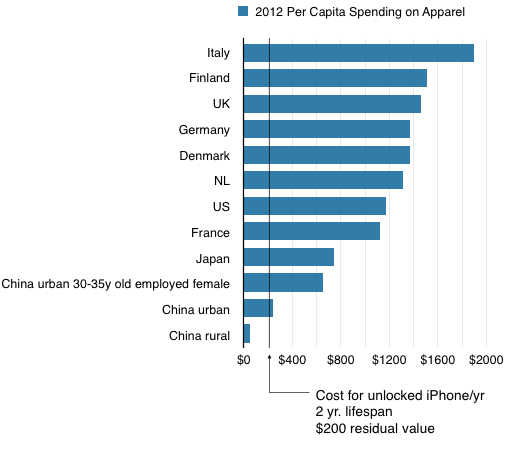
While looking at the spending, it's also easy to see how much there is to divert from a non-functional to a functional/service bundle:
In many markets individuals spend more on apparel than on personal technology. And as personal technology increasingly competes for the same jobs to be done, that spending will transfer to the entrants.
To know who's already planning for this you can follow the trade news on the hiring of talent.
Horace Dediu joins us for the 22nd episode of “The Innovation Engine” podcast to discuss innovation and the future of mobile - what the post-mobile world will look like; how Apple, Google, and others are shaping the mobile experience of the future; and the next frontiers of mobile after health and fitness.
In this episode of the podcast, Horace talks about why mobile and smartphones will no longer be thought of as synonymous in the very near future. He discusses how soon-to-be released products like Apple's HealthKit and Google Fit, combined with the revolution in wearables, will continue to drive change in industries like health care and will put more power than ever in consumers' hands.
Horace also shares his thoughts on "The Disruption Machine," Jill Lepore's New Yorker article that criticizes Clayton Christensen's theory of disruptive innovation. While he believes there is some merit to the notion that disruption is overused, Horace says the article overlooks years of research and writing since that has helped refine Chrinstensen's theories. He wrote a post for the Asymco site titled The Disruption FAQ in response to the article if you are interested in reading more of his thoughts on the matter.
Other highlights from the conversation include:
What we learned about the Apple New Product Process, or ANPP, from Leander Kahney's book Jony Ive: The Genius Behind Apple's Greatest Products
Some of the reasons why health care technology lags behind consumer technology, and why that means we are just beginning to scratch the surface of what will be possible in personal health care
Other "white spaces" in the marketplace that Horace sees as ripe for disruptive innovation, including education and transportation
Why Horace says software, not technology, is the thing with the power to truly transform industries