The new Apple TV has created a cottage industry of pundits debating the future ownership of your living room. This topic of to whom your living room belongs has been around since the 90's when Microsoft sought to plant a flag on your TV set and claim it in the name of Gates with a cable box software platform. A few billion dollars later they came away with not a single deed, not even to your couch.
Talk of ownership flared up again in the last decade as various game consoles and boxes paraded in front of consumers. There were wars waged over DVD formats, encoding formats and DRM. Then came hulu and Apple TV and roku and who knows what else I missed.
It's all bound to go badly. Here's why this property will remain off limits:
The ownership is not for the space but for the time and attention of the audience. The time spent consuming televised content is what's at stake.
That time is increasingly being fragmented. It was first broken into tiny pieces by cable channels that divided audiences into niches.
Erosion of cohesive audiences continued with DVD rentals and Netflix. Home theaters ate into both broadcast and outside-the-home entertainment
Attention was attacked with PVRs like Tivo.
Demographics were exploded with game consoles with age groups separating into different modes of consumption.
Migration of other portable devices like laptops, smartphones and iPads into the couch room are now further degrading the value of the "living room" as a significant target for advertisers.
Internationally there never was a unified living room. Consumption patterns and even broadcast business models vary widely.
Ultimately there's really nothing in "the living room" worth fighting for. The disruptive play here is the crumbling of monolithic audiences that used to define "prime time". It's not a new box to take over from another box.
The technologies that are coming to invade the living room have already broken it into parcels that lack cohesion.
Just like the division of land among numerous generations of heirs creates land only useful for residential development, it's time to abandon dreams of owning the farm. That farm has long ago stopped being fertile.
While Jobs and Schmidt were having a contest over their mobile platform activation numbers...
Pshaw to all that, says Symbian. The company points out that according to Canalys' research, there's 300,000 Symbian devices activated on a daily basis, which equals 109.5 million phones activated annually.
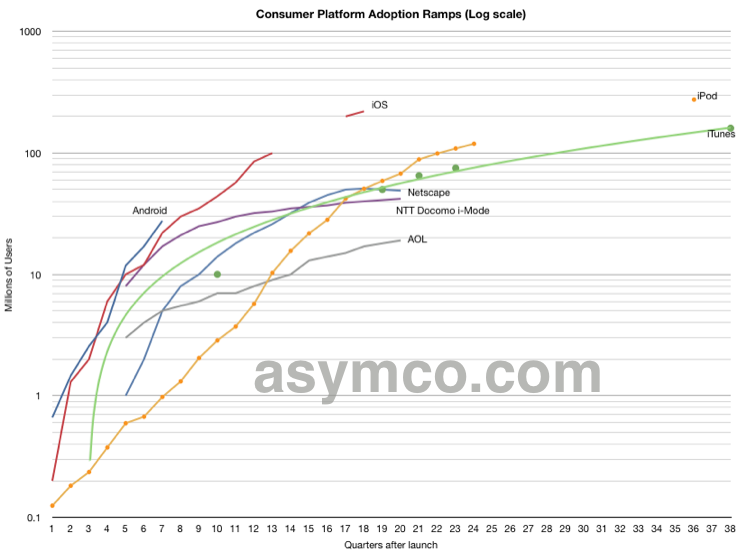
To make it more readable (but conceptually more complicated) I put the data on a log chart.
Discussion
The time span covered is nine and a half years. The top of the graph marks the one billion threshold. Reaching one billion in less than 10 years is an interesting challenge for any platform and, at first glance, it seems that both iOS and Android have a shot at it. This does not seem likely for any of the other platforms.
The challenge is that as penetration grows, it's natural for the slope for the lines to become shallower. Some platforms are simply not able to address one billion users:
i-Mode, AOL and other technologies with localized value networks are clearly limited to populations in their home countries.
iTunes is limited by the use of a PC, which has a small footprint in under-developed countries (dependency by iOS on iTunes should throw up a red flag here).
The iPod was embraced and extended by more ubiquitous mobile phones.
In contrast, mobile phones in general and smartphone platforms in particular have potential to reach a billion users (per platform.)
To wit, note that iOS and Android have similar curves to date and are both likely to overtake iPod and any other contender.
So for the obligatory theological question: Will Android follow the curve of iOS or will it diverge and continue on a steeper trajectory? Does it matter?
On June 7th, 2010, at WWDC, Apple announced that they will have sold 100 million iOS devices some time during June 2010. Today, September 1st, Apple announced that 120 million iOS devices have been sold.
Assuming that 100 million was crossed half-way through June, then the additional 20 million units must have been sold during half of June, and all of July and August. That's approximately 20 million over 75 days or 267k units per day.
Apple also announced that there are 230k new iOS activations per day which seems consistent given that they classify these as "new" activations.
There is one huge implication of this figure: Forecasts for iPhone, iPad and iPods may be too low. I had forecast 20 million units for the entire quarter (12.1 million iPhones, 4 million iPads and about 4 million iPod touch). The iPhone figure assumed 65% y/y growth at that looks way too low. There is still another month in the quarter meaning that the total could be 30% too low.
$50 billion in cash and Apple execs bawling that they can't ship enough product.
"iPhone 4 demand remains very robust and despite efforts to close the supply-demand imbalance and the continued supply ramp, Apple still cannot meet iPhone demand,"
Ghai now estimates that Apple will sell 5.75 million iPads in the quarter that ends Sept. 25, up from an earlier estimate of 5 million, and 22 million in fiscal 2011, up from 19.5 million.
That's very close to my estimate of 21 million, though I might add that my estimate is unrevised since US supply met demand. There are still markets which don't have iPad distribution however, so we'll see if global demand can be met before year end.
By the way, the estimate of 5.75 million for this quarter is higher than all but three of 14 analysts estimates on iPad unit forecasts *for the first year*.
Apple's continuing valuation struggle continues to fascinate. While underperforming on a multiple basis both the S&P 500 and its own historic value, Apple is nearing bargain bin pricing.
To illustrate this further, get the new Asymco Data Download for the iPhone.
You can now use an iPhone to visualize how the owners of the company that created it are being punished.
In first half of 2010, iPhone and iPod touch traffic increased from 33.9% to 41% in Finland. Apple's devices account for a very small percent of the total phones in use in Nokia's home country.[1] The analysis was performed by QAim on a sample of 64 million "mobile downloads".